Jump to Content
Cadmium Telluride Market - Size, Share, Industry Trends, and Forecasts (2025-2032)
Cadmium Telluride Market Size:
Cadmium Telluride Market size is estimated to reach over USD 19.91 Billion by 2032 from a value of USD 8.24 Billion in 2024 and is projected to grow by USD 9.05 Billion in 2025, growing at a CAGR of 11.7% from 2025 to 2032.
Cadmium Telluride Market Scope & Overview:
Cadmium telluride (CdTe) is a semiconductor material widely utilized in thin-film solar cells and infrared optical applications. Known for its high absorption coefficient and efficient energy conversion, CdTe enables the production of cost-effective photovoltaic panels with enhanced performance. Its stability under varying environmental conditions makes it suitable for long-term energy applications.
Key features include excellent light absorption, high thermal stability, and efficient electrical conductivity. These properties contribute to the development of lightweight and flexible solar modules, reducing material costs while improving energy output. The material's compatibility with advanced deposition techniques further enhances manufacturing efficiency.
Industries such as renewable energy, electronics, and defense integrate this compound into photovoltaic cells, radiation detectors, and infrared optics. Continuous advancements in material processing and thin-film technology are refining its applications, ensuring improved efficiency and reliability in various technological and commercial sectors.

Cadmium Telluride Market Dynamics - (DRO):
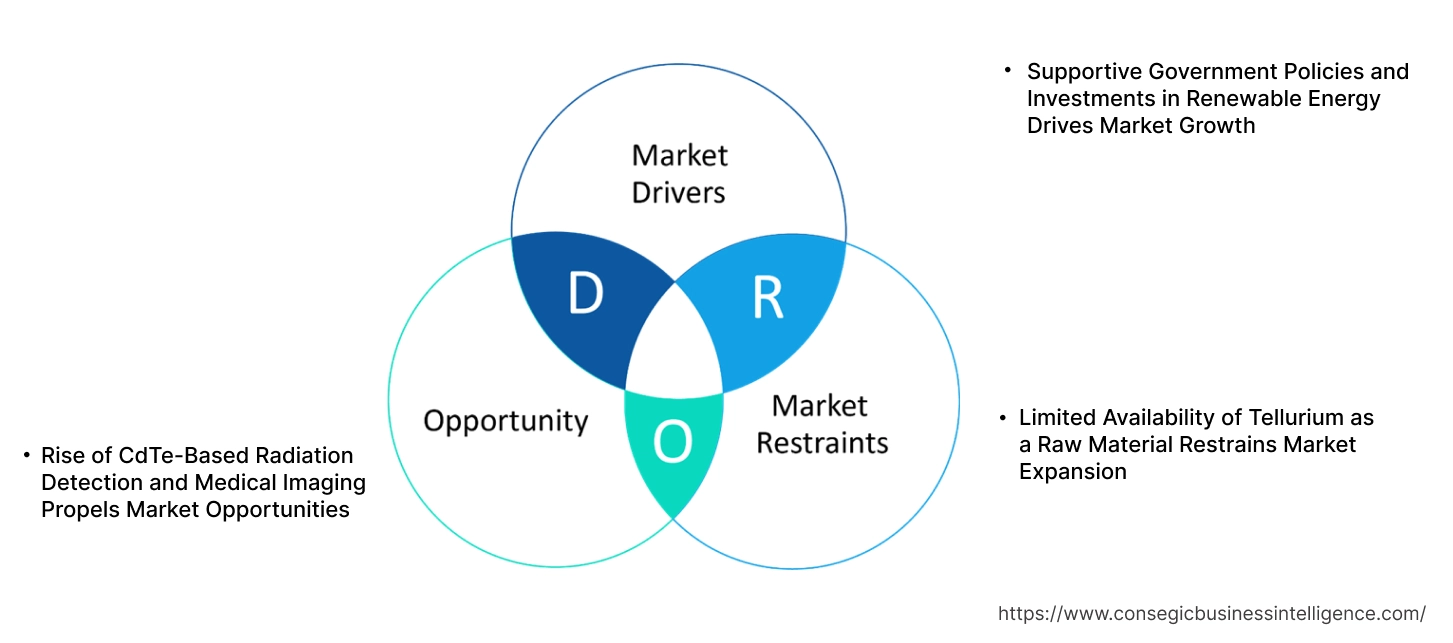
Key Drivers:
Supportive Government Policies and Investments in Renewable Energy Drives Market Growth
Government policies such as feed-in tariffs, tax credits, and carbon reduction mandates are increasing the demand for efficient, cost-effective solar solutions, making cadmium telluride solar panels a preferred choice for utility-scale solar farms. National and regional energy transition programs emphasize solar capacity expansion, reducing reliance on fossil fuels and enhancing energy security. Additionally, initiatives like net metering policies and green energy investment funds support large-scale CdTe solar module adoption. As governments set long-term renewable energy targets, this technology benefits from research funding, technological advancements, and industrial-scale manufacturing investments.
- For instance, India’s Ministry of New and Renewable Energy (MNRE) has set the minimum efficiency standards for CdTe thin-film modules for solar PV applications. For utility or grid-scale power plants, the required minimum efficiency is 19%, the highest among all categories. Whereas for rooftop and solar pumping and solar lighting, the required minimum efficiencies are 18.5% and 18% respectively.
These factors are driving cadmium telluride market expansion, ensuring continued growth in the solar sector while strengthening the global shift toward sustainable and low-carbon energy solutions.
Key Restraints:
Limited Availability of Tellurium as a Raw Material Restrains Market Expansion
Tellurium, a critical component in thin-film solar technology, is primarily obtained as a byproduct of copper refining, making its supply highly dependent on global copper production patterns. The demand for tellurium is rising as solar energy adoption increases, yet its limited availability poses a challenge for large-scale manufacturing. Supply chain disruptions, geopolitical factors, and fluctuating extraction rates create pricing volatility, impacting production costs for solar panel manufacturers. As tellurium reserves are concentrated in a few countries, reliance on specific mining operations raises concerns about supply security and long-term sustainability. The industry is exploring alternatives such as tellurium recycling and improved material efficiency to mitigate these risks. Without a stable tellurium supply, scaling production for large solar farms becomes difficult, affecting broader adoption. Addressing this challenge is crucial for sustaining cadmium telluride market growth, ensuring the continued success of thin-film solar technologies in global energy markets.
Future Opportunities:
Rise of CdTe-Based Radiation Detection and Medical Imaging Propels Market Opportunities
CdTe's high-energy X-ray absorption efficiency and superior resolution make it an ideal material for next-generation CT scanners, nuclear radiation monitoring, and homeland security screening. The healthcare sector is investing in precision imaging solutions, leading to the growth of CdTe-based detectors in oncology, cardiology, and neurological diagnostics. Additionally, defense agencies and border security organizations are deploying CdTe-enhanced radiation detection systems to improve nuclear threat identification and environmental monitoring. As advancements in X-ray imaging and semiconductor technology continue, the integration of these materials in high-performance imaging devices is expected to rise. These developments present significant cadmium telluride market opportunities, ensuring long-term expansion beyond the solar industry and into high-value sectors such as healthcare, defense, and industrial safety.
Cadmium Telluride Market Segmental Analysis :
By Product Type:
By product type, the market is divided into powder and crystal form.
The powder segment held the largest cadmium telluride market share in 2024.
- The powdered form is extensively used in photovoltaic solar cells, semiconductor components, and X-ray detectors, making it a key material in the electronics and renewable energy sectors.
- The need for high-purity cadmium telluride powder is rising as advancements in thin-film solar technology drive innovation.
- Cadmium telluride market analysis suggests that powder form is preferred due to its adaptability in semiconductor manufacturing and optoelectronic applications.
- Segmental trends indicate that improvements in refining techniques are enhancing the efficiency and stability of powder-based materials.
The crystal segment is expected to experience the fastest CAGR during the forecast period.
- Its crystals are crucial for high-precision applications such as X-ray and gamma-ray detection, optoelectronics, and thermoelectric devices.
- The need for single-crystal cadmium telluride is increasing in the medical imaging and defense industries, where high-performance materials are essential.
- Segmental trends highlight growing research into crystal-based semiconductor applications, improving device sensitivity and efficiency.
- With increasing investment in specialized electronics and defense applications, crystal-based products are contributing to cadmium telluride market growth.
By Application:
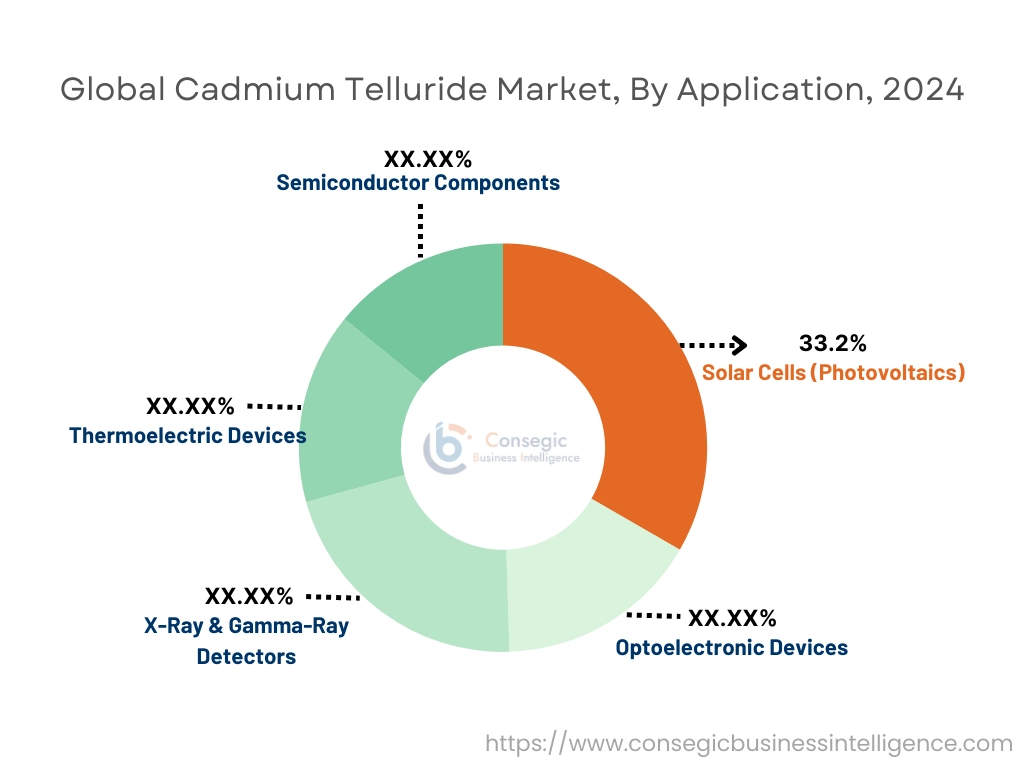
By application, the cadmium telluride market is segmented into solar cells (photovoltaics), optoelectronic devices, x-ray & gamma-ray detectors, thermoelectric devices, and semiconductor components.
The solar cells (photovoltaics) segment held the largest market share of 33.2% in 2024.
- Cadmium telluride is a key material in thin-film solar cells, offering cost-effective and high-efficiency energy conversion compared to silicon-based alternatives.
- The need for clean energy solutions is driving its widespread adoption in photovoltaic applications, particularly for utility-scale solar projects.
- Cadmium telluride market analysis suggests that ongoing improvements in solar cell efficiency are positioning it as a competitive alternative to traditional silicon panels.
- Segmental trends indicate that governments and private entities are increasing investments in thin-film solar technologies, boosting overall adoption.
The X-ray & gamma-ray detectors segment is anticipated to experience the fastest CAGR during the forecast period.
- The increasing use of cadmium telluride in medical imaging, security screening, and space-based radiation detection is fueling market expansion.
- The need for high-resolution and high-efficiency radiation detectors is driving innovation in the development of advanced CdTe-based imaging systems.
- Cadmium telluride market trends highlight a shift toward next-generation detector technologies, improving medical diagnostics and security applications.
- With rising applications in defense and space exploration, X-ray and gamma-ray detectors play a critical role in market expansion.
By End-Use Industry:
By end-use industry, the market is segmented into renewable energy, healthcare & medical imaging, aerospace & defense, electronics & semiconductors, and research & development.
The renewable energy segment held the largest cadmium telluride market share in 2024.
- The need for thin-film solar technology is accelerating, as governments and energy firms invest in next-generation photovoltaic solutions.
- Market analysis confirms that CdTe-based solar panels offer advantages in efficiency, cost, and environmental impact, making them an attractive choice for large-scale solar farms.
- Cadmium telluride market trends suggest that increasing focus on energy transition policies is strengthening its requirement in global solar energy projects.
- For instance, in September 2024, Sivananthan Laboratories announced a record-high arsenic dopant activation for crystalline CdTe produced by molecular beam epitaxy (MBE). This achievement enables higher solar energy conversion efficiency and manufacturing cost reductions without risking the long-term module durability of CdTe-based PV, enhancing US competitiveness and decreasing the levelized cost of energy.
- With ongoing research into enhancing solar cell efficiency, the renewable energy sector remains a dominant force for market growth.
The electronics & semiconductors segment is expected to have the fastest CAGR during the forecast period.
- The growing need for high-performance semiconductor materials is driving its use in optoelectronics, infrared sensors, and high-frequency transistors.
- The demand for advanced semiconductor materials in next-generation computing and telecommunication devices is expanding the market for CdTe-based components.
- Market trends indicate that advancements in quantum computing and semiconductor miniaturization are increasing research into its applications.
- With rising investments in high-tech electronics, the semiconductor sector is expected to play a significant role in cadmium telluride market expansion.
Regional Analysis:
The regions covered are North America, Europe, Asia Pacific, the Middle East and Africa, and Latin America.
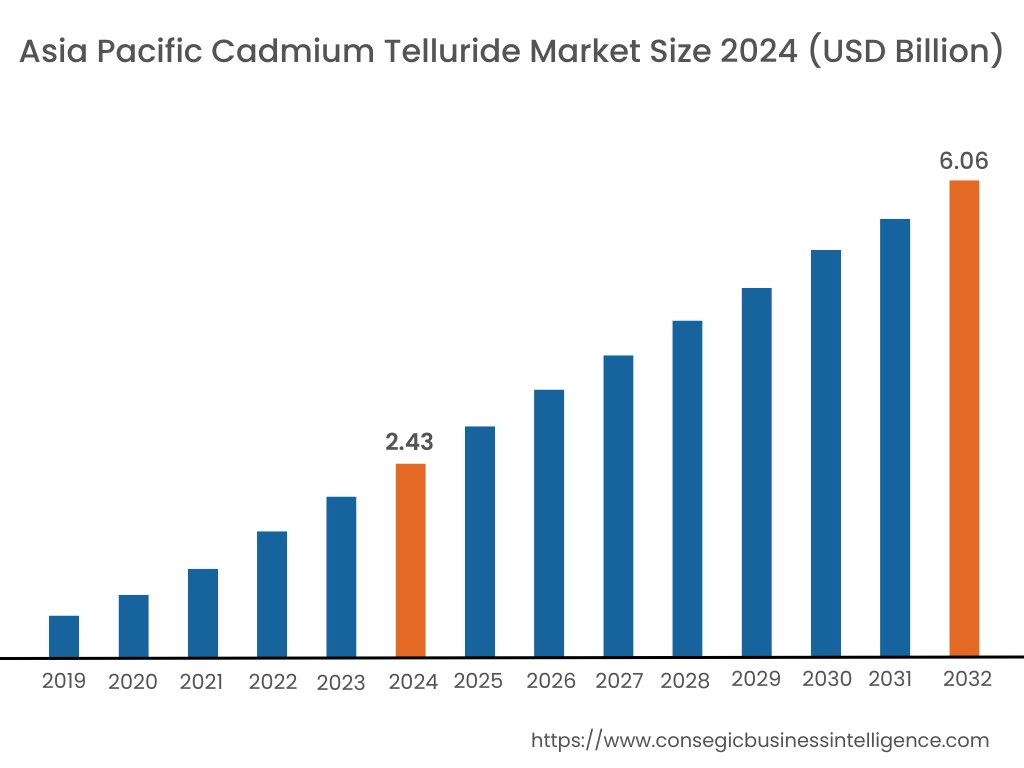
Asia Pacific is estimated to reach over USD 6.06 Billion by 2032 from a value of USD 2.43 Billion in 2024 and is projected to grow by USD 2.67 Billion in 2025. Out of this, China accounted for the maximum revenue share of 29.8%. The Asia-Pacific region is witnessing rapid growth in the cadmium telluride market, propelled by developing economies, increasing energy needs, and supportive governmental policies promoting renewable energy adoption. Countries like China and India have introduced initiatives such as the Feed-in Tariff (FIT) scheme, incentivizing its use in solar cells. The region's competitive manufacturing landscape, combined with a rising population and urbanization, has led to a surge in demand for renewable energy solutions. This environment fosters a favorable climate for the expansion of the industry, with significant investments in solar energy infrastructure and technology.

North America region was valued at USD 2.73 Billion in 2024. Moreover, it is projected to grow by USD 3.00 Billion in 2025 and reach over USD 6.45 Billion by 2032. North America leads the cadmium telluride market, primarily due to heightened awareness of renewable energy and environmental concerns. The United States, in particular, has seen substantial adoption of this technology, attributed to its cost-effectiveness and efficiency in solar energy applications. Government incentives and a growing number of utility-scale solar projects have further propelled the cadmium telluride market demand in the region. The integration of CdTe solar systems into commercial and residential buildings aligns with energy sustainability goals, presenting a significant cadmium telluride market opportunity for industry stakeholders.
Europe exhibits a robust market for cadmium telluride, driven by stringent emission norms and a strong governmental focus on adopting sustainable energy solutions. Countries such as Germany, France, and the United Kingdom are at the forefront, utilizing CdTe technology to meet renewable energy targets and reduce carbon footprints. The demand for thin-film solar cells is particularly notable, as they offer advantages in terms of cost and efficiency. Ongoing research and development activities in the field of thin-film photovoltaics are expected to further enhance the cadmium telluride market demand in the region, providing avenues for innovation and market expansion.
In Latin America, this market is gradually gaining traction, influenced by increasing investments in renewable energy projects and a growing emphasis on sustainable development. Countries such as Brazil and Mexico are exploring the potential of CdTe technology to diversify their energy portfolios and reduce dependence on conventional energy sources. The region's abundant solar resources present a natural advantage, making CdTe-based solar installations a viable option for meeting energy demands. As awareness of renewable energy benefits grows, the market is poised to experience steady growth, offering opportunities for both local and international players in the cadmium telluride industry.
The Middle East and Africa are emerging markets, with growth potential linked to the increasing adoption of solar energy solutions in response to rising energy needs and environmental considerations. Countries in the Middle East, with their high solar irradiance, are investing in solar power projects, some of which incorporate CdTe technology due to its efficiency and cost benefits. In Africa, the focus on electrification and sustainable energy access aligns with the deployment of CdTe-based solar systems, particularly in off-grid and rural areas. While challenges such as infrastructure development and financing persist, the region offers a promising landscape for the expansion of the market as part of broader renewable energy initiatives.
Top Key Players & Market Share Insights:
The cadmium telluride market is highly competitive with major players providing products and services to the national and international markets. key players are adopting several strategies in research and development (R&D), product innovation, and end-user launches to hold a strong position in the global cadmium telluride market. key players in the cadmium telluride industry include -
- CTF Solar (Germany)
- D2solar (U.S.)
- Fujikura Europe Ltd. (U.K.)
- RSI (U.S.)
- G24 Power Ltd. (U.K.)
- UPT Solar (India)
- Willard & Kelsey (WK) Solar (U.S.)
- Greatcell (Australia)
- Exeger Operations AB (Sweden)
Recent Industry Developments :
Product Launches:
- In September 2024, First Solar inaugurated a $1.1 Billion fully vertically integrated thin-film solar manufacturing facility in Alabama. It adds 3.5 gigawatts (GW) of manufacturing capacity in the United States and is expected to create over 800 new energy technology manufacturing jobs in the state.
Partnerships:
- In January 2024, First Solar signed a PPA with Cleantech Solar to establish a power generation facility in India. As per the agreement, Cleantech Solar will construct 150 megawatts (MW) of photovoltaic (PV) solar and 16.8 MW of wind-generating assets in India, supplying roughly 7.3 gigawatt-hours (GWh) of clean electricity to First Solar’s new 3.3-gigawatt (GW) vertically integrated solar manufacturing facility in India.
Cadmium Telluride Market Report Insights:
| Report Attributes | Report Details |
| Study Timeline | 2019-2032 |
| Market Size in 2032 | USD 19.91 Billion |
| CAGR (2025-2032) | 11.7% |
| By Product Type |
|
| By Application |
|
| By End-Use Industry |
|
| By Region |
|
| Key Players |
|
| North America | U.S. Canada Mexico |
| Europe | U.K. Germany France Spain Italy Russia Benelux Rest of Europe |
| APAC | China South Korea Japan India Australia ASEAN Rest of Asia-Pacific |
| Middle East and Africa | GCC Turkey South Africa Rest of MEA |
| LATAM | Brazil Argentina Chile Rest of LATAM |
| Report Coverage |
|
Key Questions Answered in the Report
How big is the Cadmium Telluride Market? −
Cadmium Telluride Market size is estimated to reach over USD 19.91 Billion by 2032 from a value of USD 8.24 Billion in 2024 and is projected to grow by USD 9.05 Billion in 2025, growing at a CAGR of 11.7% from 2025 to 2032.
What specific segmentation details are covered in the Cadmium Telluride Market report? +
The Cadmium Telluride market report includes specific segmentation details for product type, application and end-use industry.
Which is the fastest-growing region in the Cadmium Telluride Market? +
Asia Pacific is the fastest-growing region in the cadmium telluride market. These trends are encouraged by developing economies, increasing energy needs, and supportive governmental policies promoting renewable energy adoption.
Who are the major players in the Cadmium Telluride Market? +
The key participants in the Cadmium Telluride market are CTF Solar (Germany), D2solar (U.S.), RSI (U.S.), UPT Solar (India), Willard & Kelsey (WK) Solar (U.S.), Greatcell (Australia), Exeger Operations AB (Sweden), Fujikura Europe Ltd. (U.K.) and G24 Power Ltd. (U.K.).
Overview
Reputation & Certifications


Our Services
- Market Intelligence & Forecasting
- Custom Research Solutions
- Market Entry Strategy
- Competitive Intelligence
- Customer Insights
- Industry Innovation Analysis
- Investment Advisory