Jump to Content
Contraband Detector Market - Size, Share, Industry Trends, and Forecasts (2025-2032)
Contraband Detector Market Size:
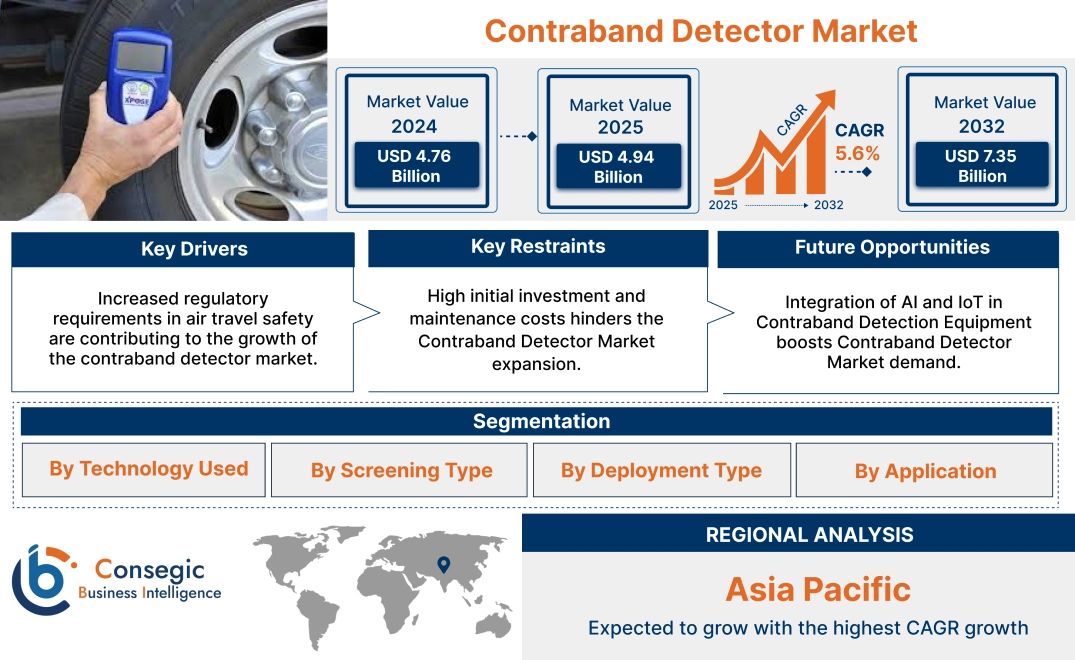
Contraband Detector Market size is estimated to reach over USD 7.35 Billion by 2032 from a value of USD 4.76 Billion in 2024 and is projected to grow by USD 4.94 Billion in 2025, growing at a CAGR of 5.6% from 2025 to 2032.
Contraband Detector Market Scope & Overview:
Contraband detectors are devices that identify and locate prohibited items like drugs, weapons, and explosives. They are used in security settings to prevent smuggling. They check hollow spaces quickly and reliably. These nonintrusive detection devices provide a passive means to screen people, vehicles, or other objects for the presence of nuclear or radiological materials. The distinct types of contraband detectors include handheld, walk-through, environmental, drive-through, drones, mail, and package detector. These technologies are used at access points to detect the presence of distinct types of contraband such as nonmetallic weapons, drugs, tobacco, and wireless communication devices. The primary end-use for these detectors are transportation security (airports, seaports), border security, law enforcement, critical infrastructure protection, public venues like stadiums, government buildings, and high-security facilities.
How is AI Impacting the Contraband Detector Market?
AI is revolutionizing the contraband detector market by moving beyond simple rule-based systems to intelligent, predictive analysis. AI-powered algorithms analyze data from scanners, such as X-ray and millimeter-wave, with far greater speed and accuracy than human operators. They can identify subtle anomalies and patterns that indicate hidden threats, reducing false positives and operator fatigue. This technology is being applied to everything from scanning baggage at airports to inspecting cargo containers and mail in correctional facilities. By continuously learning from new data, these AI systems can adapt to evolving smuggling methods, making detection more effective and efficient, ultimately enhancing security and public safety.
Contraband Detector Market Dynamics - (DRO):
Key Drivers:
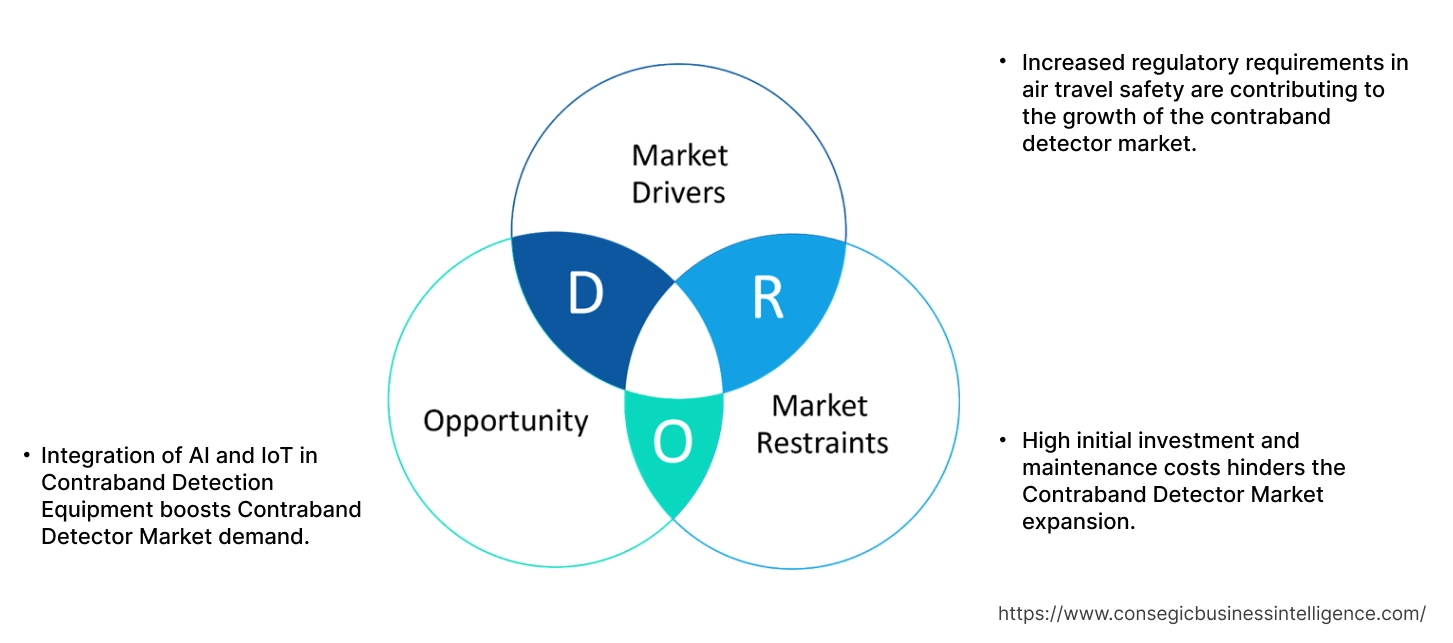
Increased regulatory requirements in air travel safety are contributing to the growth of the contraband detector market.
Security check is the first line of defense to guarantee people’s travel safety as masses choose to travel via different methods of transportation due to the rapid development in the transportation industry. Airports, high-speed rail stations, and other public areas utilize X-ray security equipment as a contraband detector, due to its high recognition, and non-destructive testing advantages.
Among these, airports have implemented very stringent security protocols to optimize the personal safety of travelers. X-ray security checks use scanners for non-destructive identification of the contents of the baggage to ensure that the contents do not contain contraband, like weapons, drugs, or explosives by analyzing the different densities of materials within items being scanned, thus reducing the risk of criminal problems, terrorist activities, invasion of harmful plants and animals, etc., making it a key tool for detecting prohibited items.
- For instance, in April 2024, Smiths Detection, a global leader in threat detection and security screening technologies, and a business of Smiths Group plc, launched its groundbreaking X-ray Diffraction (XRD) technology scanner, the SDX 10060 XDi. It’s been rolled out across many of the world’s busiest international airports, this scanner an innovative solution which plays a vital role in the continued fast-moving war against illicit narcotics and wider contraband.
Thus, the increasing demand of airport security for personal safety and smooth air travel increases the trend of these detectors contributing to the contraband detector market growth.
Key Restraints:
High initial investment and maintenance costs hinders the Contraband Detector Market expansion.
Adopting contraband detection equipment devices require a significant upfront cost, which is a major barrier for many organizations due to the expense of advanced detection technology like X-ray scanners or millimeter wave imaging systems, making it less accessible for small and medium enterprises. Advanced contraband detectors often utilize sophisticated technology like imaging systems that require substantial capital to acquire and set up. The price of contraband detection equipment, especially ones with more complex features such as AI and IoT, is overly expensive for small enterprises. Detectors designed for high-security areas like prisons or airports are costlier than those used in lower-risk environments.
Beyond the initial purchase, ongoing maintenance and calibration of these devices also add significant costs over time. This inflated cost deters smaller organizations or those with limited budgets from investing in contraband detection systems.
Thus, the overall adoption rate remains slower in cost-sensitive markets, which impacts the global expansion of the contraband detectors industry.
Future Opportunities:
Integration of AI and IoT in Contraband Detection Equipment boosts Contraband Detector Market demand.
The surge in the AI trend leads to enhancement of Artificial Intelligence with these detectors to enable highly accurate, real-time identification of hidden contraband through advanced image analysis, anomaly detection, and predictive modeling, allowing for faster and more efficient screening across various security checkpoints, including airports, borders, and correctional facilities, while minimizing false positives and adapting to evolving smuggling tactics.
AI is transforming smuggling detection by predicting high-risk shipments through analysis of various textual data. Using AI technology to assist in contraband detection acts as an additional screening layer, helping ensure prohibited items are not missed and reducing the potential for human error.
- For instance, in November 2024, in a significant step toward enhancing correctional facility security, the Hubbard County Sheriff’s Office has implemented the groundbreaking CLEARPASS C.i. partial body scanner, developed by LINEV Systems in Conroe, Texas, to prevent the smuggling of contraband such as narcotics and weapons into their jail. It features two pioneering detection capabilities: DruGuard, patented narcotics detection software and A-EYE, an AI-powered object detection and classification software.
Thus, the integration of AI with contraband detection in enhanced security is anticipated to increase the future contraband detector market opportunities.
Contraband Detector Market Segmental Analysis :
By Technology Used:
Based on technology used, the market is segmented into X-ray imaging, metal detection, spectrometry and spectroscopy, and others.
X-ray imaging accounted for the largest revenue share in the Contraband Detector Market share in 2024.
- X-ray security checks are a leading trend in security sectors as they use scanners for non-destructive identification of the contents of the baggage to ensure that the contents do not contain contraband, thus reducing the risk of criminal problems, terrorist activities, invasion of harmful plants and animals, etc.
- They provide the capability for examining the interior of large, complex objects, measuring densities and dimensions, finding flaws, and detecting contraband.
- X-ray inspections help maintain public transportation safety and protect life and property. X-ray scanners detects both metallic and non-metallic contraband and are able to detect contraband hidden on or inside the human body.
- X-ray security checks are important to ensure public safety due to increased crowd density in public transport hubs. These systems are used at international borders, in transportation venues, at government buildings, and other venues.
- For instance, in April 2024, Several Metro Atlanta Jails installed High Tech X-ray scanners to prevent contraband from making it inside. The Tek84 scanner reveals drugs and weapons hidden inside the bodies of people attempting to enter the jail.
- Thus, the demand of X-ray imaging used in contraband detection drives the Contraband Detector Market growth.
Metal detection segment is anticipated to have the highest CAGR during the forecast period.
- Metal detectors provide the responder community with an essential tool to screen individuals that may be carrying weapons or contraband that contain metallic components.
- Available in walk-through and handheld models, metal detectors are commonly used at checkpoints in airports, schools, courthouses, prisons, and military installations.
- Walk-through metal detectors are designed for either indoor or outdoor use. Outdoor models are weatherproof and are often used at temporary venues, such as concerts or sporting events. Indoor models are typically installed at a fixed location.
- Handheld metal detectors, also known as security wands, are often used at checkpoints in conjunction with walkthrough metal detectors; the handheld model provides focused screening when the alarm in the walkthrough metal detector has been triggered.
- For instance, Cumberland County Schools(CCS), launched an initiative to implement several key measures to enhance the safety of the school environment, such as advanced weapons detection systems, improved visitor management protocols, anonymous reporting systems and comprehensive agreements with local law enforcement for School Resource Officers (SROs) for the academic year 2024-25.
- Thus, the surge in demand of metal detectors is expected to increase the Contraband Detector Market trend.
By Screening Type:
Based on screening type, the market is segmented into people screening, baggage and cargo screening, and vehicle screening.
Baggage and cargo screening accounted for the largest revenue share in the Contraband Detector Market in 2024.
- A baggage scanner is a machine used at airports and other security checkpoints to scan luggage and detect potentially dangerous or prohibited items like weapons, explosives, drugs, or other contraband by utilizing X-ray technology to create an image of the bag's contents.
- They generate an X-ray image of the luggage, enabling security officers to see through the bag and identify items that might be considered contraband based on their density and shape.
- They detect assorted items such as metallic objects (weapons), dense materials (explosives), organic materials (drugs), and even liquids depending on the scanner type.
- It allows security personnel to identify suspicious objects based on their density and appearance on the scan; it is an X-ray machine designed to identify hidden contraband within luggage.
- Primarily used at airports for passenger luggage screening and are also found in other high-security locations like government buildings, seaports, and railway stations.
- Thus, the baggage and cargo segment accounts for the largest revenue in the Market.
Vehicle screening is anticipated to have the highest CAGR during the forecast period.
- A contraband detector is used in vehicle monitoring to scan a vehicle for hidden illicit substances like drugs, weapons, explosives, or substantial amounts of cash.
- It is done by detecting density variations within the vehicle's compartments, allowing authorities to identify potential contraband without having to physically dismantle the vehicle.
- Most detectors utilize radiation-based technology, like gamma rays, to penetrate the vehicle's exterior and analyze the density of objects inside, highlighting areas where suspicious items might be hidden.
- This is commonly used at border crossings, checkpoints, or during targeted vehicle searches by law enforcement.
- Thus, the rising trend of vehicle screening for contraband is leading to future market opportunities.
By Deployment type:
Based on deployment type, market is segmented into fixed and portable.
Fixed segment accounted for the largest revenue share in the Contraband Detector Market in 2024.
- A fixed contraband detector is a security device designed to identify and locate prohibited or illegal items, permanently installed in a specific location like an entrance to a facility, allowing for continuous screening of people, packages, or vehicles passing through that point.
- It offers high-capacity detection and reliable security against contraband smuggling; it is a stationary detector that cannot be easily moved compared to portable units.
- They are mounted in a fixed location, like an airport security checkpoint or prison entrance. Due to their stationary nature, they can efficiently scan a large number of people or items continuously.
- Fixed detectors often incorporate sophisticated detection technologies like X-ray imaging, metal detection, or advanced imaging systems for greater accuracy.
- Thus, the fixed segment accounts for the highest revenue, leading to growth in the Market.
The portable segment is anticipated to register the fastest CAGR during the forecast period.
- Portable contraband detectors are devices that can find hidden objects like drugs, weapons, and explosives. They can be used in vehicles, buildings, and cargo.
- They are compact, lightweight, rugged, handheld density meters designed to aid law enforcement officials with the detection of hidden objects.
- Portable detectors gives an indication of contraband concealed in inaccessible locations, such as walls, tyres, bulkheads, etc.
- They work by measuring changes in density across the target area; unexpected changes indicate the presence of hidden objects or compartments.
- For instance, in September 2024, Smiths Detection, a global leader in threat detection and security screening technologies, announced the launch of the SDX 6040 Enhanced Image Quality (EIQ), a cutting-edge screening solution designed to meet the dynamic demands of modern security environments. The SDX 6040 is highly mobile, allowing it to be moved and powered up easily.
By Application:
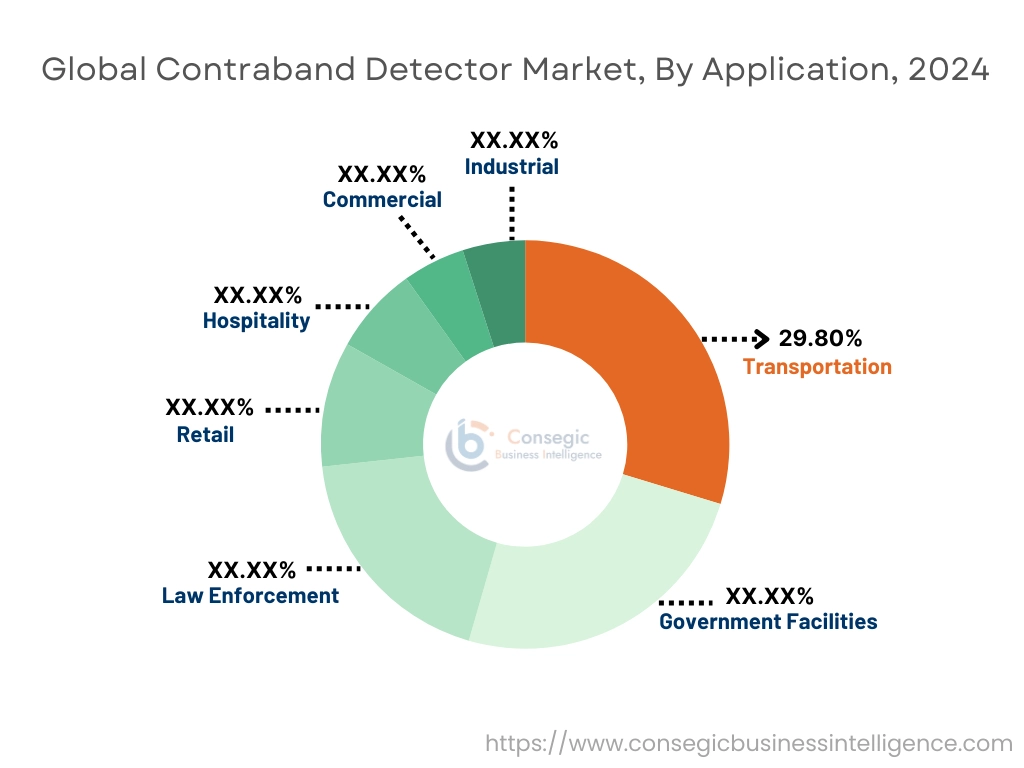
Based on application, the market is segmented into transportation, government facilities, law enforcement, retail, hospitality, commercial, and industrial.
The transportation segment accounted for the largest revenue share of 29.8% and is expected to register the fastest CAGR during the forecast period.
- X-ray security is a crucial tool in identifying potential threats in cargo shipments, such as explosive devices, weapons, and contraband.
- The technology enables the screening of cargo containers without the need for physical inspection, saving time and reducing the risk of human error.
- This allows for a more efficient and accurate detection of illegal goods, which contributes to the safety and security of individuals and the community.
- X-ray security also plays a critical role in safeguarding the health and wellbeing of people involved in the transportation and cargo industry. The use of X-ray technology enables the detection of hazardous materials and radioactive substances, which could cause harm to individuals who come into contact with them.
- For instance, in November 2024, Smiths Detection, a global leader in threat detection and security screening technologies, and a business of Smiths Group, announced its state-of-the-art IONSCAN 600 detectors testing. These detectors will be used to assess and develop security practices for the railway system, with a particular focus on strengthening anti-terrorism and anti-sabotage measures. These detectors, which use scanning strips to identify explosives and hazardous substances.
- Thus, the growth of Contraband detection in the transportation sector for the security purpose drives the market.
Regional Analysis:
The regions covered are North America, Europe, Asia Pacific, the Middle East and Africa, and Latin America.
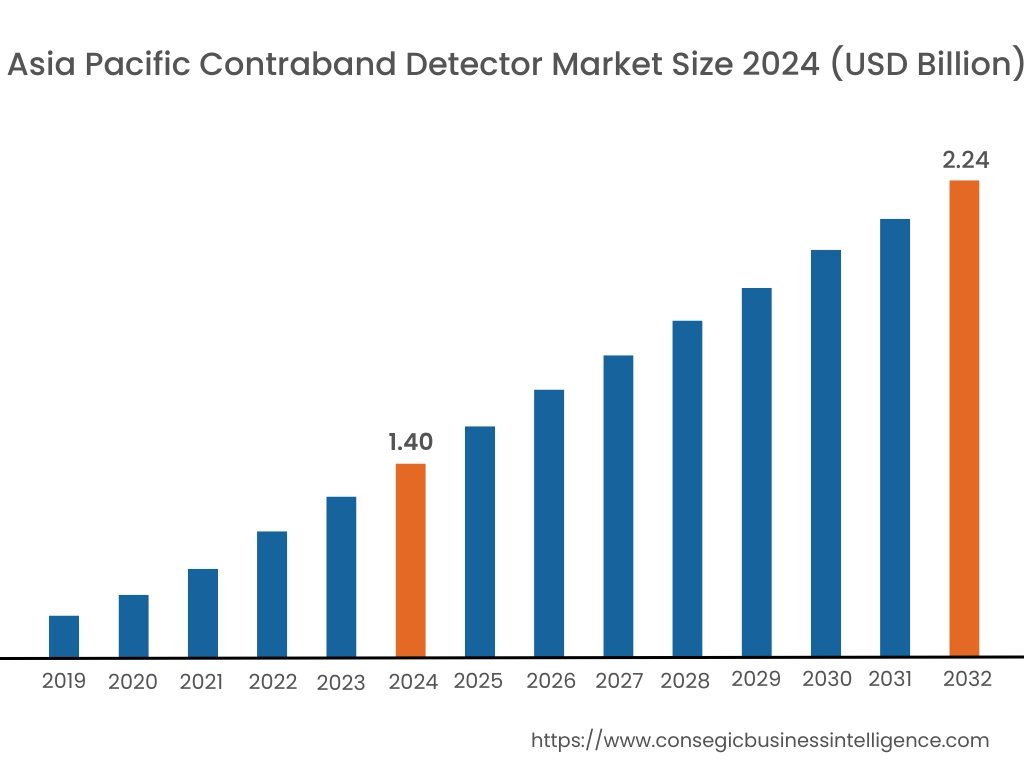
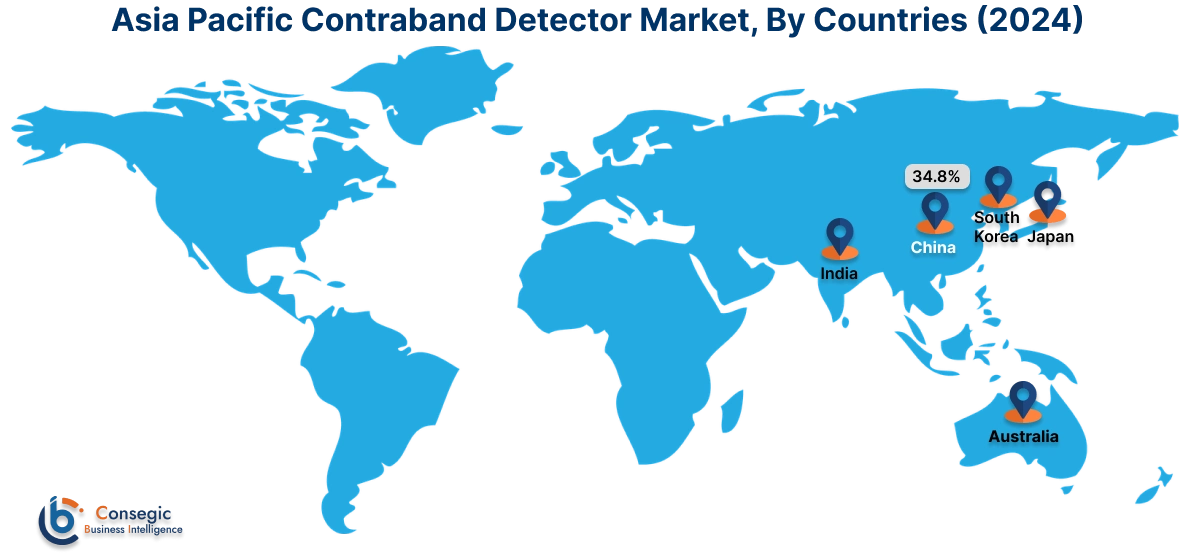
Asia Pacific region was valued at USD 1.40 Billion in 2024. Moreover, it is projected to grow by USD 1.46 Billion in 2025 and reach over USD 2.24 Billion by 2032. Out of this, China accounted for the maximum revenue share of 34.8%.
The Asia-Pacific region accounts for the largest revenue in the global Contraband detector Market. In the Asia region, these detectors are primarily used at border crossings, airports, and other key transportation hubs to scan passengers, luggage, and cargo for illegal items like drugs, weapons, and explosives, with a strong focus on security measures due to the region's complex geopolitical landscape and high volume of cross-border trade; this includes utilizing technologies like X-ray imaging, metal detection, and advanced spectroscopy to effectively detect concealed contraband, often deployed as fixed systems at checkpoints or as portable units for targeted inspections.
Their establishment improves and supports both global and regional sales of advanced X-ray scanners, particularly in fast-growing, emerging markets like Vietnam, China, India, and Indonesia.
- For instance, in December 2024, Three D Integrated Solutions Ltd. (Three DiS) and the Society for Applied Microwave Electronics Engineering and Research (SAMEER), an autonomous R&D institution under the Ministry of Electronics and Information Technology (MeitY), have entered into a strategic partnership. This collaboration aimed to focus on advanced solutions for airport navigation, communication systems, and security technologies. The aim was to execute projects of national importance, focusing on airport navigation, communication systems, and security-related equipment.
Thus, the market analysis highlights the extensive use of Contraband detection technology increases the Contraband Detector Market demand.
North America is estimated to reach over USD 2.38 Billion by 2032 from a value of USD 1.58 Billion in 2024 and is projected to grow by USD 1.64 Billion in 2025. Contraband detectors in North America are used as security devices at airports, borders, and other critical points of entry to detect illegal substances, weapons, or other prohibited items being smuggled into the region, with the United States and Canada being the primary users due to their high volume of international trade and passenger traffic; this market is often dominated by advanced technologies like X-ray imaging, millimeter-wave scanners, and chemical detection systems to effectively identify contraband with high accuracy.
The US has long been the most active in fighting the drugs trade, independently and also with collaboration of other countries. U.S. action has focused on enforcement, with some part of anti-drug funds detected to criminal law enforcement and other to treatment boosting the market trend. Drug detection equipment such as Ion Spectrometry devices have been introduced into the prison systems, law enforcement agencies and customs and border control security checkpoints.
- For instance, in June 2024, Liberty Defense Holdings Ltd. a leading technology provider of AI-based next generation detection solutions for concealed weapons and threats, will be deploying HEXWAVE to US airports in July to meet TSA’s National Amendment for Aviation Worker Security Screening.
The CBSA uses the latest scientific technology to prevent contraband and prohibited or restricted goods from entering Canada. Radiation detection portals are mass screen cargo containers for radiation. Carborne units helps search for radioactive materials and identify the type of radiation. The carborne unit is mobile and transmits data to CBSA scientists for analysis.
Thus, the market analysis highlights that the North American region is expected to be the fastest growing in the Contraband Detector Market Analysis.
There is an emerging trend of contraband detectors in European region. In Europe, they are primarily used at borders and entry points to scan luggage, vehicles, and cargo for illicit goods like drugs, weapons, explosives, and smuggled currency, with the main goal of preventing illegal activities and enhancing border security by detecting contraband attempting to cross borders; this is particularly important due to stricter regulations implemented by European countries to combat smuggling and terrorism.
Portable devices are widely used in Customs of Germany, Turkey, Hungary, Poland, France, Sweden, Lithuania, Latvia and many more. The inspection of the border crossing traffic of merchandise and the control of vehicles for illicit goods, especially drugs, cigarettes, explosives, and weapons is a prominent task for the customs services.
In the Middle East, they are primarily used to enhance security at borders, airports, and other critical infrastructure by identifying and preventing the smuggling of illegal items like weapons, drugs, explosives, and contraband goods, often due to the heightened concerns around terrorism and cross-border illegal activities in the region; this includes utilizing technologies like X-ray imaging, metal detection, and advanced scanning systems to detect hidden contraband within people, luggage, and cargo.
Governments in emerging economies such as Africa and Middle East are addressing the security issue by offering subsidies and initiating public-private partnerships to reduce financial constraints.
In Latin America, they are an emerging trend primarily used to combat drug smuggling at borders, ports, and airports, scanning people, vehicles, and cargo for illicit substances like cocaine, marijuana, and other narcotics, due to the region's significant drug trafficking issues; they are also used in prisons and other high-security locations to detect contraband like weapons and cell phones.
Top Key Players & Market Share Insights:
The Contraband Detector market is highly competitive with major players providing products and services to the national and international markets. Key players are adopting several strategies in research and development (R&D), product innovation, and end-user launches to hold a strong position in the global Contraband Detector market. Key players in the Contraband Detector industry include –
- Smith’s Detection (UK)
- OSI Systems (US)
- Berkeley Varitronics Systems (US)
- Garrett Electronics Inc (US)
- Godrej Security Solutions (India)
- Leidos (US)
- Nuctech (China)
- Metrasens (UK)
- Adani Systems (India)
- CEIA (Italy)
Recent Industry Developments :
- In February 2025, In line with Dubai's plan to accelerate the adoption of artificial intelligence (AI) applications Dubai Customs has unveiled "Al Munasiq." This advanced AI-powered platform aims to transform the classification of goods based on the Harmonized System (HS) Code. The application provides several advanced methods for searching and identifying all information related to goods, including their description, customs duty rate, and restriction status.
Contraband Detector Market Report Insights:
| Report Attributes | Report Details |
| Study Timeline | 2019-2032 |
| Market Size in 2032 | USD 7.35 Billion |
| CAGR (2025-2032) | 5.6% |
| By Technology Used |
|
| By Screening Type |
|
| By Deployment Type |
|
| By Application |
|
| By Region |
|
| Key Players |
|
| North America | U.S. Canada Mexico |
| Europe | U.K. Germany France Spain Italy Russia Benelux Rest of Europe |
| APAC | China South Korea Japan India Australia ASEAN Rest of Asia-Pacific |
| Middle East and Africa | GCC Turkey South Africa Rest of MEA |
| LATAM | Brazil Argentina Chile Rest of LATAM |
| Report Coverage |
|
Key Questions Answered in the Report
What is a Contraband Detector? −
Contraband detectors are the equipment used to locate illicit items like drugs, weapons, and explosives in security systems to prevent smuggling. They are used at airports, law enforcements, public venues, and government buildings to detect the presence of drugs, tobacco, and communication devices.
What are the drivers covered in the Contraband Detector Market report? +
The major driver of Contraband Detector market is its increased regulatory demand in airport safety. X-ray scanners are used in airport security making sure the contents of the baggage are clear of contrabands such as weapons, drugs, or explosives.
What are the major segments covered in the Contraband Detector market report, and how the dominating segment impacts the market growth? +
The major segments covered in the Contraband Detector market report are technology used, screening type, deployment type, and application. For instance, in the application segment, the transportation sector accounts for the largest and fastest growing market due to its widespread use in the transportation fields like airport security, train security ensuring locality and public safety.
Who are the major key players in the Contraband Detector market? +
The major key players in the Contraband Detector market are Smith’s Detection (UK), OSI Systems (US), Leidos (US), Nuctech (China), Metrasens (UK), Adani Systems (India), CEIA (Italy), Berkeley Varitronics Systems (US), Garrett Electronics Inc (US), and Godrej Security Solutions (India).
Overview
Reputation & Certifications


Our Services
- Market Intelligence & Forecasting
- Custom Research Solutions
- Market Entry Strategy
- Competitive Intelligence
- Customer Insights
- Industry Innovation Analysis
- Investment Advisory