Jump to Content
Controlled Environment Agriculture Market - Size, Share, Industry Trends, and Forecasts (2025-2032)
Controlled Environment Agriculture Market Size:
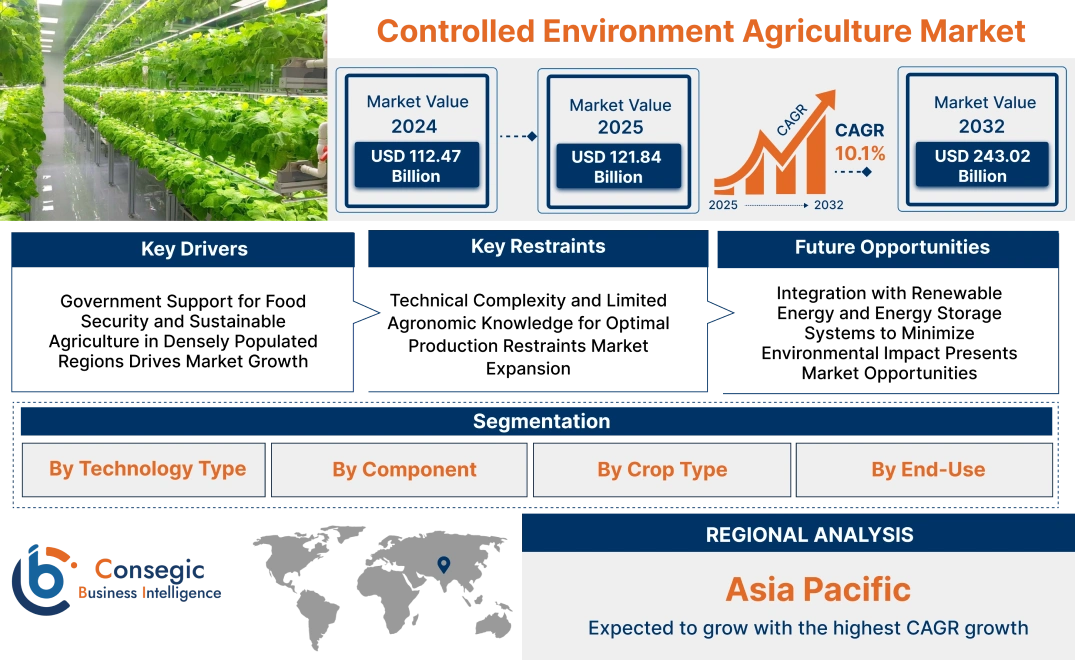
Controlled Environment Agriculture Market size is estimated to reach over USD 243.02 Billion by 2032 from a value of USD 112.47 Billion in 2024 and is projected to grow by USD 121.84 Billion in 2025, growing at a CAGR of 10.1% from 2025 to 2032.
Controlled Environment Agriculture Market Scope & Overview:
Controlled environment agriculture refers to a technology-based approach to food production where crops are grown within enclosed structures under tightly managed environmental conditions. Systems include greenhouses, vertical farms, and growth chambers equipped with sensors, automation, and climate control technologies that regulate temperature, humidity, light, and nutrient levels.
Core components involve hydroponics, aeroponics, artificial lighting, HVAC systems, and nutrient delivery mechanisms. These integrated setups ensure consistent yields, precise resource utilization, and reduced exposure to pests or diseases.
Controlled environment agriculture enables year-round cultivation, optimized land use, and minimal water consumption while supporting high-density production in urban and non-arable regions. It offers scalability, traceability, and the ability to maintain uniform crop quality regardless of external weather conditions. This model is particularly suited for high-value crops and specialty produce, aligning with modern agricultural practices focused on efficiency, reliability, and sustainability in food supply systems.
How is AI Impacting the Controlled Environment Agriculture Market?
AI is having a significant impact on the Controlled Environment Agriculture (CEA) market, transforming it into a data-driven, highly efficient industry. AI-powered systems utilize machine learning and computer vision to analyze real-time data from a multitude of sensors, precisely controlling environmental factors like temperature, humidity, and CO2 levels. This level of precision optimizes plant growth, reduces resource waste, and maximizes yields. AI also enhances crop monitoring by detecting early signs of disease, nutrient deficiencies, or pests, enabling proactive intervention. Furthermore, AI-driven automation and robotics are streamlining operations from planting to harvesting, reducing labor costs and improving overall productivity and sustainability.
Controlled Environment Agriculture Market Dynamics - (DRO) :
Key Drivers:
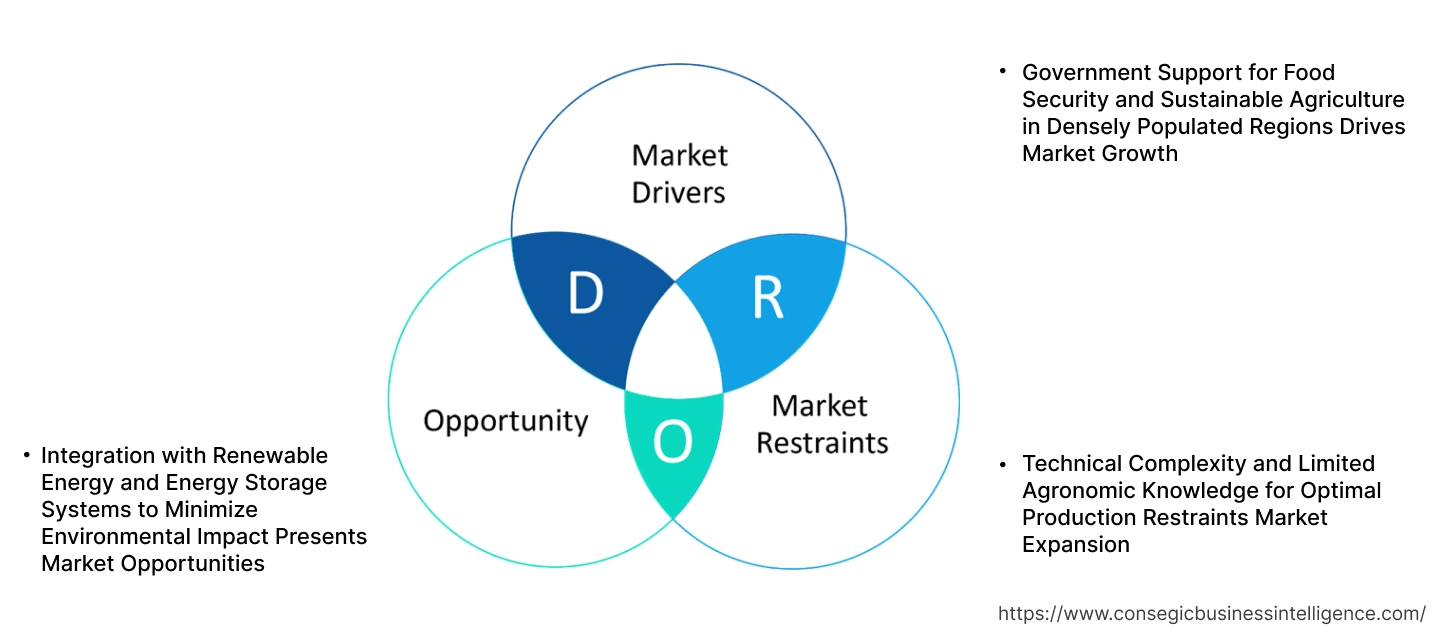
Government Support for Food Security and Sustainable Agriculture in Densely Populated Regions Drives Market Growth
Governments in Asia, the Middle East, and Northern Europe are actively encouraging indoor agriculture as a strategic method of addressing food security issues. Urbanization and scarce arable land are forcing farmers and policymakers alike to embrace year-round crop yields through greenhouses and vertical farms. Both national and local initiatives provide subsidies, research funding, and policy environments to spur private investment in controlled systems of production and growth. This assistance is complemented by zoning regulatory flexibility and energy usage as well as urban water reuse infrastructure. The measures are set up to decline dependency on food importation, make the food value chain more resilient, and deliver skilled employment to agri-tech industries. Through becoming institutionalized in urban planning and urban governance, with entry into mainstream agrifood sectors, city urban agriculture will pick up traction, thereby promoting continued controlled environment agriculture market expansion.
Key Restraints:
Technical Complexity and Limited Agronomic Knowledge for Optimal Production Restraints Market Expansion
Running high-performance indoor farms needs multidisciplinary expertise in plant science, HVAC engineering, nutrient chemistry, and automation. Control of lighting, humidity, airflow, and nutrient concentration needs real-time accuracy and integrated control systems. Inexperienced operators tend to experience problems like microbial outbreaks, nutrient imbalance, and non-uniform yields. The lack of agronomists with soilless cultivation and climate-controlled growing system expertise further aggravates the problem, especially in emerging markets. Limited technical advisory services and institutional training programs decrease new entrants' capacity to effectively scale operations. These limitations enhance operational risk and diminish trust in commercial feasibility. Even as local and sustainable food demand rises, such technical impediments go on to stifle controlled environment agriculture market growth among small and medium-scale operators.
Future Opportunities :
Integration with Renewable Energy and Energy Storage Systems to Minimize Environmental Impact Presents Market Opportunities
Controlled environment agriculture facilities are progressively incorporating solar panels, battery backup, and in-house energy management systems to cut down on dependence on grid electricity and enhance sustainability. Renewable power enables round-the-clock lighting, temperature control, and nutrient distribution in high-density vertical farms and greenhouses. Integration with energy storage systems eliminates power interruptions during grid outages and minimizes peak load fees. Such integration enhances long-term economic viability and substantially reduces the environmental impact. There is growing demand for decarbonized agricultural infrastructure, particularly in high-mandate climate markets and urban sustainability initiatives. With decreasing costs and greater access to renewable technologies, CEA operators who adopt clean energy solutions have both performance and brand benefits.
- For instance, in October 2023, Gotham Greens opened a new greenhouse in Georgia. The company builds and operates sustainable greenhouses across the USA to grow delicious leafy greens and herbs using hydroponic technology. They rely on solar energy to operate their greenhouses sustainably.
All this is developing a scalable controlled environment agriculture market opportunity driven by sustainability, cost reduction, and clean technology expansion.
Controlled Environment Agriculture Market Segmental Analysis :
By Technology Type:
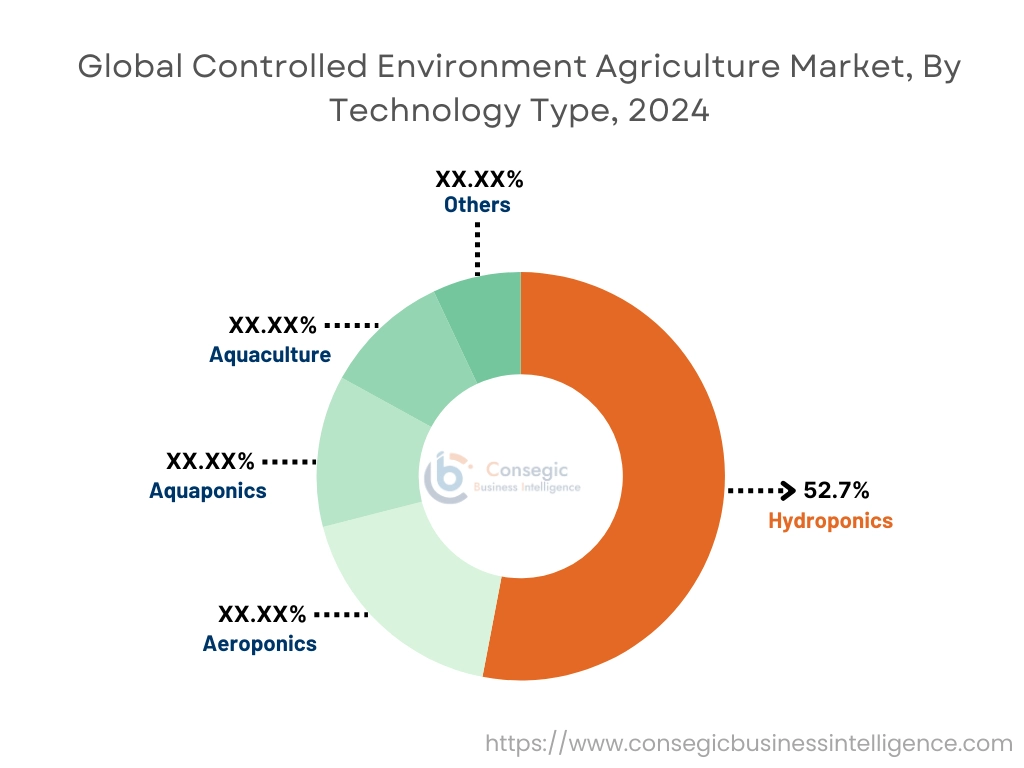
Based on technology type, the controlled environment agriculture market is segmented into hydroponics, aeroponics, aquaponics, aquaculture, and others.
The hydroponics segment accounted for the largest revenue share of 52.7% in 2024.
- Hydroponic systems allow plant cultivation without soil using nutrient-rich water, supporting precise control over growing conditions.
- They are widely adopted for leafy greens and herbs in vertical farms and greenhouses due to fast growth and high yield.
- The method minimizes water usage and is scalable for both small urban setups and large commercial farms.
- For instance, in April 2024, Vertefarm launched its innovative hydroponic micro plant factory, which utilizes vertical surface planting and root cyclic drip irrigation technologies to ensure healthy plant growth by providing ample contact with both water and air. Fitted with no additional-fee light source, the farm is designed for green leafy plants by ensuring a photosynthetic photon flux over 150 μmol/m²/s to the leaves to enable proper development. It allows users to cultivate various plants in their living rooms, balconies, kitchens, and more.
- As per controlled environment agriculture market analysis, hydroponics dominates due to its proven productivity and widespread commercial deployment.
The aeroponics segment is projected to register the fastest CAGR during the forecast period.
- Aeroponics delivers nutrients through mist to exposed roots, promoting oxygenation and accelerating plant growth.
- These systems reduce water and nutrient usage even further than hydroponics, making them ideal for sustainable farming models.
- Adoption is increasing in high-tech indoor farms focusing on high-value crops with short cycles.
- For instance, in February 2024, LettUs Grow unveiled an exclusive global partnership programme to scale benefits of aeroponics worldwide. This programme promotes geographical expansion and enhances the global reach of their ultrasonic aeroponic technology. It enables supply-chain and delivery partners to license the company’s technology for integration with their products to maximize benefits to the clients.
- According to controlled environment agriculture market trends, aeroponics is gaining momentum in regions with limited agricultural land and water scarcity.
By Component:
Based on component, the market is segmented into hardware (lighting systems, climate control systems, sensors, nutrient delivery systems, others), software (farm management software, data analytics, remote monitoring, others), and service (installation, maintenance, consulting).
The hardware segment accounted for the largest controlled environment agriculture market share in 2024.
- Hardware is the backbone of CEA operations, comprising lighting systems, climate control, sensors, and nutrient delivery systems that ensure optimal plant growth.
- LED grow lights and advanced HVAC systems allow precise control over temperature, humidity, and light spectrum, enhancing productivity.
- Sensors support real-time monitoring of environmental conditions, aiding in crop health and yield forecasting.
- As per controlled environment agriculture market analysis, capital investments in greenhouse and vertical farm infrastructure drive continued hardware dominance.
The software segment is projected to register the fastest CAGR during the forecast period.
- Farm management software integrates data from multiple systems for informed decision-making on irrigation, lighting schedules, and harvesting cycles.
- Analytics tools powered by AI and machine learning help forecast yields, reduce waste, and optimize energy usage.
- Remote monitoring platforms allow growers to manage multi-site operations and respond swiftly to anomalies.
- According to controlled environment agriculture market trends, the digitalization of farming operations is key to operational efficiency and market scalability.
By Crop Type:
Based on crop type, the controlled environment agriculture market is segmented into fruits & vegetables, herbs & microgreens, mushrooms, flowers & ornamentals, and others.
The fruits & vegetables segment held the largest revenue share in 2024.
- Tomatoes, lettuce, strawberries, and bell peppers are leading crops grown in controlled environments for year-round supply and consistent quality.
- Retailers and food service chains prefer CEA-grown produce for its traceability, pesticide-free nature, and extended shelf life.
- Vertical farms and greenhouses are increasingly dedicating space to high-demand fruits and vegetables to meet urban consumption trends.
- Furthermore, fruits & vegetables remain the most economically viable and scalable crops under controlled conditions, boosting the controlled environment agriculture market demand.
The herbs & microgreens segment is projected to grow at the fastest CAGR during the forecast period.
- Culinary herbs such as basil, cilantro, and mint, as well as microgreens like arugula and kale, have short life cycles and high market value.
- These crops thrive under LED lighting in compact spaces, making them ideal for indoor and vertical farming.
- Need from restaurants, grocery stores, and home chefs for fresh, hyper-local produce is accelerating segment development.
- For instance, in January 2025, AeroFarms, the leading supplier of microgreens to the U.S. retail market and a Certified B Corporation, unveiled that it has developed a patented technology to grow highly nutritious microgreens at scale and has fully commercialized a climate-agnostic, economically viable vertical farming solution.
- Controlled environment agriculture market expansion is supported by the low production costs and high profitability of herbs and microgreens.
By End-Use:
Based on end-use, the market is segmented into commercial growers, research & educational institutes, retail chains, and others.
The commercial growers segment held the largest controlled environment agriculture market share in 2024.
- Commercial operators utilize advanced technologies to produce large volumes of consistent-quality produce for regional distribution.
- These enterprises are expanding across urban areas to reduce transportation costs and meet consumer expectations for freshness.
- Investment in vertical farming and automated greenhouse systems is strongest among commercial entities with scalable business models.
- Controlled environment agriculture market demand from this segment is driven by sustainability goals and the need for food system resilience.
The retail chains segment is expected to grow at the fastest CAGR during the forecast period.
- Retailers are increasingly investing in on-site or partner-controlled units to supply in-store grown produce, improving transparency and freshness.
- Supermarkets are collaborating with vertical farming companies to offer “harvested today” products with minimal logistics.
- The focus on reducing food miles, increasing traceability, and enhancing shelf life is prompting retailers to adopt in-house cultivation.
- Additionally, the retail chain segment is evolving into a key distribution node within urban food systems, bolstering controlled environment agriculture market growth.
Regional Analysis:
The regions covered are North America, Europe, Asia Pacific, the Middle East and Africa, and Latin America.
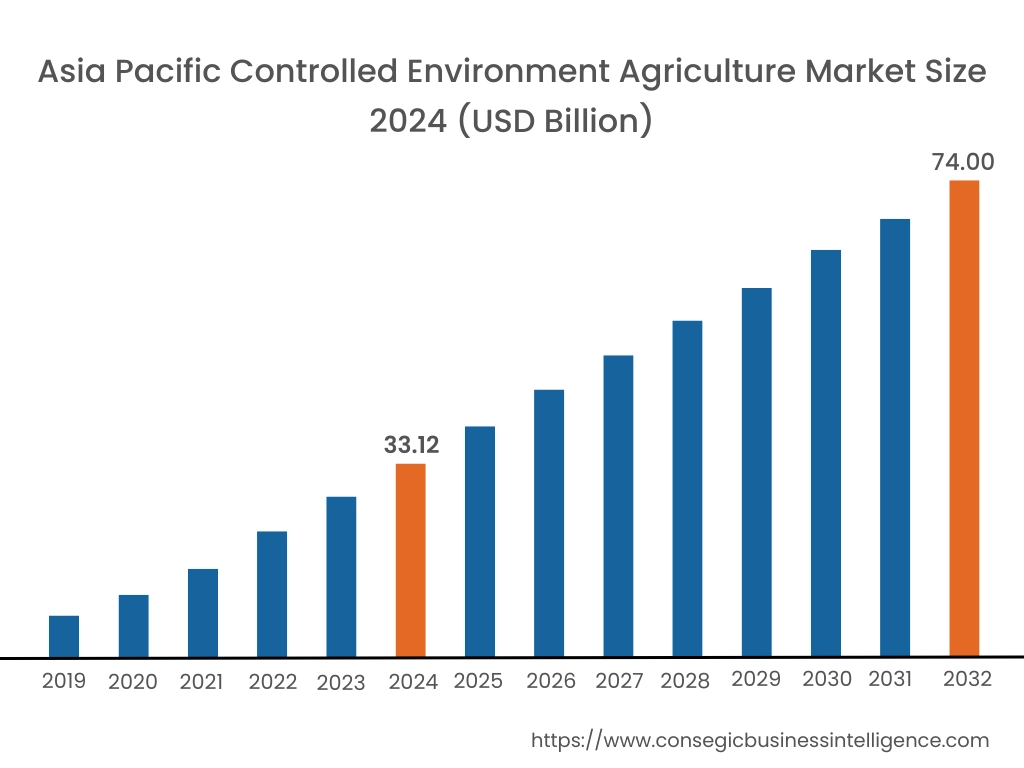
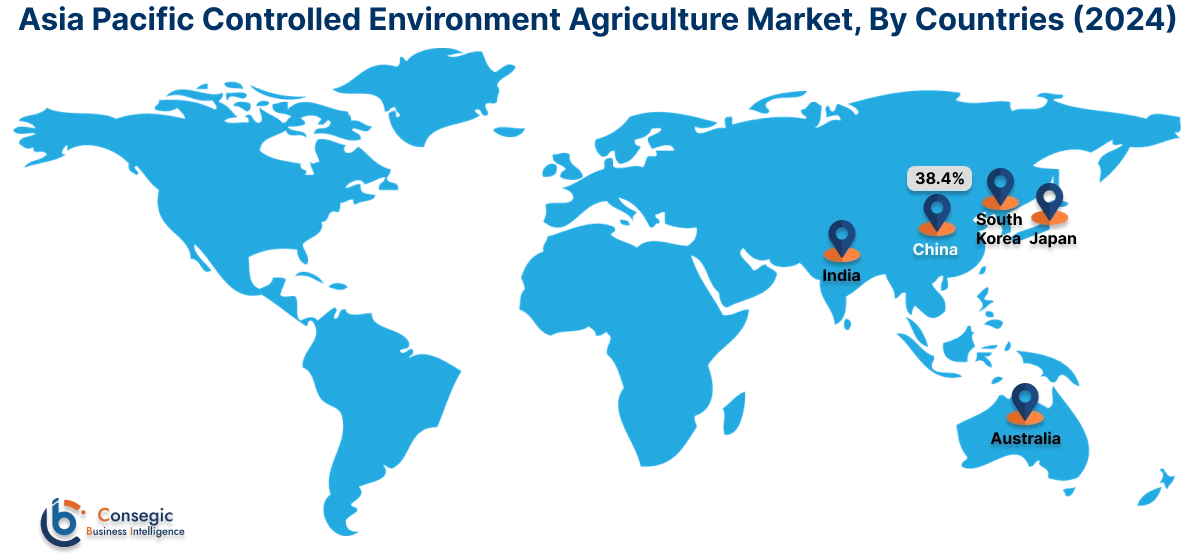
Asia Pacific region was valued at USD 33.12 Billion in 2024. Moreover, it is projected to grow by USD 35.98 Billion in 2025 and reach over USD 74.00 Billion by 2032. Out of this, China accounted for the maximum revenue share of 38.4%. Asia-Pacific is witnessing accelerated growth in the controlled environment agriculture industry, fueled by constrained arable land, high urbanization density, and changing diets. In South Korea, Singapore, and Japan, innovative vertical farming systems are being implemented in institutional and retail sectors, frequently aided by government funding for innovation. China is also greatly investing in intelligent greenhouses and rooftop farming systems in peri-urban areas to promote food security and minimize rural farmland dependence. Market research also indicates an increasing need for automation and data-based cultivation techniques that minimize labor needs. Regional expansion is being driven by increasing food safety consciousness and demand for modern, localized food production.
North America is estimated to reach over USD 78.76 Billion by 2032 from a value of USD 37.31 Billion in 2024 and is projected to grow by USD 40.34 Billion in 2025. North America is at the forefront of adopting sophisticated CEA systems, especially in the United States and Canada, with vertical farms, hydroponics, and container agriculture gaining traction. Market analysis indicates robust investor interest in urban farming startups specializing in leafy greens and herbs, driven by local food movement initiatives and retail supply chain alliances. Technological adoption of LED lighting, climate sensors, and AI-based monitoring is informing facility designs for both small-scale urban agriculture operations and large-scale commercial facilities. Expansion is fueled by need for pesticide-free crop production, water savings in cultivation, and resistance to supply chain interruption.
Europe is a regulatory-oriented market with increasing investment in sustainable and locally grown food. Nations like the Netherlands, Germany, and the United Kingdom are adopting high-tech greenhouse facilities and indoor vertical farms to respond to demand for year-round crop production. Market analysis suggests strong complementarity between controlled environment systems and the EU's Farm to Fork strategy, focusing on minimizing chemical use and food transport emissions. Moreover, circular economy practices in the region focus on incorporating renewable energy, closed-loop irrigation, and CO₂ capture in CEA infrastructure. The European controlled environment agriculture sector is growing via public-private collaborations and enhanced agri-tech innovation integration into climate-resilient food systems.
Latin America offers an up-and-coming but viable market, with adoption focused on regions such as Brazil, Mexico, and Chile. Market research indicates that greenhouse cultivation is growing as a response to unstable climate conditions and the necessity for stable, export-quality produce. CEA systems are becoming more common in floriculture, hydroponic vegetable production, and nursery propagation. Adoption is facilitated by efforts to minimize pesticide application and maximize water conservation in commercial horticulture. The controlled environment agriculture market opportunity in this region is correlated to upscaling traditional farming systems, scaling up sustainable agriculture practices, and enhancing market access through supply and consistent quality.
The Middle East and Africa are experiencing an increasing requirement for such systems as an answer to arid weather conditions, water shortage, and increased food import dependence. The UAE, Saudi Arabia, and Israel are spearheading regional initiatives, investing in indoor agriculture technologies, climate-resilient greenhouses, and desalination-based irrigation systems. In Africa, Kenya and South Africa are now starting to research modular hydroponic farms and aquaponics to feed urban populations and enhance food security. Market reports suggest that renewable energy integration and donor-funded agricultural innovation programs are being used to drive pilot-scale deployments. Although cost and technical expertise continue to be challenges, long-term growth prospects are positive because of expanding population pressure and agricultural transformation efforts.
Top Key Players and Market Share Insights:
The controlled environment agriculture market is highly competitive with major players providing products and services to the national and international markets. Key players are adopting several strategies in research and development (R&D), product innovation, and end-user launches to hold a strong position in the global controlled environment agriculture market. Key players in the controlled environment agriculture industry include -
- AeroFarms (USA)
- Gotham Greens (USA)
- Agricool (France)
- Kalera (USA)
- Eden Green Technology (USA)
- Plenty (USA)
- Lufa Farms (Canada)
- Infarm (Germany)
- Sky Greens (Singapore)
- Spread (Japan)
Recent Industry Developments :
Partnerships:
- In July 2024, Desert Control and Syngenta signed an MoU to explore collaborative efforts in sustainable agriculture. The collaboration evaluates the potential of combining organic and biological additives, including advanced biostimulants from Syngenta, with Desert Control’s Liquid Natural Clay (LNC).
Controlled Environment Agriculture Market Report Insights:
| Report Attributes | Report Details |
| Study Timeline | 2019-2032 |
| Market Size in 2032 | USD 243.02 Billion |
| CAGR (2025-2032) | 10.1% |
| By Technology Type |
|
| By Component |
|
| By Crop Type |
|
| By End-Use |
|
| By Region |
|
| Key Players |
|
| North America | U.S. Canada Mexico |
| Europe | U.K. Germany France Spain Italy Russia Benelux Rest of Europe |
| APAC | China South Korea Japan India Australia ASEAN Rest of Asia-Pacific |
| Middle East and Africa | GCC Turkey South Africa Rest of MEA |
| LATAM | Brazil Argentina Chile Rest of LATAM |
| Report Coverage |
|
Key Questions Answered in the Report
How big is the Controlled Environment Agriculture Market? −
Controlled Environment Agriculture Market size is estimated to reach over USD 243.02 Billion by 2032 from a value of USD 112.47 Billion in 2024 and is projected to grow by USD 121.84 Billion in 2025, growing at a CAGR of 10.1% from 2025 to 2032.
What specific segmentation details are covered in the Controlled Environment Agriculture Market report? +
The Controlled Environment Agriculture market report includes specific segmentation details for technology type, component, crop type and end-use.q
What are the end-use of the Controlled Environment Agriculture Market? +
The end-use of the Controlled Environment Agriculture Market are commercial growers, research & educational institutes, retail chains, and others.
Who are the major players in the Controlled Environment Agriculture Market? +
The key participants in the Controlled Environment Agriculture market are AeroFarms (USA), Gotham Greens (USA), Plenty (USA), Lufa Farms (Canada), Infarm (Germany), Sky Greens (Singapore), Spread (Japan), Agricool (France), Kalera (USA) and Eden Green Technology (USA).
Overview
Reputation & Certifications


Our Services
- Market Intelligence & Forecasting
- Custom Research Solutions
- Market Entry Strategy
- Competitive Intelligence
- Customer Insights
- Industry Innovation Analysis
- Investment Advisory