Jump to Content
Canola Meal Market - Size, Share, Industry Trends, and Forecasts (2025-2032)
Canola Meal Market Size:
Canola Meal Market size is estimated to reach over USD 14.79 Billion by 2032 from a value of USD 10.43 Billion in 2024 and is projected to grow by USD 10.71 Billion in 2025, growing at a CAGR of 4.5% from 2025 to 2032.
Canola Meal Market Scope & Overview:
Canola meal is a byproduct of canola oil extraction, widely used as a protein source in animal feed. It contains essential amino acids, fiber, and minerals, supporting livestock nutrition. This meal is characterized by high digestibility, low levels of anti-nutritional factors, and balanced protein composition.
Its benefits include improved animal growth, enhanced milk production in dairy cattle, and better feed efficiency. It serves as a cost-effective alternative to other protein sources. The meal is also used in aquaculture, poultry, swine, and cattle feed formulations.
Applications span livestock farming, aquaculture, and pet food production. The primary end users include animal feed manufacturers, commercial livestock producers, and pet food processors.

Canola Meal Market Dynamics - (DRO):
Key Drivers:
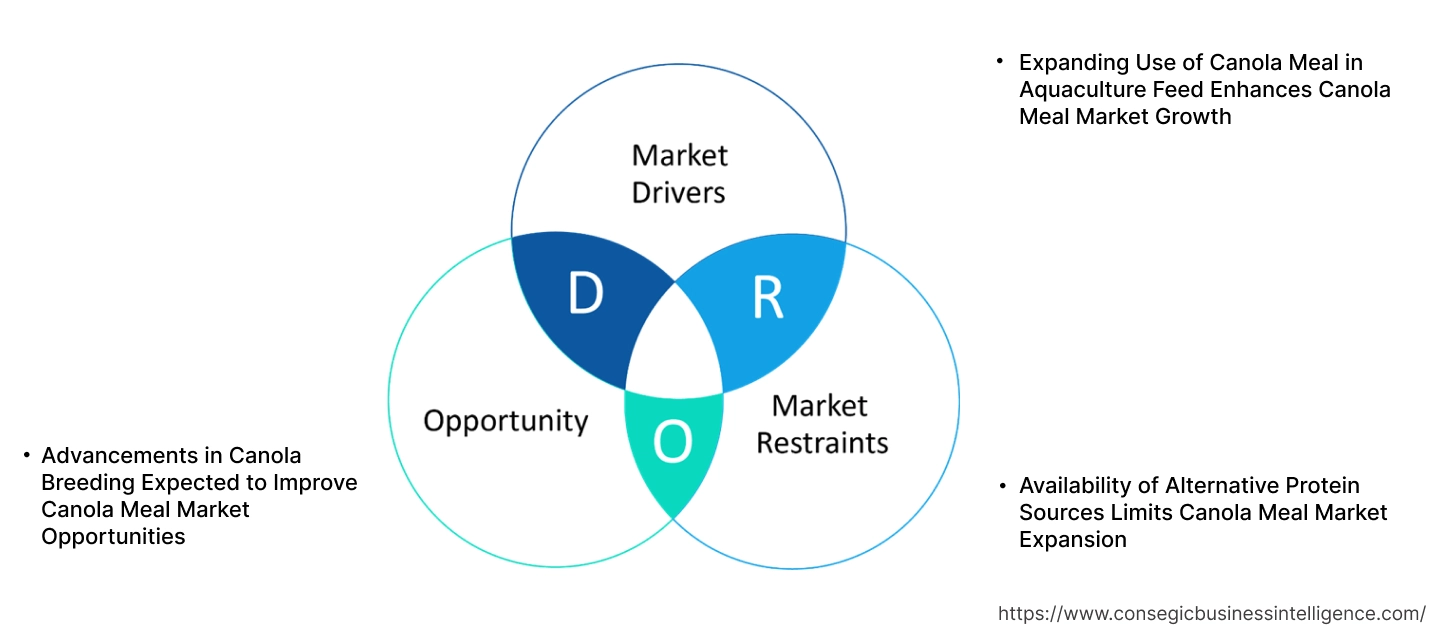
Expanding Use of Canola Meal in Aquaculture Feed Enhances Canola Meal Market Growth
The aquaculture industry is experiencing significant growth due to the rising trend for seafood and the depletion of wild fish stocks. This has increased the need for high-quality, sustainable protein sources in aquafeed formulations. Canola meal serves as a cost-effective alternative to fishmeal and soybean meal, providing essential amino acids, fiber, and moderate energy levels for various fish species. It contains relatively low levels of anti-nutritional factors, making it more digestible and suitable for aquaculture diets.
Several studies have demonstrated that replacing a portion of fishmeal with canola meal in diets for species such as tilapia and salmon does not compromise growth performance. Additionally, the opportunities of sustainable fish farming practices encourages the adoption of plant-based protein sources, further increasing the trend for canola meal in aquafeed.
Therefore, the growing emphasis on sustainable and nutritionally balanced aquafeed formulations is significantly influencing the adoption of canola meal, contributing to canola meal market expansion.
Key Restraints:
Availability of Alternative Protein Sources Limits Canola Meal Market Expansion
The presence of well-established alternative protein sources such as soybean meal, cottonseed meal, and pea protein presents a significant challenge to the canola meal market. Among these, soybean meal remains the dominant protein source in animal feed due to its higher protein content, better amino acid profile, and greater palatability. Many feed manufacturers prefer soybean meal as it offers higher digestibility and has a long history of use in livestock and aquaculture nutrition.
Additionally, the higher availability of soybean meal at competitive prices makes it a preferred choice for large-scale feed producers. Pea protein is also gaining traction due to its high protein concentration and non-allergenic properties, making it a viable alternative in specialized feed applications. The preference for these alternatives limits the widespread adoption of canola meal, particularly in regions where soybean and other plant-based proteins are abundantly produced.
Thus, the strong competition from alternative protein sources is a key restraining factor, restricting the canola meal market growth potential.
Future Opportunities:
Advancements in Canola Breeding Expected to Improve Canola Meal Market Opportunities
Research in plant genetics and breeding is paving the way for the development of enhanced canola meal with higher protein content and reduced anti-nutritional compounds. Traditional canola meal contains glucosinolates, which can negatively impact feed palatability and animal performance at high inclusion rates. However, ongoing breeding efforts are focused on producing low-glucosinolate and high-protein canola varieties, improving its digestibility and nutritional value.
These advancements are expected to make canola meal more competitive against alternative protein sources such as soybean meal. Improved varieties will enhance its application in poultry, swine, and aquaculture nutrition, ensuring better feed efficiency and animal health. Moreover, genetic modifications aimed at increasing oil content in canola seeds could lead to by-products with a higher protein concentration, further boosting the value of canola meal in animal feed formulations.
Therefore, as these innovations continue to improve the nutritional profile of canola meal, the market is expected to witness increased adoption in various feed applications, strengthening its
Canola Meal Market Segmental Analysis :
By Grade:
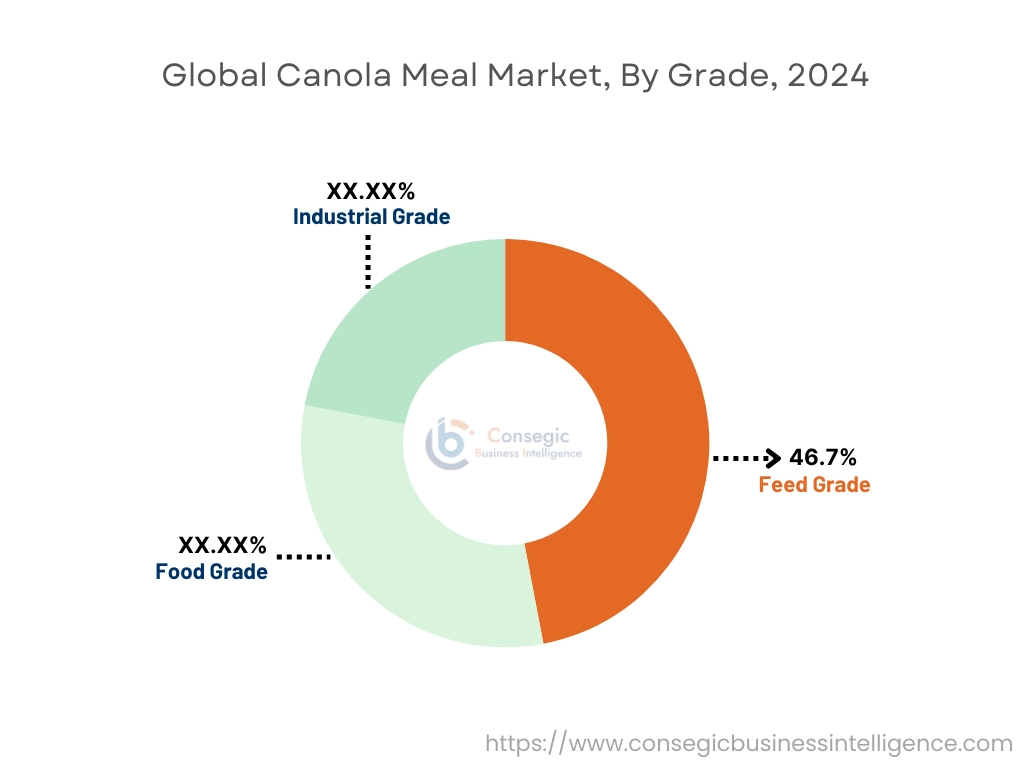
Based on grade, the canola meal market is segmented into food grade, feed grade, and industrial grade.
The feed grade segment accounted for the largest revenue in canola meal market share of 46.7% in 2024.
- Feed-grade canola meal is widely used in animal nutrition due to its high protein content and essential amino acids.
- It serves as an effective substitute for soybean meal in livestock diets, particularly for poultry, swine, and ruminants.
- The increasing trend for cost-effective animal feed solutions and the opportunities in the livestock industry have contributed to the segment's high revenue share.
- The adoption of feed-grade canola meal in aquaculture and dairy farming has further bolstered its demand.
- According to canola meal market analysis, these factors contribute to the substantial revenue share of the feed-grade segment in the canola meal market.
The industrial grade segment is anticipated to register the fastest CAGR during the forecast period.
- Industrial-grade canola meal is used in biodegradable plastics, bio-based adhesives, and other non-food applications.
- The shift towards sustainable materials and bio-based industrial solutions has increased its adoption in various manufacturing sectors.
- The rise in eco-friendly initiatives and stringent regulations on petroleum-based products have further driven the canola meal market trend for industrial-grade canola meal.
- The increased research and development activities to enhance the utilization of canola meal in industrial applications are supporting canola meal market trend.
- According to the market analysis, these factors contribute to the fast growth of the industrial-grade segment in the canola meal market.
By Application:
Based on application, the canola meal market is segmented into animal feed (poultry, swine, ruminants, aquatic animals), fertilizers, food additives, and industrial chemicals.
The animal feed segment accounted for the largest revenue in canola meal market share in 2024.
- Canola meal is extensively used in animal feed due to its high digestibility and balanced amino acid profile.
- Poultry feed is the dominant subsegment due to the large-scale poultry farming industry and the cost-effectiveness of canola meal compared to other protein sources.
- The demand for high-protein livestock feed has increased with the rise in global meat consumption.
- The inclusion of canola meal in swine and ruminant feed formulations has further boosted its adoption.
- According to canola meal market analysis, these factors contribute to the high revenue share of the animal feed segment in the canola meal market.
The industrial chemicals segment is anticipated to register the fastest CAGR during the forecast period.
- Canola meal is increasingly used in bio-based chemicals, such as adhesives, lubricants, and biodegradable plastics.
- The demand for renewable and sustainable raw materials in the chemical industry is driving canola meal market trend.
- The focus on reducing reliance on fossil-based materials and adopting environmentally friendly alternatives has led to increased canola meal utilization in industrial chemical production.
- Advances in biotechnology and enzymatic processing have enabled more efficient extraction of functional compounds from canola meal.
- According to the market analysis, these factors contribute to the fast growth of the industrial chemicals segment in the canola meal market.
Regional Analysis:
The regional segment includes North America, Europe, Asia Pacific, Middle East and Africa, and Latin America.
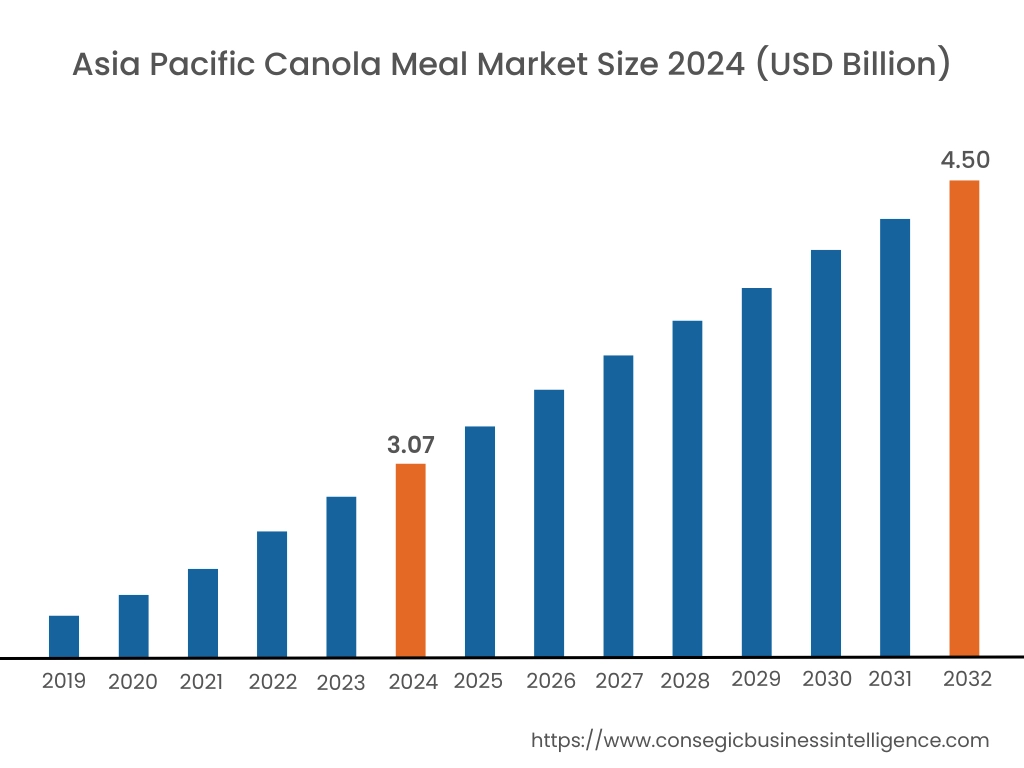
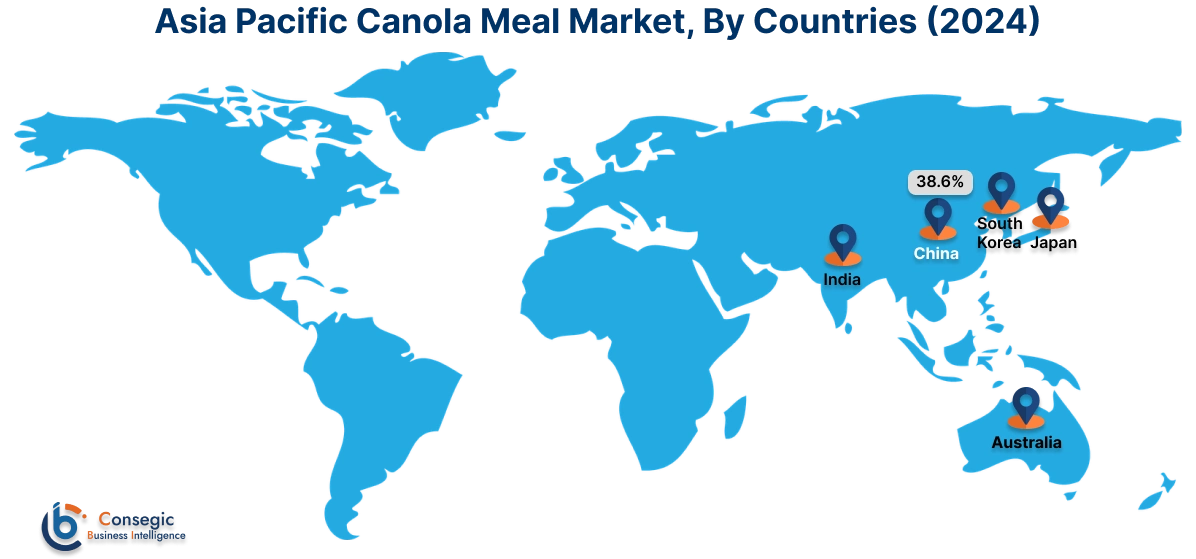
In 2024, Asia Pacific was valued at USD 3.07 Billion and is expected to reach USD 4.50 Billion in 2032. In Asia Pacific, China accounted for the highest share of 38.6% during the base year of 2024. Asia-Pacific experiences increasing demand for canola meal due to its widespread use in animal feed, particularly in China, India, Japan, and South Korea. China is a major importer of canola meal, primarily sourcing from Canada and Australia, driven by its growing livestock and aquaculture industries. India’s dairy sector relies on protein-rich feed alternatives, with canola meal being integrated into cattle feed formulations. Japan and South Korea prefer high-quality, non-GMO canola meal, impacting import patterns.
Import regulations on genetically modified products affect market accessibility, with some countries enforcing stringent testing and approval processes. The expansion of the aquaculture industry, particularly in Southeast Asia, increases the demand for plant-based protein sources, positioning canola meal as a competitive alternative to soy-based feed. Government initiatives supporting animal husbandry and food security contribute to market expansion. Economic factors, including fluctuating raw material prices and trade relations with North American suppliers, influence canola meal import volumes and pricing trends.
In 2024, North America was valued at USD 3.46 Billion and is expected to reach USD 4.79 Billion in 2032. North America holds a significant share in the canola meal market due to large-scale production in Canada and the United States. Canada is one of the largest global producers and exporters of canola, with strong processing capabilities that support the supply of canola meal for both domestic and international markets. The well-established livestock and poultry industries drive canola meal market trend for protein-rich feed alternatives. Regulatory policies on genetically modified crops influence production and trade, with the United States having a more flexible stance compared to Canada’s strict guidelines on non-GMO and organic products.
Trade agreements and export policies play a crucial role in market performance, especially concerning key importers in Asia and Europe. The rising focus on sustainable agriculture affects canola meal adoption in organic farming and animal nutrition. Research and development efforts aim to enhance canola meal’s nutritional benefits, particularly in swine and dairy feed formulations. The expansion of biofuel production impacts canola seed availability, indirectly influencing canola meal supply and pricing.
Europe’s market is influenced by strict regulations on genetically modified crops, which impact canola meal imports and domestic production. The region has a well-established dairy and livestock industry, which supports demand for high-protein feed alternatives. The European Union promotes sustainable agricultural practices, encouraging the use of plant-based protein sources in livestock feed. Canola meal serves as a viable alternative to soybean meal, especially in regions with limited soybean production.
The shift toward plant-based protein sources in animal nutrition influences market adoption, particularly in organic and specialty feed segments. Sustainable agriculture policies impact canola meal production and trade, with several European countries prioritizing non-GMO feed ingredients. Research on improving feed efficiency and enhancing the nutritional value of canola meal contributes to market advancements. The adoption of organic and non-GMO feed products continues to rise, influencing procurement strategies of major feed manufacturers.
The Middle East and Africa market is shaped by the growing ask for animal feed in poultry, dairy, and livestock farming. The reliance on imports from North America and Europe affects market pricing, availability, and supply chain stability. Government initiatives aimed at enhancing food security and promoting local livestock industries influence the requirement for protein-rich feed ingredients, including canola meal.
In the Middle East, poultry production is a key industry, with countries like Saudi Arabia and the United Arab Emirates investing in modern feed solutions. Canola meal is increasingly used as an alternative to soybean meal due to its cost-effectiveness and high protein content. In Africa, the livestock industry is expanding, with nations such as South Africa and Egypt incorporating canola meal into animal feed formulations. However, limited domestic canola production affects supply chain dynamics, making the region dependent on imports. Rising interest in improving animal nutrition and enhancing feed efficiency supports canola meal adoption.
Latin America’s canola meal market is driven by the expansion of livestock, poultry, and aquaculture industries. Countries like Brazil, Argentina, and Chile play key roles in canola meal imports and distribution. Brazil and Argentina have strong agricultural sectors that contribute to need for protein-rich animal feed, with canola meal being incorporated into livestock and poultry feed formulations.
Trade agreements with North American and European exporters impact market accessibility, influencing supply chain efficiency. Government policies supporting animal agriculture and sustainable farming practices contribute to canola meal adoption. Economic factors, including currency fluctuations and raw material costs, affect the affordability of high-protein feed alternatives. The growing aquaculture industry, particularly in Chile and Ecuador, drives ask for plant-based protein sources, increasing the use of canola meal in fish feed formulations. The focus on improving livestock productivity and reducing dependency on soybean meal enhances the market potential for canola meal in the region.
Top Key Players & Market Share Insights:
The global canola meal market is highly competitive with major players providing products and services to the national and international markets. Key players are adopting several strategies in research and development (r&d), product innovation, and end-user launches to hold a strong position in the global canola meal market. Key players in the canola meal industry include-
- Archer Daniels Midland Company (United States)
- Bunge Limited (United States)
- CHS Inc. (United States)
- Wilmar International Limited (Singapore)
- Olam International (Singapore)
- Cargill, Incorporated (United States)
- Louis Dreyfus Company (Netherlands)
- Richardson International Limited (Canada)
- Viterra Inc. (Canada)
- Ag Processing Inc. (United States)
Canola Meal Market Report Insights:
| Report Attributes | Report Details |
| Study Timeline | 2019-2032 |
| Market Size in 2032 | USD 14.79 Billion |
| CAGR (2025-2032) | 4.5% |
| By Grade |
|
| By Application |
|
| By Region |
|
| Key Players |
|
| North America | U.S. Canada Mexico |
| Europe | U.K. Germany France Spain Italy Russia Benelux Rest of Europe |
| APAC | China South Korea Japan India Australia ASEAN Rest of Asia-Pacific |
| Middle East and Africa | GCC Turkey South Africa Rest of MEA |
| LATAM | Brazil Argentina Chile Rest of LATAM |
| Report Coverage |
|
Key Questions Answered in the Report
How big is the Canola Meal Market? −
In 2024, the Canola Meal Market was USD 10.43 Billion.
What will be the potential market valuation for the Canola Meal Market by 2032? +
In 2032, the market size of Canola Meal Market is expected to reach USD 14.79 Billion.
What are the segments covered in the Canola Meal Market report? +
The grade and application are the segments covered in this report.
Who are the major players in the Canola Meal Market? +
Archer Daniels Midland Company (United States), Bunge Limited (United States), Cargill, Incorporated (United States), Louis Dreyfus Company (Netherlands), Richardson International Limited (Canada), Viterra Inc. (Canada), Ag Processing Inc. (United States), CHS Inc. (United States), Wilmar International Limited (Singapore), Olam International (Singapore) are the major players in the Canola Meal market.
Overview
Reputation & Certifications


Our Services
- Market Intelligence & Forecasting
- Custom Research Solutions
- Market Entry Strategy
- Competitive Intelligence
- Customer Insights
- Industry Innovation Analysis
- Investment Advisory