Jump to Content
Agriculture Robots Market Size & Industry Share - Growth Trends & Forecasts (2026 - 2034)
Agriculture Robots Market Size:
The Agriculture Robots Market is expected to expand from 21.63 (US$B) in 2025 to 26.37 (US$B) in 2026, and is forecast to surpass 128.57 (US$B) by 2034, growing at a CAGR of 21.9% between 2026 and 2034, according to a recent report from Consegic Business Intelligence.
Agriculture Robots Market Scope & Overview:
Agriculture robots are advanced automated systems designed to perform various farming tasks with precision and efficiency. These robots are equipped with sensors, cameras, and software that enable them to execute activities such as planting, harvesting, weeding, pruning, and monitoring crop health. By combining robotics with advanced technologies, they help streamline agricultural operations and ensure consistent productivity.
These robots come in different configurations, including autonomous tractors, unmanned aerial vehicles (UAVs) for crop monitoring, and robotic arms for harvesting. They are designed to operate in challenging environments, offering durability, accuracy, and adaptability for diverse agricultural applications. Modern agriculture robots are capable of analyzing data, adjusting operations in real-time, and integrating with farm management systems to optimize performance.
End-users of these systems include farmers, agricultural enterprises, and research institutions that require innovative tools to improve farming practices and ensure sustainable operations. Agriculture robots have become a critical element in transforming traditional farming into a more automated and efficient industry.
How is AI Impacting the Agriculture Robots Market?
AI is fundamentally reshaping the agriculture robots market by transforming robots from simple automated machines into highly intelligent and adaptable farm assistants. AI empowers these robots with capabilities like real-time environmental perception through computer vision, enabling them to differentiate between crops and weeds, identify ripe produce for harvesting, and detect early signs of disease or pests. This intelligence allows for precision tasks, from targeted weeding and spraying, which significantly reduces chemical use, to optimized planting and harvesting, minimizing waste and maximizing yields. As AI advances, agricultural robots are becoming more autonomous, collaborative, and capable of making complex decisions in dynamic farm environments, thereby addressing labor shortages and driving more efficient and sustainable farming practices.

Agriculture Robots MarketDynamics - (DRO) :
Key Drivers:
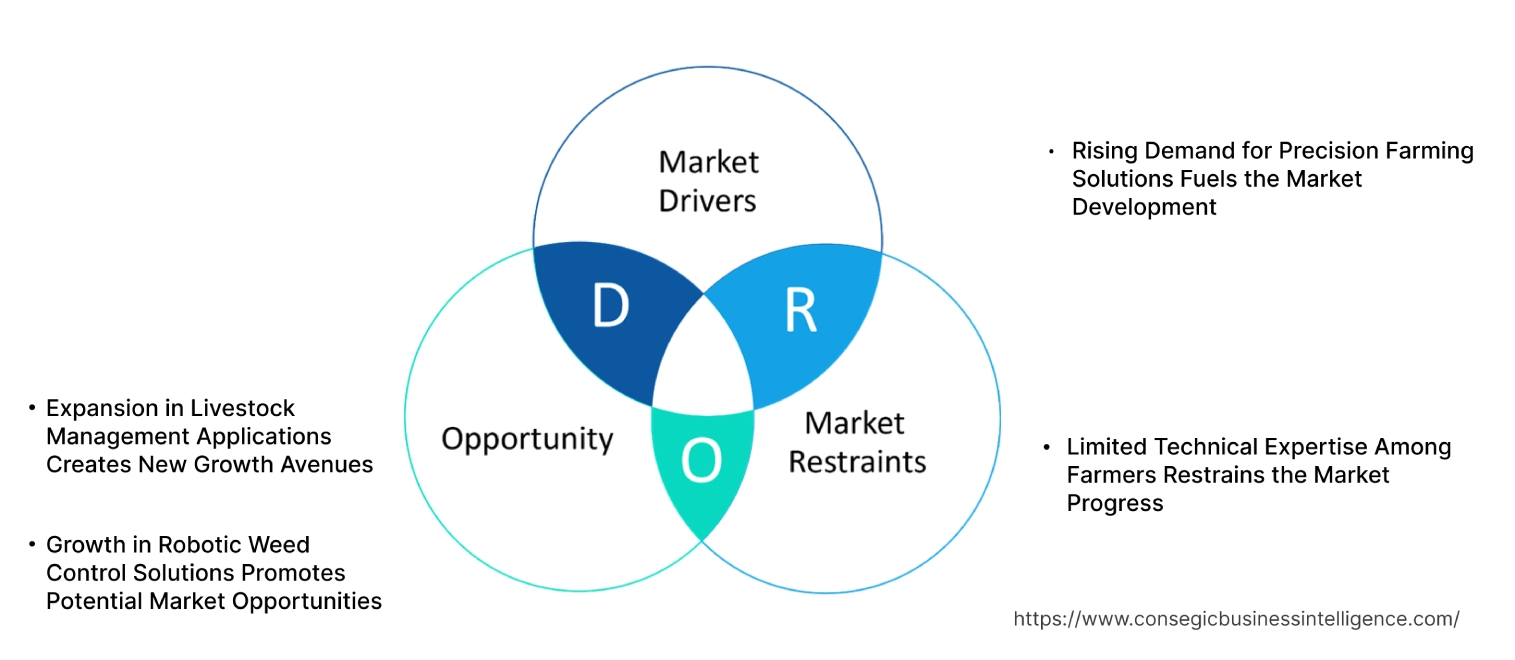
Rising Demand for Precision Farming Solutions Fuels the Market Development
The increasing focus on optimizing agricultural productivity and resource efficiency is fueling the adoption of robotics in precision farming. Advanced technologies, such as autonomous tractors, robotic sprayers, and automated harvesters, are empowering farmers to manage fields with unmatched accuracy and efficiency. These systems are equipped with advanced sensors, GPS, and AI algorithms that enable real-time monitoring of soil health, crop conditions, and environmental factors. By detecting crop stress and applying inputs such as water, fertilizers, or pesticides with precision, these robots minimize waste, reduce costs, and enhance yields.
Precision farming solutions are also aligned with sustainable agricultural practices, as they help conserve resources while maintaining high productivity. The agriculture robots market trends in smart farming and digital agriculture continue to grow, robotics is becoming a cornerstone of modern farming systems, meeting the rising demand for innovative, efficient, and eco-friendly agricultural technologies.
Key Restraints :
Limited Technical Expertise Among Farmers Restrains the Market Progress
The adoption of agricultural robotics is hindered by the lack of technical expertise among farmers, particularly in developing regions where access to advanced technologies is limited. Many farmers are unfamiliar with the operation, maintenance, and troubleshooting of robotic systems, making it difficult to integrate these solutions into their traditional workflows. This skill gap often results in underutilization of robotic technologies, reducing their potential benefits in improving productivity and efficiency.
Moreover, the complexity of setting up and customizing robotics for specific agricultural tasks, such as planting, weeding, or harvesting, exacerbates the issue. Addressing these issues typically requires additional investments in training programs and technical support, which strains already limited resources for small and medium-sized farms. As a result, the lack of technical expertise slows down the agriculture robots market demand, especially in regions where agricultural modernization is most needed to enhance productivity and sustainability.
Future Opportunities :
Expansion in Livestock Management Applications Creates New Growth Avenues
The adoption of robotics in livestock management is transforming the industry by enhancing efficiency, productivity, and animal welfare. Robotic solutions, including automated milking systems, feeding machines, and health monitoring devices, are streamlining daily operations on farms. These systems enable precise feeding schedules, real-time health tracking, and optimized milking processes, reducing manual labor requirements and ensuring better care for animals.
Robotic health monitoring systems detect early signs of illness or stress, enabling timely interventions and improving overall herd health. As global demand for dairy and meat products continues to rise, automation offers a scalable solution to meet production needs while maintaining high standards of quality and sustainability. Furthermore, these technologies are aligned with trends in precision farming, helping farmers reduce costs and enhance operational efficiency. The growing focus on sustainable and efficient livestock practices is driving significant agriculture robots market opportunities in robotic livestock management applications.
Growth in Robotic Weed Control Solutions Promotes Potential Market Opportunities
The adoption of robotic weed control systems is gaining momentum as farmers seek sustainable and efficient alternatives to traditional weeding methods. Equipped with computer vision, AI, and advanced sensors, these robots accurately identify and target weeds, reducing reliance on chemical herbicides. This precision not only minimizes environmental impact but also promotes healthier crop growth by limiting chemical exposure.
Robotic weeders are particularly effective in addressing challenges like herbicide resistance, which has become a significant concern in modern agriculture. By offering a mechanical solution, these systems eliminate the need for excessive manual labor, making them ideal for large-scale farming operations. The rising emphasis on sustainable farming practices, coupled with the growing demand for chemical-free produce, is driving the adoption of weed-controlling robotics. As advancements in AI and machine learning continue to enhance their efficiency, these robots are creating a niche market within precision farming technologies driving agriculture robots market expansion.
Agriculture Robots Market Segmental Analysis :
By Type:
Based on type, the market is segmented into Driverless Tractors, Milking Robots, UAVs/Drones, Harvesting Robots, Planting Robots, and Others.
The driverless tractors segment accounted for the largest revenue of the total agriculture robots market share in 2023.
- Driverless tractors are equipped with advanced GPS, sensors, and machine learning technologies, ensuring precise farming operations like tilling, planting, and harvesting.
- These tractors enhance productivity by reducing labor requirements and enabling round-the-clock operations, making them ideal for large-scale farming.
- Integration with farm management systems supports real-time monitoring, ensuring efficient resource utilization.
- As per agriculture robots market analysis, the dominance of this segment reflects the increasing adoption of automation in traditional farming practices.
The UAVs/Drones segment is expected to grow at the fastest CAGR during the forecast period.
- UAVs provide aerial insights for crop monitoring, pest detection, and field mapping, enhancing precision agriculture practices.
- Multi-spectral imaging and AI-based analytics in drones are transforming the way farmers manage crops, improving yield and efficiency.
- Drones are increasingly adopted in both small-scale and large-scale farming due to their cost-effectiveness and ability to cover extensive areas rapidly.
- This segment's rapid enlargement is supported by its versatility in addressing key farming challenges through advanced analytics tools further driving the agriculture robots market demand.
By Application:
Based on application, the market is segmented into Crop Monitoring, Livestock Management, Harvest Management, Soil Management, Irrigation Management, and Others.
The crop monitoring segment held the largest revenue of the total agriculture robots market share in 2023.
- Agricultural robots equipped with sensors and imaging tools enable real-time assessment of crop health, pest infestations, and nutrient deficiencies.
- These systems support precision farming by offering actionable insights, allowing farmers to optimize resource usage and enhance productivity.
- Integration with analytics tools ensures effective decision-making, helping farmers address challenges promptly.
- As per agriculture robots market trends, the segment's prominence highlights its critical role in ensuring sustainable agricultural practices.
The livestock management segment is expected to grow at the fastest CAGR during the forecast period.
- Livestock management robots assist in automating feeding, milking, and monitoring tasks, reducing labor dependency and ensuring better animal welfare.
- Technologies like RFID tagging and AI-powered analytics improve herd management efficiency, enhancing overall productivity.
- Rising awareness about sustainable livestock practices and operational efficiency drives the adoption of robots in this application.
- The rapid extension of the segment is supported by the growing need for automation in large-scale livestock operations, contributing to the agriculture robots market expansion.
By Offering:
Based on offering, the market is segmented into Hardware (Sensors, Cameras, Actuators, GPS, Control Systems), Software (Data Analytics, Machine Learning, IoT Integration), and Services (Consulting, Integration, Maintenance).
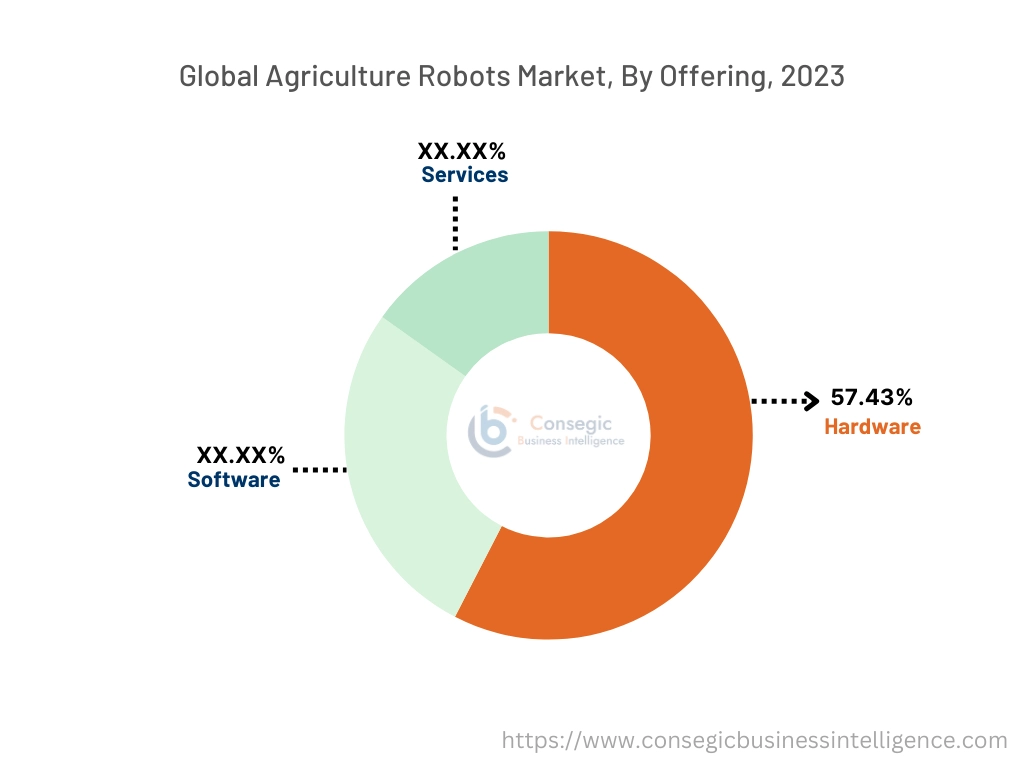
The hardware segment accounted for the largest revenue of 57.43% share in 2023.
- Essential components like sensors and cameras enable agricultural robots to perform real-time monitoring and precise operations.
- Advanced GPS and actuators ensure accurate navigation and functionality, especially in driverless tractors and drones.
- Technological advancements in hardware, including high-resolution imaging and enhanced control systems, support the adoption of robotics in agriculture.
- Therefore, the dominance of hardware reflects its critical role in enabling efficient and reliable robotic operations across farming activities, which facilitates the agriculture robots market growth.
The software segment is expected to grow at the fastest CAGR during the forecast period.
- Software solutions such as data analytics and IoT integration enable predictive modeling and resource optimization, streamlining farming operations.
- Machine learning algorithms enhance decision-making capabilities, enabling robots to adapt to varying agricultural conditions effectively.
- The increasing adoption of farm management software to monitor and optimize processes is driving the rapid proliferation of this segment.
- As per agriculture robots market analysis, the segment's growth reflects the rising reliance on digital solutions for improving agricultural efficiency and productivity.
By Farming Environment:
Based on farming environment, the market is segmented into Indoor Farming and Outdoor Farming.
The outdoor farming segment accounted for the largest revenue share in 2023.
- Outdoor farming relies on robots for large-scale operations like field monitoring, soil preparation, and irrigation management.
- Autonomous tractors and UAVs dominate this segment, ensuring high efficiency in resource utilization across expansive agricultural fields.
- The adoption of outdoor farming solutions is driven by the need to reduce labor dependency and enhance productivity in open-field environments.
- Thus, the segment's dominance underscores the reliance on automation for meeting the growing challenges in traditional agriculture, fueling the agriculture robots market growth.
The indoor farming segment is expected to grow at the fastest CAGR during the forecast period.
- Robots in indoor farming are extensively used in vertical farming and greenhouse operations, where controlled environments demand precision and efficiency.
- These systems assist in tasks such as seeding, harvesting, and monitoring, reducing human intervention and operational inefficiencies.
- Rising investments in urban agriculture and sustainable farming technologies are driving the adoption of robotics in indoor farming setups.
- The rapid growth of this segment reflects the increasing focus on maximizing output in limited spaces, creating significant agriculture robots market opportunities.
Regional Analysis:
The regions covered are North America, Europe, Asia Pacific, the Middle East and Africa, and Latin America.
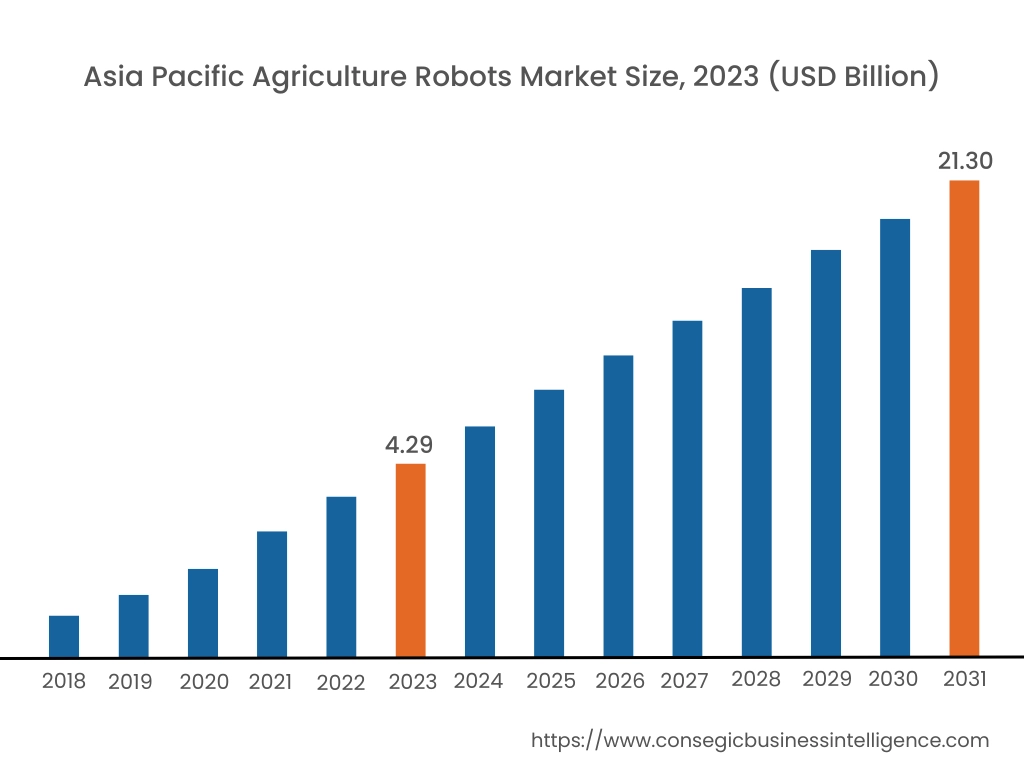
Asia Pacific region was valued at USD 4.29 Billion in 2023. Moreover, it is projected to grow by USD 5.16 Billion in 2024 and reach over USD 21.30 Billion by 2031. Out of which, China accounted for the largest share of 31.6% in 2023. The Asia-Pacific region is experiencing a surge in agricultural robot deployment, particularly in countries like China and Japan. Rapid industrialization and urbanization have led to a decline in agricultural labor, prompting the adoption of automation. The analysis shows a trend towards integrating artificial intelligence (AI) with robotics to perform complex tasks such as fruit picking and pest control.

North America is estimated to reach over USD 23.35 Billion by 2031 from a value of USD 4.85 Billion in 2023 and is projected to grow by USD 5.82 Billion in 2024. This region leads in the adoption of agricultural robots, driven by a shortage of skilled labor and a push towards automation. The United States, in particular, has seen significant integration of unmanned aerial vehicles (UAVs) and automated tractors to enhance productivity. The trend towards precision agriculture is prominent, with farmers utilizing robots for tasks such as planting, harvesting, and monitoring crop health.
European countries like France and Germany are increasingly incorporating robots into agricultural practices to address labor shortages and improve efficiency. For instance, French vineyards have turned to robots for tasks like soil tilling and weeding, especially amid difficulties in finding manual labor. The analysis of market trends indicates a growing shift towards sustainable farming practices, with robots playing a crucial role in reducing chemical usage and enhancing precision.
In Latin America, countries like Brazil and Mexico are exploring the use of agricultural robots to boost productivity and address labor challenges. The trend towards mechanization is evident in large-scale farms, where robots are employed for planting and harvesting.
The Middle East and Africa are gradually embracing agricultural robots, particularly in regions facing labor shortages and harsh climatic conditions. The analysis suggests a trend towards using robots for irrigation management and soil monitoring to optimize resource utilization.
Top Key Players & Market Share Insights:
The Agriculture Robots market is highly competitive with major players providing products and services to the national and international markets. Key players are adopting several strategies in research and development (R&D), product innovation, and end-user launches to hold a strong position in the global Agriculture Robots market. Key players in the Agriculture Robots industry include –
- Deere & Company (USA)
- AGCO Corporation (USA)
- Agribotix LLC (USA)
- Agrobot (Spain)
- Blue River Technology (USA)
- Lely Industries (Netherlands)
- Naïo Technologies (France)
- PrecisionHawk (USA)
- Ecorobotix (Switzerland)
- Octinion (Belgium)
Recent Industry Developments :
Partnerships & Collaborations:
- In April 2024, The NSF and USDA partnered to boost innovation in agricultural technology and food systems through the new Agrifood Systems Innovation (AFSI) program. This collaboration aims to address challenges in food security, sustainability, and climate change. AFSI will fund interdisciplinary research integrating advanced technologies like AI, robotics, and biotechnology to transform agricultural practices. By fostering innovation, the program seeks to enhance productivity, environmental resilience, and global competitiveness in the agricultural sector.
Investments & Funding:
- In December 2023, Chipotle invested in Greenfield Robotics and Nitricity via its $50M Cultivate Next fund. Greenfield Robotics uses autonomous robots to support regenerative farming, minimizing herbicide use and soil damage. Nitricity develops eco-friendly fertilizers aimed at reducing greenhouse gas emissions. These investments align with Chipotle’s mission to advance sustainable agricultural practices and foster environmental stewardship.
Product Launches:
- In October 2024, Verdant Robotics launched the Sharpshooter, a precision robotic application system using proprietary Bullseye Aim & Apply Technology. Capable of cutting chemical inputs by 96% and reducing weeding costs by 65%, it targets weeds and crops with millimeter precision at 120-480 shots per second. Covering up to 5 acres per hour, it offers savings, efficiency, and control for growers, while providing agronomic insights.
Agriculture Robots Market Report Insights :
| Report Attributes | Report Details |
| Study Timeline | 2021-2034 |
| Market Size in 2034 | USD 128.57 Billion |
| CAGR (2026-2034) | 21.90% |
| Base Year | 2025 |
| By Type |
|
| By Application |
|
| By Offering |
|
| By Farming Environment |
|
| By Region |
|
| Key Players |
|
| North America | U.S. Canada Mexico |
| Europe | U.K. Germany France Spain Italy Russia Benelux Rest of Europe |
| APAC | China South Korea Japan India Australia ASEAN Rest of Asia-Pacific |
| Middle East and Africa | GCC Turkey South Africa Rest of MEA |
| LATAM | Brazil Argentina Chile Rest of LATAM |
| Report Coverage |
|
Key Questions Answered in the Report
How big is the Agriculture Robots Market? −
Agriculture Robots Market size is estimated to reach over USD 70.98 Billion by 2031 from a value of USD 14.58 Billion in 2023 and is projected to grow by USD 17.51 Billion in 2024, growing at a CAGR of 21.9% from 2024 to 2031.
What are the key segments in the Agriculture Robots Market report? +
The Agriculture Robots Market report includes segmentation by type (Driverless Tractors, Milking Robots, UAVs/Drones, Harvesting Robots, Planting Robots, Others), application (Crop Monitoring, Livestock Management, Harvest Management, Soil Management, Irrigation Management, Others), offering (Hardware, Software, Services), and farming environment (Indoor Farming, Outdoor Farming). The market is also analyzed by region (Asia-Pacific, Europe, North America, Latin America, Middle East & Africa).
Which segment is expected to grow the fastest in the Agriculture Robots Market? +
The UAVs/Drones segment is expected to register the fastest CAGR during the forecast period. Drones provide aerial insights for crop monitoring, pest detection, and field mapping, enhancing precision agriculture practices and addressing key farming challenges.
Who are the major players in the Agriculture Robots Market? +
The key players in the Agriculture Robots Market include Deere & Company (USA), AGCO Corporation (USA), Agribotix LLC (USA), Agrobot (Spain), Blue River Technology (USA), Lely Industries (Netherlands), Naïo Technologies (France), PrecisionHawk (USA), Ecorobotix (Switzerland), and Octinion (Belgium).
Overview
Reputation & Certifications


Our Services
- Market Intelligence & Forecasting
- Custom Research Solutions
- Market Entry Strategy
- Competitive Intelligence
- Customer Insights
- Industry Innovation Analysis
- Investment Advisory