Jump to Content
Data Center Colocation Market Size & Industry Share - Growth Trends & Forecasts (2026 - 2034)
Data Center Colocation Market Size:
The Data Center Colocation market size was valued at 85.91 (US$B) in 2025 and is projected to grow from 97.68 (US$B) in 2026 to 272.83 (US$B) by 2034, at a CAGR of 13.7% from 2026 to 2034, according to a recent report from Consegic Business Intelligence.
Data Center Colocation Market Scope & Overview:
Data center colocation refers to the practice where businesses lease space within a shared data center to host their servers and other IT equipment. Instead of owning and maintaining their own physical infrastructure, colocation allows companies to rent space, including rack space, cabinet space, or even an entire room, within a data center facility. This shared infrastructure provides power, cooling, bandwidth, and physical security.
How is AI Impacting the Data Center Colocation Market?
AI is significantly impacting the data center colocation market by driving demand for greater capacity, increased power density, and more efficient operations. Colocation providers are adapting by offering AI-ready infrastructure, including specialized hardware such as GPUs and optimized cooling systems. Also, AI workloads require significant processing power and memory, leading to higher power and rack densities within data centers.
Data Center Colocation Market Insights:

Data Center Colocation Market Dynamics - (DRO) :
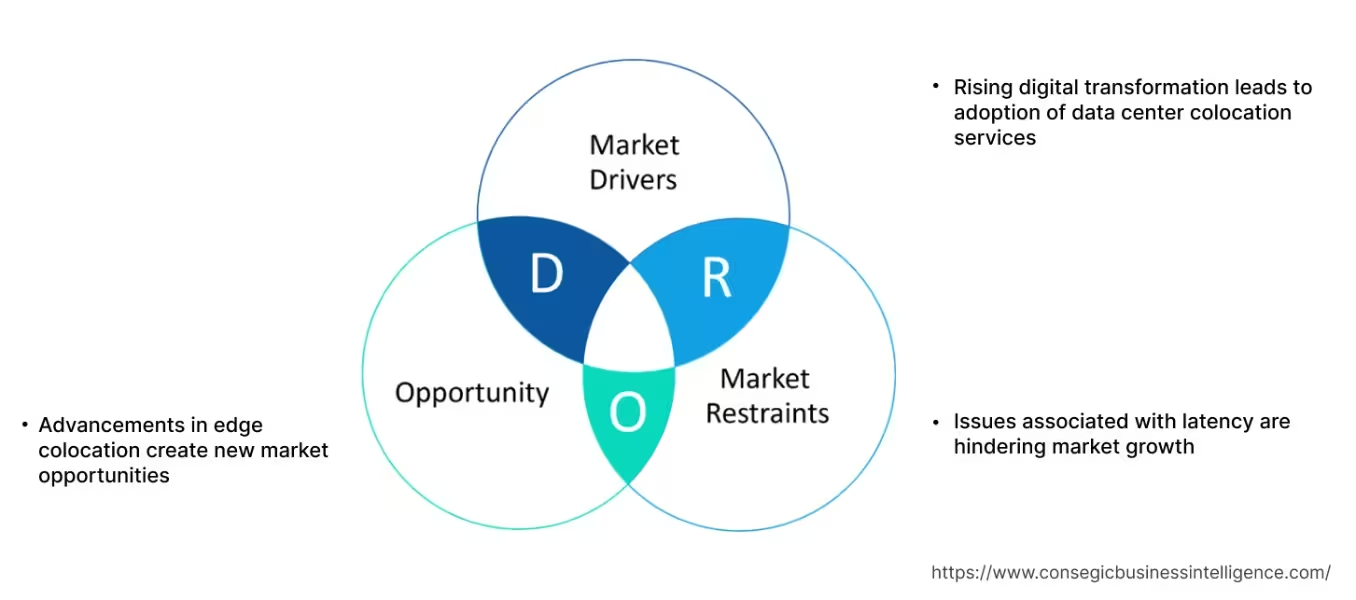
Key Drivers:
Rising digital transformation leads to adoption of data center colocation services
Data center colocation plays a crucial role in enabling digital transformation by providing businesses with access to flexible, scalable, and reliable infrastructure. It allows companies to outsource their IT infrastructure needs, including power, cooling, and physical space, while maintaining control over their data and applications. This flexibility and scalability are essential for meeting the demands of digital transformation, which often involves rapid growth, changing business needs, and evolving technologies.
- For instance, in September 2023, KPMG International stated that 72 percent of digital leaders recorded enhancement in employee productivity from digital transformation.
Thus, the market analysis depicts that the aforementioned factors are boosting the data center colocation market growth.
Key Restraints :
Issues associated with latency are hindering market growth
Data center colocation, while offering cost savings and other benefits, leads to latency issues due to factors like distance and network congestion. Latency refers to the delay experienced when sending data from one point to another and back again. Lower latency means faster response times. When colocation facilities are located far from users, data has to travel longer distances, increasing latency. Network congestion, especially during peak hours, further worsens latency.
Thus, the market analysis shows that the aforementioned factors are hindering the data center colocation market demand.
Future Opportunities :
Advancements in edge colocation create new market opportunities
Edge colocation combines the colocation model with the benefits of edge computing. It enables businesses to deploy their own hardware in a colocation data center while leveraging the proximity of edge data centers for faster content delivery and lower latency. This is particularly beneficial for applications that require real-time data processing, such as smart cities, autonomous vehicles, and online gaming.
Thus, the ongoing advancements in edge colocation are expected to boost the data center colocation market opportunities in the upcoming years.
Data Center Colocation Market Segmental Analysis :
By Type:
Based on type, the market is segmented into retail colocation and wholesale colocation.
Trends in the Type:
- Rising adoption of retail colocation for reduced capital expenditure, improved reliability, and scalability is boosting the data center colocation market size.
- Increasing trend in the adoption of wholesale colocation for large-scale operations that require increased control, scalability, and flexibility is driving the market growth.
Retail colocation segment accounted for the largest revenue of the total data center colocation market share in 2024.
- Retail colocation offers smaller increments of space (racks, cages).
- Moreover, retail colocation is better suited for smaller, more manageable deployments.
- Retail colocation clients typically have less control over their space and environment, benefiting from the data center's infrastructure and managed services.
- Addiionally, retail colocation is suitable for smaller businesses, startups, or those needing limited space and managed services.
- Therefore, the analysis shows that the aforementioned factors are boosting the data center colocation market growth.
Wholesale colocation segment is anticipated to register the fastest CAGR during the forecast period.
- Wholesale colocation provides larger, dedicated areas (suites, floors).
- Moreover, wholesale colocation provides better scalability for large-scale deployments.
- Wholesale colocation offers more control and flexibility, allowing businesses to tailor their infrastructure to specific needs and demands.
- Further, wholesale colocation caters to larger enterprises with mission-critical workloads and a need for scalability and control.
- Therefore the analysis shows that the aforementioned factors are expected to boost the data center colocation market trends during the forecast period.
By Enterprise Size:
Based on enterprise size, the market is segmented into small and medium-sized enterprises (SMEs) and large enterprises.
Trends in the Enterprise Size:
- Rising adoption of colocation services for large enterprises to access the latest technologies and infrastructure without the need to invest in them is driving the market.
- Increasing trend in the adoption of colocation services by small and medium enterprises for cost-effectiveness, scalability, and flexibility is boosting the data center colocation market size.
Large enterprises segment accounted for the largest revenue of the overall data center colocation market share in 2024.
- Colocation eliminates the need for large capital investments in building and maintaining a data center, as well as reducing operational expenses like power, cooling, and maintenance.
- Businesses can easily scale their IT infrastructure up or down as needed, without incurring significant capital expenses or disrupting operations.
- Moreover, colocation facilities often offer robust disaster recovery solutions, ensuring business continuity in the event of an outage.
- Consequently, the aforementioned factors drive the data center colocation market demand.
Small and medium-sized enterprise (SMEs) are anticipated to register the fastest CAGR during the forecast period.
- Data center colocation offers small and medium-sized enterprises (SMEs) significant advantages, including cost savings, scalability, and access to enterprise-grade infrastructure.
- Colocation providers offer flexible scaling options, allowing SMEs to quickly adjust their IT resources as their needs change. This is especially useful for growing businesses that need to expand their infrastructure without large upfront investments.
- Colocation facilities offer access to robust infrastructure, including redundant power, cooling systems, and network connections, ensuring high reliability and uptime. This provides SMEs with the same level of reliability and performance as larger enterprises.
- Therefore, the aforementioned factors are expected to drive the data center colocation market trends.
By Industry Vertical:
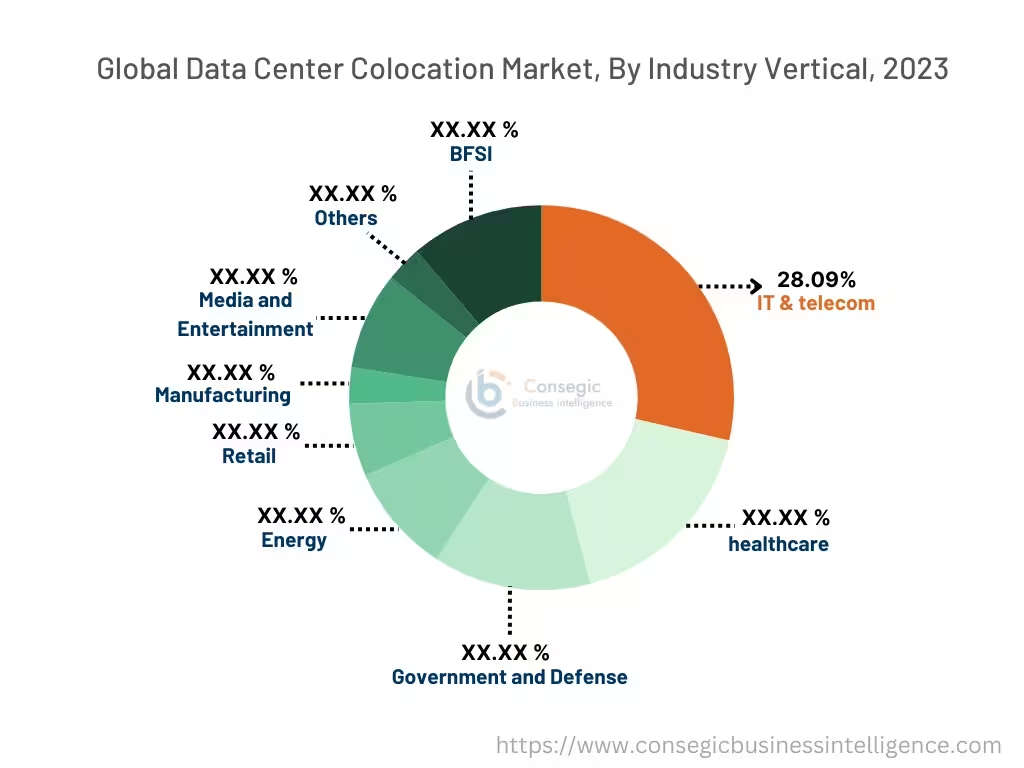
Based on industry vertical, the market is segmented into BFSI, IT & telecom, healthcare, government and defense, energy, retail, manufacturing, media and entertainment, and others.
Trends in the Industry Vertical:
- Rising adoption of data center colocation in the retail sector due to benefits including increased uptime, data analytics capabilities, and the ability to support personalized marketing and customer relationship management.
- Increasing trend in the adoption of data center colocation leads to maximized energy efficiency.
IT & telecom segment accounted for the largest revenue share of 28.09% in the market in 2024.
- Data colocation is highly useful in the IT and telecom industries because it provides a flexible, scalable, and cost-effective way to manage IT infrastructure.
- It is particularly beneficial for companies looking to connect to the internet and other networks, access cloud services, and manage their telecommunication needs.
- Data centers offer redundant power and cooling systems, robust security protocols, and 24/7 on-premises support, ensuring higher uptime and data protection.
- Thus, the data center colocation market analysis shows that the aforementioned factors are boosting the data center colocation market expansion.
The healthcare segment is anticipated to register the fastest CAGR during the forecast period.
- Data colocation is a valuable asset for the healthcare industry, enabling secure and efficient data storage, processing, and sharing among various entities like hospitals, research institutions, and pharmaceutical companies.
- Colocation data centers facilitate secure connections between healthcare organizations, allowing the rapid and secure exchange of patient information and research data.
- Colocation provides access to powerful computing resources and network infrastructure needed for advanced data analytics, machine learning, and artificial intelligence (AI) applications.
- Therefore, the aforementioned factors are expected to boost the data center colocation market opportunities.
Regional Analysis:
The regions covered are North America, Europe, Asia Pacific, the Middle East and Africa, and Latin America.
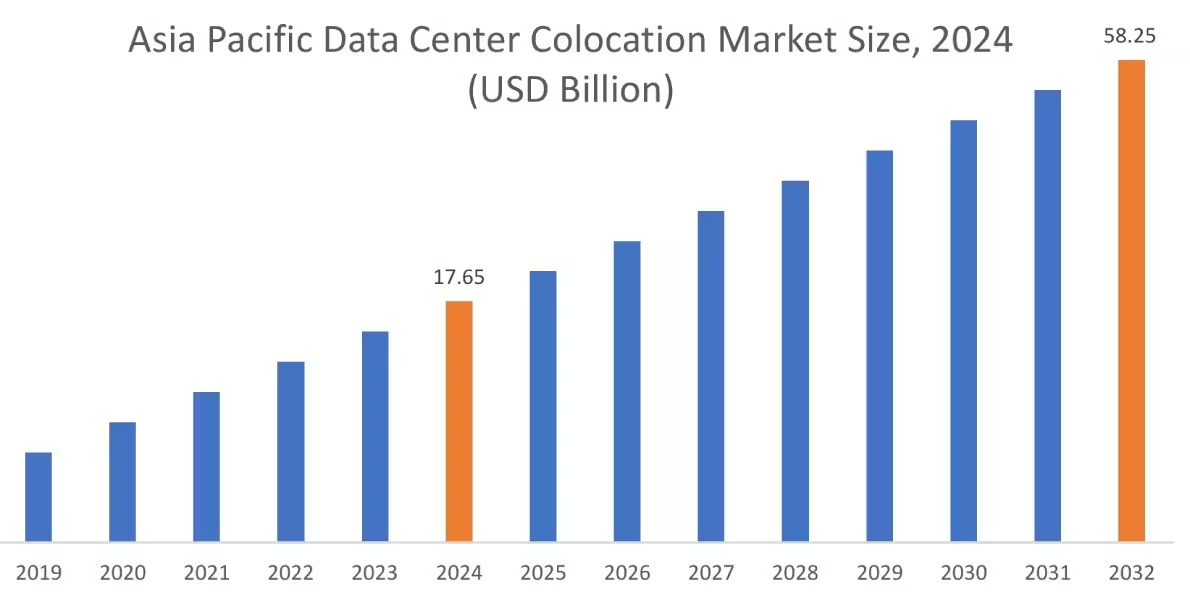
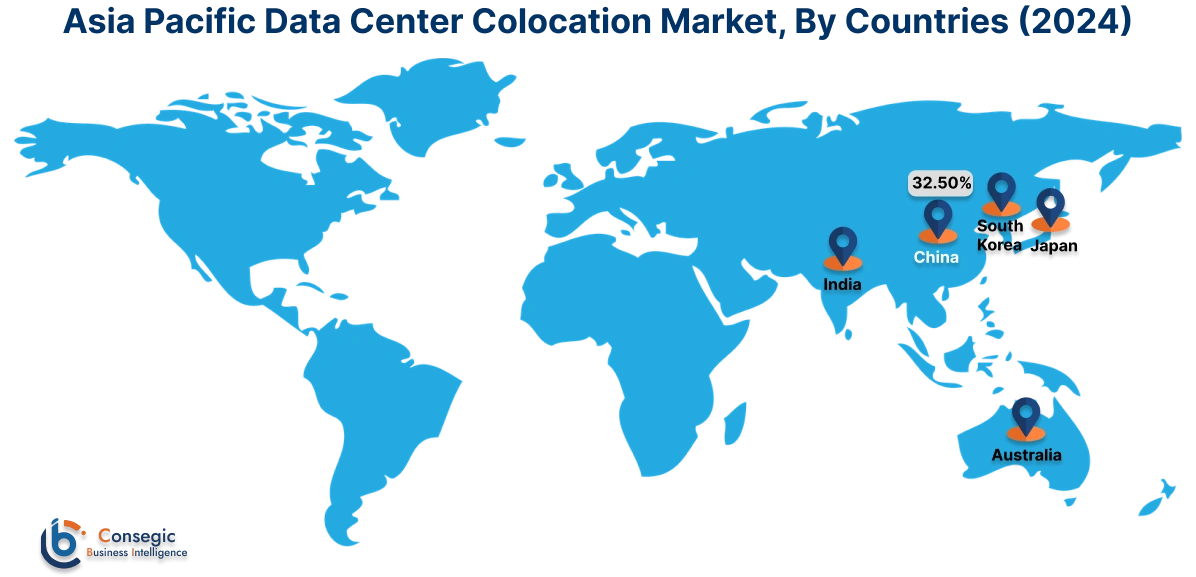
Asia Pacific region was valued at USD 17.65 Billion in 2024. Moreover, it is projected to grow by USD 20.14 Billion in 2025 and reach over USD 58.25 Billion by 2032. Out of this, China accounted for the maximum revenue share of 32.50%. The market in the region is growing due to rising digital transformation, usage of AI capabilities, deployment of 5G services, and others. Moreover, rising demand for data center space and computing power is also boosting the data center colocation market expansion.
North America is estimated to reach over USD 76.61 Billion by 2032 from a value of USD 24.21 Billion in 2024 and is projected to grow by USD 27.53 Billion in 2025. The market in the region is growing due to well-established IT & telecommunication, healthcare, and BFSI industries that require data centers for storing, processing, and distributing data and applications.
- For instance, in June 2024, a new simplified data center infrastructure, Nexus HyperFabric AI Clusters was launched by Cisco and NVIDIA, especially for generative AI. This ensures the deployment, management, and monitoring of data centers, colocation facilities, and edge sites.
Additionally, the European market growth is driven due to rising cloud computing adoption, increasing data consumption, and the rise of technologies like 5G and edge computing among others. The data center colocation market analysis in Latin America, the Middle East, and Africa shows that the market growth in these regions is driven due to factors such as increased internet penetration, digital transformation, and the need for data sovereignty.
Top Key Players & Market Share Insights:
The data center colocation industry is highly competitive with major players providing services to the national and international markets. Key players are adopting several strategies in research and development (R&D), product innovation, and end-user launches to hold a strong position in the global data center colocation market. Key players in the data center colocation industry include-
- Equinix, Inc. (USA)
- Global Switch (UK)
- KDDI Corporation (Japan)
- AT&T Intellectual Property (USA)
- Telehouse (Japan)
- Digital Realty Trust (USA)
- China Telecom Corporation Limited (China)
- CyrusOne (USA)
- CoreSite (USA)
- NTT Communications Corporation (Japan)
Recent Industry Developments :
Mergers & Acquisitions:
- In January 2024, Indosat's entire data center and edge site portfolio was acquired by BDx for USD 170 Million. This ensures the enhancement of customer service and expanding their market to Indonesia.
Data Center Colocation Market Report Insights :
| Report Attributes | Report Details |
| Study Timeline | 2021-2034 |
| Market Size in 2034 | USD 272.83 Billion |
| CAGR (2026-2034) | 13.70% |
| Base Year | 2025 |
| By Type |
|
| By Enterprise Size |
|
| By Industry Vertical |
|
| By Region |
|
| Key Players |
|
| North America | U.S. Canada Mexico |
| Europe | U.K. Germany France Spain Italy Russia Benelux Rest of Europe |
| APAC | China South Korea Japan India Australia ASEAN Rest of Asia-Pacific |
| Middle East and Africa | GCC Turkey South Africa Rest of MEA |
| LATAM | Brazil Argentina Chile Rest of LATAM |
| Report Coverage |
|
Key Questions Answered in the Report
How big is the Data Center Colocation Market? −
Data Center Colocation Market size is estimated to reach over USD 211.04 Billion by 2032 from a value of USD 66.36 Billion in 2024 and is projected to grow by USD 75.50 Billion in 2025, growing at a CAGR of 13.7% from 2025 to 2032.
What specific segmentation details are covered in the data center colocation market report? +
The data center colocation market report includes specific segmentation details for type, enterprise size, industry vertical, and region.
Which region is anticipated to register the fastest market growth? +
Asia Pacific region is expected to register the fastest growth during the forecast period.
Who are the major players in the data center colocation market? +
The key participants in the data center colocation market are Equinix, Inc. (USA), Digital Realty Trust (USA), China Telecom Corporation Limited (China), CyrusOne (USA), CoreSite (USA), NTT Communications Corporation (Japan), Global Switch (UK), KDDI Corporation (Japan), AT&T Intellectual Property (USA), and Telehouse (Japan).
Overview
Reputation & Certifications


Our Services
- Market Intelligence & Forecasting
- Custom Research Solutions
- Market Entry Strategy
- Competitive Intelligence
- Customer Insights
- Industry Innovation Analysis
- Investment Advisory