Jump to Content
Digital Signal Processor Market - Size, Share, Industry Trends, and Forecasts (2025-2032)
Digital Signal Processor Market Size:
Digital Signal Processor Market is estimated to reach over USD 20,230.73 Million by 2032 from a value of USD 11,638.39 Million in 2024 and is projected to grow by USD 12,268.73 Million in 2025, growing at a CAGR of 7.8% from 2025 to 2032.
Digital Signal Processor Market Scope & Overview:
Digital Signal Processors (DSPs) are specialized microprocessors that excel at performing complex mathematical operations on digital signals. Their architecture is optimized for tasks like filtering noise, transforming signals (image processing), and performing calculations crucial for real-time applications. The aforementioned features make them essential for devices that process audio, video, or sensor data, enabling features like noise cancellation, image enhancement, and speech recognition. Further, the digital signal processor market is experiencing growth driven by increasing need for real-time signal processing in various applications. The key trends include the rise of AI, machine learning, cloud computing and edge computing. Furthermore, application trends span diverse sectors including automotive, consumer electronics, healthcare, industrial automation, and telecommunications among others. Thus based on overall market trends, the digital signal processor market is expected to witness a significant growth rate during the forecast period.

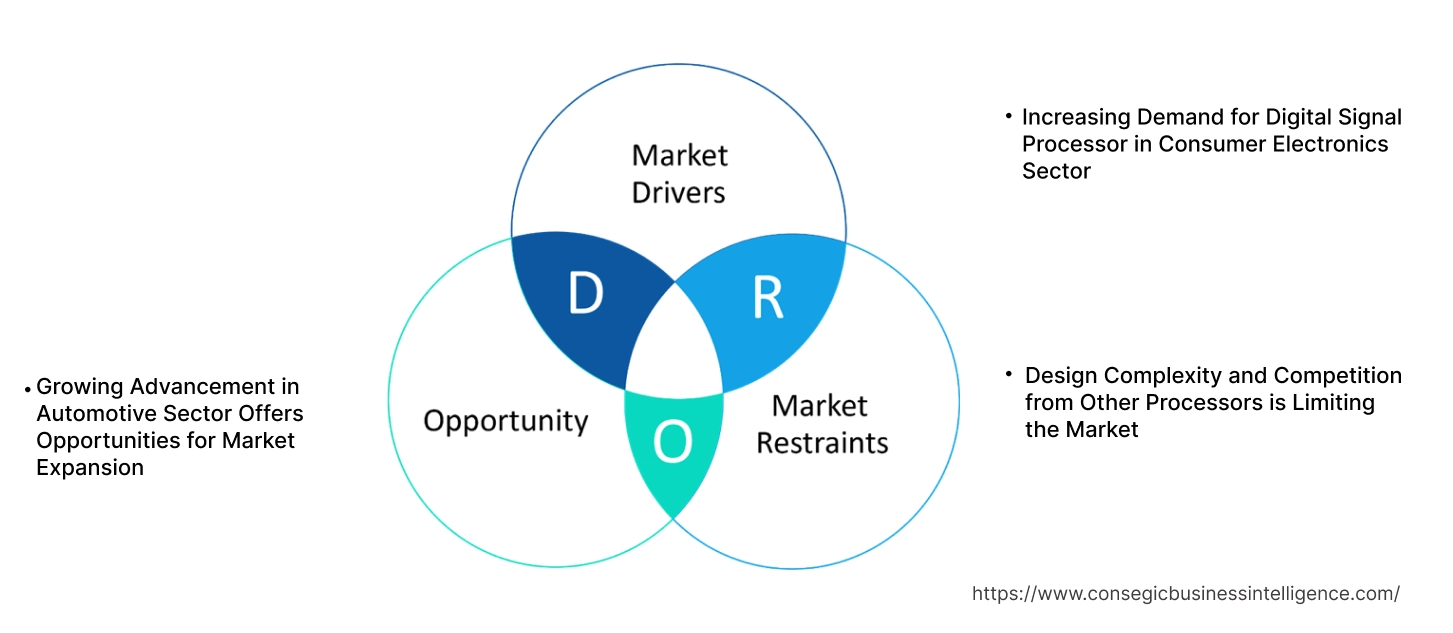
Digital Signal Processor Market Dynamics - (DRO)
Key Drivers:
Increasing Demand for Digital Signal Processor in Consumer Electronics Sector
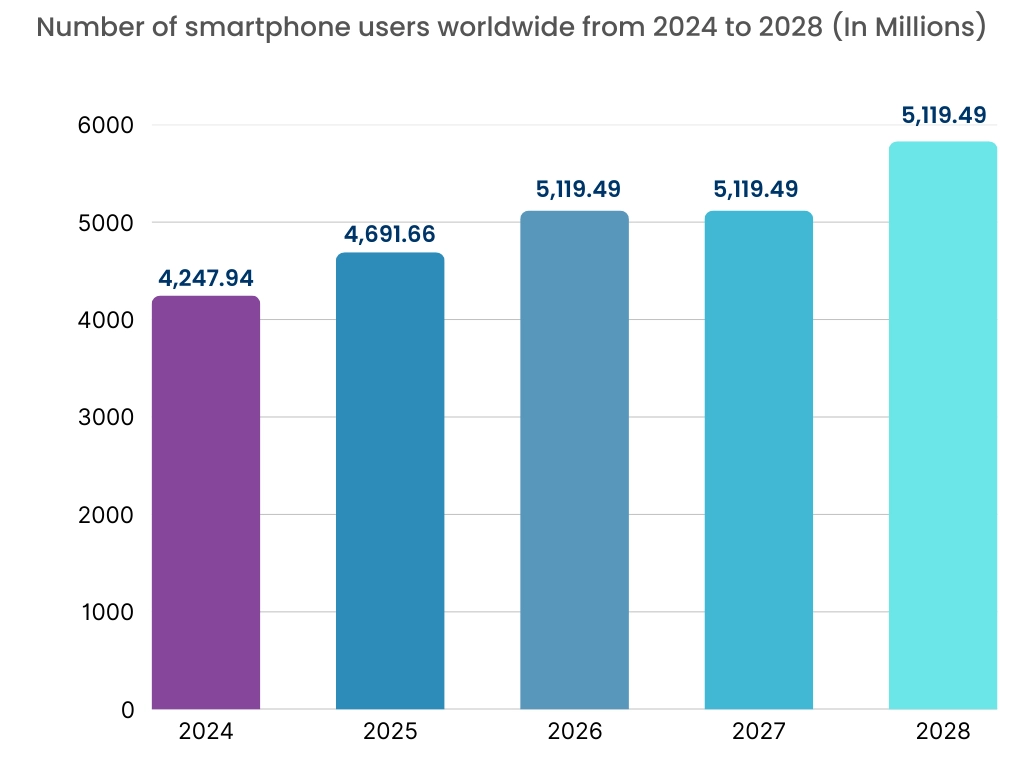
The consumer electronics sector is witnessing a surge in demand for Digital Signal Processors (DSPs) due to the increasing complexity and sophistication of modern devices. DSPs are crucial for enhancing audio and video quality in smartphones, tablets, and smart speakers. They enable features like noise cancellation, echo reduction, and high-fidelity audio processing. In televisions and cameras, DSPs power image processing algorithms, improving picture clarity, color accuracy, and video stabilization. Further, there has been a growing number of smartphones users worldwide due to factors including decreasing device costs, increasing affordability of mobile data plans, expanding network coverage, and growing reliance on mobile devices for communication, entertainment, and information access.
Furthermore, the rise of artificial intelligence (AI) and machine learning (ML) in consumer electronics is driving the need for powerful DSPs. These processors can efficiently execute complex AI algorithms for tasks like voice recognition, natural language processing, and personalized user experiences. Thus, as per analysis, as consumer devices become more intelligent and connected, DSPs will play a pivotal role in enabling seamless interactions and enhanced functionalities.
Key Restraints:
Design Complexity and Competition from Other Processors is Limiting the Market
Design complexity and competition from other processors pose significant challenges to the digital signal processor market. Developing and programming DSPs requires specialized expertise in signal processing and real-time systems, increasing development time and costs. Balancing performance, power consumption, and cost further complicates the design process. Simultaneously, general-purpose processors (GPPs), with advancements in multi-core and SIMD capabilities, are encroaching on traditional DSP applications. GPUs and FPGAs also offer competitive solutions for specific tasks like parallel processing and reconfigurable hardware. This competition from alternative processing architecture limits the adoption of dedicated DSPs in certain segments. As GPPs become more powerful and versatile, the need for specialized DSPs might decrease unless DSP vendors can offer compelling advantages in performance, power efficiency, or cost for specific niche applications.
Future Opportunities :
Growing Advancement in Automotive Sector Offers Opportunities for Market Expansion
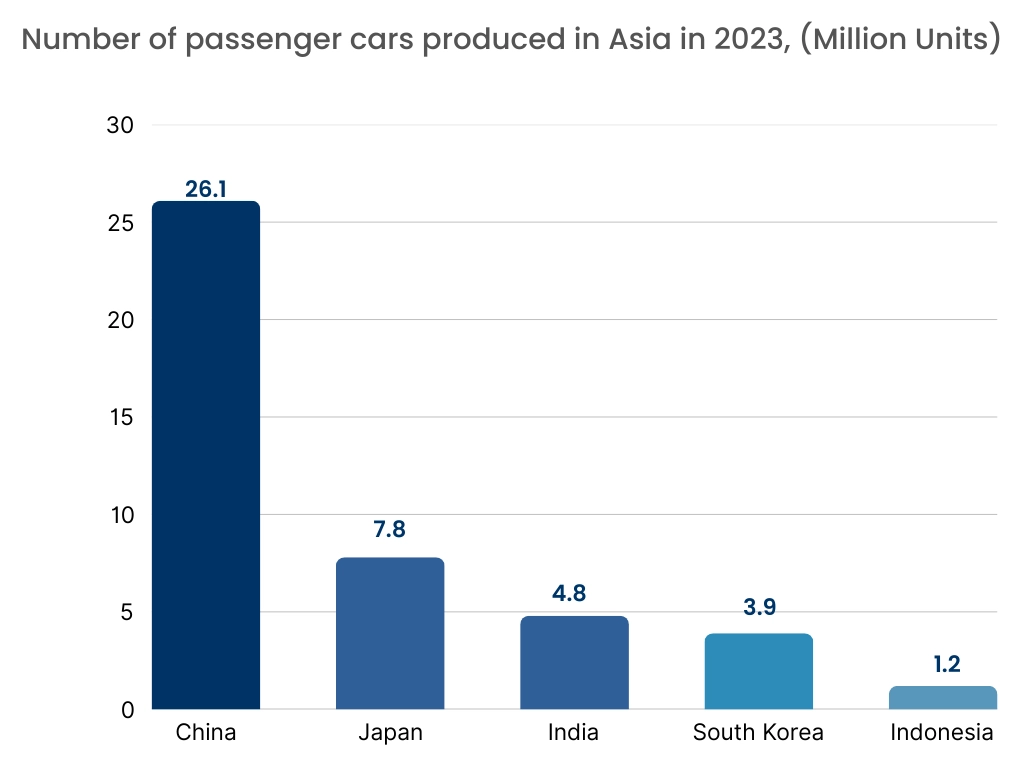
The automotive sector’s rapid advancements are creating significant opportunities for digital signal processor market expansion. Modern vehicles increasingly rely on sophisticated electronic systems for functions like advanced driver-assistance systems (ADAS), autonomous driving, and in-cabin experience enhancement. DSPs are essential for processing sensor data from cameras, radar, and lidar, enabling real-time object detection, lane keeping, and adaptive cruise control in ADAS. Furthermore, they play a crucial role in in-vehicle infotainment systems, providing high-quality audio processing, noise cancellation, and speech recognition. As vehicles become more autonomous and connected, the demand for high-performance, low-power DSPs will continue to rise, driving market growth. Further, there has been increasing automobile production especially in Asia due to factors including rising disposable incomes, growing middle class populations, government initiatives promoting manufacturing, and increasing requirement for personal vehicles.
Thus, based on analysis, advancement in vehicle technology along with growing automobile production is expected to drive the market size of digital signal processor market.
Digital Signal Processor Market Segmental Analysis :
By Type:
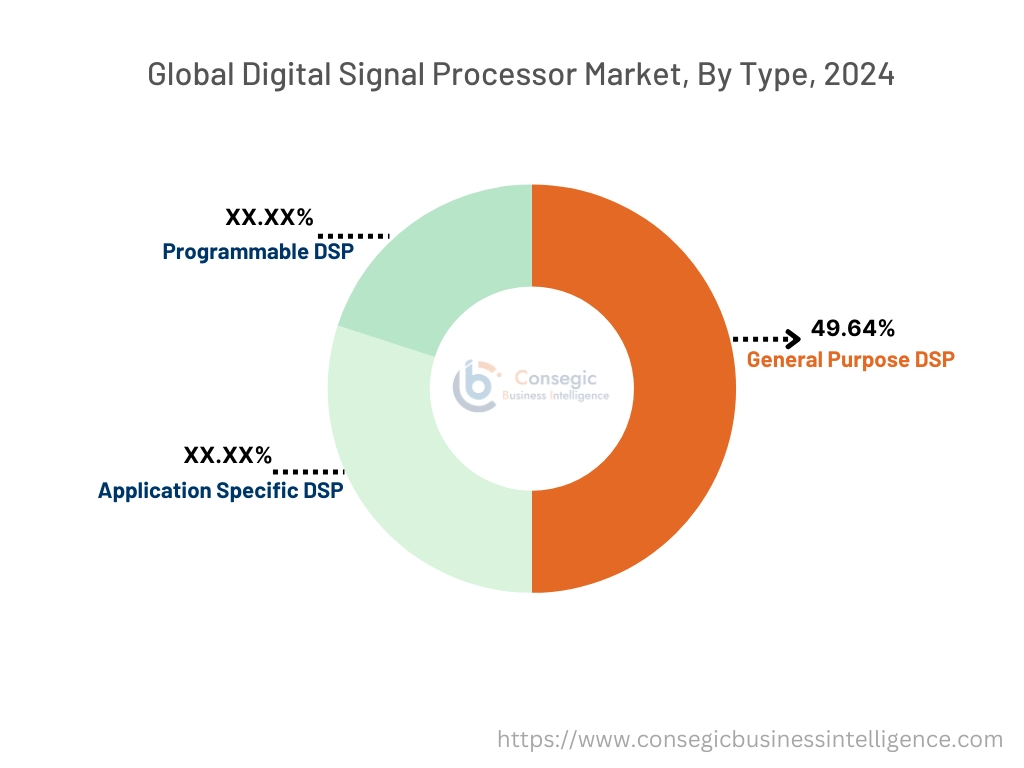
Based on the type, the market is segmented into general purpose DSP, application specific DSP, programmable DSP.
Trends in the Type:
- Programmable DSPs are increasingly adopting heterogeneous architectures, combining a traditional DSP core with other processing units.
- Many programmable DSPs are used in real-time applications such as industrial control and automotive systems.
General purpose DSP accounted for the largest revenue share of 49.64% in the year 2024.
- General purpose DSPs are increasingly incorporating more peripherals and functionalities onto the chip itself which in turn drives the market
- Further, trends including higher clock speeds, wider data paths, and more efficient architectures to handle complex algorithms drives the general purpose DSPs.
- Thus, as per analysis, increasingly incorporating more functionalities and factors including higher clock speeds and wider data paths are driving the general purpose digital signal processor market size.
Application specific DSP is anticipated to register the fastest CAGR during the forecast period.
- A major trend is the integration of specialized hardware for accelerating artificial intelligence (AI) and machine learning (ML) workloads.
- Further, application specific DSP offers a degree of customization or configurability which allows manufacturers to fine-tune the chip to their exact needs, optimizing performance and power consumption.
- Therefore, as per analysis, increasing trend of AI and ML ability to seamless and focus on customization is anticipated to boost the growth of the digital signal processor market during the forecast period.
By Core:
Based on the core, the market is segmented into single-core DSP and multi-core DSP
Trends in the Core:
- Single-core DSPs are increasingly being designed for very specific tasks, such as audio processing or simple control functions in appliances which in turn drives the digital signal processor market.
- Increasing adoption of IoT is resulting in growing requirement for ultra-low-power single-core DSPs that can run on tiny batteries for extended periods.
Multi-Core DSP accounted for the largest revenue share in the year 2024 and is anticipated to register the fastest CAGR during the forecast period.
- There's a growing need to integrate AI and machine learning capabilities directly into multi-core DSPs, enabling real-time processing of complex algorithms for tasks like image recognition and natural language processing.
- Further, increasing number of cores in a multi-core DSP continues to rise, driven by the need for higher performance in applications like video processing, communications, and complex industrial control.
- For instance, NXP Semiconductors offers MSC8154E which is a powerful, four-core DSP designed for wireless base stations and infrastructure. It uses NXP's StarCore technology, offering performance comparable to a 4GHz single-core device while saving power. Moreover, it supports next-gen wireless standards and lowers costs by integrating multiple functions.
- Thus, according to analysis, integration of AI and machine learning capabilities and increasing number of cores is driving the digital signal processor market.
By Application:
Based on the application, the market is segmented into audio and video processing, communication systems, image processing, automation and robotics, advanced driver assistance systems (ADAS), and others.
Trends in the Application:
- Rising use of 4K and 8K videos is driving the need for DSPs to handle massive amounts of data in real-time in turn driving the digital signal processor market.
- DSPs provide the real-time processing capabilities needed for precise control of robots and automated systems.
Communication Systems accounted for the largest revenue share in the year 2024.
- DSPs are crucial for the development of 5G and future communication technologies, handling complex signal processing tasks like modulation, demodulation, and channel equalization which in turn drives the need for Digital Signal Processor.
- Further, DSPs play a critical role in satellite communication systems, processing signals for uplink and downlink transmissions.
- Thus, as per analysis, growing 5G market and increasing incorporation of DSPs in satellite communication systems play a critical role in driving the market.
Advanced Driver Assistance Systems (ADAS) is anticipated to register the fastest CAGR during the forecast period.
- DSPs are key part of ADAS as it processes data from various sensors like cameras, radar, and lidar to provide features like lane departure warning, adaptive cruise control, and automatic emergency braking.
- Further, DSPs enable ADAS to make critical decisions in real-time, such as identifying potential hazards and taking corrective actions.
- Therefore, as per analysis, growing advancements in ADAS and increasing automobile production are anticipated to boost the growth of the market during the forecast period.
By End User:
Based on the end user, the market is segmented into consumer electronics, automotive, industrial, healthcare, aerospace and defense, and others.
Trends in the end user:
- DSPs are being deployed in industrial IoT (IIoT) devices for tasks like predictive maintenance, process control, and data analytics.
- Increasing use of DSPs in medical imaging devices like MRI and CT scanners to process and reconstruct images for diagnosis.
Consumer Electronics accounted for the largest revenue share in the year 2024 and is anticipated to register the fastest CAGR during the forecast period.
- DSPs in consumer electronics are increasingly being used to run AI algorithms locally, enabling features like voice recognition, image processing, and personalized recommendations.
- Further, the proliferation of portable devices, there's a strong emphasis on power-efficient DSPs that can extend battery life.
- Furthermore, growing smartphones and tablets sector is significantly driving the market.
- Thus, growing smartphone market and increasing focus on AI is driving the digital signal processor market.
Automotive is anticipated to register the fastest CAGR during the forecast period.
- DSPs are crucial for the development of advanced driver-assistance systems (ADAS) and autonomous driving, processing data from various sensors to enable features like lane keeping assist, adaptive cruise control, and automatic emergency braking.
- Furthermore, DSPs are used in in-vehicle infotainment systems to provide high-quality audio processing, noise cancellation, and video processing for entertainment and navigation.
- For instance, Texas Instruments Incorporated offers AM62D-Q1 processor which targets high-performance digital signal processing applications like automotive audio, radar, sonar, ultrasound, and instrumentation. It features an Arm Cortex-A53, a TI C7000 DSP core, a matrix multiplication accelerator, and a dedicated MCU island, all with industrial and automotive-grade safety and security features.
- Therefore, increasing demand for DSPs for in-vehicle infotainment systems and ADAS is anticipated to boost the growth of the market during the forecast period.
Regional Analysis:
The regions covered are North America, Europe, Asia Pacific, Middle East and Africa, and Latin America.
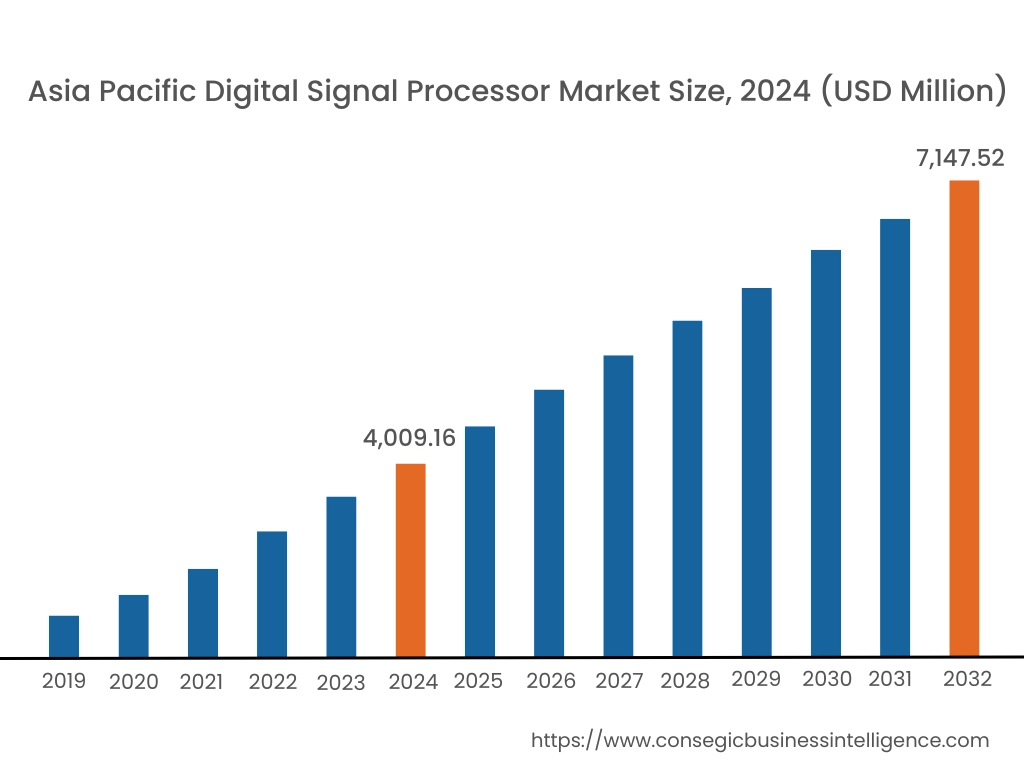
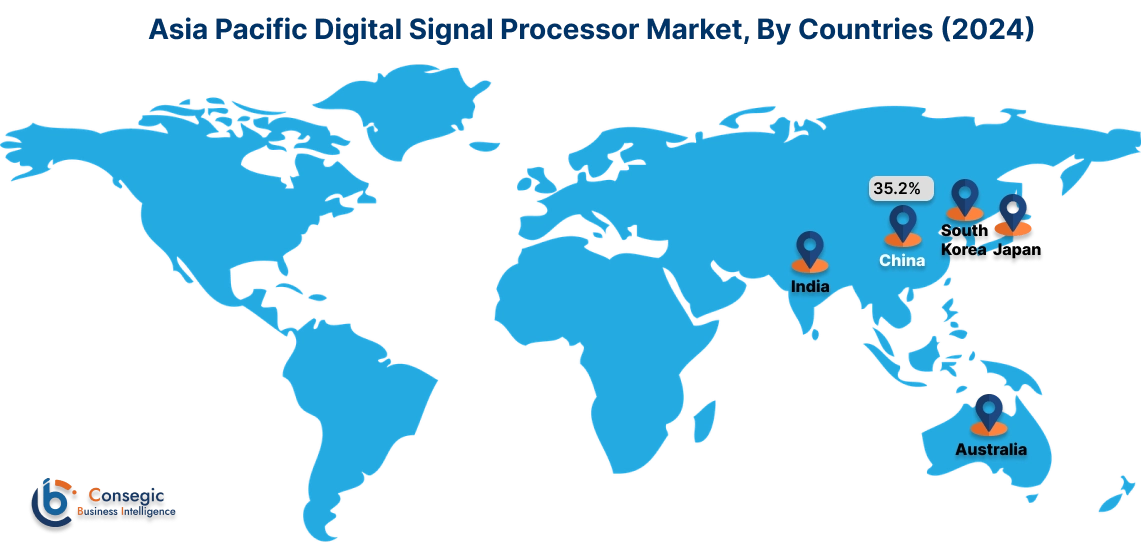
Asia Pacific region was valued at USD 4,009.16 Million in 2024. Moreover, it is projected to grow by USD 4,235.32 Million in 2025 and reach over USD 7,147.52 Million by 2032. Out of this, China accounted for the maximum revenue share of 35.2%. The market growth for digital signal processors is mainly driven by the region's rapid industrialization, increasing adoption of advanced technologies like 5G and IoT, and the presence of major consumer electronics and automotive manufacturing hubs.
- For instance, in July 2024, Microchip Technology Inc. one of a key global player in the market, introduced new dsPIC33A family of DSCs which enhances real-time control with a 32-bit architecture, double-precision floating-point unit, and DSP engine. This enables faster computation for complex embedded control algorithms in motor control, power supply, and sensing systems. Key improvements include better math processing, code efficiency, faster context switching, and reduced latency
North America is estimated to reach over USD 5,664.60 Million by 2032 from a value of USD 3,296.89 Million in 2024 and is projected to grow by USD 3,472.10 Million in 2025. The market growth for digital signal processors in North America is mainly driven by the region's strong focus on technological innovation, its leading role in industries like aerospace and defense, and the high demand for advanced consumer electronics and automotive solutions. Furthermore, the presence of key DSP vendors and research institutions contributes significantly to market expansion.
- For instance, in March 2024, Marvell introduced Spica Gen2-T which is the industry's first 5nm, 800 Gbps transmit-only PAM4 optical DSP. The processor is designed for TRO modules, and it reduces 800 Gbps optical module power consumption by over 40% while maintaining interoperability. This addresses the increasing bandwidth demands of cloud and AI, allowing for more efficient and cost-effective interconnect in large-scale deployments.
The regional trends analysis depicts that the strong automotive sector, growing adoption of industrial automation technologies, and increasing investments in research and development in Europe is driving the market. Additionally, the primary factor driving the market in the Middle East and African region is the increasing investment in infrastructure development, coupled with growing demand for advanced technologies in sectors like telecommunications, oil and gas, and security. Further, the growing adoption of digital technologies across various sectors coupled with increasing investments in infrastructure development is paving the way for the progress of market in Latin America region.
Top Key Players and Market Share Insights:
The global digital signal processor market is highly competitive with major players providing solutions to the national and international markets. Key players are adopting several strategies in research and development (R&D), product innovation, and end-user launches to hold a strong position in the digital signal processor industry. Key players in the digital signal processor market include-
- Texas Instruments Incorporated (US)
- NXP Semiconductors (Netherlands)
- Cirrus Logic, Inc. (US)
- Broadcom Corp. (US)
- Qualcomm Technologies, Inc. (US)
- Microchip Technology Inc. (US)
- Marvell (US)
- Analog Devices, Inc. (US)
- STMicroelectronics (Switzerland)
- Toshiba Corp., (Japan)
- Infineon Technologies AG (Germany)
- Renesas Electronics Corp
Recent Industry Developments :
Product Launch:
- In June 2024, NXP Semiconductors introduced SAF9xxx family of audio DSPs to bring AI and machine learning to automotive infotainment. It features a neural network engine, hardware accelerators, and Cadence Tensilica HiFi 5 DSPs for advanced audio and speech processing. The family also offers a software-defined radio option with up to 5 tuners. This allows for new features like driver/passenger recognition and emergency vehicle detection.
- In December 2024, Marvell introduced Aquila DSP which is the industry's first coherent-lite 1.6 Tbps solution optimized for O-band wavelengths, targeting data center campus connectivity. It offers a cost-effective, power-efficient, and scalable alternative to traditional PAM4 or C-band coherent solutions, addressing the growing need for high-bandwidth, low-latency interconnects in distributed data centers.
- In September 2024, Broadcom Inc. announced the general availability of Sian2, a 200G/lane PAM-4 DSP PHY. This new DSP, along with the existing Sian DSP, enables 800G and 1.6T optical transceivers for AI clusters. Sian2 offers 200G/lane electrical and optical interfaces, doubling the bandwidth of current solutions while aiming for lower power, latency, and cost per bit.
Digital Signal Processor Market Report Insights :
| Report Attributes | Report Details |
| Study Timeline | 2019-2032 |
| Market Size in 2032 | USD 20,230.73 Million |
| CAGR (2025-2032) | 7.8% |
| By Type |
|
| By Core |
|
| By Application |
|
| By End User |
|
| By Region |
|
| Key Players |
|
| North America | U.S. Canada Mexico |
| Europe | U.K. Germany France Spain Italy Russia Benelux Rest of Europe |
| APAC | China South Korea Japan India Australia ASEAN Rest of Asia-Pacific |
| Middle East and Africa | GCC Turkey South Africa Rest of MEA |
| LATAM | Brazil Argentina Chile Rest of LATAM |
| Report Coverage |
|
Key Questions Answered in the Report
How big is the Digital Signal Processor Market? −
The Digital Signal Processor Market is estimated to reach over USD 20,230.73 Million by 2032 from a value of USD 11,638.39 Million in 2024 and is projected to grow by USD 12,268.73 Million in 2025, growing at a CAGR of 7.8% from 2025 to 2032.
What specific segmentation details are covered in the Digital Signal Processor report? +
The digital signal processor report includes specific segmentation details for type, core, application, end user, and regions.
Which is the fastest segment anticipated to impact the market growth? +
In the digital signal processor market, consumer electronics is the fastest growing segment during the forecast period due to increasing demand for sophisticated audio and video processing, the proliferation of smart devices with AI capabilities, and the growing integration of DSPs in a wide range of consumer products like smartphones, wearables, and home entertainment systems.
Who are the major players in the Digital Signal Processor market? +
The key participants in the Digital Signal Processor Market are Texas Instruments Incorporated (US), NXP Semiconductors (Netherlands), Marvell (US), Analog Devices, Inc. (US), STMicroelectronics (Switzerland), Toshiba Corp. (Japan), Infineon Technologies AG (Germany), Renesas Electronics Corp. (Japan), Cirrus Logic, Inc. (US), Broadcom Corp. (US), Qualcomm Technologies, Inc. (US), Microchip Technology Inc. (US), and others.
What are the key trends in the Digital Signal Processor Market? +
Digital signal processor market is being shaped by several key trends including increasing demand for AI and machine learning capabilities at the edge, the rise of cloud and edge computing, the focus on power efficiency and connectivity, and the expanding applications of DSPs in automotive, consumer electronics, healthcare, industrial automation, and telecommunications.
Overview
Reputation & Certifications


Our Services
- Market Intelligence & Forecasting
- Custom Research Solutions
- Market Entry Strategy
- Competitive Intelligence
- Customer Insights
- Industry Innovation Analysis
- Investment Advisory