Jump to Content
Farm Equipment Rental Market - Size, Share, Industry Trends, and Forecasts (2025-2032)
Farm Equipment Rental Market Size:
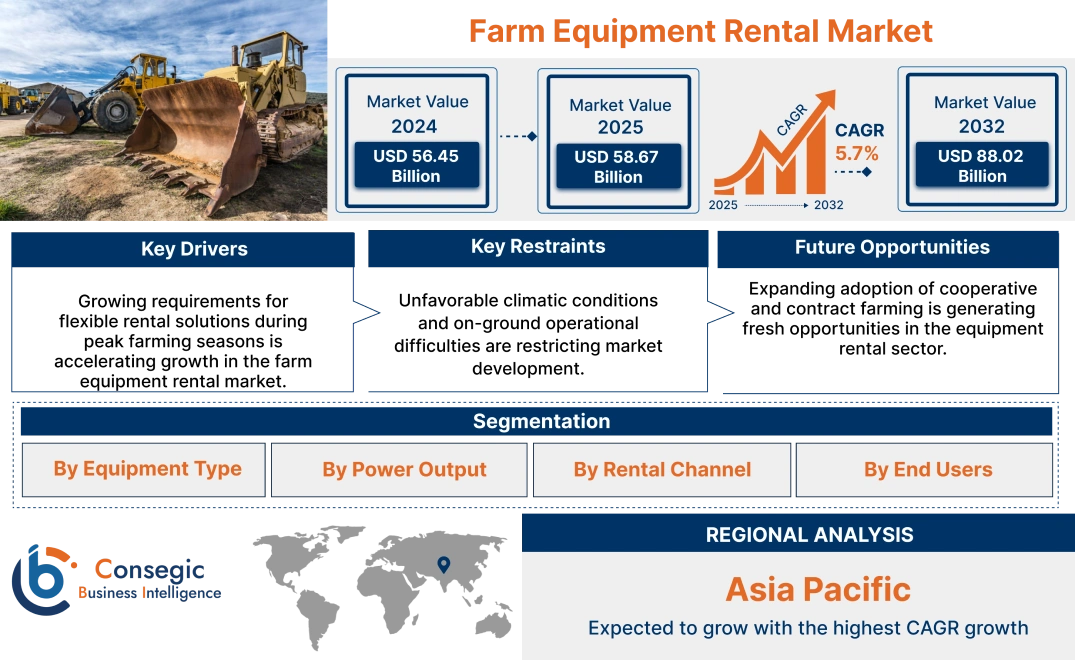
Farm Equipment Rental Market size is estimated to reach over USD 88.02 Billion by 2032 from a value of USD 56.45 Billion in 2024 and is projected to grow by USD 58.67 Billion in 2025, growing at a CAGR of 5.7% from 2025 to 2032.
Farm Equipment Rental Market Scope & Overview:
Farm equipment rental involves the provision of agricultural machinery and tools to users on a temporary basis for specific tasks or seasonal operations. This service model allows access to a variety of equipment ranging from tractors and harvesters to sprayers and tillers, without requiring long-term ownership. Rental offerings are typically managed by third-party providers, cooperatives, or dealerships, with scheduling and pricing based on usage duration, machine category, and operational hours.
Rental systems may operate through physical locations or online platforms where users can choose equipment based on their crop, field dimensions, or timing needs. The machinery is kept in good working condition with proper checks before and after each use. Most units are compatible with standard farming attachments and are prepared for the farming practices specific to a region.
End-users include small and medium-scale farmers, agri-service contractors, and institutional farms that require flexible access to mechanization without the overhead of full-time asset ownership. Farm equipment rental systems support resource-efficient deployment of capital-intensive machinery tailored to variable-scale operations.
Farm Equipment Rental Market Dynamics - (DRO) :
Key Drivers:
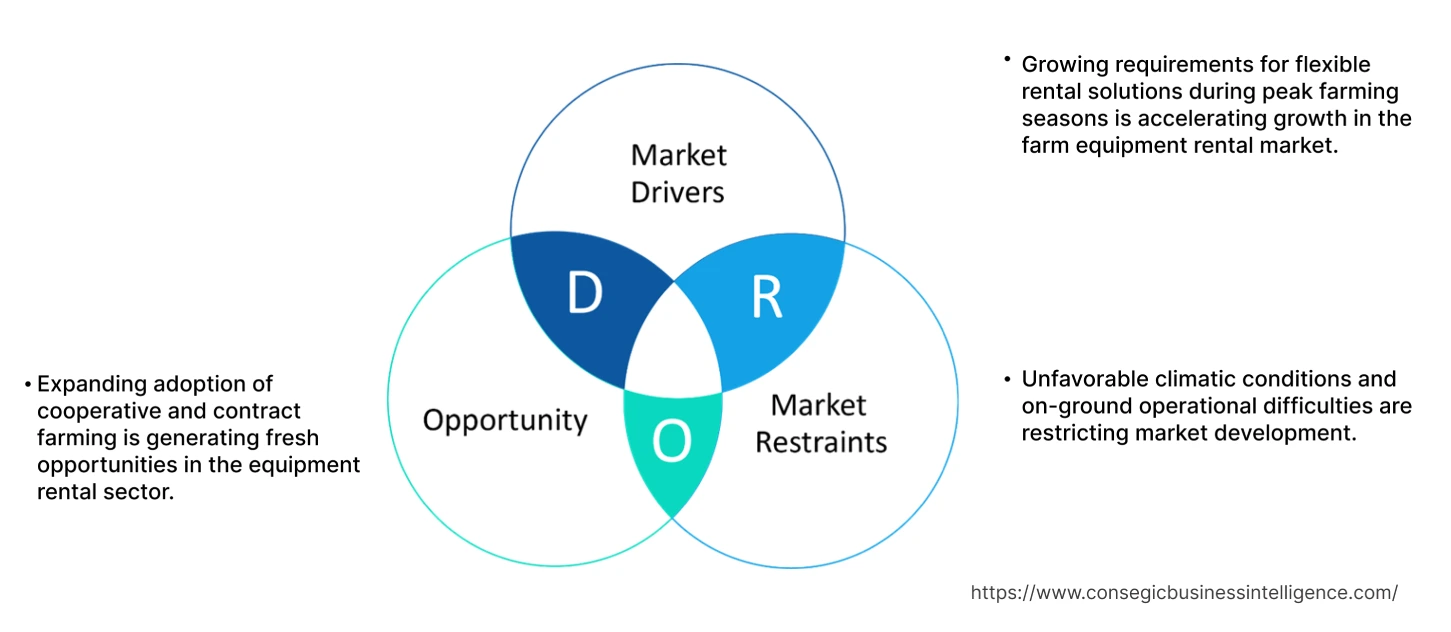
Growing requirements for flexible rental solutions during peak farming seasons is accelerating growth in the farm equipment rental market.
The seasonal nature of agriculture, where specific machinery is essential during peak periods such as planting and harvesting, strongly drives the demand for short-term rental services. Farmers experience changing equipment needs throughout the crop cycle—for instance, tools used during planting may not be needed at harvest time, and vice versa. Short-term rentals offer a cost-effective alternative to purchasing machinery that is only utilized a few times annually. In high crop rotation regions with multiple harvests per year, rental options give farmers access to the latest technologies without requiring large capital investments. This flexibility empowers farmers to adapt quickly to their operational needs, enhancing productivity and efficiency. The ability to rent equipment on requirement not only reduces financial strain but also ensures that farmers are equipped with modern tools to maintain high-performance standards. As a result, short-term equipment rentals are becoming a preferred solution, significantly propelling market growth.
Key Restraints:
Unfavorable climatic conditions and on-ground operational difficulties are restricting market development.
Weather conditions are a significant factor influencing the need for farm equipment, especially during peak farming seasons. Unpredictable weather, such as prolonged droughts or excessive rainfall, can disrupt planting or harvesting schedules, making it challenging to predict the exact timing when machinery will be needed. These fluctuations create uncertainty for rental companies, as they may struggle to meet requirements when weather conditions do not align with scheduled farming activities. Delayed or altered farming operations also lead to operational inefficiencies, as equipment may sit idle or be used for shorter periods than expected. Furthermore, inclement weather can affect delivery times, maintenance schedules, and overall equipment availability, leading to delays in operations. For both farmers and rental companies, these challenges can negatively impact productivity, reduce revenue possibilities, impeding market growth.
Future Opportunities :
Expanding adoption of cooperative and contract farming is generating fresh opportunities in the equipment rental sector.
In contract farming, farmers are increasingly growing crops based on agreements with buyers, which often require specialized equipment to meet specific crop production needs. Renting these arrangements necessitate access to high-end machinery that might not otherwise be affordable for small-scale farmers.
- For instance, Spright Agro Limited offers structured contract farming services aimed at bridging the gap between farmers and buyers through well-defined agreements. The company provides end-to-end support including quality seeds, crop advisory, farm inputs, and assured buyback at pre-agreed prices, thereby reducing market uncertainties for farmers.
Additionally, cooperative farming, where multiple farmers pool resources to share equipment, further accelerates the need for rental services. Instead of purchasing expensive machinery that may be underutilized, these cooperative models allow for the shared use of rental equipment. This approach not only reduces costs but also ensures that farmers in cooperative models have access to the latest, most efficient technology. As these farming models continue to grow, the need for specialized and cost-effective farm equipment rentals will increase, creating significant growth opportunities in the market.
Farm Equipment Rental Market Segmental Analysis :
By Equipment Type:
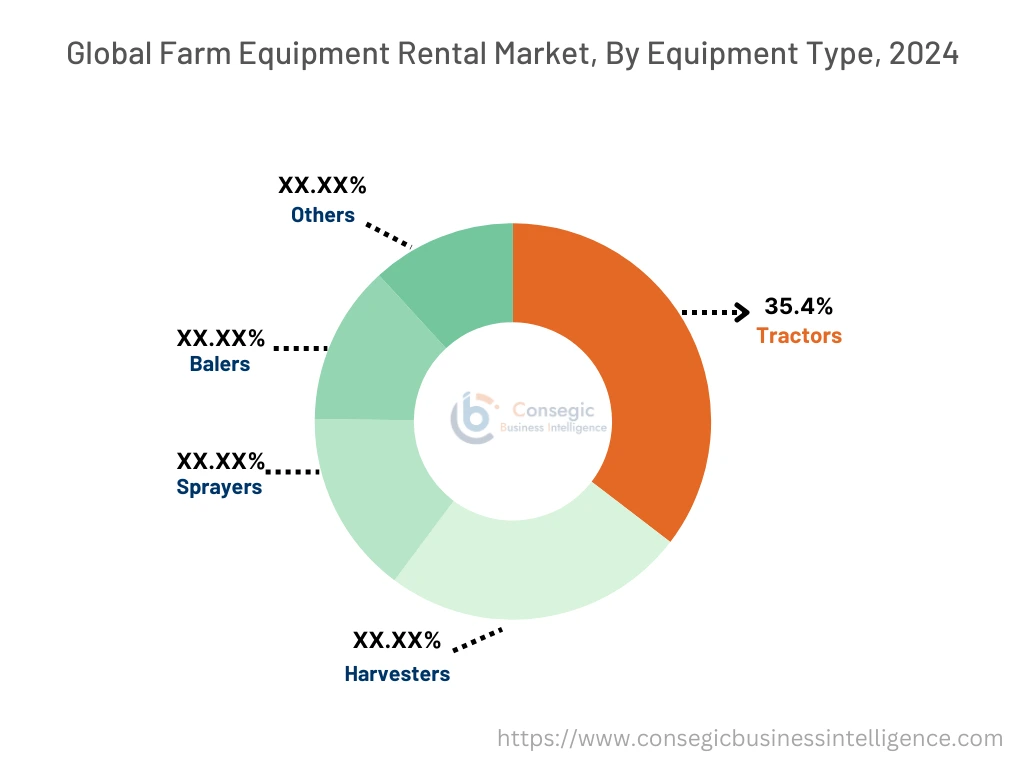
Based on Equipment Type, the market is categorized into tractors, harvesters, sprayers, balers, and others.
The Tractors segment holds the largest revenue of the overall Farm Equipment Rental Market share of 35.4% in the year 2024.
- Tractors are the most rented agricultural machinery due to their broad applicability in tillage, planting, hauling, and general field operations.
- Both smallholder and commercial farms rely on tractor rentals during peak seasons to minimize upfront capital investment.
- Rental service providers offer a range of tractor horsepower options to meet the diverse needs of row crop, orchard, and mixed-use farms.
- According to the Farm Equipment Rental market analysis, their versatility, year-round utility, and availability through both organized and informal channels, make tractors the largest segment, fueling the global Farm Equipment Rental market expansion.
The Harvesters segment is expected to grow at the fastest CAGR during the forecast period.
- Harvesters are rapidly gaining traction in rental markets, particularly in regions with seasonal crops such as rice, wheat, and corn.
- The high acquisition and maintenance costs of harvesters make them ideal candidates for rental models, especially among small and medium-scaled farms.
- Organized rental platforms are expanding their harvester fleets to address labor shortages and ensure timely harvesting in large acreage fields.
- For instance, in August 2023, Swaraj Tractors, a part of the Mahindra Group, unveiled the Swaraj 8200 Wheel Harvester. This new harvester is designed to deliver high operational efficiency, improved grain quality, and reduced crop loss, especially suited for large-scale paddy harvesting. It features several industry-first technological upgrades, including a powerful engine, robust build quality, and operator comfort enhancements.
- As per the market analysis, the growing demand for combine harvesters and rising government initiatives fuel the global Farm Equipment Rental market development.
By Power Output:
Based on Power Output, the market is categorized into 30 HP, 31–70 HP, 71–130 HP, and above 130 HP.
The 31–70 HP segment holds the largest revenue of the overall Farm Equipment Rental Market share in the year 2024.
- This range covers compact to mid-scale equipment, well-suited for general field activities like plowing, sowing, and spraying on small and medium farms.
- Equipment in this category is fuel-efficient, easier to transport, and versatile for multiple crop types and geographies.
- Rental firms maintain a steady supply of 31–70 HP equipment as it strikes the right balance between performance and affordability.
- According to the Farm Equipment Rental market analysis, the widespread use of mid-ranged power farm equipment and easy availability, significantly fuels the market growth.
The Above 130 HP segment is expected to grow at the fastest CAGR during the forecast period.
- High-horsepower equipment is primarily used in large-scale farming operations, especially for deep tillage, harvesting, and heavy-duty hauling.
- These machines are rented during short but intensive activity periods to avoid the high cost of ownership and long off-season storage.
- Rental providers are expanding their fleet of more than 130 HP units to support commercial growers and the growing need for high-capacity machinery in large field operations for efficient execution is also fueling the requirement.
- The rising trend for commercial agriculture and large-scale farming have substantially driven the Farm Equipment Rental market demand.
By Rental Channel:
Based on rental channel, the market is categorized into Direct-to-Farmer, Dealership-Based, and Platform-Based (Digital Rental Platforms).
The Dealership-Based segment holds the largest revenue share of the overall Farm Equipment Rental Market in the year 2024.
- Traditional dealership networks represent the most widespread and trusted rental channel, especially in rural markets where personal relationships and after-sales support matter.
- Authorized dealerships manage both sales and rentals for OEMs, offering farmers access to a wide range of machinery along with maintenance support.
- These networks maintain a stable fleet and are preferred by medium-to-large growers who value reliable equipment and trained service personnel.
- Thus, the exceeding demand for dealers due to their strong infrastructure, established reputation, and ongoing OEM collaboration, significantly drives the Farm Equipment Rental market trends.
The Platform-Based (Digital) segment is expected to grow at the fastest CAGR during the forecast period.
- Digital rental platforms are rapidly gaining traction by providing farmers with transparent pricing, availability tracking, and equipment comparisons via mobile and web interfaces.
- These platforms often work in an asset-light model, connecting individual owners or rental businesses with farmers through location-based matching.
- Real-time booking, GPS-enabled fleet monitoring, and predictive maintenance alerts are features accelerating adoption among younger, tech-savvy farmers in the market.
- For instance, in March 2023, Mahindra launched the Krish-e Smart Kit (KSK). Krish-e is an after-market device that particularly benefits farmers and equipment rental businesses. This retrofittable kit enables real-time monitoring of key machine parameters such as fuel usage, engine hours, and maintenance schedules via a mobile app. It also helps rental service providers reduce downtime, optimize equipment utilization, and extend machinery lifespan.
- The shifting trend of digital rental services in rural areas and the demand for flexible, data-driven solutions is significantly fueling the global Farm Equipment Rental market expansion.
By End-Users:
Based on End-Users, the market is categorized into Farmers, Agri-Cooperatives, Contract Farming Agencies, and Government Programs.
The Farmers segment holds the largest revenue share of the overall Farm Equipment Rental Market in the year 2024.
- Small and mid-scale farmers are the largest users of rental equipment, primarily to avoid the high capital cost of purchasing machinery for seasonal use.
- Rental enables access to modern implements such as seeders, sprayers, and harvesters, improving productivity without financial burden.
- Local rental entrepreneurs and dealership models cater primarily to this segment, often with cash-based or short-term rental structures.
- Thus, the increasing need due to their exceeding number and consistent demand significantly drives the global Farm Equipment Rental market trends.
The Contract Farming Agencies segment is expected to grow at the fastest CAGR during the forecast period.
- Contract farming firms operate large clusters of land across multiple growers, necessitating fleet-scale rental solutions for timely planting, spraying, and harvesting.
- These agencies prefer leasing agreements or fleet-level subscriptions for high-power tractors, harvesters, and irrigation systems.
- Adoption is growing due to the emphasis on consistent crop cycles, reduced labor dependency, and field data integration.
- The rising commercial agriculture practices is significantly fueling the global Farm Equipment Rental market opportunities.
Regional Analysis:
The regions covered are North America, Europe, Asia Pacific, Middle East and Africa, and Latin America.
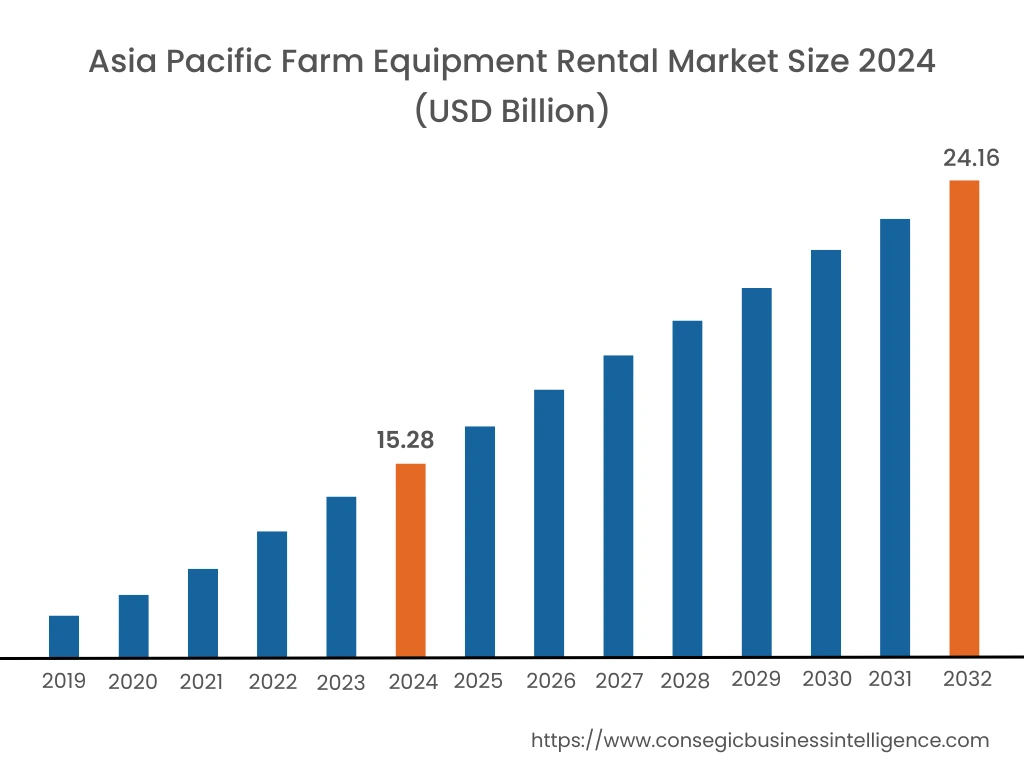
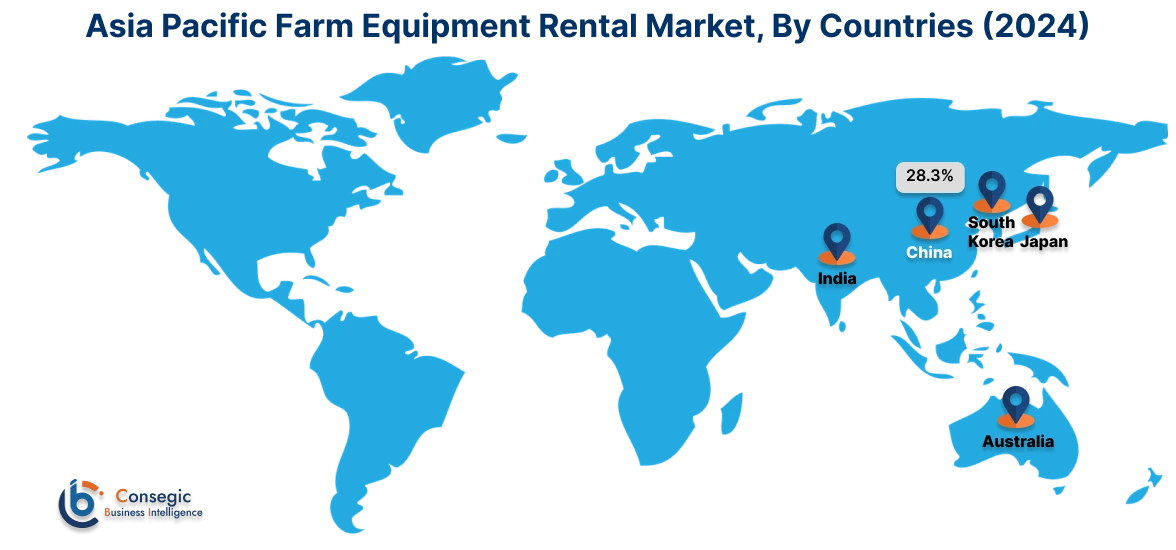
Asia Pacific region was valued at USD 15.28 Billion in 2024. Moreover, it is projected to grow by USD 15.90 Billion in 2025 and reach over USD 24.16 Billion by 2032. Out of this, China accounted for the maximum revenue share of 28.3%.
In Asia‑Pacific, China and India dominate by deploying digital marketplaces for tractor and combine rentals, with Japan and South Korea introducing autonomous‑ready platforms for greenhouse and high‑value orchard applications. The integration of IoT sensors into rented machinery to optimize utilization and bundled service packages, maintenance plus operator training is gaining traction in emerging markets such as Thailand and Vietnam. Analysis of the market showed that shifting trend towards rural mechanization schemes and trade‑fair demonstrations and joint ventures between global OEMs and local fabricators have significantly driven the Farm Equipment Rental market demand.
North America is estimated to reach over USD 29.32 Billion by 2032 from a value of USD 18.77 Billion in 2024 and is projected to grow by USD 19.51 Billion in 2025.
In North America, dynamic shift toward technologically advanced farming methods, where precision agriculture is increasingly supported by smart rental platforms and real‑time data platforms boosts market growth. Shifting farm economics and technology adoption are reshaping farm equipment rental across the United States, Canada, and Mexico. Notable trends support the rise of online rental platforms in the U.S., where short‑term leasing meets peak seasonal needs and the rising remote‑site equipment drop‑off services propels market development.
- For instance, in April 2024, CASE Construction Equipment announced the launch of their big lineup of new equipment upgrades that are Easy-to-Use, Easy-to-Own Machines for rental companies to help them grow their business in North America. Their objective with the introduction of these new machines and upgrades is to improve the return on investment for both rental companies and their clients.
Analysis of the market showed that flexible financing options and integrated maintenance support and strategic alliances between rental firms and farmers are significantly driving the Farm Equipment Rental industry in this region.
Europe exhibits a strong presence in the market due to the sustainability goals and environmental regulations in this region. Across Europe, leading countries like Germany and France are driving rental uptake with advanced telematics and usage‑based billing models, as Spain and Italy follow suit by offering cooperative hub schemes in wine and olive‑growing districts. Furthermore, market analysis depicts that incentive programs supporting resource efficiency and developing mobile apps that allow farmers to reserve machinery in real-time significantly boosts the Farm Equipment Rental market in this region.
Across the Middle East and Africa, agriculture is adapting to the challenges posed by arid climates and resource scarcity by turning to smart seasonal rental machinery. Desert and semi‑arid conditions in the United Arab Emirates and South Africa are leading to specialized rental fleets equipped with drought‑resilient implements, while Morocco and Egypt explore twilight‑operating schedules supported by solar‑powered equipment. Analysis of the market showed that targeted policy measures supporting food security spur rental offerings and partnerships with international logistics providers
In Latin America, Brazil’s large‑scale soybean and corn producers are embracing rental models that include digital tracking and prepaid usage plans, and Argentina’s viticulture regions follow with cooperative fleets for seasonal needs. One notable trend is the deployment of cloud‑based reservation systems to manage inventory across multiple locations, while another trends emphasizes value‑added services, such as operator certification and performance reporting, to enhance transparency. Analysis of the market showed that initiatives to modernize agricultural operations support rental market uptake and alliances between agritech startups and traditional rental companies drives Farm Equipment Rental market growth in this region.
Top Key Players and Market Share Insights:
The Farm Equipment Rental Market is highly competitive with major players providing products and services to the national and international markets. Key players are adopting several strategies in research and development (R&D), product innovation, and end-user launches to hold a strong position in the global Farm Equipment Rental Market. Key players in the Farm Equipment Rental industry include -
- Deere & Company (United States)
- CNH Industrial (United Kingdom)
- United Rentals, Inc. (United States)
- Mahindra&Mahindra Ltd. (India)
- Tractor Junction (India)
- United Ag & Turf (United States)
- Khetigaadi (India)
- Krushak Smart Farming Solutions Pvt. Ltd. (India)
- One Farmer Agri Technologies Private Limited (India)
- Sunbelt Rentals, Inc. (United States)
Recent Industry Developments :
Product Launches:
- In May 2024, United Rentals Inc. announced their adoption across new digital platforms including Total Control, United Rentals Mobile App, and the online marketplace. These platforms enable consumers to rent equipment, check real-time status of deliveries, place service calls and track status, take equipment off rent, and make payments. Additionally, customers are able to remotely track equipment usage through telematics, allowing them to optimize fleet for each project and ensure efficient utilization of rented machinery.
Farm Equipment Rental Market Report Insights :
| Report Attributes | Report Details |
| Study Timeline | 2019-2032 |
| Market Size in 2032 | USD 88.02 Billion |
| CAGR (2025-2032) | 5.7% |
| By Equipment Type |
|
| By Power Output |
|
| By Rental Channel |
|
| By End-Users |
|
| By Region |
|
| Key Players |
|
| North America | U.S. Canada Mexico |
| Europe | U.K. Germany France Spain Italy Russia Benelux Rest of Europe |
| APAC | China South Korea Japan India Australia ASEAN Rest of Asia-Pacific |
| Middle East and Africa | GCC Turkey South Africa Rest of MEA |
| LATAM | Brazil Argentina Chile Rest of LATAM |
| Report Coverage |
|
Key Questions Answered in the Report
How big is the Farm Equipment Rental Market? −
Farm Equipment Rental Market size is estimated to reach over USD 88.02 Billion by 2032 from a value of USD 56.45 Billion in 2024 and is projected to grow by USD 58.67 Billion in 2025, growing at a CAGR of 5.7% from 2025 to 2032.
What specific segments are covered in the Farm Equipment Rental Market? +
The Farm Equipment Rental Market specific segments for Equipment Type, Power Output, Rental Channel, End-Users and Region.
Which is the fastest-growing region in the Farm Equipment Rental Market? +
Asia pacific is the fastest growing region in the Farm Equipment Rental Market.
What are the major players in the Farm Equipment Rental Market? +
The key players in the Farm Equipment Rental Market are Deere & Company (United States), CNH Industrial (United Kingdom), United Rentals, Inc. (United States), Mahindra&Mahindra Ltd. (India), Tractor Junction (India), United Ag & Turf (United States), Khetigaadi (India), Krushak Smart Farming Solutions Pvt. Ltd. (India), One Farmer Agri Technologies Private Limited (India), Sunbelt Rentals, Inc. (United States), and others.
Overview
Reputation & Certifications


Our Services
- Market Intelligence & Forecasting
- Custom Research Solutions
- Market Entry Strategy
- Competitive Intelligence
- Customer Insights
- Industry Innovation Analysis
- Investment Advisory