Jump to Content
Fitness Equipment Market - Size, Share, Industry Trends, and Forecasts (2025-2032)
Fitness Equipment Market Size:
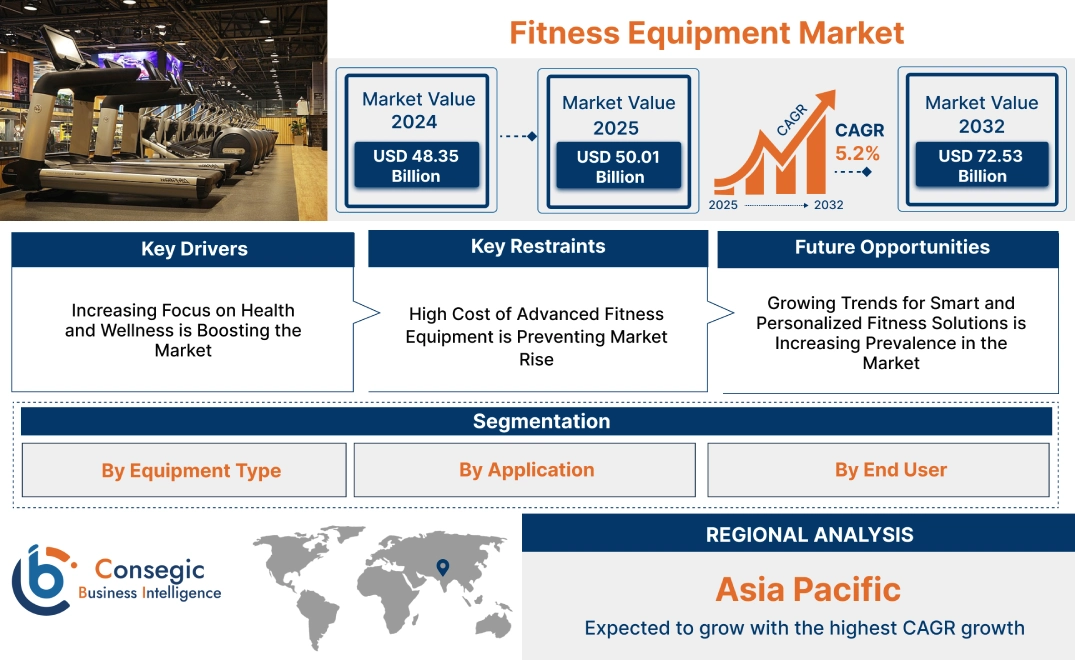
The Fitness Equipment Market size is estimated to reach over USD 72.53 Billion by 2032 from a value of USD 48.35 Billion in 2024 and is projected to grow by USD 50.01 Billion in 2025, growing at a CAGR of 5.2% from 2025 to 2032.
Fitness Equipment Market Scope & Overview:
The fitness equipment focuses on developing, manufacturing, and distributing equipment designed to support physical exercise, strength training, and overall health improvement. This market includes a wide range of products such as treadmills, stationary bikes, elliptical machines, free weights, resistance machines, and multifunctional gym equipment. These products cater to both individual users and commercial facilities such as gyms, health clubs, and rehabilitation centers.
Key characteristics of fitness equipment include durability, ergonomic designs, advanced digital interfaces, and connectivity with fitness-tracking apps and wearable devices. The benefits include improved physical fitness, enhanced workout efficiency, and personalized fitness tracking capabilities.
Applications span residential fitness, commercial gyms, corporate wellness programs, and rehabilitation centers, catering to different demographics and fitness levels. End-users include individuals, gym owners, corporate wellness managers, and healthcare facilities, driven by increasing health and fitness awareness, rising prevalence of lifestyle-related disorders, and advancements in smart and connected fitness technologies.
Fitness Equipment Market Dynamics - (DRO) :
Key Drivers:
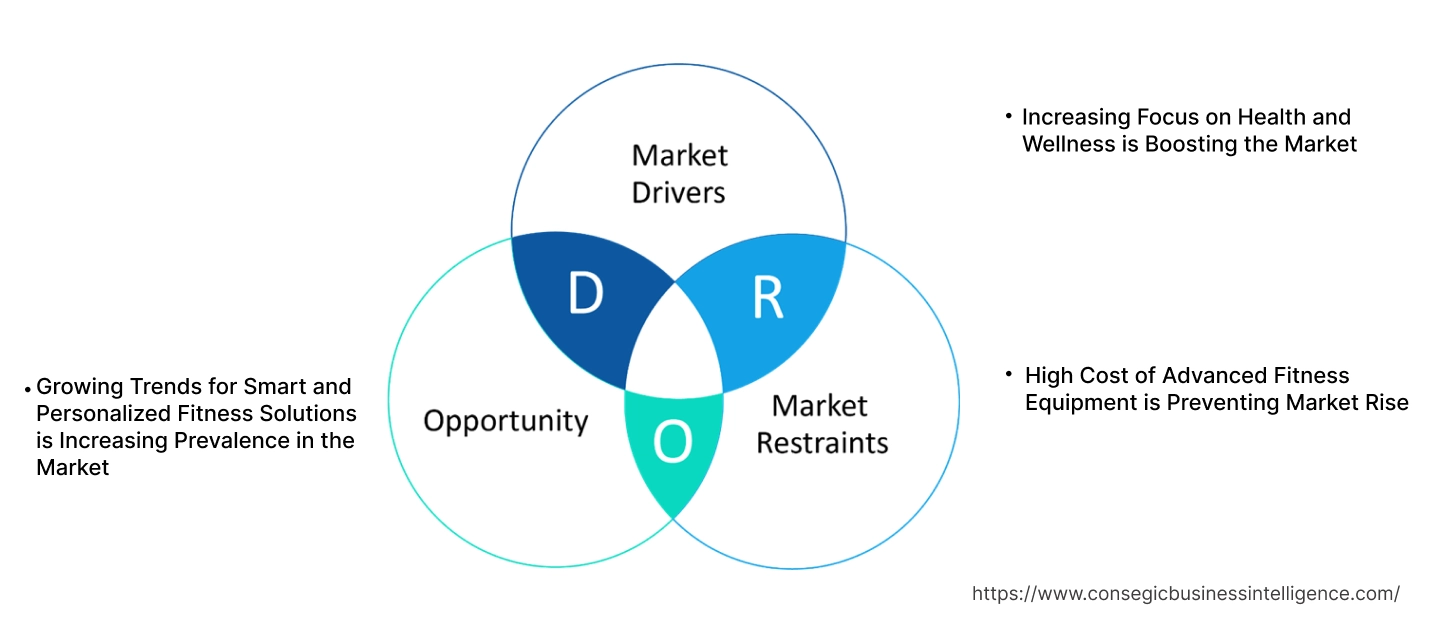
Increasing Focus on Health and Wellness is Boosting the Market
The growing awareness of health and wellness, driven by rising incidences of lifestyle-related diseases such as obesity, diabetes, and cardiovascular conditions, is a significant driver for the market. Consumers are increasingly investing in fitness equipment for home and commercial use to maintain an active lifestyle. Additionally, the popularity of at-home fitness solutions has surged, particularly following the COVID-19 pandemic, as people seek convenient ways to exercise. Advanced fitness equipment with features such as digital connectivity, app integration, and real-time performance tracking is gaining traction, as users prioritize personalized fitness experiences. The integration of technologies like AI, IoT, and virtual reality (VR) in fitness equipment is further enhancing consumer engagement and driving fitness equipment market trends.
Key Restraints:
High Cost of Advanced Fitness Equipment is Preventing Market Rise
A significant restraint for this market is the high cost of technologically advanced equipment, which limits accessibility to a broader consumer base. High-end equipment featuring connected fitness platforms, digital displays, and performance analytics can be cost-prohibitive, particularly for individuals and smaller gyms in emerging markets. Additionally, the maintenance and operational expenses associated with advanced machines pose challenges for commercial fitness facilities. The presence of low-cost alternatives and second-hand equipment further intensifies price competition, making it difficult for premium manufacturers to penetrate price-sensitive markets.
Future Opportunities :
Growing Trends for Smart and Personalized Fitness Solutions is Increasing Prevalence in the Market
The increasing adoption of smart fitness equipment and demand for personalized workout solutions present significant growth opportunities for the market. Smart fitness equipment equipped with AI and IoT capabilities enables users to monitor performance metrics such as heart rate, calorie burn, and exercise intensity in real-time. Moreover, fitness equipment integrated with virtual coaching platforms and on-demand workout content offers personalized training experiences, enhancing user engagement. The rise of hybrid fitness models, where users can combine gym workouts with virtual sessions at home, is also driving the trends for connected fitness equipment. Manufacturers focusing on developing compact, affordable, and smart fitness devices tailored for home use are well-positioned to capitalize on this growing trend.
These dynamics emphasize the increasing importance of fitness equipment in supporting health and wellness goals, driven by evolving consumer preferences for convenience and technology-driven solutions. While cost remains a barrier, advancements in smart and personalized fitness offerings are creating new opportunities for innovation that results in fitness equipment market expansion.
Fitness Equipment Market Segmental Analysis :
By Equipment Type:
Based on equipment type, the market is segmented into cardiovascular training equipment, strength training equipment, body composition analyzers, and others.
The cardiovascular training equipment segment accounted for the largest revenue in fitness equipment market share in 2024.
- Cardiovascular training equipment, such as treadmills, elliptical machines, and stationary bikes, is widely used for improving cardiovascular health and endurance.
- Rising consumer focus on heart health and weight management has led to increased adoption in both home and commercial settings.
- Advancements in smart cardio equipment with integrated fitness tracking and connectivity features enhance user experience.
- Increasing awareness about the importance of aerobic exercises drives the dominance in this segmental analysis.
The body composition analyzers segment is anticipated to register the fastest CAGR during the forecast period.
- Body composition analyzers are gaining traction due to their ability to provide detailed insights into body fat, muscle mass, and hydration levels.
- Increasing adoption in gyms and health clubs for personalized fitness and weight management plans supports trends.
- Rising interest in health monitoring and wellness among individuals drives fitness equipment market trends for compact and portable analyzers for home use.
- Innovations in body composition technology, such as app connectivity and real-time data sharing, further propel as displayed in this segmental analysis.
By Application:
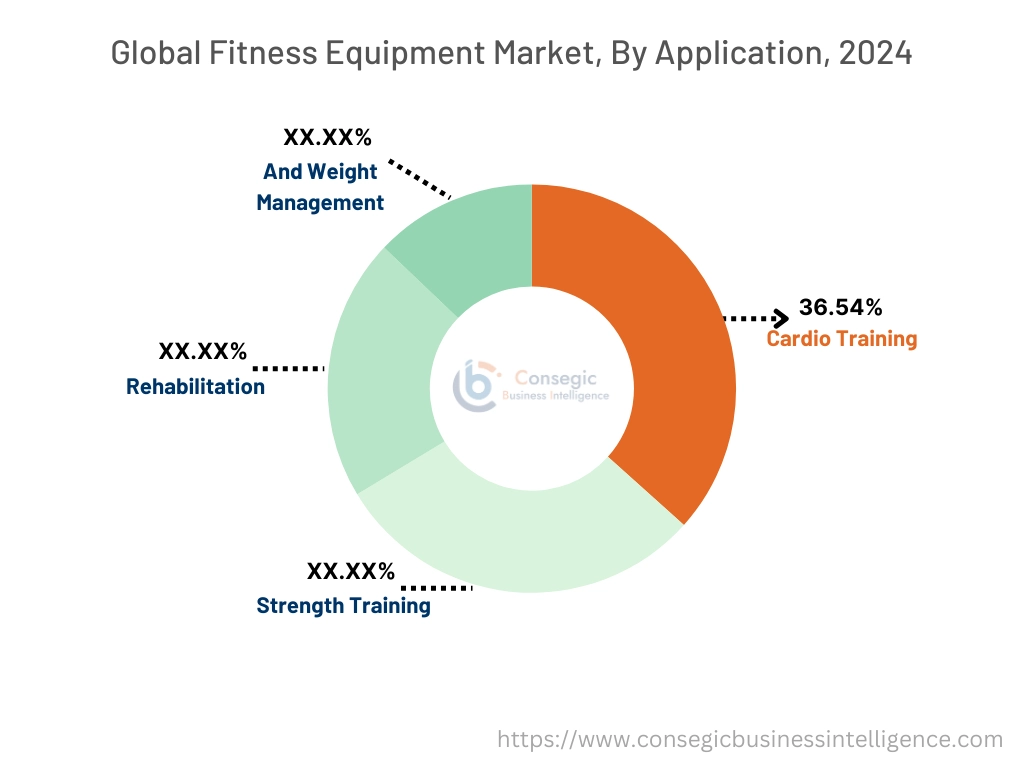
Based on application, the market is segmented into cardio training, strength training, rehabilitation, and weight management.
The cardio training segment accounted for the largest revenue of fitness equipment market share of 36.54% in 2024.
- Cardio training remains the foundation of fitness routines, making equipment for aerobic exercises highly sought after.
- Increasing awareness about the benefits of cardio training for cardiovascular health and overall fitness boosts in this segmental analysis.
- Expansion of fitness facilities offering specialized cardio programs supports the demand for cardio-focused equipment.
- The rising use of advanced treadmills and bikes with virtual training features enhances fitness equipment market growth.
The rehabilitation segment is anticipated to register the fastest CAGR during the forecast period.
- Rehabilitation-focused fitness equipment is increasingly used in hospitals and physiotherapy centers for recovery and injury prevention.
- Growing prevalence of lifestyle-related diseases and post-surgical recovery needs drive trends for rehabilitation equipment.
- Technological advancements in low-impact training devices for therapeutic use enhance patient outcomes.
- Expanding healthcare investments in advanced rehabilitation centers globally supports fitness equipment market growth as displayed in this segmental analysis.
By End-User:
Based on end-users, the market is segmented into home users, health clubs/gyms, hospitals and rehabilitation centers, corporate offices, and hotels and resorts.
The health clubs/gyms segment accounted for the largest revenue share in 2024.
- Health clubs and gyms remain the primary consumers of fitness equipment due to their need for diverse and high-performance machines.
- Rising memberships in fitness clubs driven by growing health consciousness support this segment’s dominance.
- Increasing investments in upgrading gym facilities with smart and connected fitness devices attract consumers.
- Expanding presence of premium fitness chains globally bolsters demand for professional-grade equipment.
The home users segment is anticipated to register the fastest CAGR during the forecast period.
- Home fitness equipment is gaining popularity due to the convenience and flexibility it offers for exercising at home.
- Increasing adoption of compact and multifunctional equipment suitable for home environments supports segmental trends.
- Rising consumer preference for home gyms, driven by trends for remote work and busy lifestyles, fuels fitness equipment market demand.
- Technological advancements in foldable and app-integrated devices enhance user engagement and adoption.
Regional Analysis:
The regions covered are North America, Europe, Asia Pacific, the Middle East and Africa, and Latin America.
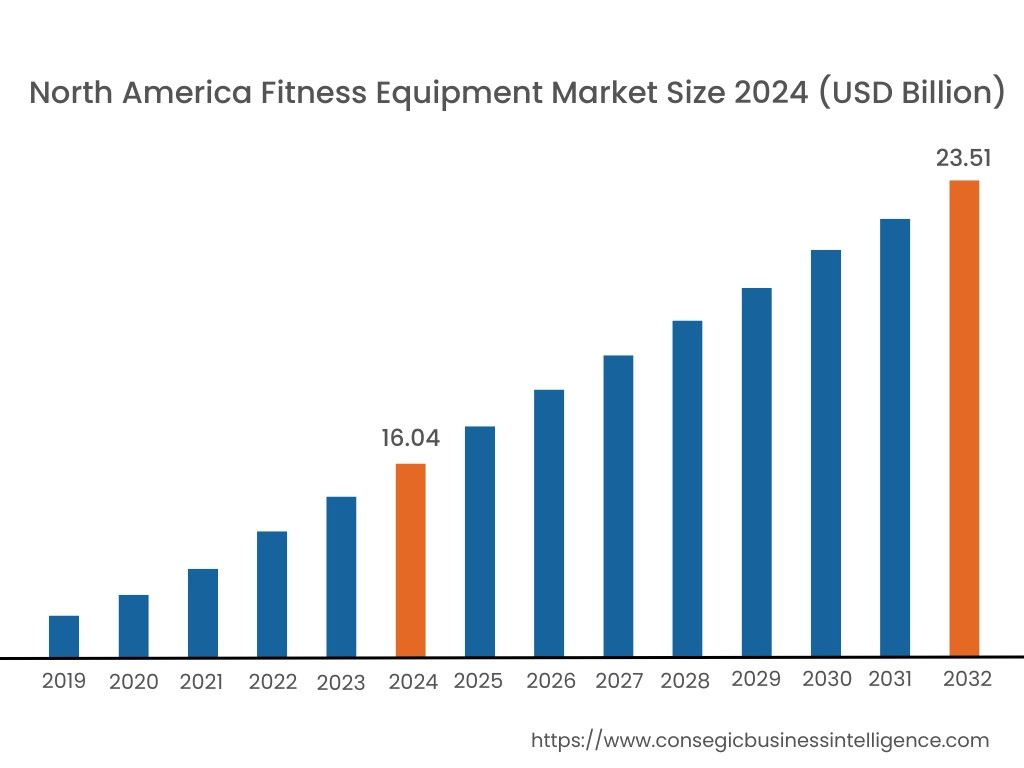
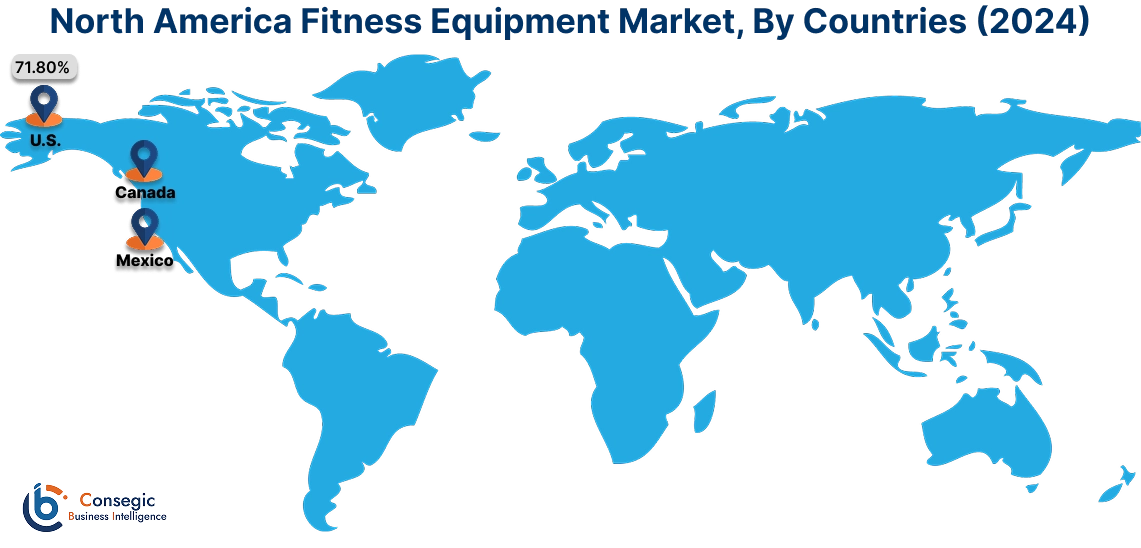
In 2024, North America was valued at USD 16.04 Billion and is expected to reach USD 23.51 Billion in 2032. In North America, the U.S. accounted for the highest share of 71.80% during the base year of 2024. North America holds a dominant share in the global fitness equipment market, driven by increasing health consciousness, high penetration of gym memberships, and growing demand for home fitness solutions. The U.S. leads the region due to its well-developed fitness culture, presence of major fitness equipment manufacturers, and rising adoption of advanced connected fitness devices. Home fitness equipment, such as treadmills, stationary bikes, and resistance machines, has gained popularity, particularly with the rising preference for at-home workouts. Canada contributes with an increasing focus on wellness and health clubs, supported by government-led health awareness programs. However, the premium pricing of advanced fitness equipment may limit adoption in lower-income groups.
In Asia Pacific, the market is experiencing the fastest growth with a CAGR of 5.6% over the forecast period. The fitness equipment market, is fueled by rising urbanization, increasing disposable incomes, and growing awareness about fitness and health in China, India, and Japan. China dominates the region with a booming fitness industry, including gym chains and rising sales of home fitness equipment. India’s growing middle-class population and increased focus on wellness drive demand for affordable and portable fitness equipment. Japan emphasizes technologically advanced fitness solutions, such as connected equipment with integrated health tracking features, catering to its tech-savvy population. However, the high cost of advanced equipment and limited gym penetration in rural areas may hinder growth in certain parts of the region.
Europe is a prominent market for fitness equipment, supported by a strong emphasis on health and wellness, growing gym memberships, and increasing adoption of home fitness solutions. Countries like Germany, the UK, and France are key contributors. As per fitness equipment market analysis, it is portrayed that Germany drives the market with its robust fitness club culture and high usage of advanced strength and cardio equipment. The UK emphasizes at-home fitness solutions, fueled by the increasing adoption of smart fitness devices. France focuses on expanding public fitness infrastructure, including outdoor gym equipment in urban areas. However, market analysis highlights that economic challenges and fluctuating consumer spending on non-essential goods may affect market growth.
The Middle East & Africa region is witnessing steady growth in the global fitness equipment market, driven by increasing awareness about physical health, rising investments in fitness clubs, and government initiatives to promote healthy lifestyles. Countries like Saudi Arabia and the UAE are adopting advanced fitness equipment in high-end gyms and wellness centers, supported by government efforts to reduce lifestyle-related diseases. In Africa, South Africa is emerging as a key market, focusing on affordable gym setups and fitness programs to cater to a growing health-conscious population. However, the fitness equipment market analysis shows limited purchasing power, and inconsistent fitness infrastructure in certain areas may restrict broader market development.
Latin America is an emerging market, with Brazil and Mexico leading the region. Brazil’s increasing fitness culture, coupled with a rising number of gyms and health clubs, drives fitness equipment market demand for both commercial and home-use fitness equipment. Mexico focuses on integrating fitness programs in schools and workplaces, creating new fitness equipment market opportunities for fitness equipment manufacturers. The region also benefits from rising awareness about fitness and wellness among the younger population. However, economic instability and fluctuating import regulations in smaller economies may pose challenges to fitness equipment market expansion.
Top Key Players and Market Share Insights:
The fitness equipment market is highly competitive with major players providing products and services to the national and international markets. Key players are adopting several strategies in research and development (R&D), product innovation, and end-user launches to hold a strong position in the global fitness equipment market. Key players in the fitness equipment industry include -
- Nautilus, Inc. (United States)
- Life Fitness (United States)
- Technogym S.p.A. (Italy)
- Precor Incorporated (United States)
- Johnson Health Tech Co., Ltd. (Taiwan)
- ICON Health & Fitness, Inc. (United States)
- Matrix Fitness (United States)
- Cybex International (United States)
- True Fitness Technology, Inc. (United States)
- Shuhua Sports Co., Ltd. (China)
Recent Industry Developments :
Innovations:
- In November 2023, Peloton introduced the Peloton Row, a premium indoor rowing machine priced at $2,995. This addition to Peloton's lineup underscores the company's commitment to expanding its at-home fitness offerings. The Peloton Row features a 23.8-inch touchscreen display, providing users with access to a comprehensive library of interactive classes, including rowing, strength training, yoga, meditation, cardio, and stretching workouts. Equipped with sensors in the seat and handle, the machine monitors user movements to ensure proper form throughout workouts. This development highlights Peloton's strategic efforts to diversify its product range and cater to the growing demand for versatile home fitness equipment
Research and Innovation:
- In July 2024, NordicTrack announced an annual investment of over $15 Billion in research and development, emphasizing its commitment to innovation in the home fitness equipment market. The company leverages its 25+ years of expertise to design advanced products incorporating cutting-edge technology and ergonomic features. This substantial investment positions NordicTrack as a leader in developing innovative fitness solutions to cater to evolving consumer demands.
Fitness Equipment Market Report Insights :
| Report Attributes | Report Details |
| Study Timeline | 2019-2032 |
| Market Size in 2032 | USD 72.53 Billion |
| CAGR (2025-2032) | 5.2% |
| By Equipment Type |
|
| By Application |
|
| By End-User |
|
| By Region |
|
| Key Players |
|
| North America | U.S. Canada Mexico |
| Europe | U.K. Germany France Spain Italy Russia Benelux Rest of Europe |
| APAC | China South Korea Japan India Australia ASEAN Rest of Asia-Pacific |
| Middle East and Africa | GCC Turkey South Africa Rest of MEA |
| LATAM | Brazil Argentina Chile Rest of LATAM |
| Report Coverage |
|
Key Questions Answered in the Report
What is the current and projected size of the Fitness Equipment Market? −
The Fitness Equipment Market size is estimated to reach over USD 72.53 Billion by 2032 from a value of USD 48.35 Billion in 2024 and is projected to grow by USD 50.01 Billion in 2025, growing at a CAGR of 5.2% from 2025 to 2032.
What are the key segments in the Fitness Equipment Market? +
The market is segmented by Equipment Type (Cardiovascular Training Equipment, Strength Training Equipment, Body Composition Analyzers, Others), Application (Cardio Training, Strength Training, Rehabilitation, Weight Management), and End-User (Home Users, Health Clubs/Gyms, Hospitals, Corporate Offices, Hotels and Resorts).
Which segment holds the largest share in the Fitness Equipment Market? +
Cardiovascular Training Equipment accounted for the largest share in 2024 due to its widespread use in improving cardiovascular health and endurance.
Which segment is expected to grow the fastest in the Fitness Equipment Market? +
The Body Composition Analyzers segment is projected to grow at the fastest CAGR, driven by rising interest in health monitoring and personalized fitness plans.
What are the main factors driving the growth of the Fitness Equipment Market? +
The market is driven by increasing health awareness, the rising prevalence of lifestyle-related diseases, advancements in smart fitness technologies, and the growing trend of at-home fitness solutions.
Overview
Reputation & Certifications


Our Services
- Market Intelligence & Forecasting
- Custom Research Solutions
- Market Entry Strategy
- Competitive Intelligence
- Customer Insights
- Industry Innovation Analysis
- Investment Advisory