Jump to Content
Gene Panel Market - Size, Share, Industry Trends, and Forecasts (2025 - 2032)
Gene Panel Market Size:
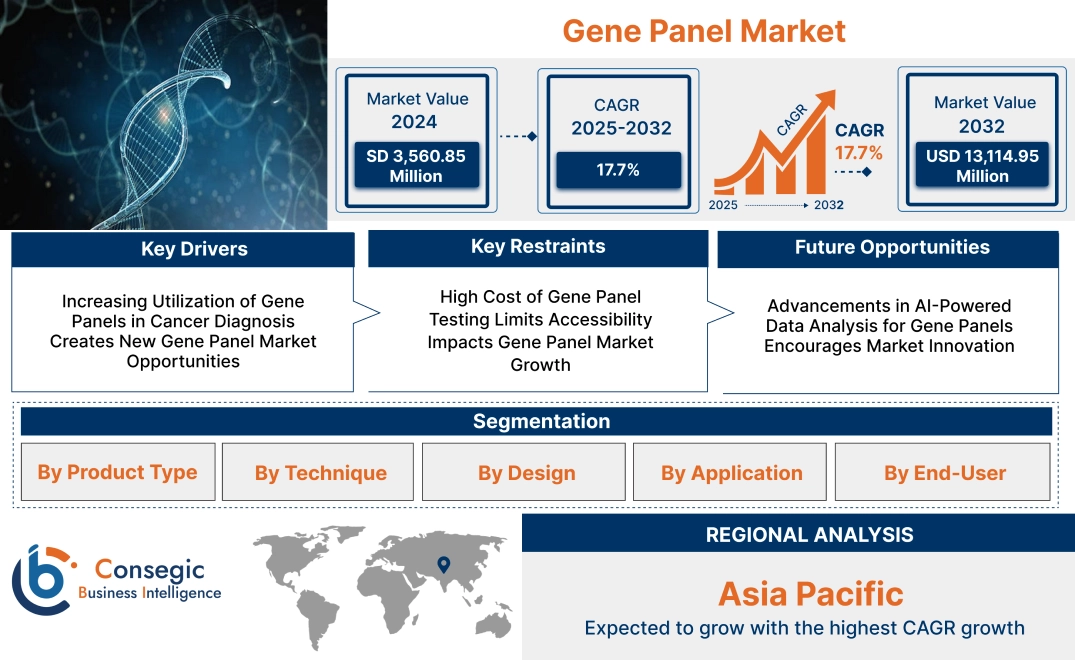
Gene Panel Market size is estimated to reach over USD 13,114.95 Million by 2032 from a value of USD 3,560.85 Million in 2024 and is projected to grow by USD 4,127.67 Million in 2025, growing at a CAGR of 17.7% from 2025 to 2032.
Gene Panel Market Scope & Overview:
Gene panels are diagnostic tools designed to analyze multiple genes simultaneously for identifying genetic mutations linked to diseases or traits. These panels utilize advanced sequencing technologies to provide accurate and reliable results in a time-efficient manner. Gene panels offer features like high specificity, targeted sequencing, and customizable content for disease-specific gene analysis. They support precision medicine by identifying genetic predispositions and facilitating tailored treatment plans.
The benefits of gene panels include efficient diagnosis, cost-effectiveness, and reduced testing time. They enhance healthcare outcomes by enabling early detection of hereditary conditions and complex disorders. Applications of gene panels span oncology, cardiology, neurology, and rare genetic diseases. End-use industries include clinical diagnostics, research institutions, biotechnology firms, and pharmaceutical companies, underscoring their significance in advancing medical research and patient care.
How is AI Impacting the Gene Panel Market?
AI is revolutionizing the gene panel market by accelerating gene discovery, enhancing diagnostic accuracy, and enabling personalized medicine through improved data analysis and automation. AI-powered tools analyze vast amounts of genomic data to identify disease-related genes, predict disease risks, and streamline the development of targeted gene therapies, leading to more effective and personalized healthcare solutions.
Gene Panel Market Dynamics - (DRO) :
Key Drivers:
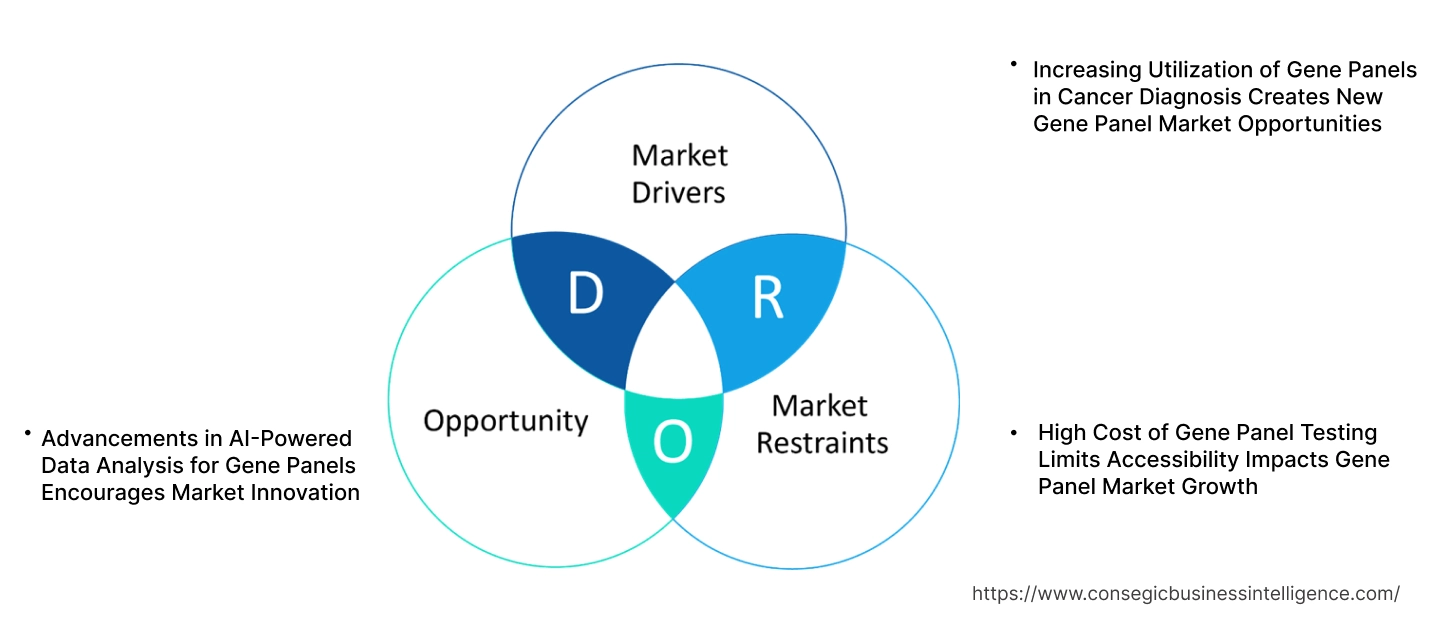
Increasing Utilization of Gene Panels in Cancer Diagnosis Creates New Gene Panel Market Opportunities
Gene panels are widely adopted for identifying genetic mutations associated with various cancers, aiding in precise diagnosis and personalized treatment plans. These panels enable healthcare professionals to detect actionable mutations by analyzing multiple genes simultaneously, streamlining the diagnostic process and improving patient outcomes. For instance, BRCA1 and BRCA2 gene panels are used to identify breast and ovarian cancer risks, facilitating timely medical intervention.
This critical role of gene panels in enhancing cancer diagnostics significantly contributes to the gene panel market expansion.
Key Restraints:
High Cost of Gene Panel Testing Limits Accessibility Impacts Gene Panel Market Growth
The expenses associated with gene panel testing, including laboratory infrastructure, reagents, and professional expertise, restrict adoption, particularly in low-income regions. These costs create financial barriers for patients and healthcare systems, impacting widespread utilization. For example, comprehensive gene panels for hereditary diseases can cost thousands of dollars, limiting accessibility for many patients.
The high costs involved in gene panel testing hinder market adoption, particularly among economically constrained populations.
Future Opportunities :
Advancements in AI-Powered Data Analysis for Gene Panels Encourages Market Innovation
The integration of artificial intelligence (AI) into gene panel testing is anticipated to transform the market by enhancing data analysis and interpretation accuracy. AI algorithms will facilitate faster identification of genetic variants, improving the reliability of test results and accelerating clinical decision-making processes. For instance, AI-driven platforms are expected to identify rare mutations more efficiently, enabling early disease detection and prevention strategies.
The future application of AI-powered analytics in gene panel testing is poised to unlock substantial gene panel market opportunities, driving innovation and adoption globally.
Gene Panel Market Segmental Analysis :
By Product & Service:
Based on product and service, the gene panel market is segmented into test kits & reagents and services.
The test kits & reagents segment accounted for the largest revenue in gene panel market share in 2023.
- The test kits & reagents segment includes pre-configured gene panels, reagents, and consumables essential for conducting gene testing.
- This segment is growing due to the increasing adoption of genetic testing in diagnostics, personalized medicine, and research.
- Reagents are crucial for amplifying genetic material, and the availability of pre-designed kits enhances the ease of testing, offering standardized and reliable results.
- As research and diagnostics sectors adopt these tools, the trend for test kits & reagents continues to rise.
- The widespread use of these kits across hospitals, diagnostic labs, and academic institutions fuels gene panel market growth.
- Therefore, according to gene panel market analysis, the test kits & reagents segment is poised to maintain its dominance due to the growing trend for genetic diagnostics and personalized treatment solutions.
The services sector is anticipated to register the fastest CAGR during the forecast period.
- This segment encompasses services such as genetic testing, sequencing, and panel design tailored to specific research or clinical needs.
- The surge in trend for genetic testing for cancer, hereditary disorders, and pharmacogenomics has expanded the role of service providers.
- Additionally, services enable customized testing for various conditions and provide insights into genetic predispositions, which are integral for personalized medicine.
- Service-based models also facilitate access to the latest genetic testing technologies, driving their adoption.
- Thus, according to gene panel market analysis, with the increasing focus on genomics and its integration in clinical applications, the services segment is set to expand rapidly.
By Technique:
Based on technique, the market is segmented into amplicon-based targeted sequencing and hybridization-based targeted sequencing.
The amplicon-based targeted sequencing segment accounted for the largest revenue in gene panel market share in 2023.
- Amplicon-based sequencing targets specific gene regions, providing highly accurate results, which makes it highly preferred in research and diagnostics.
- This technique is widely used due to its cost-effectiveness, flexibility in designing panels, and the ability to capture small genetic alterations.
- It plays a critical role in cancer genomics, pharmacogenetics, and other genetic testing applications.
- The ability to focus on specific regions of interest allows for quicker and more efficient sequencing, thus enhancing its trend across various sectors.
- Therefore, according to market analysis, the amplicon-based technique remains a key contributor to market revenue due to its widespread application in genetic diagnostics and research.
The hybridization-based targeted sequencing segment is anticipated to register the fastest CAGR during the forecast period.
- Hybridization-based sequencing utilizes probes to capture target regions from the genome, making it useful for detecting mutations and variations across a broad spectrum of genes.
- This technique is favored for its robustness, sensitivity, and versatility in different types of genetic analyses.
- With technological advancements in probe design and hybridization methods, this technique is expanding rapidly in clinical diagnostics, particularly in rare genetic disorders and cancer genomics.
- Thus, according to market analysis, as the trend for non-invasive and more accurate diagnostics grows, hybridization-based sequencing is expected to experience significant growth.
By Design:
Based on design, the market is segmented into predesigned gene panels and customized gene panels.
The predesigned gene panels segment accounted for the largest revenue share in 2023.
- Predesigned gene panels provide standardized testing solutions for various genetic conditions, such as cancer and inherited disorders.
- These panels are widely adopted due to their convenience, comprehensive coverage, and consistency in diagnostic results.
- The segment benefits from the increasing preference for clinically validated panels, which have a proven track record in identifying genetic mutations and abnormalities.
- As they are ready-to-use and easy to implement, predesigned panels are driving their popularity in clinical and research environments.
- Therefore, according to market analysis, the predesigned gene panels segment continues to dominate the market, with their broad applicability in genetic testing.
The customized gene panels segment is expected to register the fastest CAGR during the forecast period.
- Customized gene panels are designed according to the specific needs of a patient or research project, enabling a personalized approach to genetic testing.
- This segment is expanding rapidly, particularly in cancer research and precision medicine, as it allows for tailored genetic assessments.
- With the growing emphasis on personalized treatments and targeted therapies, the gene panel market demand for customized gene panels is expected to rise significantly.
- Thus, according to market analysis, as research advances and genetic data becomes more precise, the need for customized panels will continue to grow, driving innovation in the segment.
By Application:
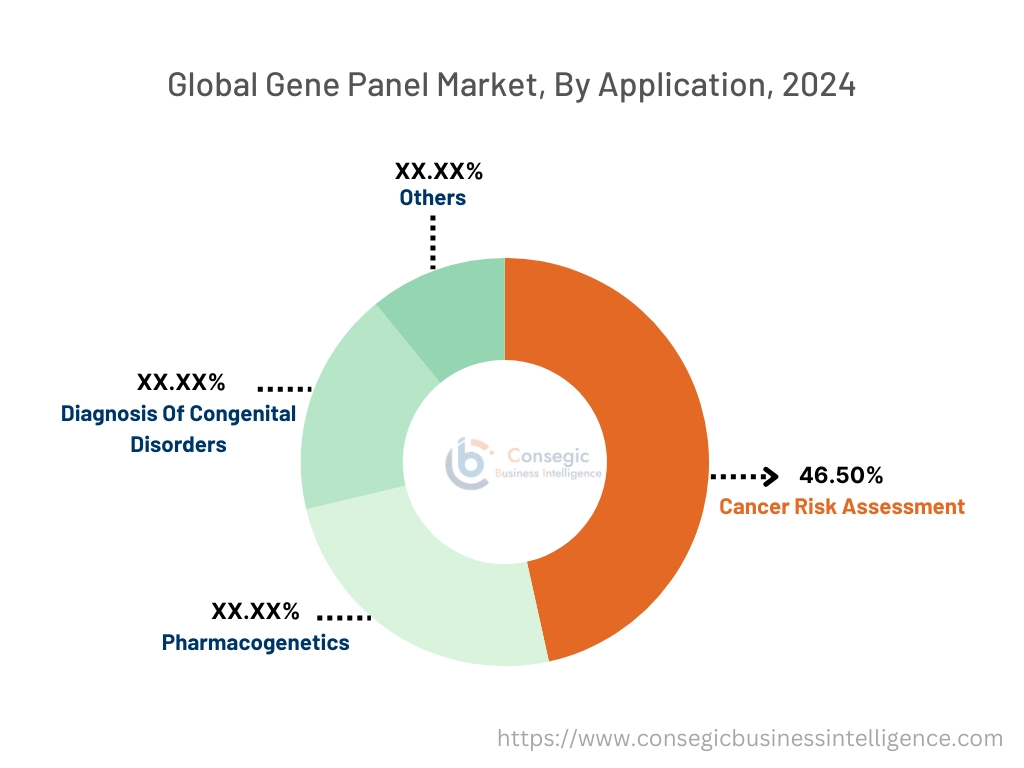
Based on application, the gene panel market is segmented into cancer risk assessment, pharmacogenetics, diagnosis of congenital disorders, and others.
The cancer risk assessment segment accounted for the largest revenue share of 46.50% in 2023.
- Cancer risk assessment utilizes gene panels to identify genetic predispositions to various types of cancer, enabling early detection and personalized treatment plans.
- This application has witnessed substantial growth due to the rising prevalence of cancer and the growing adoption of genetic testing in oncology.
- Gene panels for cancer risk assessment help healthcare providers offer tailored prevention and treatment strategies, which is driving their increasing use in clinical settings.
- Therefore, according to market analysis, as the awareness of genetic testing for cancer risk grows, this segment is expected to continue dominating the market.
The pharmacogenetics segment is anticipated to register the fastest CAGR during the forecast period.
- Pharmacogenetics involves using genetic information to predict a patient’s response to specific drugs, which is crucial for personalized medicine.
- With the increasing emphasis on tailoring drug treatments to individual genetic profiles, the pharmacogenetics segment is expanding rapidly.
- Advances in genomics and the integration of genetic testing into clinical practice are expected to propel the growth of this segment, particularly in drug development and therapeutic applications.
- Thus, according to market analysis, pharmacogenetics is poised to become a significant driver of gene panel market expansion in the coming years.
By End-User:
Based on end-users, the gene panel market is segmented into hospitals & diagnostic laboratories, academic & research institutions, and pharmaceutical & biotechnology companies.
The hospitals & diagnostic laboratories segment accounted for the largest revenue share in 2023.
- Hospitals and diagnostic laboratories use gene panels extensively for clinical diagnostics, including disease risk assessments and genetic disorder diagnoses.
- The increasing availability of advanced genomic technologies in these settings has boosted the gene panel market demand for gene panels.
- As personalized medicine becomes more prevalent, hospitals and diagnostic laboratories are becoming key players in the adoption of genetic testing, thus contributing to the market’s growth.
- Therefore, according to market analysis, this segment continues to lead the market, driven by the growing need for accurate genetic diagnostics in healthcare.
The pharmaceutical & biotechnology companies segment is anticipated to register the fastest CAGR during the forecast period.
- Pharmaceutical and biotechnology companies use gene panels for drug development, clinical trials, and precision medicine applications.
- The growing trend of personalized medicine and the need for genetic testing in drug efficacy and safety evaluations is fueling the demand for gene panels among these companies.
- With ongoing advancements in genomic technologies and their integration into drug discovery processes, this segment is expected to experience significant growth.
- Thus, according to market analysis, pharmaceutical & biotechnology companies are likely to become major contributors to the market expansion over the next few years.
Regional Analysis:
The regional segment includes North America, Europe, Asia Pacific, Middle East and Africa, and Latin America.
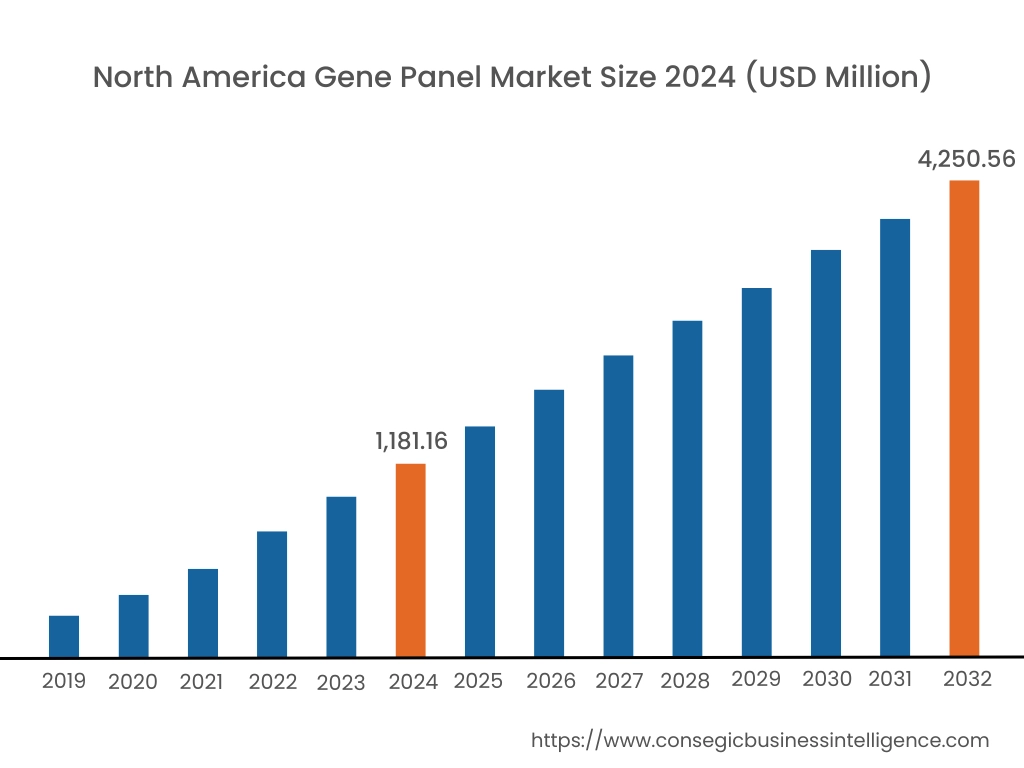
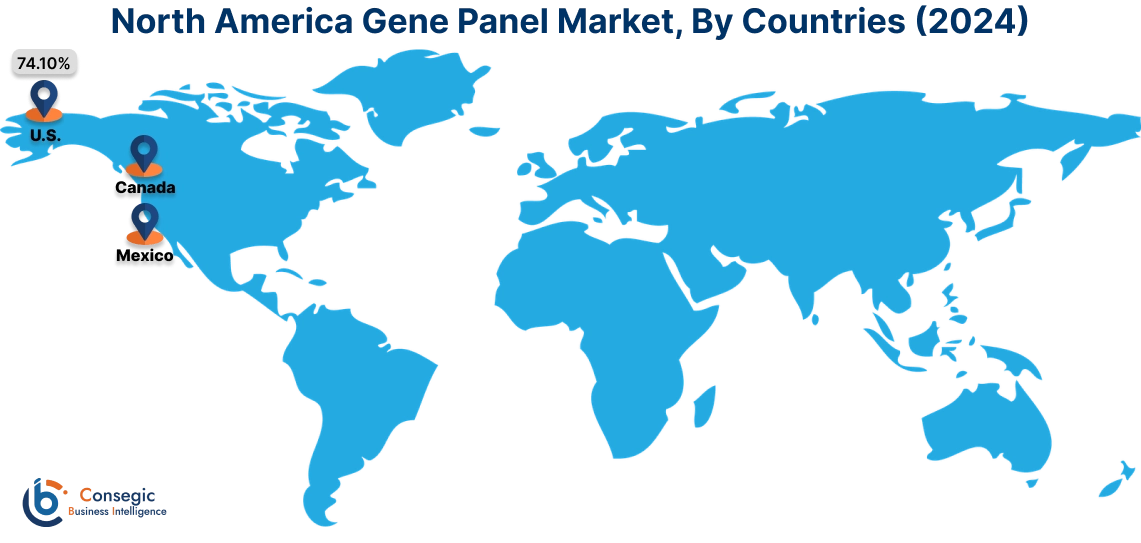
In 2024, North America was valued at USD 1,181.16 Million and is expected to reach USD 4,250.56 Million in 2032. In North America, the U.S. accounted for the highest share of 74.10% during the base year of 2024. The United States leads the market due to strong investments in healthcare and biotechnology. The adoption of advanced genetic testing technologies, particularly for cancer and hereditary diseases, supports the demand for gene panels. Additionally, the presence of well-established healthcare infrastructure and key players in the region, along with increased awareness of personalized medicine, accelerates gene panel market trend. Moreover, research funding and advancements in genomics further enhance market performance in North America.
In Asia Pacific, the market is experiencing the fastest growth with a CAGR of 18.2% over the forecast period. It is driven by growing healthcare needs and the increasing prevalence of genetic disorders. Countries like China, Japan, and India are focusing on improving healthcare services, leading to higher demand for genetic testing solutions. The region's rising investments in biotechnology and genomics research contribute to the adoption of gene panels. Furthermore, the growing focus on personalized medicine and precision healthcare in emerging markets like India and China significantly boosts market performance.
Europe represents a significant portion of the global gene panel market, with countries like Germany, the UK, and France contributing the most. The demand for gene panels is primarily driven by the increasing prevalence of genetic diseases and the growing use of genetic testing in clinical applications. Europe’s strong regulatory framework, which supports personalized medicine and genomic research, further enhances market adoption. The region’s public healthcare systems are increasingly integrating genetic testing into routine clinical practice, expanding the application of gene panels across various therapeutic areas, including oncology and rare genetic disorders.
The Middle East and Africa exhibit moderate gene panel market trend. While the region's healthcare infrastructure continues to develop, the adoption of gene panels remains limited by factors such as economic constraints and access to advanced healthcare technologies. However, countries like the UAE and Saudi Arabia are making significant progress in expanding their healthcare systems, which supports the demand for genetic testing services. Increased awareness of genetic diseases and growing investment in healthcare technologies contribute to a gradual rise in the use of gene panels across the region.
Latin America presents a growing but relatively untapped market for gene panels. Brazil and Mexico are the leading markets in the region, with rising awareness of genetic testing and personalized medicine. However, challenges such as limited healthcare infrastructure and economic constraints hinder the widespread adoption of gene panels. Despite these challenges, the region's growing focus on improving healthcare access and the rising prevalence of genetic disorders, including cancer and inherited diseases, offer opportunities for the gene panel market. Additionally, collaborations with global healthcare organizations and advancements in genomics research are expected to drive market development in Latin America.
Top Key Players and Market Share Insights:
The Global Gene Panel Market is highly competitive with major players providing FWA to the national and international markets. Key players are adopting several strategies in research and development (R&D), product innovation, and end-user launches to hold a strong position in the Global Gene Panel Market. Key players in the Gene Panel industry include-
- Thermo Fisher Scientific Inc. (United States)
- Illumina, Inc. (United States)
- PerkinElmer Inc. (United States)
- Oxford Nanopore Technologies (United Kingdom)
- MedGenome Labs Pvt. Ltd. (India)
- Agilent Technologies Inc. (United States)
- QIAGEN N.V. (Germany)
- Myriad Genetics, Inc. (United States)
- Foundation Medicine, Inc. (United States)
- Bio-Rad Laboratories, Inc. (United States)
Gene Panel Market Report Insights :
| Report Attributes | Report Details |
| Study Timeline | 2019-2032 |
| Market Size in 2032 | USD 13,114.95 million |
| CAGR (2025-2032) | 17.7% |
| By Product Type |
|
| By Technique |
|
| By Design |
|
| By Application |
|
| By End-User |
|
| By Region |
|
| Key Players |
|
| North America | U.S. Canada Mexico |
| Europe | U.K. Germany France Spain Italy Russia Benelux Rest of Europe |
| APAC | China South Korea Japan India Australia ASEAN Rest of Asia-Pacific |
| Middle East and Africa | GCC Turkey South Africa Rest of MEA |
| LATAM | Brazil Argentina Chile Rest of LATAM |
| Report Coverage |
|
Key Questions Answered in the Report
How big is the Gene Panel Market? −
In 2024, the Gene Panel Market was USD 3,560.85 million.
What will be the potential market valuation for the Gene Panel Market by 2032? +
In 2032, the market size of Gene Panel Market is expected to reach USD 13,114.95 million.
What are the segments covered in the Gene Panel Market report? +
The product type, technique, design, application, and end-user are the segments covered in this report.
Who are the major players in the Gene Panel Market? +
Thermo Fisher Scientific Inc. (United States), Illumina, Inc. (United States), Agilent Technologies Inc. (United States), QIAGEN N.V. (Germany), Myriad Genetics, Inc. (United States), Foundation Medicine, Inc. (United States), Bio-Rad Laboratories, Inc. (United States), PerkinElmer Inc. (United States), Oxford Nanopore Technologies (United Kingdom), MedGenome Labs Pvt. Ltd. (India) are the major players in the Gene Panel market.
Overview
Reputation & Certifications


Our Services
- Market Intelligence & Forecasting
- Custom Research Solutions
- Market Entry Strategy
- Competitive Intelligence
- Customer Insights
- Industry Innovation Analysis
- Investment Advisory