Jump to Content
Handheld Laser Distance Meter Market - Size, Share, Industry Trends, and Forecasts (2025-2032)
Handheld Laser Distance Meter Market Size:
Handheld Laser Distance Meter Market size is estimated to reach over USD 6.80 Billion by 2032 from a value of USD 4.25 Billion in 2024 and is projected to grow by USD 4.43 Billion in 2025, growing at a CAGR of 6.1% from 2025 to 2032.
Handheld Laser Distance Meter Market Scope & Overview:
A handheld laser distance meter is a compact measuring device that uses laser technology to calculate distances with high accuracy and speed. Commonly used in construction, interior design, surveying, and facility management, it enables quick linear, area, and volume measurements with minimal manual effort.
These meters typically feature a digital display, built-in memory, Bluetooth connectivity, and user-friendly interfaces. Many models include additional functionalities such as continuous measurement mode, Pythagorean calculation, and data logging capabilities.
Key advantages include portability, precision, time efficiency, and improved safety by allowing users to take measurements from a distance, including hard-to-reach or hazardous areas. The handheld laser distance meter enhances productivity in layout planning, material estimation, and structural assessments. Its lightweight design and compatibility with mobile applications make it a preferred tool for professionals seeking reliable, real-time data in both indoor and outdoor environments.

Handheld Laser Distance Meter Market Dynamics - (DRO) :
Key Drivers:
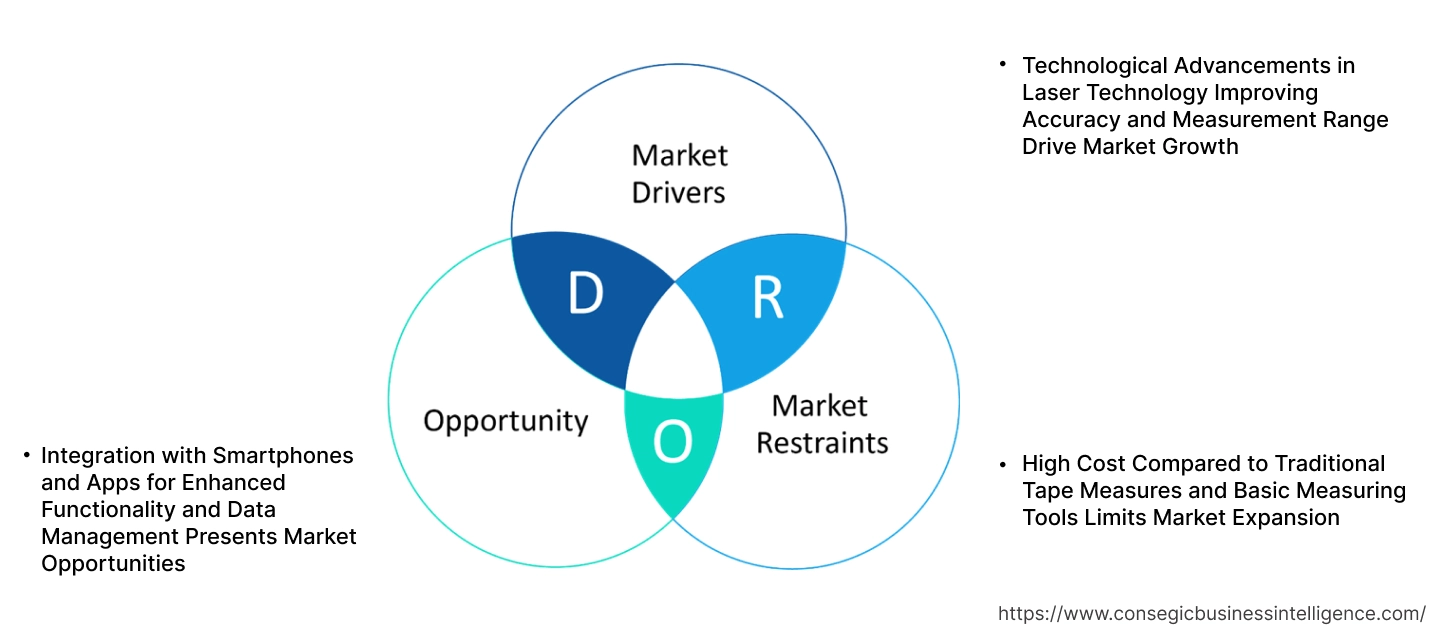
Technological Advancements in Laser Technology Improving Accuracy and Measurement Range Drive Market Growth
Advancements in laser technology have significantly enhanced the functionality and precision of handheld laser distance meters. These devices now offer improved accuracy, extended range, and faster measurement speeds, making them ideal for a wide range of applications, including construction, real estate, and interior design. Modern laser distance meters are equipped with advanced laser sensors and algorithms that provide precise measurements over greater distances, even in challenging lighting conditions. As users demand more reliable and efficient tools, these technological improvements are helping them become indispensable in measuring tasks. The ability to easily capture accurate measurements with minimal effort has resulted in increased adoption in both professional and consumer markets.
- For instance, in June 2024, Laser Technology Inc. (LTI) released the upgraded TruPulse 200i. The product offers higher accuracy, a more streamlined interface, improved Bluetooth pairing performance with any device and a rugged, waterproof housing for protection from weather conditions. It includes an adjusted button layout for easier navigation.
As a result, the growing need for precise, high-performance measuring tools continues to drive the handheld laser distance meter market expansion.
Key Restraints:
High Cost Compared to Traditional Tape Measures and Basic Measuring Tools Limits Market Expansion
Despite the advantages of handheld laser distance meters, their high upfront cost remains a significant barrier to broader adoption, particularly among small contractors and DIY enthusiasts. Basic measuring tools like tape measures are considerably more affordable and are often perceived as sufficient for simpler measurement tasks. As a result, many potential users, especially in price-sensitive markets, opt for conventional methods rather than investing in laser-based devices. Additionally, the cost of advanced models with extended features such as Bluetooth connectivity or area and volume calculations further limits the accessibility of these devices for everyday use. This pricing disparity, combined with the availability of affordable alternatives, creates a challenge for manufacturers in driving mass adoption. Despite increasing demand for advanced measuring tools, the high cost compared to traditional measuring solutions continues to hinder the handheld laser distance meter market growth in budget-conscious segments.
Future Opportunities :
Integration with Smartphones and Apps for Enhanced Functionality and Data Management Presents Market Opportunities
Smartphone integration is opening up new possibilities for handheld laser distance meters, enhancing their functionality and utility. By connecting to smartphones via Bluetooth, users can easily transfer measurement data to apps for further analysis, storage, or reporting. This integration allows for seamless project management, accurate documentation, and even real-time collaboration between team members. With mobile apps providing added features such as customizable measurements, area calculations, and even 3D visualization, the demand for more advanced and connected solutions is increasing. Furthermore, smartphone-based features enable users to access advanced measurement tools that were previously confined to larger, more expensive equipment. As construction, design, and engineering industries continue to digitize and require more efficient, accessible solutions, the integration of such devices with mobile technology is driving new growth.
- For instance, Xiaomi has a product line of smart laser distance meters, the Xiaomi Smart Laser Measure. Its functioning can be expanded by connecting with the Mi Home/Xiaomi Home app on a smartphone using Bluetooth. This enables users to remotely measure distances using the smartphone, floor plan with real-time surveying and preview home appliance recommendations accordingly, as well as calculate the area/volume/length easily.
These innovations are creating significant handheld laser distance meter market opportunities, making these devices more versatile and user-friendly.
Handheld Laser Distance Meter Market Segmental Analysis :
By Laser Class:
Based on laser class, the market is segmented into Class 1, Class 2, Class 3A, and Class 3B.
The Class 2 segment accounted for the largest handheld laser distance meter market share in 2024.
- Class 2 lasers are widely used due to their safe operating standards, with minimal eye damage risk if exposure is limited to short durations.
- These lasers are commonly used for general distance measurement applications, such as in construction, real estate, and interior design, where safety and ease of use are paramount.
- Class 2 meters are more affordable compared to higher-class models, making them popular among DIY enthusiasts and small businesses.
- As per handheld laser distance meter market analysis, the Class 2 segment continues to dominate due to its balance between cost, performance, and safety.
The Class 3A segment is projected to experience the fastest CAGR during the forecast period.
- Class 3A lasers offer more power and range compared to Class 2 models, making them ideal for professional applications that require longer measurement distances and higher accuracy.
- These lasers are commonly used in construction, engineering, and surveying applications, where precise and long-distance measurements are essential.
- The rising adoption of Class 3A meters in commercial and industrial projects is expected to drive the market expansion in this segment.
- According to handheld laser distance meter market trends, the need for Class 3A meters is increasing as professionals seek more powerful, accurate, and versatile measurement tools.
By Display Type:
Based on display type, the market is segmented into LCD, LED, and OLED.
The LCD segment held the largest revenue share in 2024.
- LCD displays are commonly used in handheld laser distance meters due to their low power consumption, affordability, and clear readability in various lighting conditions.
- These displays are durable and widely available, making them suitable for use in a broad range of industries, including construction, real estate, and surveying.
- LCD technology remains the preferred choice for distance meters in both consumer and professional markets due to its established reliability.
- As per the handheld laser distance meter market analysis, the LCD display segment continues to dominate due to its cost-effectiveness and widespread use.
The OLED segment is expected to witness the fastest CAGR during the forecast period.
- OLED displays offer superior contrast ratios, wider viewing angles, and greater energy efficiency compared to LCD displays.
- OLED displays are becoming increasingly popular in high-end models that require enhanced readability in low-light conditions or on larger screens.
- The demand for OLED technology is rising due to its visual appeal and the growing trend toward high-performance, premium models.
- For instance, in January 2025, Nikon unveiled the Golfer's Laser Rangefinder COOLSHOT 50i GII with a red internal OLED display. Designed for golfers, it features a strong magnet to attach to golf carts and clubs, and two display modes that can be easily switched: a golf mode (slope-adjusted distance and actual distance) and an actual distance mode.
- According to handheld laser distance meter market trends, the OLED segment is poised for significant growth as technology advances and more applications call for high-end displays.
By Application:
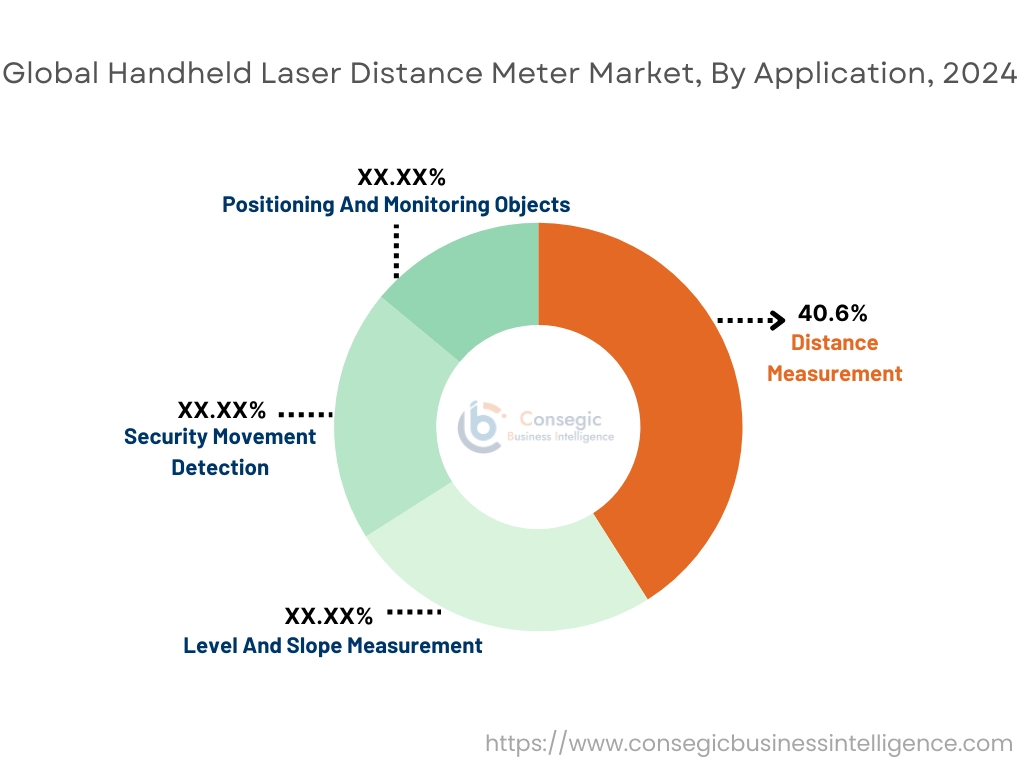
Based on application, the market is segmented into distance measurement, level and slope measurement, security movement detection, and positioning and monitoring objects.
The distance measurement segment accounted for the largest handheld laser distance meter market share of 40.6% in 2024.
- Distance measurement remains its primary function, with applications spanning across construction, real estate, and outdoor activities.
- These meters are favored for their accuracy, ease of use, and efficiency in providing real-time measurements for a wide range of tasks.
- The growing demand for precision in distance measurement, particularly in construction, is a key driver behind this segment’s dominance.
- Thus, the distance measurement application continues to dominate due to its simplicity and broad applicability across multiple industries, driving handheld laser distance meter market growth.
The security movement detection segment is expected to experience the fastest CAGR.
- Devices with motion detection features are increasingly being adopted in security applications, including perimeter security, intruder detection, and monitoring areas for unauthorized access.
- These meters are equipped with motion sensors that can detect changes in distance, enabling real-time monitoring and security alerts.
- The rise in necessity for advanced security systems, particularly in residential and commercial properties, is boosting the growth of this application.
- For instance, in February 2023, Northrop Grumman manufactured and supplied the US Marine Corps Next Generation Handheld Targeting System (NGHTS). The tool enables the transmission of precise location or the use of laser designation for communication instead of calling in target coordinates on a field radio. Furthermore, it provides superior observation in even the most environmentally and physically difficult locations.
- Hence, the security application segment is expanding as more users seek enhanced safety solutions for both personal and business environments, boosting the handheld laser distance meter market demand.
By End Use Industry:
Based on end-use industry, the handheld laser distance meter market is segmented into construction, real estate, mining, military, and others.
The construction segment held the largest revenue share in 2024.
- They are extensively used in the construction industry for measuring distances, dimensions, and calculating area in both residential and commercial building projects.
- These devices offer accuracy and speed, which are crucial in ensuring efficiency and reducing errors on construction sites.
- The rise of the construction industry globally, particularly in emerging economies, continues to drive a strong requirement.
- Thus, the construction sector dominates the handheld laser distance meter market demand due to the critical need for precision in building and infrastructure development.
The mining segment is expected to grow at the fastest CAGR during the forecast period.
- In mining, handheld laser distance meters are used for surveying, site planning, and measuring distances in underground and open-pit mining operations.
- These meters help improve accuracy and reduce measurement errors, which is essential in optimizing mining operations.
- As the need for minerals continues to rise globally, mining companies are adopting advanced tools like laser distance meters to improve their operational efficiency.
- According to the handheld laser distance meter market expansion, the mining sector is poised for rapid growth, driven by the increasing need for precision in measurement and monitoring within mines.
Regional Analysis:
The regions covered are North America, Europe, Asia Pacific, the Middle East and Africa, and Latin America.
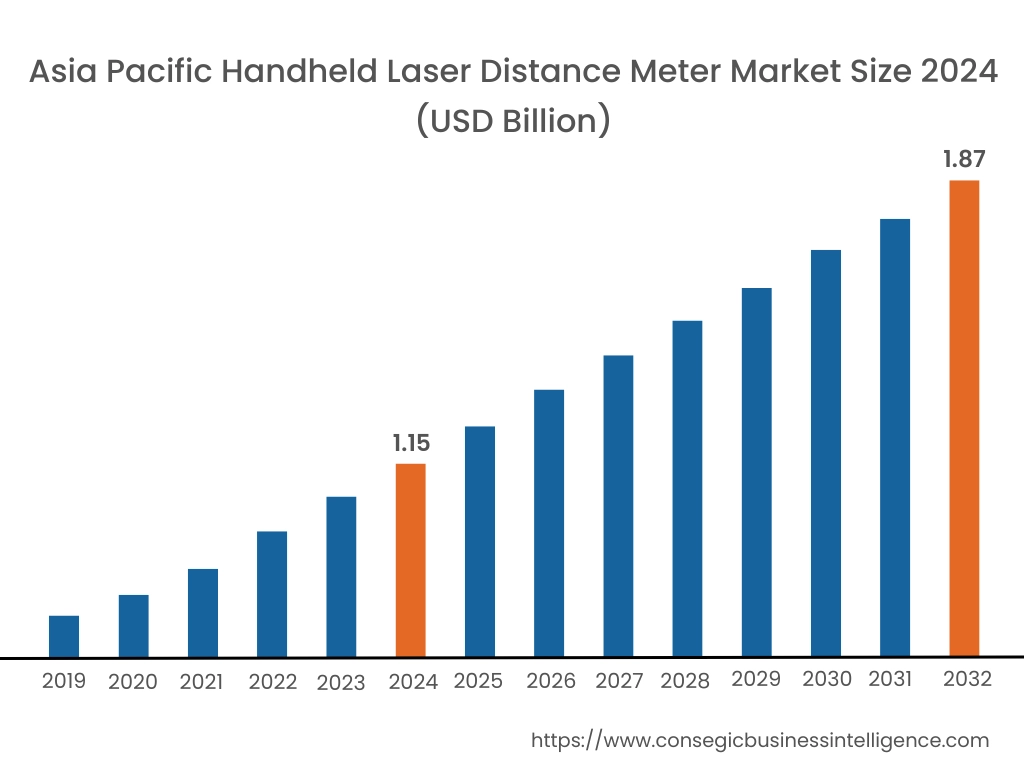
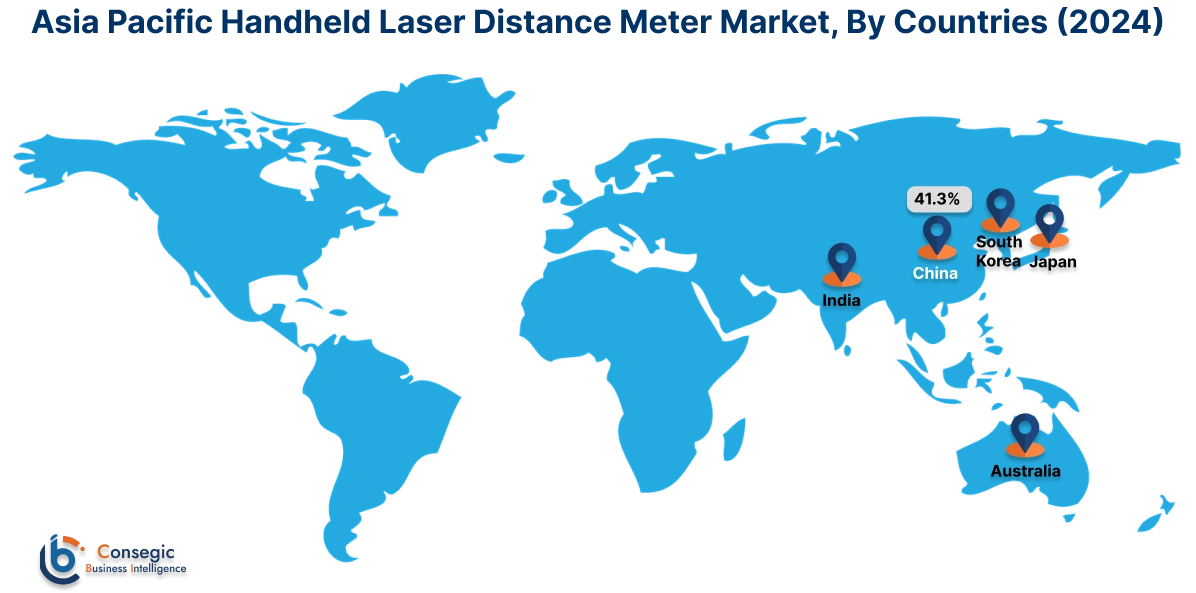
Asia Pacific region was valued at USD 1.15 Billion in 2024. Moreover, it is projected to grow by USD 1.20 Billion in 2025 and reach over USD 1.87 Billion by 2032. Out of this, China accounted for the maximum revenue share of 41.3%. Asia-Pacific is experiencing the fastest growth due to rising infrastructure development, urban expansion, and increasing digitization in construction workflows. In China, India, South Korea, and Japan, handheld laser distance meters are gaining traction among architects, real estate professionals, and site engineers. Market analysis shows a preference for cost-effective models with robust measurement functionality and multi-surface compatibility. Local manufacturers are driving product accessibility, and domestic training initiatives are improving awareness among end-users. Growth in this region is fueled by rising construction labor efficiency needs and the incorporation of smart tools into public infrastructure and commercial building projects.
North America is estimated to reach over USD 2.27 Billion by 2032 from a value of USD 1.41 Billion in 2024 and is projected to grow by USD 1.47 Billion in 2025. In North America, adoption is prominent across both construction and remodeling sectors, where professionals increasingly require fast, digital alternatives to traditional tape measures. Market analysis indicates that general contractors, home inspectors, and facility maintenance teams are adopting compact laser meters integrated with Bluetooth, digital displays, and app connectivity. The United States and Canada are emphasizing precision-based work in commercial and residential settings, driving steady requirement. Expansion in this region is further supported by product availability through retail, online, and B2B distribution channels along with widespread user education.
Europe is a mature and innovation-focused market, particularly in Germany, France, and the United Kingdom. Market analysis reveals strong need for ergonomic, weather-resistant handheld laser devices tailored to jobsite conditions in urban redevelopment, architectural planning, and renovation. Users in this region value high-accuracy rangefinding combined with CAD and BIM system integration. The handheld laser distance meter market opportunity in Europe is supported by smart construction adoption, EU directives encouraging digital tool deployment in building and engineering sectors, and a growing need for productivity-enhancing solutions among construction and surveying professionals.
Latin America is seeing gradual adoption, particularly in Brazil, Mexico, and Chile. Market analysis suggests that handheld laser distance meters are increasingly replacing analog tools in mid-sized construction companies and interior design studios. As project timelines shorten and the requirement for precise layouts increases, contractors are integrating these tools to improve accuracy and efficiency. The market opportunity in Latin America lies in expanding distribution networks, offering multi-language interface options, and aligning with regional training programs that introduce professionals to digital measurement workflows.
In the Middle East and Africa, the market is growing, especially in the UAE, Saudi Arabia, and South Africa. Demand is driven by extensive real estate development, interior design customization, and infrastructure planning. Market analysis highlights a growing interest in laser distance meters for architectural visualization and onsite assessment in smart city initiatives. Although awareness remains limited in some areas, growth is expected through government-supported modernization projects and improved access to durable, battery-efficient devices suited to extreme climate conditions. Regional adoption will benefit from targeted product education and professional-grade tool offerings.
Top Key Players and Market Share Insights:
The handheld laser distance meter market is highly competitive with major players providing products and services to the national and international markets. Key players are adopting several strategies in research and development (R&D), product innovation, and end-user launches to hold a strong position in the global handheld laser distance meter market. Key players in the handheld laser distance meter industry include -
- Leica Geosystems AG (Switzerland)
- Bosch Power Tools GmbH (Germany)
- South Surveying & Mapping Instrument Co., Ltd. (China)
- Precaster Enterprises Co., Ltd. (Taiwan)
- SOLA-Messwerkzeuge GmbH (Austria)
- Hilti Corporation (Liechtenstein)
- Stabila Messgeräte Gustav Ullrich GmbH (Germany)
- Makita Corporation (Japan)
- Stanley Black & Decker, Inc. (USA)
- Fluke Corporation (USA)
Recent Industry Developments :
Product Launches:
- In June 2024, Laser Technology Inc. (LTI), the world’s leading manufacturer of professional-grade laser rangefinders, launched the new and improved TruPulse 360i. The compass-fused product features tactile buttons, an ultra-bright display and expanded Bluetooth connectivity.
Handheld Laser Distance Meter Market Report Insights:
| Report Attributes | Report Details |
| Study Timeline | 2019-2032 |
| Market Size in 2032 | USD 6.80 Billion |
| CAGR (2025-2032) | 6.1% |
| By Laser Class |
|
| By Display Type |
|
| By Application |
|
| By End Use Industry |
|
| By Region |
|
| Key Players |
|
| North America | U.S. Canada Mexico |
| Europe | U.K. Germany France Spain Italy Russia Benelux Rest of Europe |
| APAC | China South Korea Japan India Australia ASEAN Rest of Asia-Pacific |
| Middle East and Africa | GCC Turkey South Africa Rest of MEA |
| LATAM | Brazil Argentina Chile Rest of LATAM |
| Report Coverage |
|
Key Questions Answered in the Report
How big is the Handheld Laser Distance Meter Market? −
Handheld Laser Distance Meter Market size is estimated to reach over USD 6.80 Billion by 2032 from a value of USD 4.25 Billion in 2024 and is projected to grow by USD 4.43 Billion in 2025, growing at a CAGR of 6.1% from 2025 to 2032.
What specific segmentation details are covered in the Handheld Laser Distance Meter Market report? +
The Handheld Laser Distance Meter market report includes specific segmentation details for laser class, display type, application and end-use industry.
What are the end-use industries of the Handheld Laser Distance Meter Market? +
The end-use industries of the Handheld Laser Distance Meter Market are construction, real estate, mining, military, and others.
Who are the major players in the Handheld Laser Distance Meter Market? +
The key participants in the Handheld Laser Distance Meter market are Leica Geosystems AG (Switzerland), Bosch Power Tools GmbH (Germany), Hilti Corporation (Liechtenstein), Stabila Messgeräte Gustav Ullrich GmbH (Germany), Makita Corporation (Japan), Stanley Black & Decker, Inc. (USA), Fluke Corporation (USA), South Surveying & Mapping Instrument Co., Ltd. (China), Precaster Enterprises Co., Ltd. (Taiwan) and SOLA-Messwerkzeuge GmbH (Austria).
Overview
Reputation & Certifications


Our Services
- Market Intelligence & Forecasting
- Custom Research Solutions
- Market Entry Strategy
- Competitive Intelligence
- Customer Insights
- Industry Innovation Analysis
- Investment Advisory