Jump to Content
Isononanol Market - Size, Share, Industry Trends, and Forecasts (2025-2032)
Isononanol Market Size:
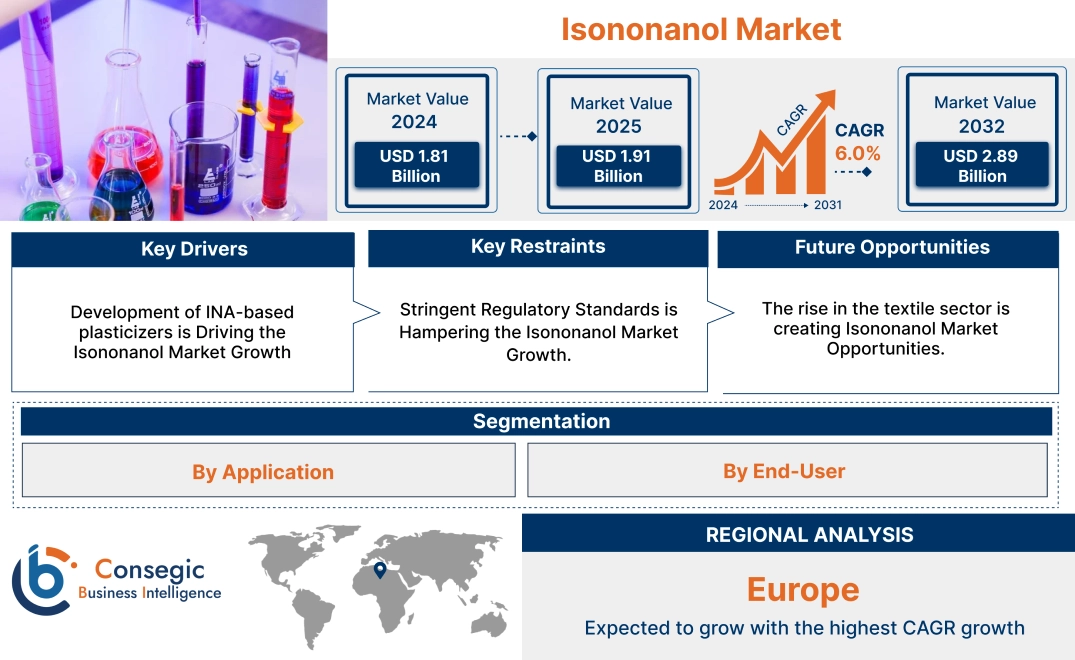
Isononanol Market size is growing with a CAGR of 6.0% during the forecast period (2025-2032), and the market is projected to be valued at USD 2.89 Billion by 2032 from USD 1.81 Billion in 2024. Additionally, the market value for the 2025 attributes to USD 1.91 Billion.
Isononanol Market Scope & Overview:
Isononanol (INA) which is also known as isononyl alcohol is a branched chain of alcohol with molecular formula C9H20O. It is mainly a colorless or pale-yellow liquid that provides properties such as low volatility, good solvency, and high stability mainly under varying temperature conditions. It is used as a key component in the production of plasticizers such as such as diisononyl phthalate (DINP), diisononyl cyclohexanoate (DINCH), diisononyl adipate (DINA) and triisononyl trimellitate (TINTM), which are mainly used in PVC based products. Along with plasticizers the compound finds its application in lubricants, coatings, surfactants & detergents, personal care products, and others. The end-user for this compound consists of construction, automotive, personal care & cosmetics, textiles, and others.
Isononanol Market Dynamics - (DRO):
Key Drivers:
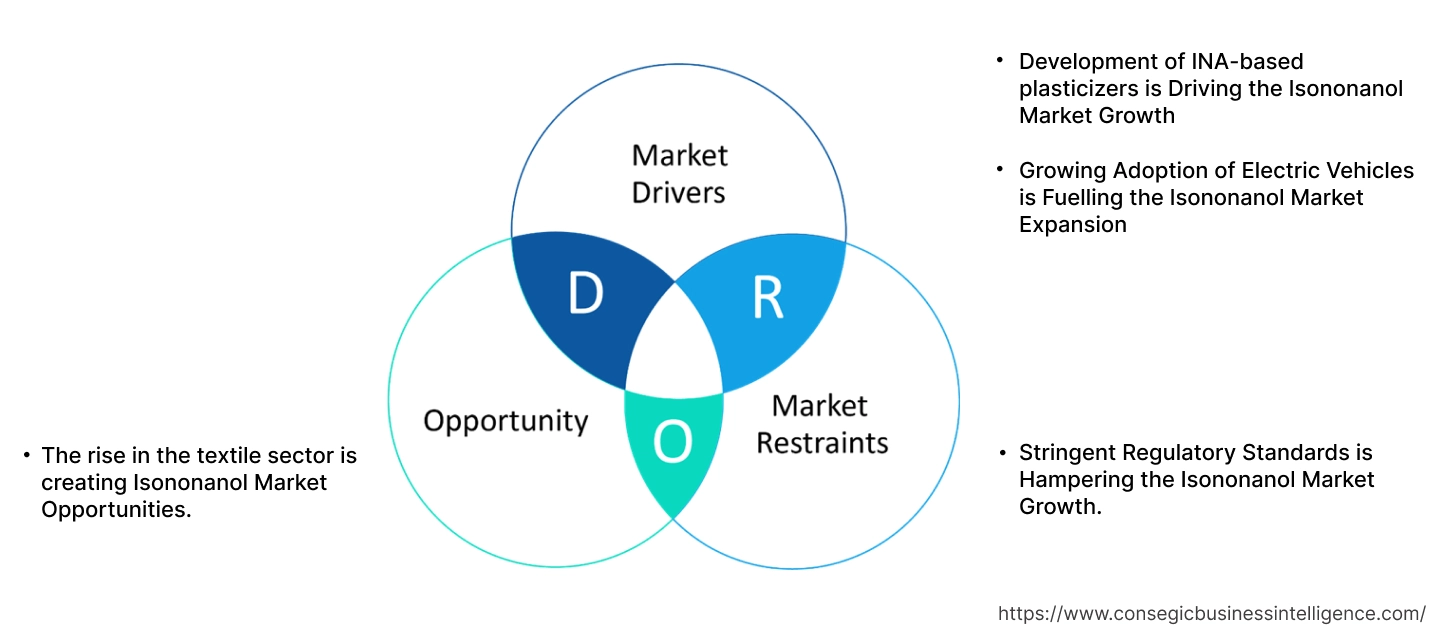
Development of INA-based plasticizers is Driving the Isononanol Market Growth
Plasticizers are additives that increase the plasticity and fluidity of a material. Isononanol is mainly used as a base material in the production of plasticizers. The product offers properties such as low volatility which contributes to the long-term performance of plasticizer products. These plasticizers are compatible with a wide range of polymers such as PVC and they offer excellent flexibility and resistance to high temperature. These properties are encouraging manufacturers in developing novel plasticizers for various applications.
For instance,
- In April 2023, Evonik expanded its plasticizer portfolio with the launch of ELATUR TM, which is a next generation plasticizer. It is an INA-based plasticizer which is suitable for applications such as high temperature cables, and high-quality interior fittings.
Thus, the development of novel plasticizer for various applications is driving the isononanol market demand.
Growing Adoption of Electric Vehicles is Fuelling the Isononanol Market Expansion
Isononanol is a key component used to produce diisononyl phthalate (DINP), which is a plasticizer used in various automotive applications. In electric vehicles (EV’s), the compound contributed towards flexibility and durability to various interior components such as dash boards, door panels, and cable insulations. The requirement of light weight and durable material in EVs and the rise in adoption of EVs influences the use isononyl alcohol-based products.
For instance,
- The data by IEA states that the global electric car market experienced a significant rise, with total sales showing an 18% increase in 2023 compared to previous year. This growth shows the accelerating consumer adoption of electric vehicles.
Thus, the rise in the adoption of electric vehicles and the use of lightweight and durable materials is influencing the market growth.
Key Restraints:
Stringent Regulatory Standards is Hampering the Isononanol Market Growth.
The isononanol industry faces significant hurdles due to stringent regulatory standards imposed by various regulatory bodies worldwide. These regulations are designed to ensure product safety and efficacy. They mainly involve rigorous testing, extensive documentation, and lengthy approval processes. Compliance with these standards is time-consuming and costly, particularly for smaller companies or those developing novel ingredients. Additionally, changes in regulatory guidelines or the introduction of stricter regulations disrupt established processes and require significant investments in research, development, and manufacturing to meet the new standards. These factors contribute to increased costs, delayed product launches, and limited market access, in turn hindering the development of the market.
Future Opportunities:
The rise in the textile sector is creating Isononanol Market Opportunities.
The textile sector is growing because of the rise in demand for durable, aesthetically pleasing, and high-quality textile products. Isononyl alcohol is used in the production of certain surfactants which are used for textiles. The compound is also used as a chemical intermediate in formulation of pigments, softening agents, and finishing treatments to enhance the textile properties. The rise in demand for textiles is driving the adoption of this compound.
For instance,
- The data by Indian Brand Equity Foundation, in November 2024, states that, the Indian textiles and apparel market is experiencing a robust expansion, with 10% growth rate by 2030. This signifies a substantial upward trend in the industry, increasing the domestic demand and exports.
Thus, the rise in the textile sector is creating lucrative isononanol market opportunities in the coming years.
Isononanol Market Segmental Analysis :
By Application:
Based on the application, the market is categorized into plasticizers, lubricants, coatings, surfactants & detergents, personal care products, and others.
Trends in the Application:
- Development of high-performance plasticizers is influencing the use of isononyl alcohol in them.
- The requirement for enhanced surfactants and finishing agents is influencing the surfactants & detergents segment.
The plasticizer segment accounted for the largest market share in 2024.
- INA serves as an important building block in the production of high-performance plasticizers.
- It is used in plasticizers such as plasticizers such as diisononyl phthalate (DINP), diisononyl cyclohexanoate (DINCH), diisononyl adipate (DINA) and triisononyl trimellitate (TINTM).
- The nine carbon structure of the compound contributes to the enhanced properties of the plasticizers such as low volatility, excellent compatibility with polyvinyl chloride (PVC), and exceptional flexibility.
- Manufacturers are introducing novel plasticizers with properties such as low-temperature flexibility and low viscosity. These properties are important for various applications.
- For instance, in January 2022, Evonik introduced ELATUR DINCD, which is a isononanol-based plasticizer. It is used in interior and exterior applications such as textile fabrics, roofing membranes, floor coverings, adhesives and sealants, as well as paints and coatings.
- Thus, as per the market analysis, the rise in the use of high-performance plasticizers is influencing the isononanol market trends.
The surfactants & detergents segment is expected to grow at the fastest CAGR over the forecast period.
- Isononyl alcohol is used in surfactants & detergents to enhance their properties.
- Surfactants are substances that reduce the surface tension of liquids, allowing them to mix with other substances.
- Isononyl alcohol is used to create specific types of surfactants.
- These surfactants are valued because they are good at cleaning, and they are stable, meaning they don't break down easily.
- The surfactants also help in removing the impurities form raw fibers, preparing them for the dying process.
- During dyeing, they ensure even color distribution and penetration, improving the quality and consistency of the dyed fabric.
- In printing, they contribute to sharper patterns and better dye adhesion.
- Thus, the rising use of this compound in surfactants and detergents is enhancing the trend for the segment in the coming years.
By End-User:
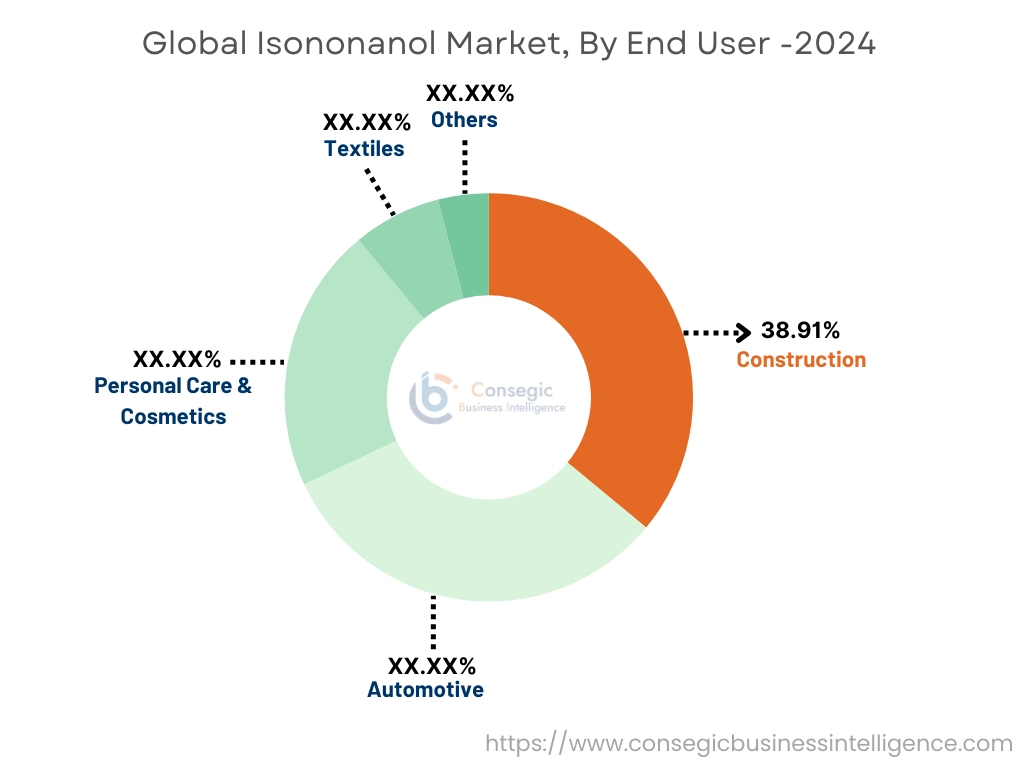
Based on the end user, the market is categorized into construction, automotive, personal care & cosmetics, textiles, and others.
Trends in end user:
- The growing trend of PVC products in various construction applications is influencing the use of isononyl alcohol.
- The requirement for technical textiles with specialized properties is influencing the use of isononyl alcohol.
The construction segment accounted for the largest isononanol market share of 38.91% in the year 2024.
- Isononyl alcohol is used in plasticizers used in the construction industry mainly for flexible polyvinyl chloride (PVC) products.
- Plasticized PVC is utilized in a variety of applications, including the manufacturing of electrical cables, pipes, flooring, roofing membranes, and window profiles.
- The flexibility and durability of the compound enhances the performance and longevity of these construction materials.
- This allows them to withstand diverse environmental conditions and mechanical stresses.
- The low volatility contributes to the long-term stability of PVC products. This reduces the risk of material degradation and ensures sustained performance in building applications.
- The rise in residential construction influences the use of these compounds.
- For instance, the data by the S. Census Bureau states that the number of construction of privately-owned houses completed was 1,518,000 in June 2023 which is higher by 5.5% from 2022.
- Thus, as per the market analysis, the rise in the construction sector influences the use of plasticizes that are made using isononyl alcohol. This is driving the market share.
The textile segment is expected to grow at the fastest CAGR over the forecast period.
- Isononyl alcohol is used in the production of surfactants and chemical intermediates, which are critical components in various textile processing stages.
- They serve as a building block for surfactants used in scouring, dyeing, printing, and finishing processes.
- These surfactants effectively remove impurities from raw fibers, ensuring a clean substrate for subsequent treatments.
- During dyeing, INA-derived surfactants act as leveling agents, promoting dye distribution of uniform dye and enhancing colorfastness.
- In printing, they improve dye penetration and pattern sharpness, contributing to higher-quality printed fabrics.
- Thus, as per the isononanol market analysis, the use this compound in textile sector is influencing the market trends in the coming years.
Regional Analysis:
The regional segment includes North America, Europe, Asia Pacific, the Middle East and Africa, and Latin America.

In 2024, Asia Pacific accounted for the highest isononanol market share at 42.63% and was valued at USD 0.77 Billion and is expected to reach USD 1.15 Billion in 2032. In Asia Pacific, China accounted for the highest market share of 35.08% during the base year of 2024.
The Asia Pacific region is dominating the isononanol market demand mainly because of the rise in the use of plasticizer in the construction sector. The rise in the use of flexible PVC products influences the use of this compound. Additionally, manufacturers of specialty chemicals are encouraging the rise in production and commercialization of INA for various applications through various partnerships.
For instance,
- In 2024, Perstorp's partnered with PETRONAS to expand the production and availability of essential chemical intermediates. The company has expanded its C8-C10 Oxo alcohols offerings by incorporating isononyl alcohol, Iso-Dodecene, and Oxo Oil 9N into its product range. This partnership leverages PETRONAS's resources and infrastructure, particularly in the Asian market, with Perstorp's expertise in specialty chemicals.
Thus, as per the market analysis, the rise in the use of plasticizers and partnership for development of oxo-alcohol is influencing the market in this region.

Europe is experiencing the fastest growth with a CAGR of 6.8% over the forecast period. The use of isononyl alcohol in the European textile sector is driven by the requirement for high-quality, sustainable, and specialized textile products. European textile manufacturers prioritize advanced processing techniques and adhere to stringent environmental regulations, which influence the application of INA-derived surfactants and chemical intermediates. These surfactants are essential for processes like scouring, dyeing, and finishing, contributing to improved fabric quality and performance. Thus, as per the isononanol market analysis, the rise in the use of isononyl alcohol in textile products is influencing the isononanol market trends in the coming years.
The increasing adoption of electric vehicles (EVs) in North America influences the use of isononanol. The compound is used in the production of plasticizers, particularly diisononyl phthalate which is used extensively in automotive interiors and cable insulation. As the EV market expands, the requirement for lightweight and durable interior components and reliable cable systems also rises. Thus, as per the market analysis, the growing adoption of EVs enhances the use isononyl alcohol in various components used in EVs.
The Middle East and Africa (MEA) regions are experiencing a notable rise in lubricant consumption, driven by increasing industrialization, expanding automotive sectors, and growing infrastructure development. This rise in the requirement of lubricant is creating significant opportunities for the use of isononyl alcohol. The compound serves as a crucial component in the production of high-performance lubricants. This contributes to their stability, viscosity, and overall effectiveness, particularly in demanding conditions prevalent in the region. Thus, these factors are influencing the isononanol market expansion in this region in the coming years.
The Latin American region is experiencing a notable surge in its personal care and cosmetics sector, which is consequently driving an increased interest in isononyl alcohol. Its emollient properties make it an important ingredient in various cosmetic and personal care formulations, contributing to the required texture and feel of products like lotions, creams, and other skincare items. Manufacturers in the region are recognizing the benefits of this compound in their formulations, leading to its greater adoption and contributing to the growth of the market in Latin America.
Top Key Players & Market Share Insights:
The global Isononanol market is highly competitive with major players providing precise products to the national and international markets. Key players are adopting several strategies in research and development (R&D) and product innovation to hold a strong position in the global Isononanol market. Key players in the Isononanol industry include-
- Evonik (Germany)
- NAN YA PLASTICS CORPORATION (Taiwan)
- BASF SE (Germany)
- KH NEOCHEM (Japan)
- OQ Chemical GmbH (Germany)
- PETRONAS Chemicals Group (Malaysia)
- ATAMAN KIMYA (Istanbul)
- Dow (United States)
- ExxonMobil (United States)
Recent Industry Developments :
Partnerships:
- In 2024, Perstorp's partnered with PETRONAS to expand the production and availability of essential chemical intermediates. The company has expanded its C8-C10 Oxo alcohols offerings by incorporating Isononanol, Iso-Dodecene, and Oxo Oil 9N into its product range. This partnership leverages PETRONAS's resources and infrastructure, particularly in the Asian market, with Perstorp's expertise in specialty chemicals.
Isononanol Market Report Insights:
| Report Attributes | Report Details |
| Study Timeline | 2019-2032 |
| Market Size in 2032 | USD 2.89 Billion |
| CAGR (2025-2032) | 6.0% |
| By Application |
|
| By End-User |
|
| By Region |
|
| Key Players |
|
| North America | U.S. Canada Mexico |
| Europe | U.K. Germany France Spain Italy Russia Benelux Rest of Europe |
| APAC | China South Korea Japan India Australia ASEAN Rest of Asia-Pacific |
| Middle East and Africa | GCC Turkey South Africa Rest of MEA |
| LATAM | Brazil Argentina Chile Rest of LATAM |
| Report Coverage |
|
Key Questions Answered in the Report
How big is the Isononanol market? −
In 2024, the Isononanol market is USD 1.81 Billion.
Which is the fastest-growing region in the Isononanol market? +
Europe is the fastest-growing region in the Isononanol market.
What specific segmentation details are covered in the Isononanol market? +
Application and End User segmentation details are covered in the Isononanol market.
Who are the major players in the Isononanol market? +
Evonik (Germany), NAN YA PLASTICS CORPORATION (Taiwan), PETRONAS Chemicals Group (Malaysia) are some of the major players in the market.
Overview
Reputation & Certifications


Our Services
- Market Intelligence & Forecasting
- Custom Research Solutions
- Market Entry Strategy
- Competitive Intelligence
- Customer Insights
- Industry Innovation Analysis
- Investment Advisory