Jump to Content
Laser Technology Market Size & Industry Share - Growth Trends & Forecasts (2026 - 2034)
Laser Technology Market Size:
Laser Technology Market size is estimated to reach over 52.63 (US$B) by 2034 from a value of 21.43 (US$B) in 2025 and is projected to grow by 23.68 (US$B) in 2026, growing at a CAGR of 10.5% from 2026 to 2034, according to a recent report from Consegic Business Intelligence.
Laser Technology Market Scope & Overview:
Laser technology involves the generation and application of focused light beams through the process of light amplification by stimulated emission of radiation. This technology is widely utilized across diverse industries for applications such as cutting, welding, engraving, communication, and medical procedures. Lasers offer precision, high efficiency, and adaptability, making them suitable for tasks that require accuracy and minimal material waste.
Various types of lasers, including solid-state, gas, fiber, and diode lasers, are used depending on the specific requirements of applications. They are employed in manufacturing for material processing, in healthcare for surgeries and diagnostics, in telecommunications for high-speed data transmission, and in defense for targeting and range-finding. Advanced laser systems integrate features such as tunable wavelengths, compact designs, and energy efficiency to meet the demands of complex operational environments.
End-users of laser systems include industries such as automotive, electronics, healthcare, and aerospace, where precision, reliability, and advanced capabilities are essential. These systems enable enhanced productivity, improved accuracy, and innovative solutions for a variety of industrial and technological applications.

Laser Technology MarketDynamics - (DRO) :
Key Drivers:
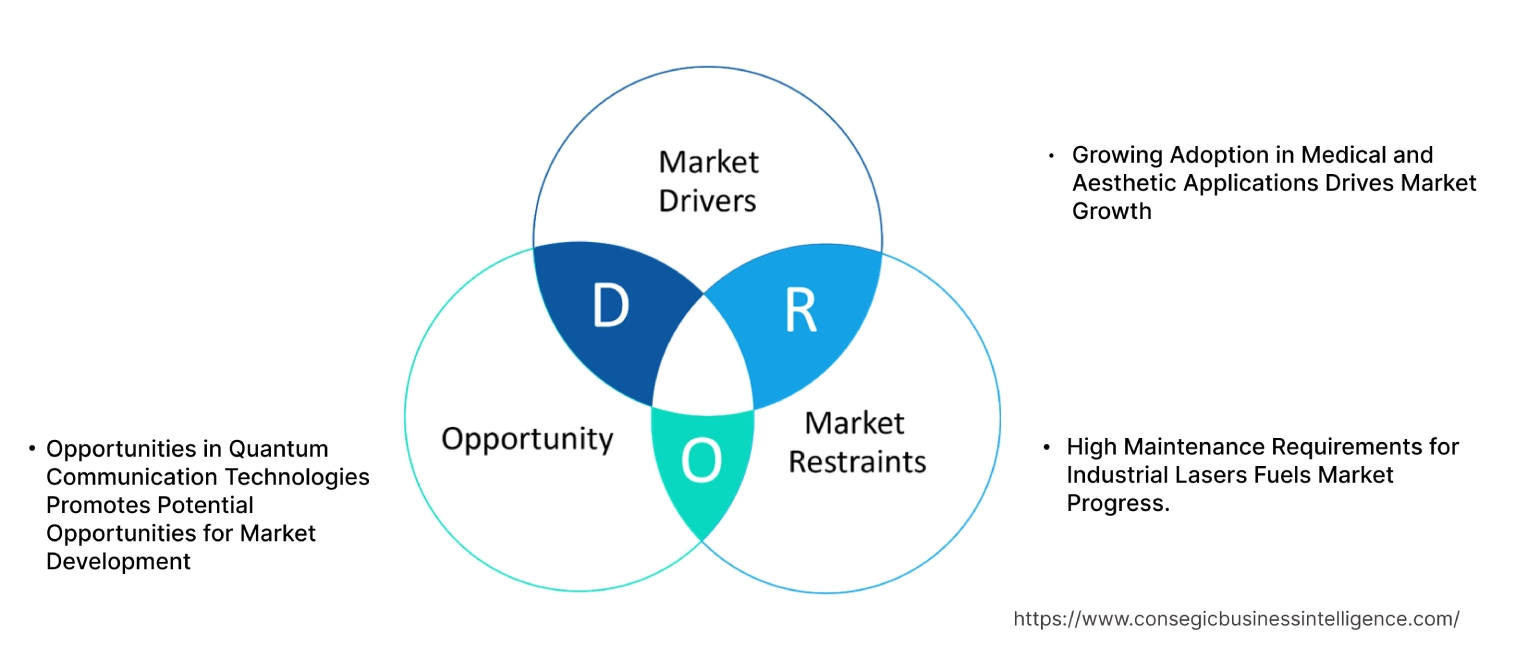
Growing Adoption in Medical and Aesthetic Applications Drives Market Growth
The adoption of laser systems in medical and aesthetic applications is growing rapidly due to their unmatched precision and versatility. In healthcare, lasers are widely used in dermatology for skin resurfacing, tattoo removal, and acne treatment, as well as in ophthalmology for corrective vision surgeries like LASIK. Oncology treatments also rely on laser technologies for targeted therapies with minimal damage to surrounding tissues.
In the aesthetic domain, minimally invasive procedures enabled by lasers are gaining popularity for their shorter recovery times and reduced risk of complications. Additionally, lasers play a critical role in advanced imaging and diagnostic systems, improving accuracy in detecting conditions like cancer or retinal diseases. These capabilities align with the rising trends in precision medicine and non-invasive healthcare solutions, making laser systems an integral part of modern medical practices and aesthetic treatments. The laser technology market demand is further driven by advancements in laser technology, offering greater safety and efficiency.
Key Restraints :
High Maintenance Requirements for Industrial Lasers Fuels Market Progress.
Industrial-grade laser systems, particularly those used in high-power applications such as cutting, welding, and engraving, demand regular maintenance to maintain efficiency and reliability. Maintenance tasks include alignment calibration, cleaning of optical components, cooling system inspections, and periodic replacement of wear-prone parts like lenses or diodes. These activities are both time-intensive and costly, especially for industries operating multiple laser systems in high-demand environments.
Additionally, improper maintenance results in reduced precision, energy inefficiency, and equipment downtime, negatively impacting production schedules. Industries with limited technical expertise often face challenges in handling the complex maintenance procedures required for these advanced systems. For small and medium-sized enterprises (SMEs), the financial and operational burden of upkeep may deter investment in laser technologies. These high maintenance demands restrict the adoption in cost-sensitive industries, slowing the overall laser technology market growth despite their numerous advantages.
Future Opportunities :
Opportunities in Quantum Communication Technologies Promotes Potential Opportunities for Market Development
Laser systems are integral to the advancement of quantum communication technologies, which leverage quantum mechanics for ultra-secure data transmission. These technologies use laser-generated photons to encode information, ensuring data security through quantum key distribution (QKD), which is nearly impervious to interception or tampering.
Applications in government and military communications are driving the need for high-precision laser systems capable of supporting secure networks and encryption protocols. Additionally, next-generation data centers are exploring quantum communication to enhance cybersecurity and ensure seamless data flow across global infrastructures.
As quantum technologies expand into sectors such as finance and healthcare, laser systems tailored to support quantum networks and high-speed photon transmission are becoming increasingly valuable. The potential for quantum communication to revolutionize secure data exchange offers significant laser technology market opportunities for advanced laser systems, positioning them at the forefront of this emerging market.
Laser Technology Market Segmental Analysis :
By Type:
Based on type, the market is segmented into Solid-State Lasers, Gas Lasers, Fiber Lasers, Semiconductor Lasers, Dye Lasers, and Others.
The Fiber Lasers segment held the largest revenue of the total laser technology market share in 2023.
- Fiber lasers are extensively used in material processing applications such as cutting, welding, and marking due to their high precision and efficiency.
- Their compact design, low maintenance requirements, and ability to operate in harsh environments make them ideal for industrial manufacturing and automotive sectors.
- The growing adoption of fiber lasers in metal fabrication and additive manufacturing reflects the increasing preference for versatile and cost-effective laser systems.
- Trends indicate the continuous innovation in fiber laser technology, such as high-power fiber lasers, for advanced industrial applications further driving laser technology market expansion.
The Semiconductor Lasers segment is expected to grow at the fastest CAGR during the forecast period.
- Semiconductor lasers are widely used in telecommunications and optical data storage, supporting high-speed data transmission and processing.
- These lasers are key components in LiDAR systems, enabling advancements in autonomous vehicles and aerospace technologies.
- The segment's rapid growth is supported by the rising demand for compact and energy-efficient laser solutions in consumer electronics and communication networks.
- Thus, the laser technology market analysis highlights the importance of semiconductor lasers in emerging applications like 3D printing and holography.
By Application:
Based on application, the market is segmented into Material Processing, Laser Surgery, Communication, Instrumentation, Lithography, and Others.
The Material Processing segment accounted for the largest revenue of the total laser technology market share in 2023.
- Lasers are integral to industrial material processing tasks such as cutting, welding, drilling, and marking, ensuring high precision and speed.
- Industries like automotive and aerospace rely on laser systems for producing complex parts with minimal material waste.
- The growing adoption of lasers in additive manufacturing and 3D printing applications is transforming production processes across multiple sectors.
- As per laser technology market trends, the dominance of this segment underscores the critical role of lasers in improving operational efficiency and manufacturing outcomes.
The Laser Surgery segment is expected to grow at the fastest CAGR during the forecast period.
- Laser technology is increasingly used in medical applications for minimally invasive procedures such as eye surgery, dermatology, and oncology treatments.
- Healthcare providers are adopting laser systems for their precision, reduced recovery times, and ability to target specific tissues without affecting surrounding areas.
- The segment's fast-track growth is supported by advancements in medical lasers and the growing focus on patient-centric care solutions.
- Therefore, the laser technology market analysis emphasizes the role of lasers in enhancing the accuracy and success rates of surgical procedures.
By Technology:
Based on technology, the market is segmented into Continuous Wave (CW) Lasers and Pulsed Lasers.
The Continuous Wave (CW) Lasers segment held the largest revenue share in 2023.
- CW lasers are widely used in applications requiring constant laser output, such as cutting, welding, and communication systems.
- These lasers are preferred in industrial manufacturing due to their ability to deliver consistent and high-power output over extended periods.
- Trends highlight the increasing integration of CW lasers in medical imaging and diagnostics for real-time monitoring and analysis.
- Thus, the dominance of CW lasers reflects their versatility and widespread adoption across industries requiring uninterrupted laser operations, fueling the laser technology market growth.
The Pulsed Lasers segment is expected to grow at the fastest CAGR during the forecast period.
- Pulsed lasers are crucial for precision applications, including micromachining, lithography, and laser ablation in semiconductor manufacturing.
- These lasers are extensively used in research and development activities for their ability to deliver high-intensity bursts of energy.
- Market analysis underscores the rising requirement for pulsed lasers in applications requiring controlled energy delivery and minimal thermal damage.
- The rapid expansion of this segment reflects its importance in high-precision and advanced manufacturing processes, contributing to the laser technology market demand.
By Wavelength:
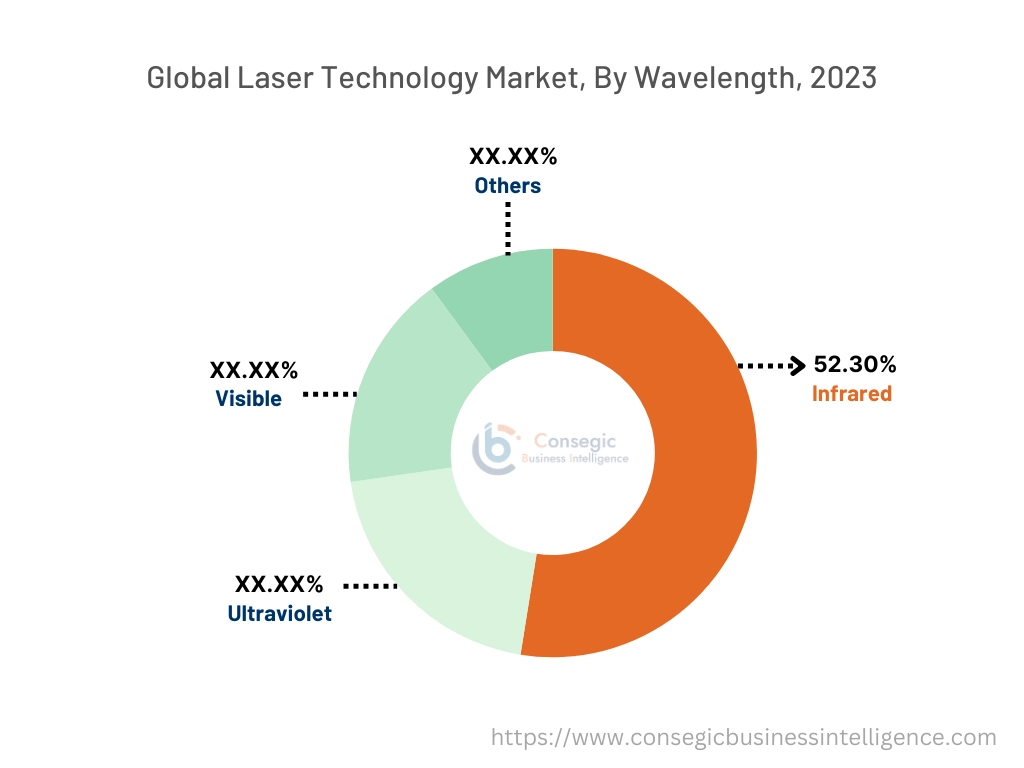
Based on wavelength, the market is segmented into Infrared, Ultraviolet, Visible, and Others.
The Infrared segment accounted for the largest revenue of 52.30% share in 2023.
- Infrared lasers are widely used in material processing, communication systems, and medical diagnostics for their high efficiency and penetration capabilities.
- These lasers are essential for remote sensing and LiDAR applications, driving advancements in aerospace, defense, and autonomous vehicles.
- The segment's dominance is attributed to the growing utilization of infrared lasers in industrial automation and telecommunication networks.
- Therefore, the laser technology market trends indicate the increasing adoption of infrared lasers for emerging applications in augmented reality and virtual reality systems.
The Ultraviolet segment is expected to grow at the fastest CAGR during the forecast period.
- Ultraviolet lasers are critical for photolithography processes in semiconductor manufacturing, enabling the production of advanced microchips and electronic components.
- These lasers are also used in medical and biological research for their ability to sterilize surfaces and analyze molecular structures.
- The rapid growth of this segment reflects the increasing need for UV lasers in precision manufacturing and life sciences applications.
- Thus, the market analysis highlights the role of UV lasers in supporting innovations in nanotechnology and biotechnology, boosting the laser technology market expansion.
By End-User Industry:
Based on end-user industry, the market is segmented into Automotive, Aerospace & Defense, Healthcare, Electronics & Semiconductors, Telecommunications, Industrial Manufacturing, and Others.
The Automotive segment held the largest revenue share in 2023.
- Laser systems are widely used in automotive manufacturing for welding, cutting, and marking components with high precision and efficiency.
- The increasing adoption of laser technology in electric vehicle (EV) production for battery and component assembly is transforming the automotive sector.
- Market analysis emphasizes the importance of lasers in enhancing manufacturing capabilities and reducing production costs in the automotive sector.
- Thus, the dominance of this segment reflects its reliance on laser systems for achieving superior product quality and operational efficiency creating significant laser technology market opportunities.
The Healthcare segment is expected to grow at the fastest CAGR during the forecast period.
- Laser technology is extensively used in medical applications for diagnostic imaging, therapeutic procedures, and minimally invasive surgeries.
- The segment benefits from advancements in laser systems, enabling improved accuracy and patient outcomes in healthcare settings.
- Trends highlight the growing adoption of lasers in cosmetic procedures and regenerative medicine, driving innovations in healthcare delivery.
- As per the segmental trends, the rapid proliferation of this segment underscores its role in enhancing medical care and supporting advanced healthcare solutions.
Regional Analysis:
The regions covered are North America, Europe, Asia Pacific, the Middle East and Africa, and Latin America.
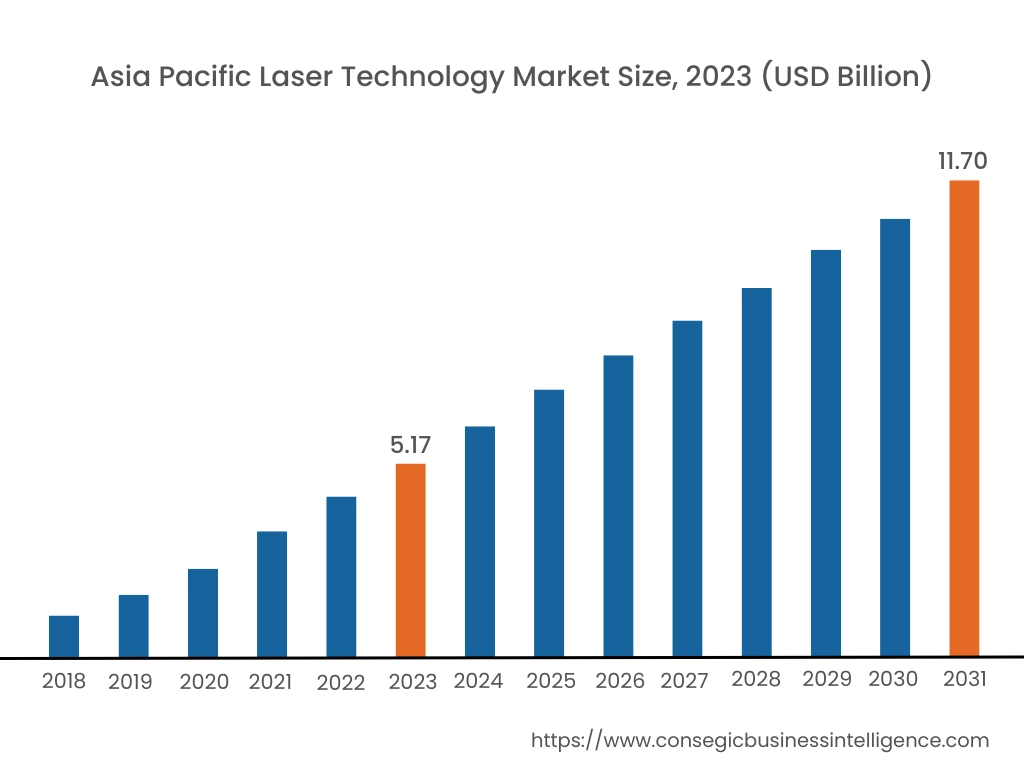
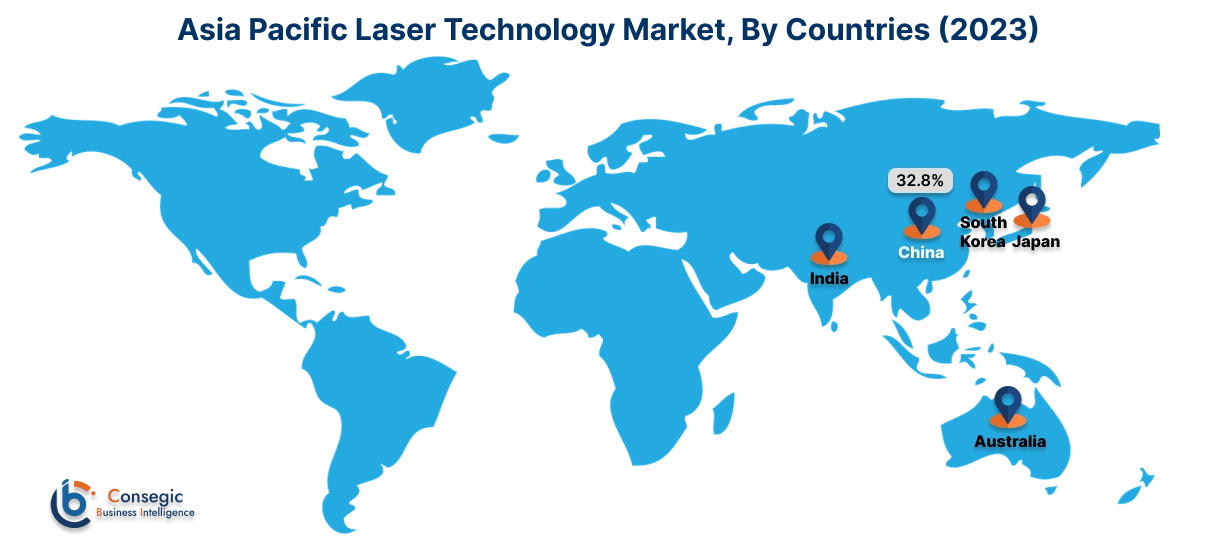
Asia Pacific region was valued at USD 5.17 Billion in 2023. Moreover, it is projected to grow by USD 5.63 Billion in 2024 and reach over USD 11.70 Billion by 2031. Out of these, China accounted for the largest share of 32.8% in 2023. The Asia-Pacific region is experiencing rapid growth in the laser technology market, propelled by industrialization and technological advancements in countries like China, Japan, and South Korea. The region has become a global hub for electronics manufacturing, where laser technologies are extensively used for cutting, welding, and engraving applications. Government initiatives promoting industrial automation and smart manufacturing further influence market trends.
North America is estimated to reach over USD 12.84 Billion by 2031 from a value of USD 5.84 Billion in 2023 and is projected to grow by USD 6.35 Billion in 2024. This region maintains a significant position in the laser technology market, driven by extensive applications in the manufacturing, healthcare, and defense sectors. The United States, in particular, has integrated laser technologies across various industries, with a notable emphasis on medical lasers for treatments and non-invasive procedures.
Europe holds a substantial stake in the global laser technology market, with countries like Germany, France, and the United Kingdom leading in innovation and application. The region's strong manufacturing base, particularly in the automotive and aerospace industries, drives the utilization of laser technologies for precision machining and material processing. The analysis indicates a growing trend towards adopting laser-based additive manufacturing and 3D printing technologies, aligning with Industry 4.0 initiatives.
The Middle East & Africa region shows a growing interest in laser technologies, particularly in the healthcare and oil & gas sectors. Countries like the United Arab Emirates and Saudi Arabia are investing in advanced medical equipment and industrial machinery that incorporate laser technologies. The analysis suggests an increasing trend towards adopting laser-based diagnostic and therapeutic tools in the medical field, driven by a focus on enhancing healthcare services.
Latin America is an emerging market for laser technologies, with Brazil and Mexico being key contributors. The region's expanding automotive and manufacturing sectors are adopting laser technologies for improved precision and efficiency in production processes. Government policies aimed at industrial modernization and technological innovation influence market growth.
Top Key Players & Market Share Insights:
The Laser Technology market is highly competitive with major players providing products and services to the national and international markets. Key players are adopting several strategies in research and development (R&D), product innovation, and end-user launches to hold a strong position in the global Laser Technology market. Key players in the Laser Technology industry include –
- TRUMPF (Germany)
- Coherent, Inc. (USA)
- IPG Photonics Corporation (USA)
- Han's Laser Technology Industry Group Co., Ltd. (China)
- MKS Instruments, Inc. (USA)
- Lumentum Operations LLC (USA)
- Jenoptik AG (Germany)
- Lumibird (France)
- II-VI Incorporated (USA)
- Laserline GmbH (Germany)
Recent Industry Developments :
Investments & Funding:
- In June 2024, Xcimer Energy raised $100M in Series A funding led by Hedosophia, alongside notable investors like Breakthrough Energy Ventures and Lowercarbon Capital. The funds will establish a Denver facility to develop a prototype laser system with unparalleled energy efficiency and cost-effectiveness.
Partnerships & Collaborations:
- In July 2024, TRUMPF partnered with SiMa.ai to integrate AI into laser systems for advanced manufacturing applications. This collaboration embeds SiMa.ai’s MLSoC technology into TRUMPF’s lasers, enhancing capabilities like welding, cutting, and 3D printing. The AI-powered systems improve precision, efficiency, and real-time monitoring, addressing industries such as electric vehicles and aerospace. The partnership highlights TRUMPF's commitment to innovation and SiMa.ai’s expertise in energy-efficient machine learning at the edge.
- In November 2024, IonQ partnered with NKT Photonics to advance quantum computing through next-generation laser technologies. NKT Photonics will supply high-performance laser systems for IonQ’s current and future barium-based quantum computers, enhancing computational accuracy and scalability. This collaboration aims to optimize laser performance to support IonQ's mission of delivering cutting-edge quantum solutions for diverse applications.
Product Launches:
- In September 2024, Samsung unveiled The Premiere 9 and Premiere 7 projectors, delivering advanced laser technology for home entertainment. These ultra-short-throw projectors support 4K resolution, HDR10+, and immersive audio for a cinematic experience. The Premiere 9 offers up to 2800 ANSI lumens, while the Premiere 7 delivers up to 2200 ANSI lumens, ensuring vibrant visuals even in bright environments. With smart TV features, these projectors integrate popular streaming apps and voice assistants, redefining living room entertainment.
Laser Technology Market Report Insights :
| Report Attributes | Report Details |
| Study Timeline | 2021-2034 |
| Market Size in 2034 | USD 52.63 Billion |
| CAGR (2026-2034) | 10.50% |
| Base Year | 2025 |
| By Type |
|
| By Application |
|
| By Technology |
|
| By Wavelength |
|
| By End-User Industry |
|
| By Region |
|
| Key Players |
|
| North America | U.S. Canada Mexico |
| Europe | U.K. Germany France Spain Italy Russia Benelux Rest of Europe |
| APAC | China South Korea Japan India Australia ASEAN Rest of Asia-Pacific |
| Middle East and Africa | GCC Turkey South Africa Rest of MEA |
| LATAM | Brazil Argentina Chile Rest of LATAM |
| Report Coverage |
|
Key Questions Answered in the Report
How big is the Laser Technology Market? −
Laser Technology Market size is estimated to reach over USD 39.01 Billion by 2031 from a value of USD 17.58 Billion in 2023 and is projected to grow by USD 19.11 Billion in 2024, growing at a CAGR of 10.5% from 2024 to 2031.
What specific segmentation details are covered in the Laser Technology Market report? +
The Laser Technology Market report includes segmentation details by type (Solid-State Lasers, Gas Lasers, Fiber Lasers, Semiconductor Lasers, Dye Lasers, Others), application (Material Processing, Laser Surgery, Communication, Instrumentation, Lithography, Others), technology (Continuous Wave (CW) Lasers, Pulsed Lasers), wavelength (Infrared, Ultraviolet, Visible, Others), end-user industry (Automotive, Aerospace & Defense, Healthcare, Electronics & Semiconductors, Telecommunications, Industrial Manufacturing, Others), and region (Asia-Pacific, Europe, North America, Latin America, Middle East & Africa).
Which is the fastest-growing segment in the Laser Technology Market? +
The Laser Surgery segment is expected to grow at the fastest CAGR during the forecast period. Laser technology is increasingly used in medical applications for minimally invasive procedures, improving precision, patient recovery time, and surgical outcomes.
Who are the major players in the Laser Technology Market? +
The major players in the Laser Technology Market include TRUMPF (Germany), Coherent, Inc. (USA), IPG Photonics Corporation (USA), Han's Laser Technology Industry Group Co., Ltd. (China), MKS Instruments, Inc. (USA), Lumentum Operations LLC (USA), Jenoptik AG (Germany), Lumibird (France), II-VI Incorporated (USA), and Laserline GmbH (Germany).
Overview
Reputation & Certifications


Our Services
- Market Intelligence & Forecasting
- Custom Research Solutions
- Market Entry Strategy
- Competitive Intelligence
- Customer Insights
- Industry Innovation Analysis
- Investment Advisory