Jump to Content
Lauric Acid Market - Size, Share, Industry Trends, and Forecasts (2025-2032)
Lauric Acid Market Size:
The lauric acid market size is growing with a CAGR of 9.0% during the forecast period (2025-2032), and the market is projected to be valued at USD 1.21 Billion by 2032 from USD 0.61 Billion in 2024. Additionally, the market value for the 2025 attributes to USD 0.66 Billion.
Lauric Acid Market Scope & Overview:
Lauric acid is saturated medium-chain fatty acid with the chemical formula C12H24O2. It is primarily found in coconut oil, palm kernel oil, and dairy products. It is a white crystalline solid with good thermal stability and chemical solubility.It is available in both low purity (<98%) and high purity (≥98%) forms. It offers advantages such as biodegradability, antimicrobial activity along with emulsifying properties. Due to these advantages, it is used in various end-use sector such as cosmetics & personal care, food & beverages, pharmaceuticals, textiles, and others. This acid is distributed through direct and indirect sales channels to soap manufacturers, cosmetic companies, and food processing units.
How is AI Impacting the Lauric Acid Market?
AI is significantly impacting the lauric acid market by enhancing efficiency, optimizing production, and fostering innovation. AI-powered tools are being used for predictive maintenance, supply chain optimization, and demand forecasting, leading to reduced costs and improved resource utilization. Furthermore, AI is accelerating research and development in lauric acid applications, potentially leading to new product formulations and market expansion.

Lauric Acid Market Dynamics - (DRO) :
Key Drivers:
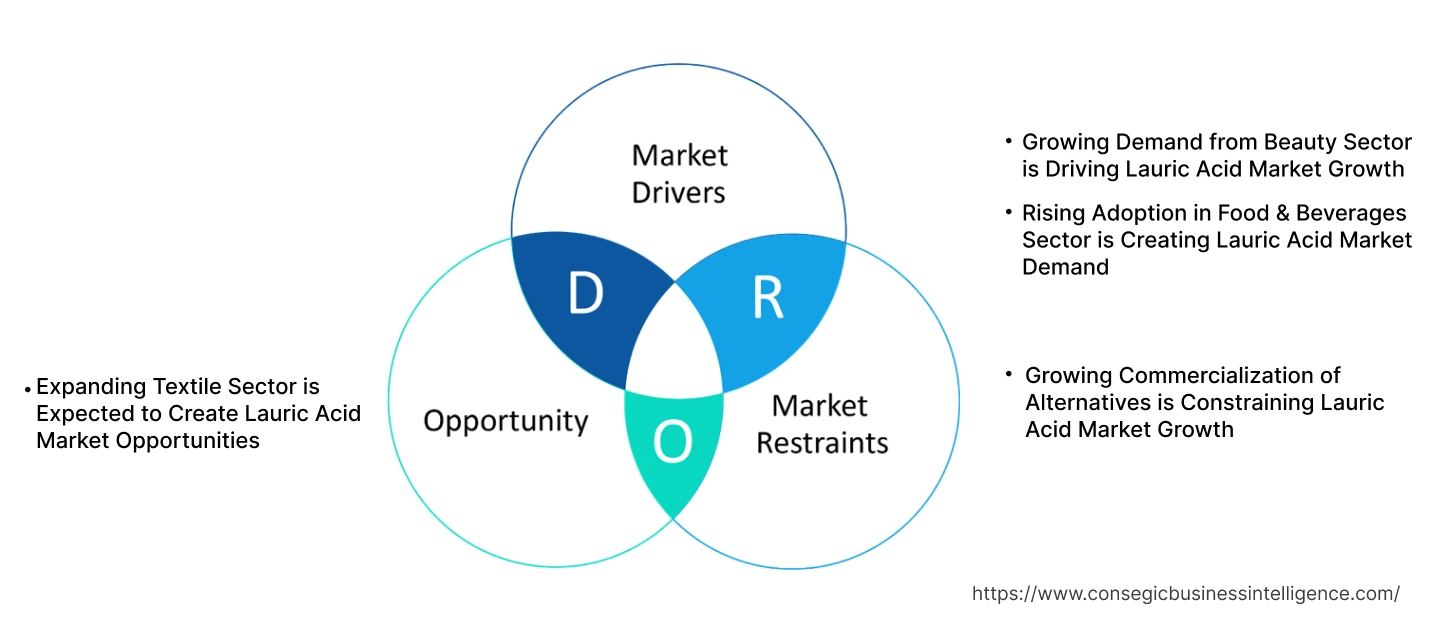
Growing Demand from Beauty Sector is Driving Lauric Acid Market Growth
In the beauty sector also known as cosmetic and personal care sector, lauric acid is used in lotions and creams due to its moisturizing and skin softening properties. It is also used in the production of soaps and shampoos amongst others. The beauty sector is growing supported by increasing disposable incomes, high youth population and rising beauty consciousness driving the market growth.
- According to L’Oréal Annual Report, the global beauty sector is increased by 8% in 2023 as compared to the year 2022. This growing beauty sector is driving the use of acid in the manufacturing of lotions and creams.
Hence, growing demand from the beauty sector is leading to lauric acid market expansion.
Rising Adoption in Food & Beverages Sector is Creating Lauric Acid Market Demand
Lauric acid is utilized in the food and beverages sector as a food additive and preservative in dairy products. It is also used to maintain dough consistency and moisture retention in bakery products. The consumption of food and beverages is increasing due to the rising global population and increasing awareness of nutrition further driving market growth.
- According to National Restaurant Association, the food and beverages sales increased by 5.4% in United States in 2024 as compared to the year 2023. This growing consumption of food and beverages is driving the use of the acid as a food additive and preservative.
Thus, rising adoption in the food & beverages sector is creating lauric acid market demand.
Key Restraints:
Growing Commercialization of Alternatives is Constraining Lauric Acid Market Growth
The commercialization of alternatives such as myristic acid and stearic acid is growing. They provide similar functions to that of lauric acid. The myristic acid is widely used in soap manufacturing, textiles and detergents due to its lower production costs and greater availability. Furthermore, stearic acid is preferred in detergent manufacturing due to better thickening and stabilizing properties, further reducing reliance on Lauric acid. Additionally, synthetic surfactants such as sodium lauryl sulfate and sodium laureth sulfate are few of the other alternatives that offer cost-effectiveness in cosmetics and personal care products. Hence, the growing commercialization of alternatives is constraining the market growth.
Future Opportunities :
Expanding Textile Sector is Expected to Create Lauric Acid Market Opportunities
In the textile sector, lauric acid is used as a lubricant & processing agent in textile manufacturing. It is also utilized in textile scouring, dyeing, and finishing processes due to its wetting and dispersing properties. This acid is also used in printing process, ensuring even color absorption in fabrics. The textile sector is expanding due to growing urbanization, technological advancements and government support.
- According to Ministry of Textiles, textile sector in India is anticipated to expand with a CAGR of 10% by 2030 from 2024. This expansion will lead to more use of the acid for dyeing and finishing processes.
Hence, expanding the textile sector is expected to create lauric acid market opportunities.
Lauric Acid Market Segmental Analysis :
By Purity:
Based on purity, the market is categorized into low purity (<98%) and high purity (≥98%).
Trends in Purity
- According to lauric acid market trends, low purity is extensively used in detergents and plant-based disinfectants.
- The adoption of high purity is growing in the production of high-quality drugs as per market trends.
The low purity (<98%) segment accounted for the largest market share in the year 2024.
- The low purity (<98%) contains a low percentage of lauric acid along with other fatty acids such as palmitic acid in higher percentages.
- It is widely used in the production of detergents due to its emulsifying and foaming properties. This acid is also utilized in the plant-based disinfectants to kills bacteria and viruses contributing to surface hygiene.
- The adoption of plant-based disinfectants is rising due to environmental concerns and growing focus on sustainability. To cater for this, companies are launching plant-based disinfection products.
- For instance, in 2024, CloroxPro launched plant-based disinfecting wipes. This includes low purity lauric acid to kill viruses and bacteria on surface.
- Hence, the adoption of plant-based disinfection products is growing, which is driving the segment.
The high purity (≥98%) segment is expected to grow at the fastest CAGR over the forecast period.
- The high purity (≥98%) lauric acid is a refined formulation with minimal impurities. It has superior consistency, stability and effectiveness.
- Due to these properties, it is increasingly used in premium cosmetics and specialized food formulations.
- This formulation is also utilized in the high-quality drugs due to its antimicrobial action and capacity for drug delivery.
- Furthermore, the governments are imposing regulations related to high-purity ingredients in pharmaceuticals. This is driving the use of this high purity acid by pharmaceutical companies in drug production.
- Thus, as government regulations are growing, the need for high purity formulation of this acid is increasing for its utilization in production of drugs. This will drive the segment for the forecasted years.
By End-Use:
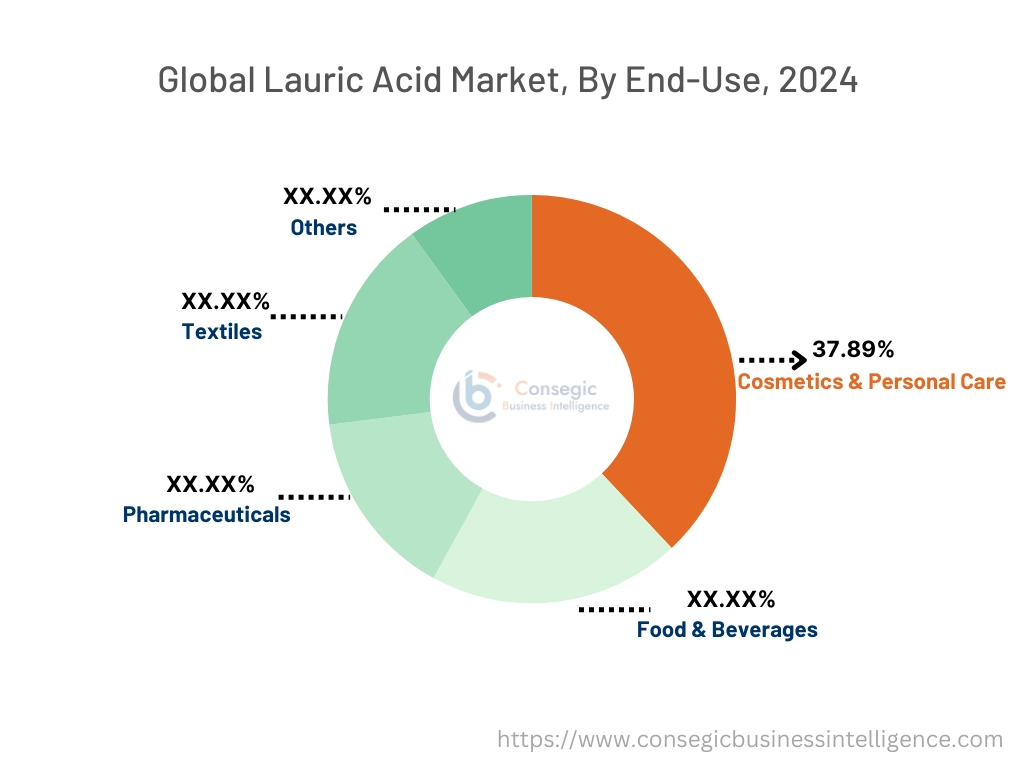
Based on end-use, the market is categorized into cosmetics & personal care, food & beverages, pharmaceuticals, textiles, and others.
Trends in End-Use
- As per lauric acid market trends, the acid is widely used in moisturizers and lip balms due to its antimicrobial properties.
- Use of lauric acid is growing in textile manufacturing to enhance fabric softness as per market trends.
The cosmetics & personal care segment accounted for the largest market share of 37.89% in the year 2024.
- In cosmetics and personal care, lauric acid is widely used in moisturizers, anti-acne treatments and lip balms due to its antimicrobial, emulsifying, and moisturizing properties.
- Its key advantage is its ability to stabilize formulations while providing skin-conditioning benefits.
- The sourcing of this acid from coconut and palm kernel oil makes it an important ingredient in plant-based personal care products such as shower gel and deodorants.
- The consumer preference for plant-based and sustainable personal care products is growing. To cater this, companies are incorporating lauric acid into their personal care products.
- Thus, growing consumer preference for plant-based personal care products is driving the use of this acid, thereby driving the segment.
The textiles segment is expected to grow at the fastest CAGR over the forecast period.
- In textiles, lauric acid is used in fabric coatings and textile finishes to prevent bacterial growth.
- It is also incorporated into fabric treatments to enhance softness and smoothness, particularly in luxury clothing.
- The demand for apparel is rising due to strong consumption and adoption of e-commerce. To catch up with this, countries are investing in textile manufacturing.
- According to Vietnam Briefing, Singapore invested USD 590 Million in textile manufacturing in Vietnam in 2024 as a foreign direct investment. This is driving the use of lauric acid in fabric coatings and textile finishes.
- Thus, textile manufacturing is expanding which requires this acid to enhance smoothness. This will drive the segment for the forecasted years.
By Sales Channel:
Trends in Sales Channel
- Direct sales channel ensures bulk and consistent product supply to detergent companies, soap manufacturers and cosmetic manufacturers.
- Adoption of indirect sales channel is growing due to easy shopping experience and proliferation of retail outlets as per market trends.
The direct sales segment accounted for the largest market share in the year 2024.
- Direct sales is a type of sales channel where products are sold directly to customers without any intermediaries.
- Lauric acid is widely sold through direct sales to textile companies, soap manufacturers, and cosmetics companies. They prefer direct procurement to ensure steady supply and lower costs.
- The large-scale buyers also benefit from customized orders and quality assurance directly.
- Additionally, the long-term contracts and partnership between manufacturers and these industrial buyers are growing. This leads to an increase in direct sales of this acid to ensure a steady supply.
- Hence, direct sales are expanding due to growing partnership between manufacturers and industrial buyers, thereby driving the segment.
The indirect sales segment is expected to grow at the fastest CAGR over the forecast period.
- Indirect sales is a type of sales channel where products are sold through intermediaries such as distributors, retailers or agencies.
- It further includes retail sales and online sales where lauric acid is sold through retailers or through online marketplaces to textile companies, soap manufacturers, and cosmetics companies.
- Furthermore, innovation in retail technology is growing along with rising preference for personalized shopping. This is leading to more retail sales in countries.
- For instance, according to CEIC, the retail sales in China is increased by 12.7% in 2023 as compared to the year 2022. This includes lauric acid which is distributed through retailers to smaller scale food processing companies, soap manufacturers, and cosmetics companies.
- Thus, the adoption of retail sales is growing supported by innovation in retail technology. This will drive the segment for the forecasted years.
Regional Analysis:
The regions covered are North America, Europe, Asia Pacific, the Middle East and Africa, and Latin America.
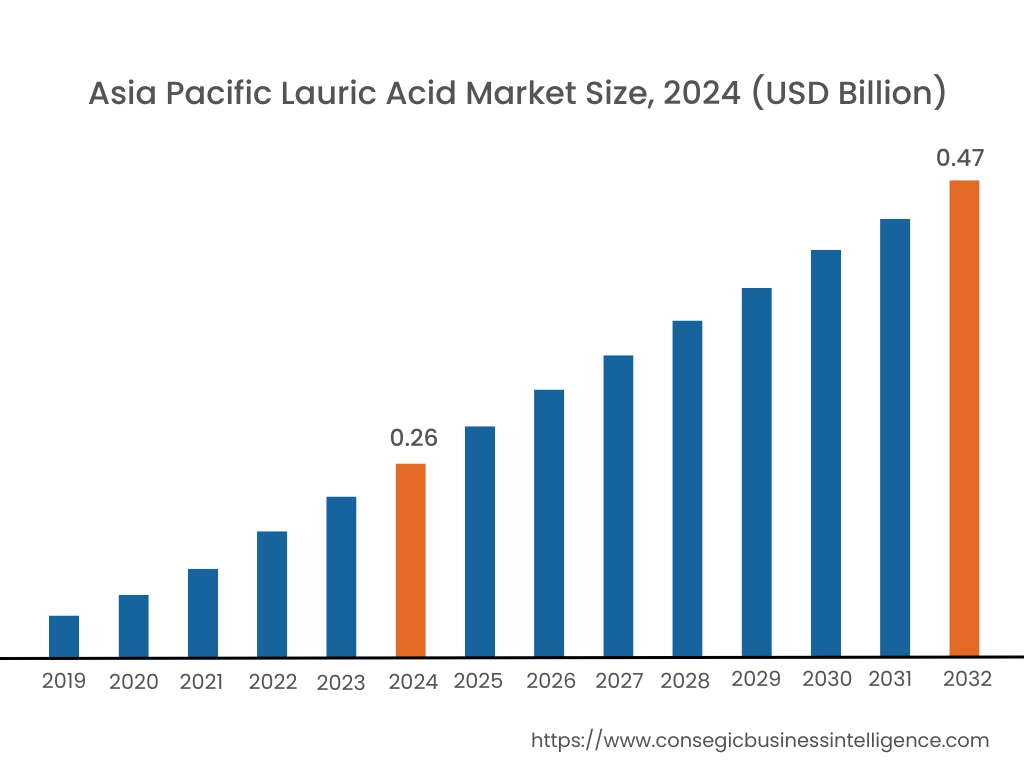
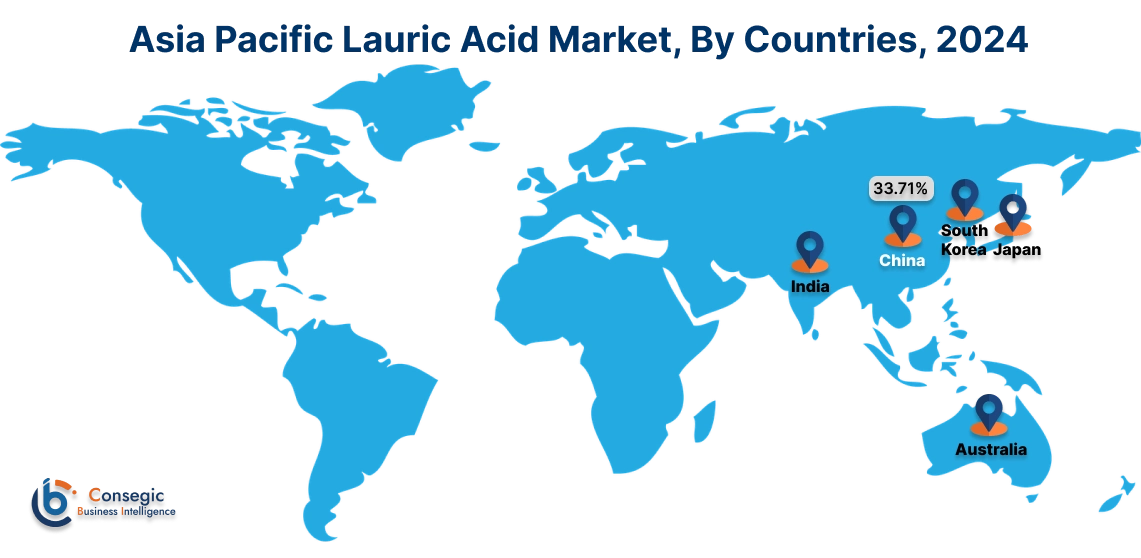
In 2024, Asia Pacific accounted for the highest market share at 42.11% and was valued at USD 0.26 Billion and is expected to reach USD 0.47 Billion in 2032. In Asia-Pacific, the China accounted for the highest market share of 33.71% during the base year of 2024. As per analysis, Asia Pacific region holds a dominant position in the market due to expanding the cosmetics & personal care sector. Lauric acid is used in sulphate-free and premium skin care products such as facewash and cleansers due to its gentle cleansing properties. It also supports hair growth and nourishments though its antifungal and natural moisturizing properties. Moreover, companies in the region are investing in premium skincare products further driving the market.
- In 2024, ClayCo Cosmetics secured USD 2 Million investment from Unilever Ventures to expand premium skincare range in India. This is further driving the use of this acid facewash and cleansers.
Therefore, the Asia Pacific region is dominating in the market, supported by expanding the cosmetics & personal care sector as per analysis.
Europe is expected to witness the fastest CAGR of 11.1% over the forecast period of 2025-2032. According to lauric acid market analysis, Europe region is growing considerably in the market driven by expanding pharmaceutical industry. Lauric acid is used in formulation of liquid-based drug carriers to improve biocompatibility. It is also used in the capsules and tablets as a binder and coating agent. Additionally, the investment in the pharmaceutical sector is also growing further, boosting market growth across the region. Hence, the lauric acid market share of Europe is expected to emerge rapidly through expanding the pharmaceutical sector as per analysis.
According to lauric acid market analysis, the North America region is growing rapidly driven by advancements in technology. Advanced molecular distillation and functional crystallization have enhanced the purity of the product. Countries such as United States leads the market due to innovations in automation and artificial intelligence driven process control. The key players in this region are optimizing production and ensuring high quality acid for various applications such as detergent and fabric softener in turn driving market growth in this region.
The Middle East & Africa region is experiencing moderate proliferation in the market, driven by the food & beverages care sector. In this sector, lauric acid is used to improve creaminess and mouthfeel in chocolates and confectionaries. It is also used in low-fat and plant-based formulations to support nutrition and health. The consumers in the region are focusing on plant-based food, further driving lauric acid market expansion.
As per market analysis, Latin America is growing steadily in the market driven by expanding textile sector. Lauric acid is used in industrial textile washing to remove grease and oils. It is also utilized as a softening and anti-static agent in fiber processing to reduce friction and improve fabric texture. Countries such as Brazil and Argentina are few of the leading countries in the market supported by expanding textile manufacturing plants.
Top Key Players and Market Share Insights:
The lauric acid industry is highly competitive with major players providing products to the national and international markets. Key players are adopting several strategies in research and development (R&D) and product innovation to hold a strong position in the global lauric acid market. Key players in the lauric acid industry include-
- Kao Corporation (Japan)
- Wilmar International (Singapore)
- Acme-Hardesty (United States)
- BASF (Germany)
- Gravity Chemicals & Specialties (India)
- Oleon NV (Belgium)
- Procter & Gamble (United States)
- PT Bakrie Renewable Chemicals (Indonesia)
- Emery Oleochemicals (United States)
- Aak AB (Sweden)
Recent Industry Developments :
Product Launch:
- In 2024, Coco2 launched coconut-based infant formula in Australia. It contains lauric acid and is available in three varieties.
Lauric Acid Market Report Insights :
| Report Attributes | Report Details |
| Study Timeline | 2019-2032 |
| Market Size in 2032 | USD 1.21 Billion |
| CAGR (2025-2032) | 9.0% |
| By Purity |
|
| By End-Use |
|
| By Sales Channel |
|
| By Region |
|
| Key Players |
|
| North America | U.S. Canada Mexico |
| Europe | U.K. Germany France Spain Italy Russia Benelux Rest of Europe |
| APAC | China South Korea Japan India Australia ASEAN Rest of Asia-Pacific |
| Middle East and Africa | GCC Turkey South Africa Rest of MEA |
| LATAM | Brazil Argentina Chile Rest of LATAM |
| Report Coverage |
|
Key Questions Answered in the Report
How big is the lauric acid market? −
In 2024, the lauric acid market is USD 0.61 Billion.
Which is the fastest-growing region in the lauric acid market? +
Europe is the fastest-growing region in the lauric acid market.
What specific segmentation details are covered in the lauric acid market? +
Purity, End-Use and Sales Channel are covered in the lauric acid market.
Who are the major players in the lauric acid market? +
Kao Corporation (Japan), Wilmar International (Singapore), and Acme-Hardesty (United States) are some of the major players in the market.
Overview
Reputation & Certifications


Our Services
- Market Intelligence & Forecasting
- Custom Research Solutions
- Market Entry Strategy
- Competitive Intelligence
- Customer Insights
- Industry Innovation Analysis
- Investment Advisory