Jump to Content
Led Driver Market Size & Industry Share - Growth Trends & Forecasts (2026 - 2034)
LED Driver Market Size:
LED Driver Market size is estimated to reach over 1,82,144.79 (US$M) by 2034 from a value of 36,652.67 (US$M) in 2025 and is projected to grow by 43,799.94 (US$M) in 2026, growing at a CAGR of 19.5% from 2026 to 2034, according to a recent report from Consegic Business Intelligence.
LED Driver Market Scope & Overview:
An LED driver is an essential component in LED lighting systems that provides the necessary electrical power to LEDs, ensuring they operate efficiently and reliably. By regulating the current, the driver ensures that the LEDs emit consistent brightness and prevent potential damage from voltage fluctuations. Additionally, they offer dimming capabilities, allowing users to adjust brightness levels according to their needs, which enhances energy efficiency and prolongs the lifespan of the LEDs. Moreover, it also includes various protective features to guard against over-voltage, over-current, and thermal issues, further ensuring the safety and longevity of the lighting system. They come in different types, such as constant current drivers, which provide a steady current output, and constant voltage drivers, which deliver a fixed voltage suitable for applications like LED strips. The aforementioned features are major determinants for increasing their deployment in residential, commercial, and other industries.
LED Driver Market Insights:

LED Driver Market Dynamics - (DRO) :
Key Drivers:
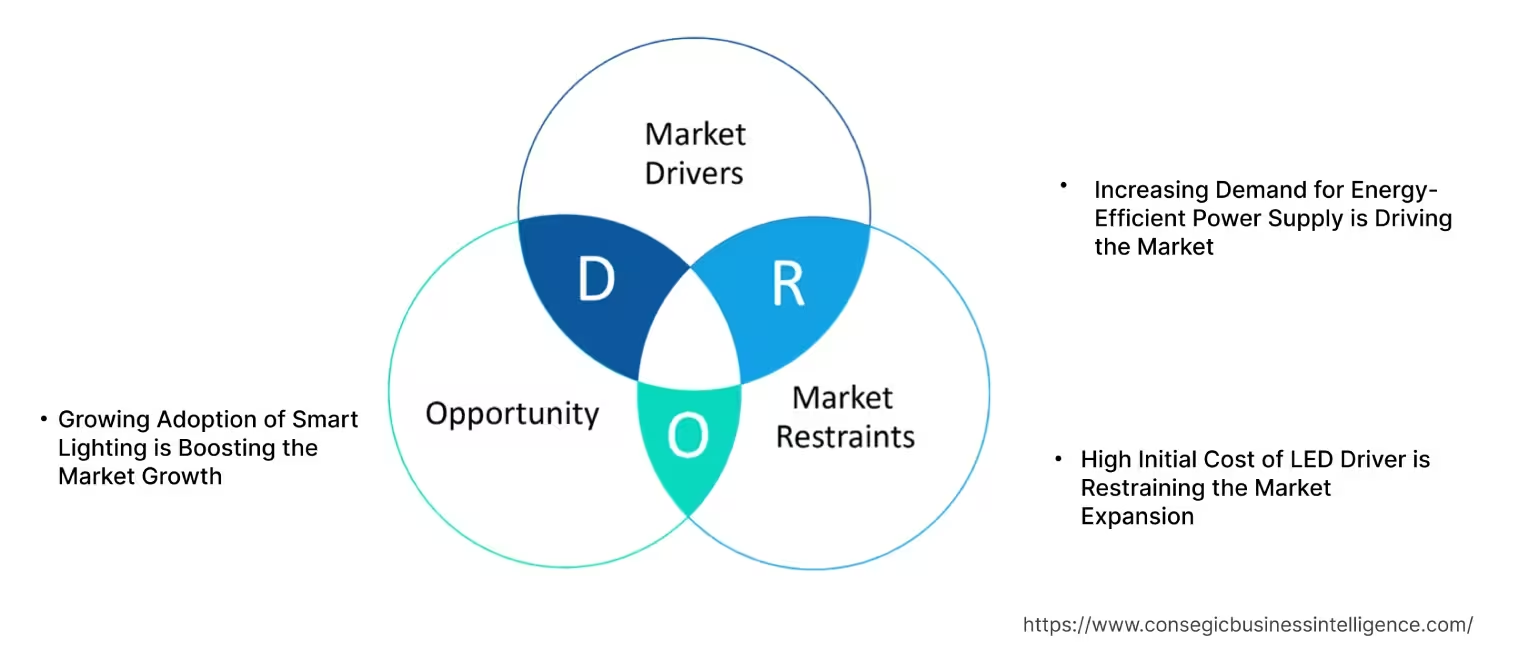
Increasing Demand for Energy-Efficient Power Supply is Driving the Market
As energy efficiency becomes a global priority, industries and governments alike are focusing on reducing energy consumption and minimizing environmental impact. LED drivers, which regulate the power supplied by LEDs, are at the forefront of this shift as they offer optimized power usage, reduce energy wastage, and extend the lifespan of LED lighting systems. Additionally, these drivers are essential for achieving the goals of smart city projects and energy regulations aimed at reducing carbon footprints. Moreover, advancements in this technology are enabling higher power efficiency, smart control, and better integration with renewable energy sources.
- In November 2022, Signify launched an ultra-efficient product lineup of lighting solutions. The products include MASTER LEDbulbs and MASTER LEDtubes with incorporated drivers which provide the most energy-efficient power usage. These lighting solutions save energy up to 60%, making it the preferred choice for lower carbon footprint.
Therefore, the widespread adoption of energy-efficient lighting systems across various applications is boosting the LED driver market growth.
Key Restraints :
High Initial Cost of LED Driver is Restraining the Market Expansion
The high initial costs associated with advanced LED drivers represent a significant barrier to entry for consumers and businesses looking to upgrade their lighting systems. While the long-term energy savings and operational efficiency of LED technology are well-documented, the upfront investment can be considerable, particularly for small and medium enterprises (SMEs) and residential customers with limited budgets.
Businesses often face challenges justifying these expenses, as the perception of higher costs compared to traditional lighting solutions may lead decision-makers to prioritize short-term savings over potential long-term benefits. This financial barrier can result in delayed upgrades to more efficient technologies, as organizations weigh the return on investment (ROI) against their current financial constraints. Hence, the high initial cost associated with advanced driver and lighting systems is hindering the LED driver market demand.
Future Opportunities :
Growing Adoption of Smart Lighting is Boosting the Market Growth
The increasing adoption of smart lighting systems is driven by the broader movement toward smart homes and smart cities. As more consumers and municipalities embrace the Internet of Things (IoT) and connected technologies, the need for advanced lighting solutions has surged. Smart lighting systems leverage LED drivers to enable functionalities that enhance convenience, energy efficiency, and overall user experience. Additionally, lighting systems can be integrated with home automation platforms, allowing users to control their lights remotely via smartphones or voice-activated assistants. This level of control includes features like scheduling, where lights can be programmed to turn on or off at specific times, and automated dimming based on natural light levels or occupancy.
- In June 2022, Samsung Electronics introduced SmartThings Home Life offering a smart home experience to the users. This allows users to adjust lighting remotely and automatically dim based on occupancy and daylight conditions. SmartThings Energy takes control over the energy consumption of the devices and manages the energy supply with optimization.
Consequently, the analysis shows that the rise of smart lighting solutions is fostering the LED driver market opportunities.
LED Driver Market Segmental Analysis :
By Supply Type:
Based on supply type, the market is segmented into constant current LED and constant voltage LED.
Trends in the Supply Type:
- Constant current LED drivers are gaining traction in high-power lighting applications such as street lighting, industrial lighting, and automotive headlights. Their ability to provide uniform brightness and protect LEDs from overcurrent makes them ideal for environments where reliability and longevity are crucial.
- With the rising adoption of LED strips in residential and commercial lighting, there is an increasing demand for low-voltage (12V or 24V) constant voltage drivers.
The constant current LED accounted for the largest revenue share in the year 2023 and is anticipated to register the fastest CAGR during the forecast period.
- Constant current drivers are designed to provide a fixed current to LEDs, regardless of the voltage fluctuations, ensuring uniform brightness and preventing damage to LEDs.
- These drivers are crucial in applications where reliability, uniform light output, and extended LED lifespan are required, making them the dominant choice for professional and large-scale lighting systems.
- Moreover, it is often integrated with energy-efficient lighting systems including smart controls and dimming features.
- For instance, Phillips introduced Xitanium LED drivers, a constant current driver specifically designed for outdoor and industrial applications. These drivers offer high performance, and enhanced energy efficiency and are integrated with smart lighting controls.
- Hence, due to its ability to cater to a broader range of high-performance lighting needs and the versatility of constant current drivers is proliferating the LED driver market growth.
By Dimming Method:
Based on the dimming method, the market is bifurcated into analog and digital.
Trends in the Dimming Method:
- Analog dimming solutions are increasingly being integrated into existing lighting systems, allowing users to upgrade to LED technology without extensive rewiring or changes to infrastructure.
- Digital dimming enables more complex lighting control scenarios, such as zoning and scene setting, allowing users to create tailored lighting environments for various occasions.
Analog dimming accounted for the largest revenue of the total LED driver market share in 2023.
- Analog dimming methods typically involve varying the voltage or current to control the brightness of LEDs. This can include techniques like phase-cut dimming (leading-edge and trailing-edge), which adjusts the electrical waveform to dim the lights.
- These dimmers are easy to install and operate and are compatible with existing electrical systems, allowing for easy retrofitting of traditional lighting without extensive rewiring.
- For instance, Osram's PARATHOM PAR38 supports analog dimming methods with conventional dimmers. It features simple installation, low maintenance cost low energy consumption, and high performance in their lighting applications.
- Overall, the aforementioned features of the analog dimming method are fueling the market.
The digital dimming method is anticipated to register the fastest CAGR during the forecast period.
- Digital dimming methods involve using digital communication protocols to control LED brightness. These methods provide precise control and the ability to integrate with smart lighting systems.
- It allows for more complex lighting control options, such as zoning, scheduling, and scene setting, which are becoming essential in both residential and commercial applications.
- As smart home and IoT technologies continue to evolve, digital dimming solutions that can be controlled via mobile apps and voice-activated devices are increasingly in demand.
- For instance, providing advanced digital dimming features that enhance user experience and energy efficiency.
- Thus, as per the market trend analysis these factors position digital dimming as a leading technology in the evolving landscape of lighting control solutions.
By Sales Channel:
Based on sales channels, the market is bifurcated into online and offline.
Trends in the Sales Channel:
- Online retailers are focusing on improving user experiences through better website design, detailed product descriptions, user reviews, and comparison tools, making it easier for customers to find the right LED drivers.
- Retailers are integrating online and offline sales channels, offering click-and-collect services where customers can order online and pick up products in-store, enhancing convenience and flexibility.
The offline sales channel accounted for the largest revenue share of the total LED driver market share in 2023.
- Offline sales channels offer the advantage of personal interaction and expert advice enabling customers to consult with knowledgeable staff and gain recommendations tailored to specific needs.
- Many consumers and businesses prefer the immediate availability of products that offline retail stores, electrical supply shops, and distributors provide.
- Additionally, the ability to inspect products before purchase remains a significant advantage of offline sales to access the quality, size, and compatibility of drivers.
- Thus, as per the analysis the immediacy and personalized service offered by offline sales channels is propelling the LED driver market trends.
The online sales channel is anticipated to register the fastest CAGR during the forecast period.
- The growing preference for online shopping continues to influence consumer behavior, with more customers turning to e-commerce platforms for their lighting solutions.
- This offers unparalleled convenience, allowing customers to shop from anywhere and at any time.
- Moreover, e-commerce platforms provide access to a wider variety of products, including specialized and niche products that may not be available in local stores, thus catering to diverse consumer needs.
- Hence, online channels are poised to take a more prominent role in the LED driver market opportunities.
By End-User:
Based on end-users, the market is segmented into residential, commercial, and industrial.
Trends in the End-User:
- There is a rising trend toward integrating LED drivers with smart home systems, enabling features like remote control, automated scheduling, and voice activation through platforms such as Amazon Alexa and Google Assistant.
- Businesses are focusing on sustainability by implementing energy-efficient lighting solutions, often supported by LED drivers that comply with green building certifications and environmental standards.
- Industries are increasingly adopting energy management systems that incorporate LED drivers, optimizing energy consumption for improved operational efficiency.
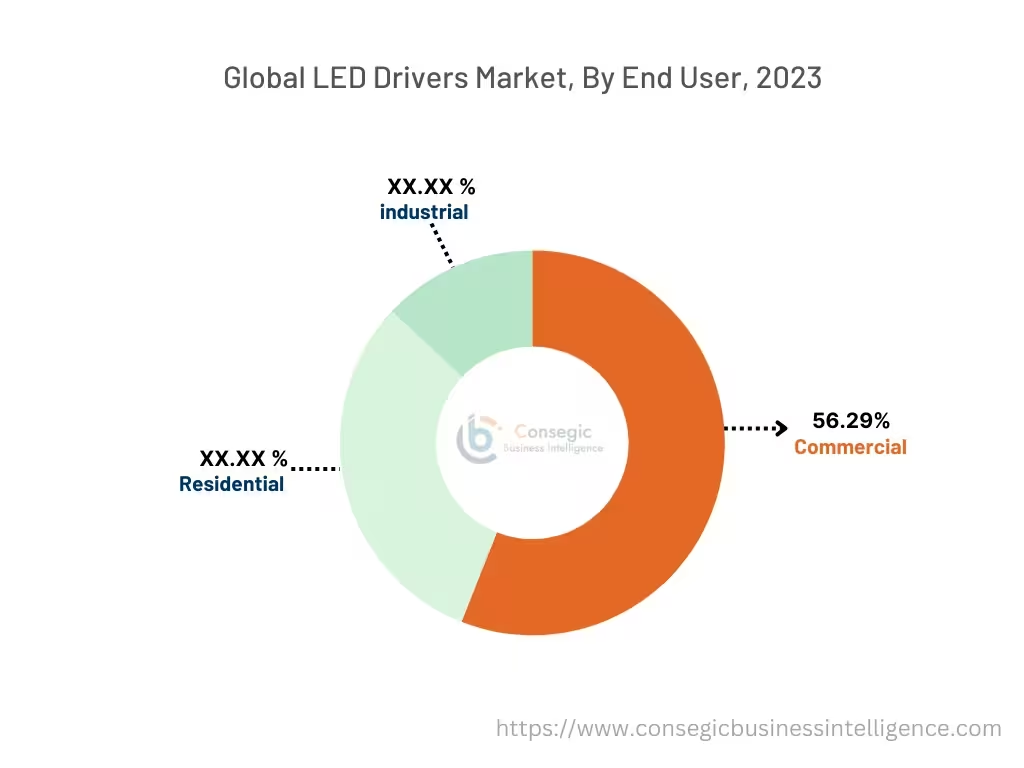
The commercial accounted for the largest revenue share of 56.29% in 2023.
- The commercial segment encompasses various business environments, including offices, retail stores, hospitality venues, and educational institutions.
- Businesses are increasingly prioritizing energy-efficient lighting solutions to reduce operating costs. LED drivers are essential for optimizing energy use and enhancing the overall efficiency of lighting systems.
- For instance, Lutron Electronics introduced the Vive wireless Commercial Lighting Control system including dimming controllers and drivers, targeting commercial environments . This wireless control helps new and existing commercial buildings efficient, comfortable, and productive.
- Therefore, these factors are contributing to the current dominance of the commercial sector in the LED driver market demand.
The residential is anticipated to register the fastest CAGR during the forecast period.
- The rise of smart homes, equipped with integrated lighting solutions, will require LED drivers that support features such as remote control, automation, and energy monitoring.
- With a growing emphasis on sustainability, more consumers are opting for energy-efficient lighting solutions that align with eco-friendly practices, enhancing the appeal of LED technology.
- In March 2021, Signify expanded its smart home lighting portfolio, enabling connectivity with Philip Hue and Wiz. The products in this lineup are incorporated with LED drivers which support enhanced control and seamless integration with smart home systems, catering to the need for connected home lighting solutions.
- Consequently, as per the analysis, given these factors the residential segment is anticipated to propel the LED driver market trends.
Regional Analysis:
The regions covered are North America, Europe, Asia Pacific, the Middle East and Africa, and Latin America.
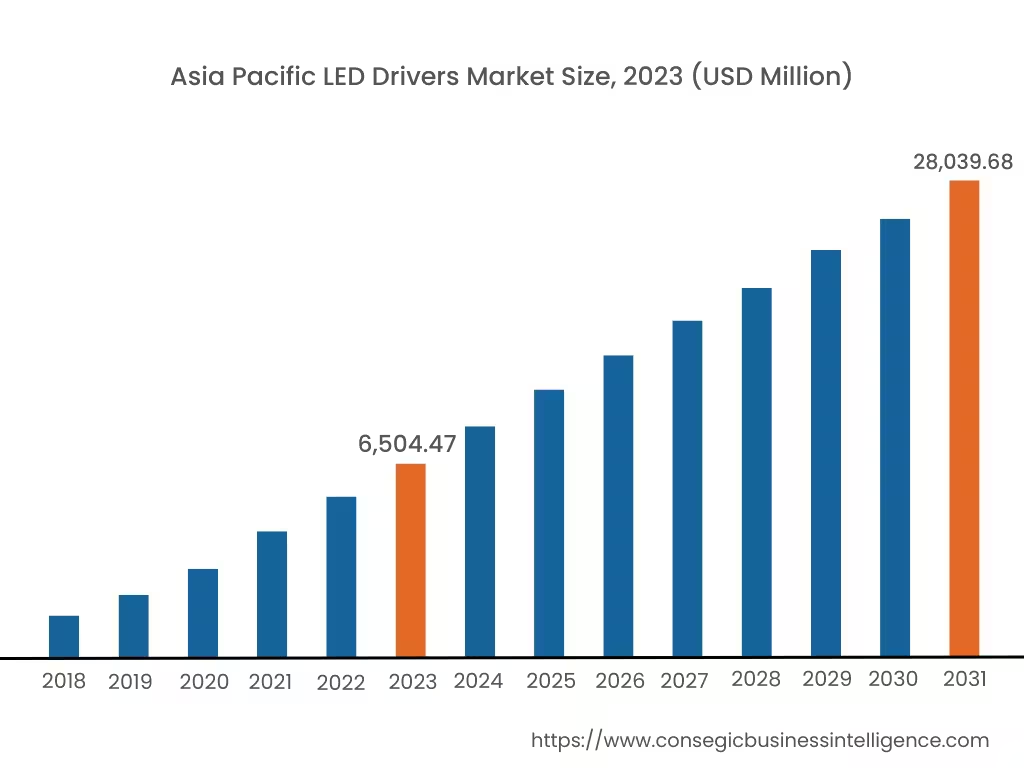
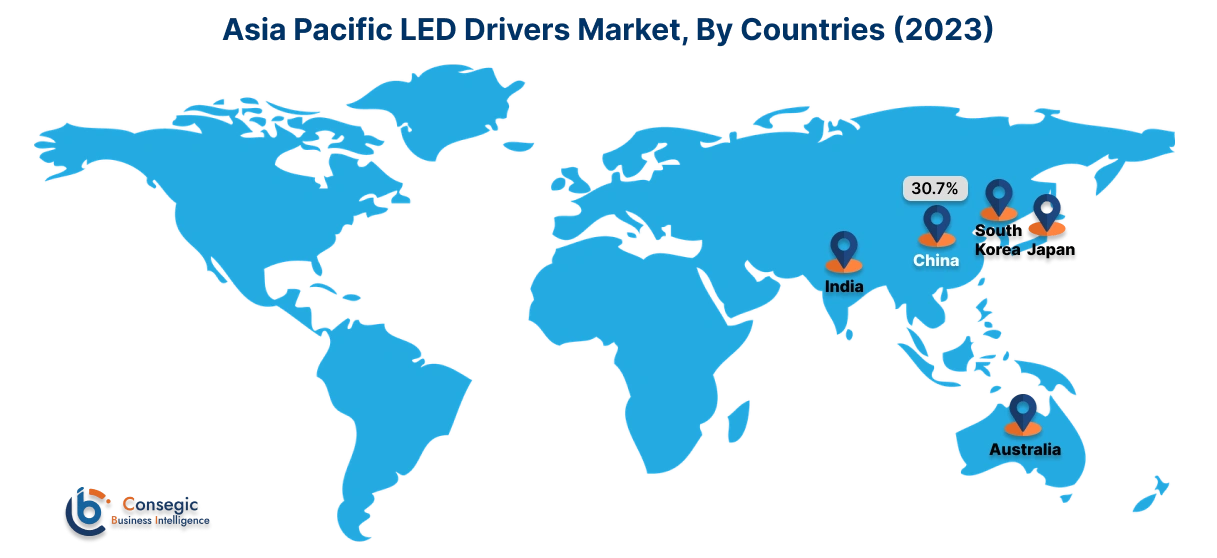
Asia Pacific region was valued at USD 6,504.47 Million in 2023. Moreover, it is projected to grow by USD 7,679.42 Million in 2024 and reach over USD 28,039.68 Million by 2031. Out of this, China accounted for the maximum revenue share of 30.7%. As per the LED driver market analysis, the Asia-Pacific region is experiencing rapid growth, primarily fueled by the booming construction industry and accelerating urbanization in countries including China, India, and Japan. A rising population and increasing demand for energy-efficient lighting solutions. Furthermore, government initiatives aimed at improving energy efficiency significantly contribute to LED driver market expansion. The integration of smart lighting solutions and IoT technology is also gaining momentum, with major manufacturers ramping up production capabilities to meet the growing need for innovative LED drivers in this dynamic and diverse market.
North America is estimated to reach over USD 35,938.19 Million by 2031 from a value of USD 8,595.55 Million in 2023 and is projected to grow by USD 10,121.84 Million in 2024. North America stands as a prominent leader in the market, primarily driven by the United States and Canada. The region's strong focus on energy efficiency, bolstered by government regulations and incentives promoting sustainable lighting solutions, fuels the market. The adoption of smart homes and smart city initiatives is also on the rise, further enhancing the market's growth. As manufacturers increasingly integrate IoT technology into their lighting solutions, the requirement for smart LED drivers capable of remote control and automation continues to surge, positioning North America at the forefront of innovation in this sector.
- In May 2023, Fulham launched four LED driver families including WorkHorse, ThoroLED, PONY, and SugarCube. These drivers aimed at delivering energy-efficient and eco-friendly lighting solutions. These products provide high-performance, high-efficiency LED drivers that boast output voltage ranges for indoor and outdoor applications.
Europe plays a pivotal role in the global LED driver market, with key countries including Germany, the UK, and France leading in the adoption of energy-efficient technologies. The region's stringent environmental policies and commitment to sustainability drive the increasing requirement for LED lighting and, consequently, its drivers. Additionally, the rise of smart city projects across Europe, coupled with substantial investments in renewable energy, contributed to the market's growth.
In Latin America, the market is gradually gaining momentum, with Brazil and Mexico emerging as the largest markets in the region. Urbanization and the pressing need for energy-efficient lighting solutions are key factors propelling market growth, supported by government incentives promoting sustainable practices. The increasing interest in modernizing infrastructure within urban areas is contributing to the LED driver market expansion.
The LED driver market analysis in the Middle East and Africa shows that the market is still developing but is poised for significant growth due to increasing investments in infrastructure and urban development projects. The demand for energy-efficient solutions, coupled with the need for modern lighting in both commercial and residential sectors, is driving the market forward.
Top Key Players & Market Share Insights:
The LED driver market is highly competitive with major players providing products to the national and international markets. Key players are adopting several strategies in research and development (R&D), product innovation, and end-user launches to hold a strong position in the global LED driver market. Key players in the LED driver industry include-
- Texas Instruments (US)
- NXP Semiconductors (Netherlands)
- Osram Opto Semiconductors (Germany)
- Mean Well Enterprises (Taiwan)
- Infineon Technologies (Germany)
- STMicroelectronics (Switzerland)
- Broadcom Inc. (US)
- Microchip Technology Inc. (US)
- Signify Holding (Netherlands)
- Maxim Integrated (US)
- Cree, Inc. (US)
- Lutron Electronics (US)
- Cypress Semiconductor (US)
- Renesas Electronics (Japan)
- Analog Devices (US)
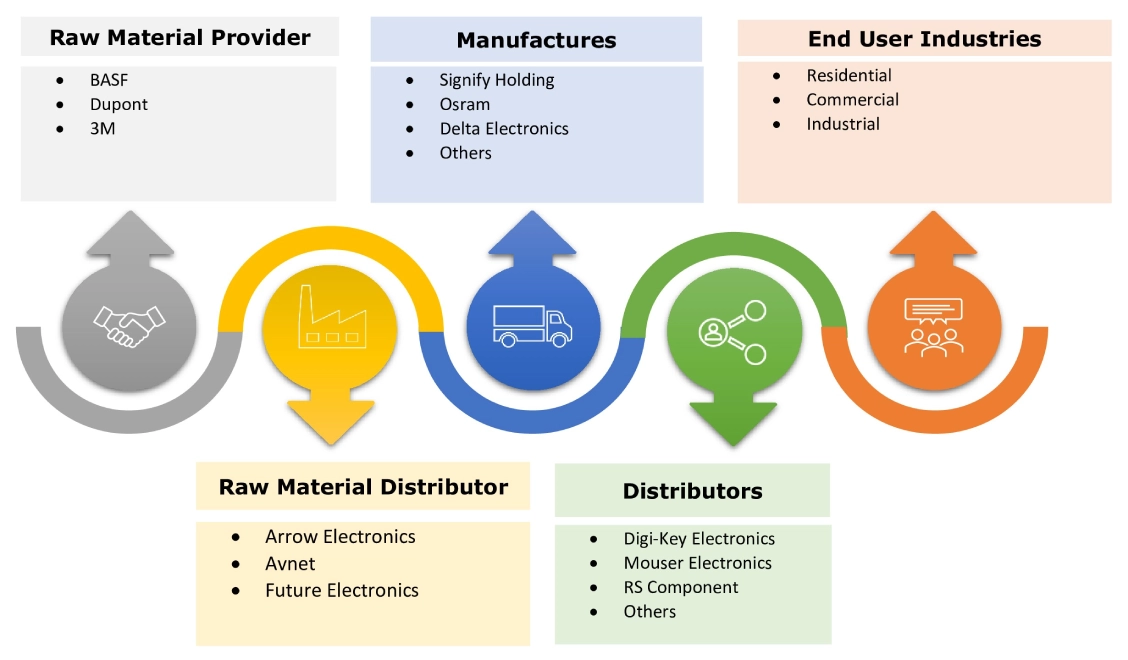
LED Driver Market Ecosystem:
Recent Industry Developments :
Product Launches:
- In August 2024, Cree LED unveiled higher-performance XLamp XE-G LEDs with a driver to deliver a 20% increase in efficiency. It is optimized for directional lighting applications that benefit from multi-color LED designs, such as indoor directional lighting, architectural lighting, entertainment lighting, and automotive lighting.
- In April 2024, Signify launched an Ultra-Efficient LED luminaire designed to enable energy savings of up to 21.7%. Its modular design makes it possible to fit TrueBlend luminaires in the same cutout as existing fittings, delivering time and cost savings for the customer.
- In August 2023, Delta introduced the EUCO Arena Sport LED Driver with DALI 2/D4i and DMX/RDM versions. This DALI-2 lighting protocol caters to the need for IoT connectivity integration into LED sports lighting and other industrial and commercial lighting applications.
Product Enhancement:
- In June 2024, Melexis expanded its LIN RGB family with the launch of MLX81123, a smart LED driver for automotive ambiance lighting. It includes a transceiver and protocol handler, which facilitate seamless connection between RGB ambient modules and the pre-existing LIN network of the vehicle.
Collaboration:
- In January 2023, Infineon collaborated with Nichia to launch a high-definition micro-LED matrix solution integrated with the capability of an LED driver. This micro-driver IC from Infineon can drive 16,384 micro-LEDs individually using pulse-width modulation control.
LED Driver Market Report Insights :
| Report Attributes | Report Details |
| Study Timeline | 2021-2034 |
| Market Size in 2034 | USD 182,144.79 Million |
| CAGR (2026-2034) | 19.50% |
| Base Year | 2025 |
| By Supply Type |
|
| By Dimming Method |
|
| By Sales Channel |
|
| By End-User |
|
| By Region |
|
| Key Players |
|
| North America | U.S. Canada Mexico |
| Europe | U.K. Germany France Spain Italy Russia Benelux Rest of Europe |
| APAC | China South Korea Japan India Australia ASEAN Rest of Asia-Pacific |
| Middle East and Africa | GCC Turkey South Africa Rest of MEA |
| LATAM | Brazil Argentina Chile Rest of LATAM |
| Report Coverage |
|
Key Questions Answered in the Report
What is an LED driver? −
An LED driver is an essential component in LED lighting systems that provides the necessary electrical power to LEDs, ensuring they operate efficiently and reliably. By regulating the current, the driver ensures that the LEDs emit consistent brightness and prevent potential damage from voltage fluctuations.
How big is the LED driver market? +
LED Driver Market size is estimated to reach over USD 106,736.52 Million by 2031 from a value of USD 25,739.03 Million in 2023 and is projected to grow by USD 30,288.66 Million in 2024, growing at a CAGR of 19.5% from 2024 to 2031.
What is the key market trend? +
There is a rising trend toward integrating LED drivers with smart home systems, enabling features like remote control, automated scheduling, and voice activation through platforms such as Amazon Alexa and Google Assistant.
Which region will lead the global LED driver market? +
The Asia-Pacific region will lead the global LED driver market driven by the booming construction industry and accelerating urbanization in countries including China, India, and Japan. A rising population and increasing demand for energy-efficient lighting solutions.
Overview
Reputation & Certifications


Our Services
- Market Intelligence & Forecasting
- Custom Research Solutions
- Market Entry Strategy
- Competitive Intelligence
- Customer Insights
- Industry Innovation Analysis
- Investment Advisory