Jump to Content
Liquid Cooling Systems Market - Size, Share, Industry Trends, and Forecasts (2025-2032)
Liquid Cooling Systems Market Size:
Liquid Cooling Systems Market size is estimated to reach over USD 47.50 Billion by 2032 from a value of USD 24.46 Billion in 2024 and is projected to grow by USD 26.14 Billion in 2025, growing at a CAGR of 8.6% from 2025 to 2032.
Liquid Cooling Systems Market Scope & Overview:
Liquid cooling systems are thermal management solutions that use liquid-based fluids to dissipate heat from electronic devices, machinery, or high-performance systems. These systems circulate coolant through heat exchangers or cooling blocks, transferring thermal energy away from heat-sensitive components to maintain optimal operating temperatures.
Key features include high thermal conductivity, precise temperature control, and quiet operation. They offer superior heat dissipation efficiency compared to air-based systems, enabling greater performance and reliability in densely packed or high-power environments. The systems are available in closed-loop or open-loop configurations, with components such as pumps, reservoirs, radiators, and tubing tailored to specific applications.
Data centers, industrial machinery, medical devices, and electric vehicles integrate liquid cooling systems to enhance system longevity, reduce thermal stress, and ensure stable operation under demanding conditions. Their adaptability to compact layouts and ability to handle high heat loads make them essential for modern cooling infrastructure.
How is AI Transforming the Liquid Cooling Systems Market?
The integration of AI is considerably transforming the liquid cooling systems market. Moreover, AI-powered systems can enable real-time, dynamic optimization of cooling systems to manage the intense heat generated by high-performance computing (HPC) workloads, thereby improving energy efficiency and reducing operational costs. AI solutions can analyze sensor data from data centers to continuously adjust variables such as temperature and humidity, in turn leading to more efficient cooling and improved hardware performance. Consequently, the above factors are anticipated to drive the market growth in upcoming years.

Liquid Cooling Systems Market Dynamics - (DRO):
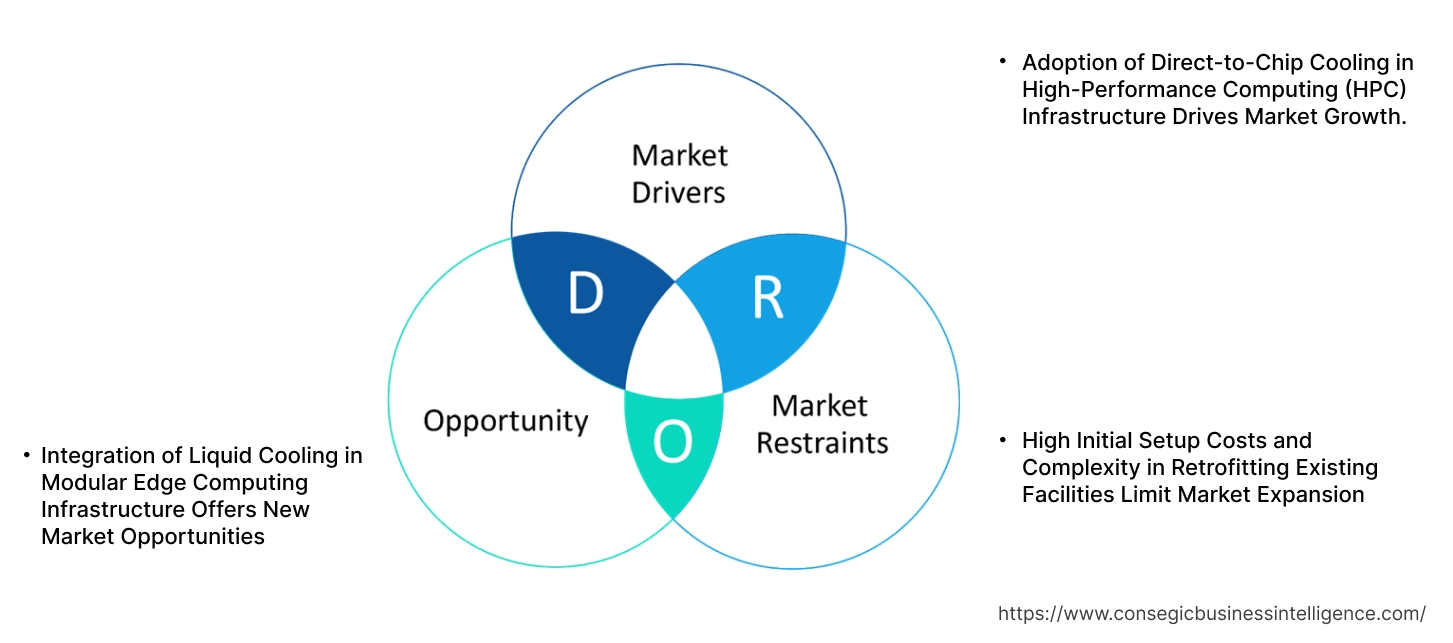
Key Drivers:
Adoption of Direct-to-Chip Cooling in High-Performance Computing (HPC) Infrastructure Drives Market Growth.
The increasing computational intensity in sectors such as scientific research, financial analytics, and artificial intelligence is driving the adoption of direct-to-chip liquid cooling solutions in high-performance computing (HPC) environments. These systems offer highly efficient thermal regulation at the chip level, removing heat directly from CPUs, GPUs, and other high-density components. By reducing dependence on airflow and mechanical cooling infrastructure, direct-to-chip designs lower power consumption, enable higher rack densities, and minimize data center footprint. This thermal precision ensures system reliability even under peak performance conditions, supporting uninterrupted computational workflows. The growing demand for scalable, energy-efficient, and space-optimized cooling architectures in mission-critical HPC facilities is accelerating the transition from traditional air cooling to direct liquid engagement.
- For instance, in March 2025, Vertiv launched the Vertiv™ CoolLoop RDHx, a chilled water, high-density rear door heat exchanger (RDHx) specifically designed to support the higher thermal demands of AI, high-performance computing (HPC), and other power-dense IT workloads. It offers enhanced adaptability and efficiency with primary and secondary cooling circuit integration as well as modular compatibility, enabling installation on 600mm and 800 mm-wide IT racks.
As organizations invest in advanced computing clusters to handle complex workloads, the technology is becoming central to future-ready data center strategies. This structural shift is a core contributor to the liquid cooling systems market expansion.
Key Restraints:
High Initial Setup Costs and Complexity in Retrofitting Existing Facilities Limit Market Expansion
Implementing liquid cooling technologies involves considerable upfront investment, particularly when transitioning from air-cooled infrastructure. These systems require specialized hardware, including cold plates, coolant distribution units, piping, and custom server designs. Additionally, the installation process demands careful adaptation of facility, often involving downtime, spatial reconfiguration, and integration of leak-proof components. For existing data centers, retrofitting poses further challenges in aligning legacy server configurations with liquid-compatible designs, increasing operational disruption and cost. The complexity of plumbing, coolant management, and power system adjustments places financial strain on small to mid-sized enterprises. Despite efficiency benefits, budget constraints often lead operators to postpone adoption or limit it to select high-density zones. This economic barrier restricts broader technology penetration across geographies and industries. The resulting hesitation among buyers, especially in cost-sensitive environments, is a key restraint to liquid cooling systems market growth.
Future Opportunities:
Integration of Liquid Cooling in Modular Edge Computing Infrastructure Offers New Market Opportunities
The proliferation of edge computing infrastructure, particularly in applications requiring real-time processing such as autonomous vehicles, industrial automation, and 5G base stations, is opening new demand for compact and efficient thermal management solutions. Liquid cooling is emerging as a preferred method for managing heat in modular and micro-data centers deployed at edge locations where airflow is restricted and ambient conditions are variable. These systems offer high thermal performance without requiring large-scale HVAC installations, reducing energy consumption and ensuring consistent performance in limited space. Vendors are now engineering pre-integrated liquid-cooled enclosures tailored to edge environments, enabling simplified deployment and rapid scalability. As edge computing workloads grow in complexity and thermal load, liquid cooling adoption is expected to accelerate across decentralized computing networks.
- For instance, in February 2025, Asperitas launched a line of modular Direct Forced Convection immersion cooling tanks for standalone edge facilities.
This convergence of thermal innovation and edge architecture is set to unlock significant liquid cooling systems market opportunities through demand-responsive, space-efficient solutions.
Liquid Cooling Systems Market Segmental Analysis :
By Component:
Based on component, the liquid cooling systems market is segmented into solutions and services. The solutions segment includes direct liquid cooling and indirect liquid cooling, while services include design and consulting, installation and deployment, and support and maintenance.
The solutions segment accounted for the largest liquid cooling systems market share in 2024.
- Direct liquid cooling solutions are widely adopted in data centers and high-performance computing due to their superior thermal management efficiency.
- Indirect cooling is prevalent in industrial environments where traditional airflow is insufficient for heat-intensive systems.
- The liquid cooling systems market trends show that pre-engineered solution packages dominate deployments across modular computing environments.
- Therefore, as thermal loads increase across processors and electronics, the solutions segment supports steady market growth.
The services segment is projected to witness the fastest CAGR during the forecast period.
- Customization requirements for cooling design and infrastructure integration are driving the need for consulting and deployment services.
- Ongoing system monitoring, maintenance, and fluid replacement boost recurring revenue for service providers.
- Segmental trends indicate rapid expansion of managed services in cloud and edge computing facilities.
- Therefore, service-based delivery models support scalability and long-term asset management, contributing to the liquid cooling systems market expansion.
By Fluid Type:
Based on fluid type, the market is segmented into water-based coolants, dielectric oils, deionized water, glycol & water mixtures, mineral oils, and fluorocarbon-based liquids.
Water-based coolants held the dominant market share in 2024.
- These fluids offer high thermal conductivity, cost efficiency, and are widely compatible with both direct and indirect systems.
- Water’s ease of handling and availability makes it the primary medium in data centers and industrial cooling.
- Liquid cooling systems market analysis indicates that refined formulations with corrosion inhibitors are increasingly adopted.
- Thus, the demand for sustainable, low-toxicity solutions supports continued leadership of water-based fluids in commercial deployments.
Dielectric oils are expected to witness the fastest CAGR during the forecast period.
- Their electrically non-conductive nature allows full immersion of servers and components without damage.
- These fluids are essential in emerging use cases like modular immersion-cooled server racks and edge micro data centers.
- Market trends show an increased investment in advanced synthetic oils for aerospace and defense electronics.
- With rising heat densities, dielectric oils provide superior long-term stability, driving segmental contribution to the liquid cooling systems market demand.
By Application:
Based on application, the liquid cooling systems market is segmented into data centers, automotive, industrial equipment, consumer electronics, power electronics, telecommunications, aerospace & defense, medical equipment, gaming & high-performance computing, and others.
Data centers held the largest share of the market in 2024.
- Rising power densities in server racks and the shift to AI and machine learning workloads are intensifying cooling requirements.
- Direct-to-chip cooling and rear-door heat exchangers are widely used in hyperscale and colocation environments.
- Segmental trends emphasize increasing retrofits in legacy data centers to meet energy efficiency standards.
- Therefore, this segment is expected to remain critical to the liquid cooling systems market demand across North America, Europe, and Asia-Pacific.
Gaming & high-performance computing (HPC) is projected to grow at the fastest CAGR.
- Overclocked processors and GPUs require advanced thermal solutions for stability and performance.
- DIY enthusiasts and esports arenas are increasingly deploying closed-loop and custom liquid cooling rigs.
- The market demand is fueled by innovations in compact radiators, pump blocks, and silent fanless systems.
- Thus, with edge AI, simulation, and metaverse workloads rising, this segment plays a central role in the liquid cooling systems market trends.
By End-Use Industry:
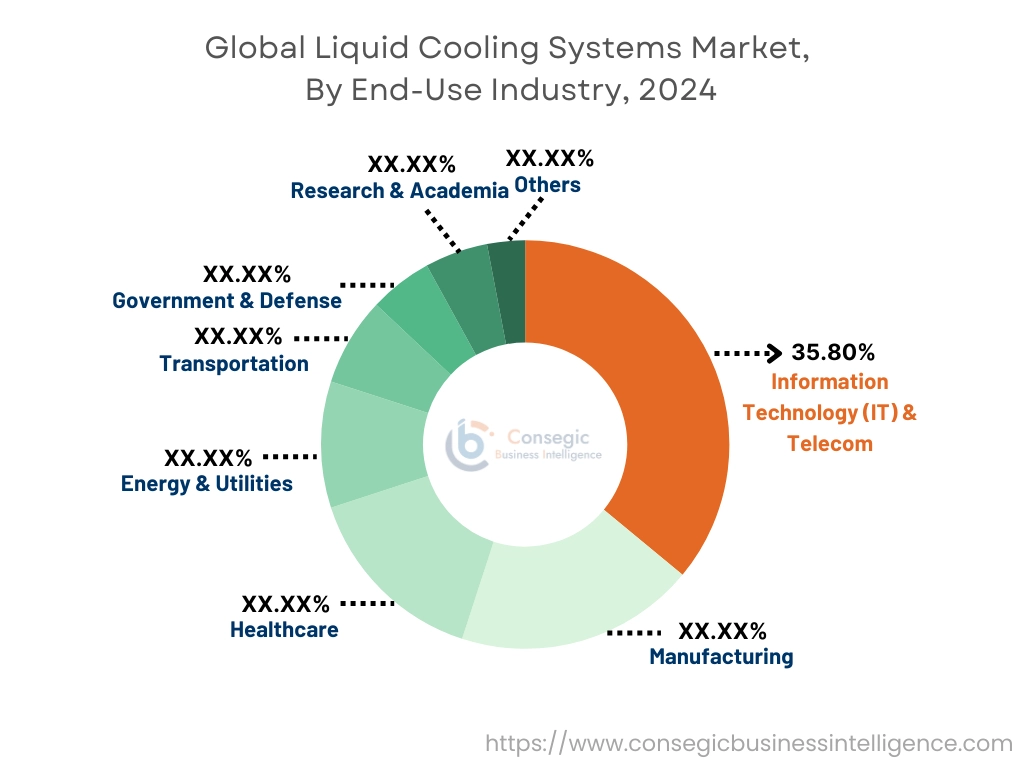
Based on end-use industry, the market is segmented into information technology (IT) & telecom, manufacturing, healthcare, energy & utilities, transportation, government & defense, research & academia, and others.
The IT & telecom segment accounted for the largest liquid cooling systems market share of 35.80% in 2024.
- Increasing cloud infrastructure and 5G network densification are driving the need for advanced thermal management.
- Telecom base stations and micro data centers require compact cooling solutions that can function in remote and harsh environments.
- Segmental analysis indicates that telecom operators are integrating closed-loop liquid systems to reduce OPEX and improve uptime.
- Therefore, the growing digitization of telecom infrastructure is a key enabler of the liquid cooling systems market growth.
The research & academia segment is expected to register the highest CAGR during the forecast period.
- Supercomputers and academic AI labs require dense compute nodes with reliable thermal efficiency.
- High-performance clusters for simulation, genome sequencing, and fluid dynamics increasingly rely on liquid-cooled hardware.
- Government funding and university partnerships accelerate the adoption of advanced cooling technologies in this sector.
- For instance, in November 2024, Equinix and the National University of Singapore collaborated to explore sustainability and energy solutions for data centres. This included investigation of solutions such as alternative power sources, digital twins technology, liquid cooling and direct current power distribution systems.
- As per the liquid cooling systems market analysis, academic institutions are becoming testbeds for next-gen cooling frameworks.
Regional Analysis:
The regions covered are North America, Europe, Asia Pacific, the Middle East and Africa, and Latin America.
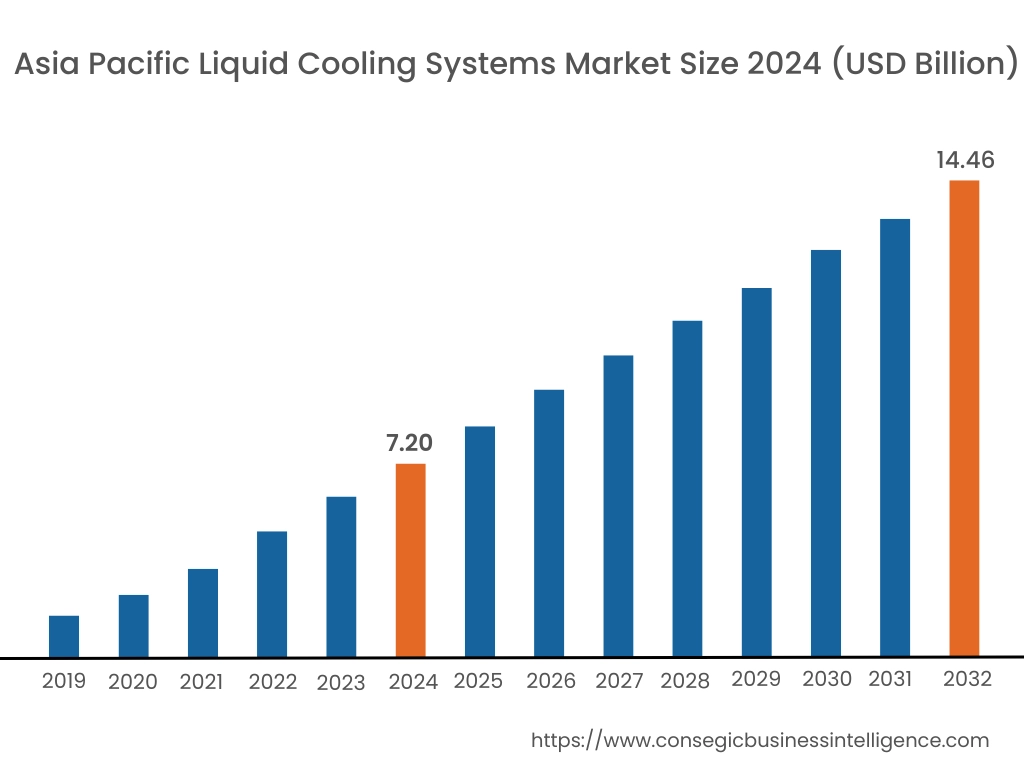
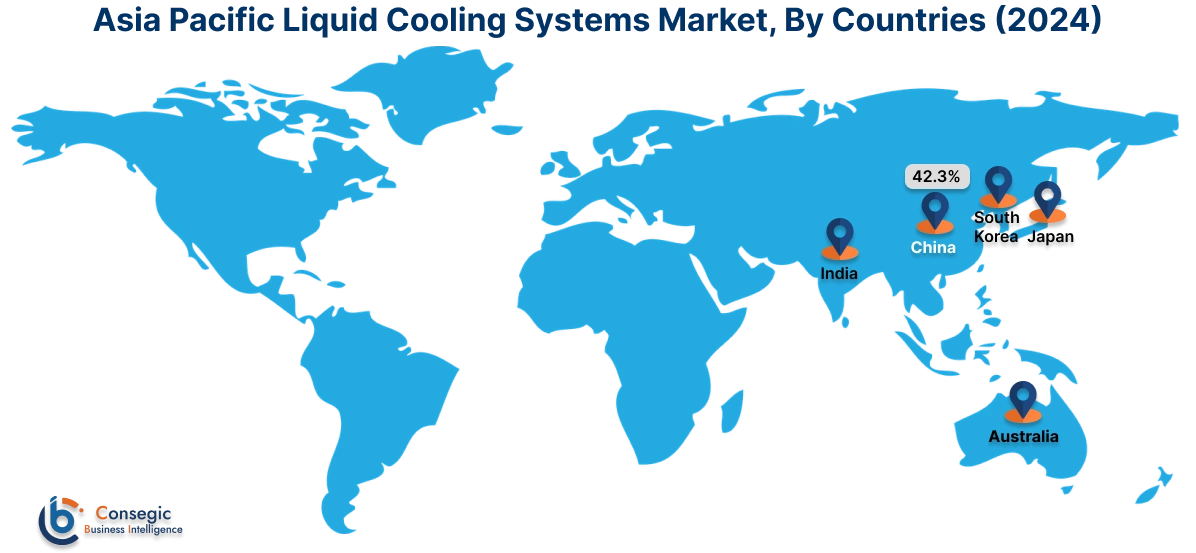
Asia Pacific region was valued at USD 7.20 Billion in 2024. Moreover, it is projected to grow by USD 7.72 Billion in 2025 and reach over USD 14.46 Billion by 2032. Out of this, China accounted for the maximum revenue share of 42.3%. Asia-Pacific is the fastest-growing region in the liquid cooling systems industry, bolstered by expanding data center installations, increased IT outsourcing, and a thriving consumer electronics sector. Countries such as China, India, Japan, and South Korea are witnessing accelerated investment in smart cities, telecommunications, and semiconductor manufacturing. The increasing need for real-time data processing and high-capacity computing power is pushing infrastructure providers toward thermal solutions that can handle greater heat densities.
- For instance, in February 2025, HKBN Enterprise Solutions collaborated with Global Switch, a leading data centre operator, to provide enterprise customers with highly resilient and advanced data management solutions. This partnership leverages HKBN’s fibre network infrastructure and one-stop managed services to meet the growing requirements of high-performance computing and efficient data storage in the era of artificial intelligence (AI).
Analysis indicates a strong focus on liquid-based cooling in hyperscale facilities and government-funded research labs. The growing prevalence of e-sports and 5G rollout in urban centers also reinforces regional growth by elevating hardware cooling needs.
North America is estimated to reach over USD 15.39 Billion by 2032 from a value of USD 8.11 Billion in 2024 and is projected to grow by USD 8.65 Billion in 2025. North America maintains a dominant position in the liquid cooling systems market, as supported by the advanced data center infrastructure and early adoption of high-performance computing across the United States and Canada. The region's focus on optimizing energy efficiency, especially within hyperscale and edge data centers, continues to propel the shift from air cooling to liquid-based technologies. In addition, industries such as aerospace, defense, and automotive are investing in compact, high-density cooling solutions for electronic components. The continued rollout of AI and machine learning infrastructure further enhances market activity, with analysis suggesting strong public and private sector alignment in sustainable thermal management strategies.
Europe presents a mature and innovation-focused market, with regional demand driven by environmental policies and regulatory incentives for energy-efficient operations. Countries such as Germany, the Netherlands, and the Nordics are at the forefront of green data center deployment, where liquid cooling technologies are gaining traction to reduce carbon footprint and operational overhead. Analysis reveals a growing shift toward modular and immersion cooling applications across cloud computing and industrial automation segments. Additionally, regional collaborations between universities, OEMs, and cloud providers support continuous advancement in high-density cooling designs. The liquid cooling systems market opportunity in Europe lies in balancing performance with sustainability across evolving digital infrastructure.
In Latin America, the adoption of liquid cooling systems is emerging gradually, influenced by the modernization of data centers and rising energy costs. Brazil, Mexico, and Chile are leading digitization efforts, which involve upgrading legacy cooling infrastructures to improve performance and operational efficiency. As financial institutions and public sector agencies increase their IT load, demand for scalable, energy-saving thermal solutions is expected to rise. Market analysis suggests that regional growth will depend on greater awareness, technology transfer partnerships, and localized manufacturing to reduce procurement costs and deployment barriers.
The Middle East and Africa represent a developing market where digital transformation, coupled with extreme climate conditions, is creating a foundation for future adoption of advanced cooling solutions. UAE and Saudi Arabia are investing in cloud computing, smart infrastructure, and blockchain technologies, which require robust and efficient thermal management. The region aims to become a hub for data hosting for global tech firms, which supports market interest. Furthermore, while current adoption remains limited, pilot projects and proof-of-concept deployments offer promising indicators of future expansion.
Top Key Players & Market Share Insights:
The liquid cooling systems market is highly competitive with major players providing products and services to the national and international markets. Key players are adopting several strategies in research and development (R&D), product innovation, and end-user launches to hold a strong position in the global liquid cooling systems market. Key players in the liquid cooling systems industry include -
- Schneider Electric (France)
- Asetek (Denmark)
- Fujitsu Ltd. (Japan)
- Lenovo Group Limited (China)
- Alfa Laval (Sweden)
- CoolIT Systems (Canada)
- Iceotope Technologies (United Kingdom)
- Rittal GmbH & Co. KG (Germany)
- LiquidStack (Netherlands)
- Asperitas (Netherlands)
Recent Industry Developments :
- In February 2025, Telehouse unveiled a liquid cooling lab in collaboration with Legrand & EkkoSense in London Docklands. This facility displays cutting-edge cooling technologies from industry leaders, including Legrand and EkkoSense, to help customers manage the rising thermal needs of high-performance computing (HPC) and AI workloads.
Acquisitions:
- In February 2025, Lightpath completed the acquisition of all assets of United Fiber and Data (UFD). This expands Lightpath’s geographical reach in the New York and Ashburn regions. The company also launched LightCube Edge Data Centers.
Partnerships:
- In March 2025, Giga Computing, a subsidiary of GIGABYTE Technology, signed a Memorandum of Understanding (MoU) with SK Telecom and SK Enmove to partner on developing AI Data Center (AIDC) and high-performance computing (HPC), as well as increasing the adoption of liquid cooling technology in next-generation data centers. This strategic collaboration aims to innovate high-performance, energy-efficient, and sustainable data center solutions.
Liquid Cooling Systems Market Report Insights:
| Report Attributes | Report Details |
| Study Timeline | 2019-2032 |
| Market Size in 2032 | USD 47.50 Billion |
| CAGR (2025-2032) | 8.6% |
| By Component |
|
| By Fluid Type |
|
| By Application |
|
| By End-Use Industry |
|
| By Region |
|
| Key Players |
|
| North America | U.S. Canada Mexico |
| Europe | U.K. Germany France Spain Italy Russia Benelux Rest of Europe |
| APAC | China South Korea Japan India Australia ASEAN Rest of Asia-Pacific |
| Middle East and Africa | GCC Turkey South Africa Rest of MEA |
| LATAM | Brazil Argentina Chile Rest of LATAM |
| Report Coverage |
|
Key Questions Answered in the Report
How big is the Liquid Cooling Systems Market? −
The global Liquid Cooling Systems market is estimated to reach over USD 47.50 Billion by 2032 from a value of USD 24.46 Billion in 2024, growing at a CAGR of 8.6% from 2025 to 2032.
What specific segmentation details are covered in the Liquid Cooling Systems Market report? +
The Liquid Cooling Systems market report includes specific segmentation details for component, fluid type, application and end-use industry.
Which is the fastest-growing region in the Liquid Cooling Systems Market? +
Asia Pacific is the fastest-growing region in the Liquid Cooling Systems market. These trends are encouraged by expanding data center installations, increased IT outsourcing, and a thriving consumer electronics sector.
Who are the major players in the Liquid Cooling Systems Market? +
The key participants in the Liquid Cooling Systems market are Schneider Electric (France), Asetek (Denmark), CoolIT Systems (Canada), Iceotope Technologies (United Kingdom), Rittal GmbH & Co. KG (Germany), LiquidStack (Netherlands), Asperitas (Netherlands), Fujitsu Ltd. (Japan), Lenovo Group Limited (China) and Alfa Laval (Sweden).
Overview
Reputation & Certifications


Our Services
- Market Intelligence & Forecasting
- Custom Research Solutions
- Market Entry Strategy
- Competitive Intelligence
- Customer Insights
- Industry Innovation Analysis
- Investment Advisory