Jump to Content
Location of Things Market - Size, Share, Industry Trends, and Forecasts (2025-2032)
Location of Things Market Size:
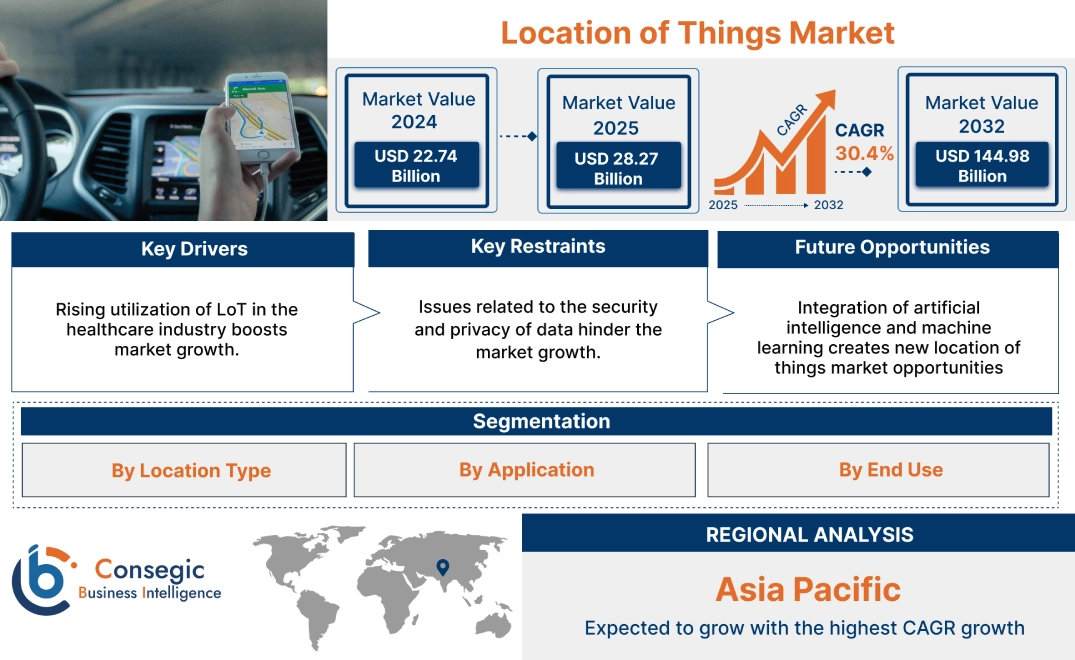
Location of Things Market size is estimated to reach over USD 144.98 Billion by 2032 from a value of USD 22.74 Billion in 2024 and is projected to grow by USD 28.27 Billion in 2025, growing at a CAGR of 30.4% from 2025 to 2032.
Location of Things Market Scope & Overview:
Location of Things (LoT), a part of the Internet of Things (IoT), is a collection of devices and sensors that track and communicate the location of objects and assets. LoT uses Bluetooth Low Energy (BLE) and other technologies to communicate with each other to understand the physical location. Location of things enhances operational efficiency, reduces costs, improves customer services, improves safety measures, optimizes logistics, and enables asset tracking. LoT is used in fleet management, asset tracking, supply chain management, smart agriculture, traffic management, and healthcare monitoring.
How is AI Transforming the Location of Things Market?
AI is increasingly being integrated into the location of things sector, particularly for providing real-time, location-based insights for enhanced decision-making, automation, and personalized experiences across various industries such as logistics, retail, urban planning, and connected vehicles, among others. Moreover, AI can analyze vast amounts of location data to identify patterns, predict behavior, optimize routes, and automate tasks such as asset tracking and others.
Additionally, AI solutions can analyze complex geospatial data in real-time to identify patterns, trends, and anomalies, in turn leading to better resource optimization and predictive capabilities. Consequently, the above factors are projected to boost the market growth in upcoming years.
Location of Things Market Dynamics - (DRO) :
Key Drivers:
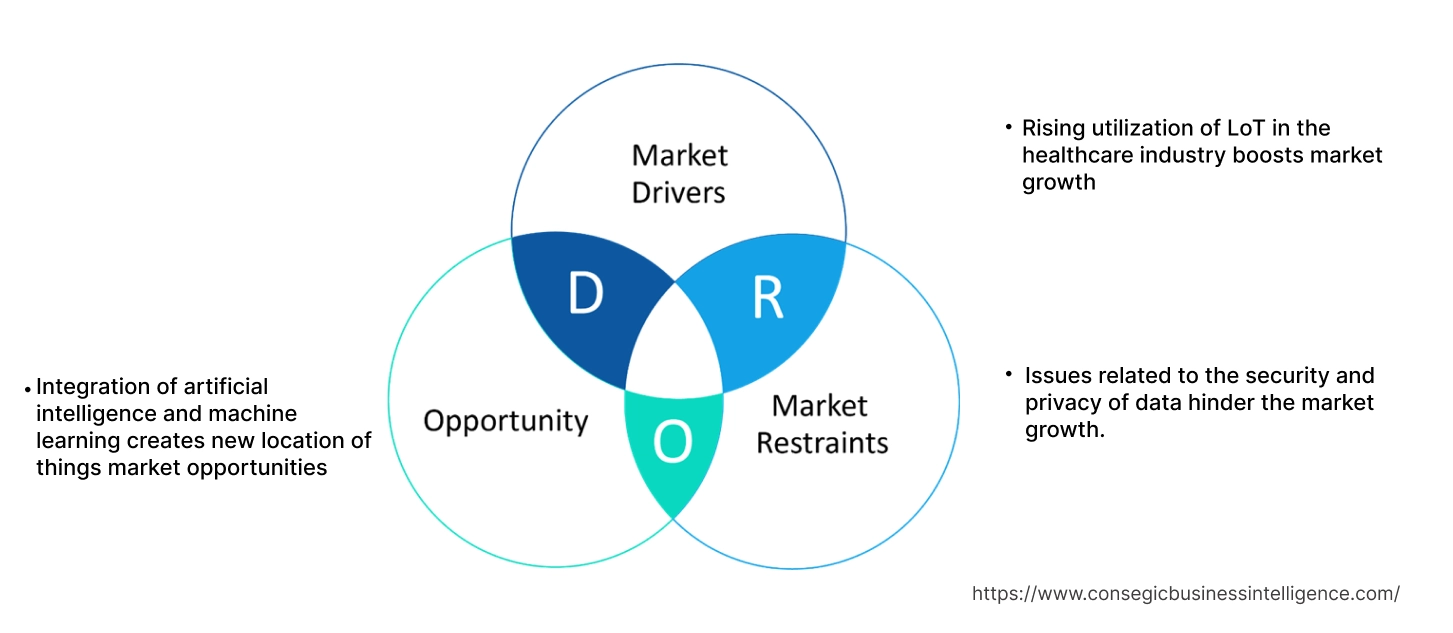
Rising utilization of LoT in the healthcare industry boosts market growth.
LoT in healthcare is used to track the real-time location of medical equipment, including wheelchairs, defibrillators, oxygen tanks, and others within a building using sensors and tags. It allows staff to quickly locate necessary items and optimize workflow, particularly in large hospitals where equipment can easily be misplaced. Moreover, it is used for asset management, patient monitoring, staff optimization, inventory management, and effective emergency response.
- For instance, in September 2024, ZTE partnered with hospital of Soochow University to build 5G-powered IoT integration network solution. It connects various medical devices while reducing the number of network types.
Thus, the market analysis shows that the aforementioned factors are boosting the usage and demand of LoT in healthcare, in turn driving the location of things market growth.
Key Restraints:
Issues related to the security and privacy of data hinder the market growth.
LoT works on large amounts of data that cause security and privacy issues. This is caused due to improper user authorization to access and store data. Moreover, many IoT devices collect location data without clear user understanding or explicit consent, raising privacy concerns about how this data is being used. In such cases, users may not have sufficient control over how their location data is collected, shared, or used. This can also lead to location data being stored for longer than necessary, in turn increasing privacy risks.
Thus, the location of things market analysis shows that the aforementioned factors are restraining the location of things market demand.
Future Opportunities :
Integration of artificial intelligence and machine learning creates new location of things market opportunities
Artificial intelligence (AI) and machine learning (ML) tools allow precision tracking and analysis of real-time insights to make intelligent decisions based on where things are located. AI algorithms filter out noise and improve the precision of location data. By analyzing historical location data, AI models predict future movements. The data is used by systems to automatically trigger actions based on real-time location information. Moreover, AI provides real-time updates on the location of objects and enables dynamic monitoring and response capabilities.
- For instance, in February 2025, Accuver showcased its AEGIS-AP LPS solution. The solution estimates the location of the device by analyzing transmission data with base stations without the need to directly transmit location data. The solution uses AI/ML algorithms to improve the positioning accuracy of the location.
Thus, the ongoing advancements in AI and ML are projected to drive location of things market opportunities during the forecast period.
Location of Things Market Segmental Analysis :
By Location Type:
Based on the location type, the market is segmented into indoor location and outdoor location.
Trends in the Location Type:
- Increasing demand in the adoption of location of things for asset tracking in outdoor sectors including logistics and transportation is driving the location of things market size.
- Rising trend in the adoption of indoor LoT for staff optimization and enhancing customer experience.
The outdoor segment accounted for the largest revenue share in the location of things market share in 2024.
- LoT is primarily used to track the location of assets in outdoor environments. It is used for logistics optimization, environmental monitoring, route management, and targeted advertising.
- For instance, in December 2021, CoreKinect and Comcast’s MachineQ collaborated to launch a LoRaWAN-based outdoor tracking solution. The solution provides real-time monitoring of assets and inventory.
- Therefore, rising advancements associated with outdoor tracking solutions are driving the location of things market expansion.
The indoor segment is expected to register the fastest CAGR growth during the forecast period.
- LoT is often used in indoor locations to track the exact location of assets within a building by using IoT technology.
- It is used for asset tracking, security and access control, maintenance management, emergency response, and space utilization analysis.
- For instance, in January 2025, Qualcomm launched Qualcomm Aware Platform. The platform allows enterprises to add indoor positioning and geolocation to connected devices.
- Thus, the increasing developments related to indoor location positioning and tracking solutions are expected to propel the location of things market trends during the forecast period.
By Application:
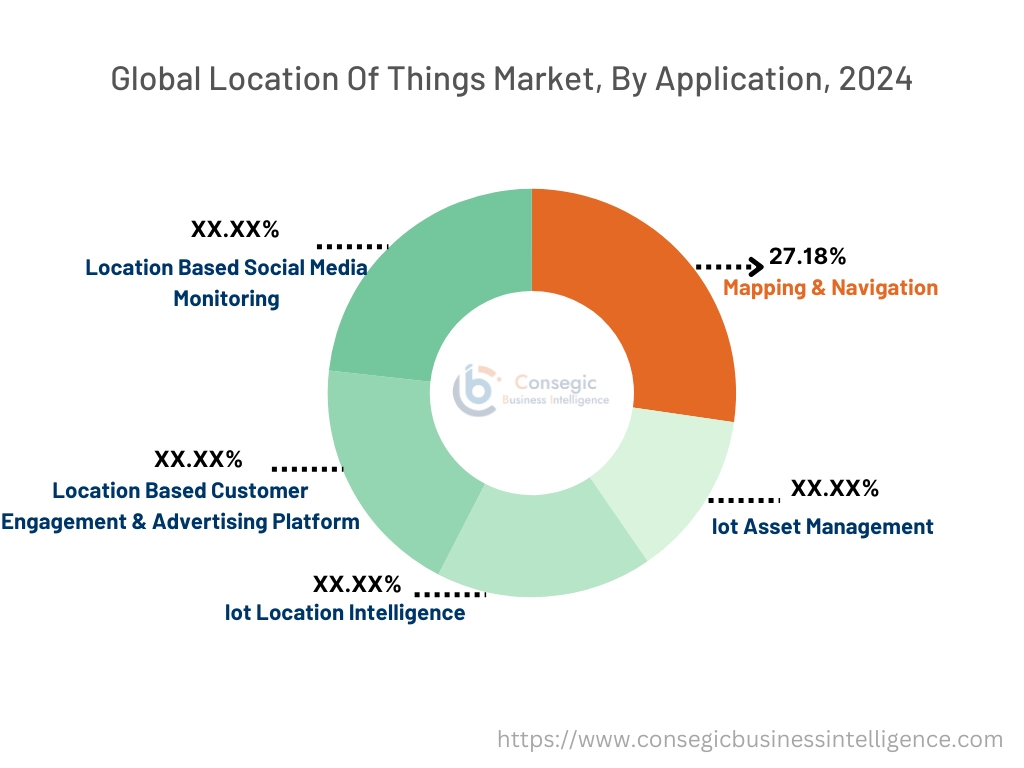
Based on the application, the market is segmented into IoT asset management, IoT location intelligence, location based customer engagement & advertising platform, location based social media monitoring, and mapping & navigation.
Trends in the Application:
- Rising adoption of LoT in customer engagement and advertising platforms to create more relevant and contextual marketing.
- Increasing demand in the adoption of LoT in proximity-based services is boosting the location of things market size.
The mapping and navigation segment accounted for the largest revenue share of 27.18% in the market in 2024.
- LoT offers the exact position of things that is used in navigation apps to guide users to places, asset tracking to monitor the location of valuable items, delivery services to optimize routes, and smart city management to monitor traffic patterns.
- For instance, in September 2024, Samsara, in collaboration with Esri, announced a new integration to improvise fleet management and real-time data sharing for government agencies.
- Therefore, the market analysis shows that the increasing adoption of LoT in mapping and navigation applications is driving the location of things market trends.
The IoT asset management segment is expected to register the fastest CAGR growth during the forecast period.
- IoT sensors integrated with assets transmit the location data, enabling real-time updates. This allows businesses to manage inventory more effectively and prevent loss or misuse. Moreover, businesses are able to streamline delivery routes and improve logistics efficiency.
- For instance, in September 2024, Semtech Corporation, in collaboration with Traxmate, launched an IoT tracking platform. The platform offers seamless outdoor and indoor asset-tracking solutions.
- Thus, the rising application of LoT in IoT asset management is expected to drive the location of things market expansion during the forecast period.
By End User:
Based on the end user, the market is segmented into BFSI, defense, government & public utilities, healthcare & life sciences, industrial manufacturing, media & entertainment, retail, transportation & logistics, and others.
Trends in the End User:
- Rising trend in the adoption of LoT in the defense sector to track and monitor the precise location of military assets, personnel, and equipment in real-time.
- Increasing trend in the adoption of LoT in locating specific items within a warehouse for faster retrieval.
The transportation and logistics segment accounted for the largest revenue in the location of things market share in 2024.
- In the transportation and logistics sector, the LoT is used to track the real-time location of assets including vehicles, and shipments. It enables efficient route optimization, real-time delivery updates, and enhanced asset management, in turn, leading to better customer service and cost reduction.
- For instance, in April 2024, Hapag-Lloyd launched its first dry container tracking solution ‘Live Position’. It deploys IoT technology in logistics on a large scale.
- Moreover, in June 2022, Wiliot launched a Reusable Transport Item (RTI) solution. The solution continuously monitors the location and temperature of produce to ensure freshness for its customers.
- Therefore, wide applications offered by LoT in the transportation and logistics sector are driving the location of things market growth.
The retail segment is expected to register the fastest CAGR growth during the forecast period.
- In the retail sector, LOT tracks the accurate location of items within a store or a building. It provides benefits including improved inventory management, personalized customer experiences, efficient staff workflows, and real-time asset tracking.
- For instance, SmartSense launched SmartSense VOYAGE, an IoT-solution for real-time tracking and monitoring. The solution offers tracking of asset position throughout the supply chain.
- Thus, the rising utilization of LoT in the retail sector is projected to boost the location of things market demand during the forecast period.
Regional Analysis:
The regions covered are North America, Europe, Asia Pacific, the Middle East and Africa, and Latin America.
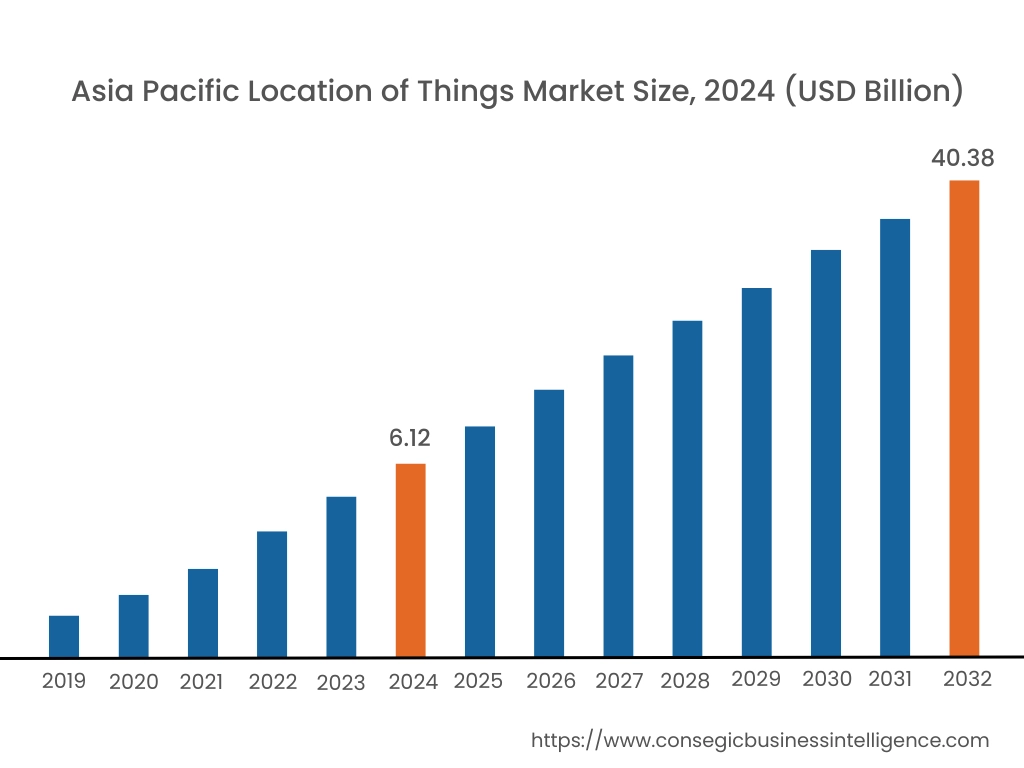
Asia Pacific region was valued at USD 6.12 Billion in 2024. Moreover, it is projected to grow by USD 7.63 Billion in 2025 and reach over USD 40.38 Billion by 2032. Out of this, China accounted for the maximum revenue share of 36.2%. The location of things market in the region is driven by growing IoT adoption, technological advancements, and government initiatives in smart city development and smart manufacturing.
- For instance, in April 2024, Nissan Motor Co. and Panasonic Corp. launched a location sharing service. The service offers information of the location and charging status of private cars, which are automatically sent to home appliances.
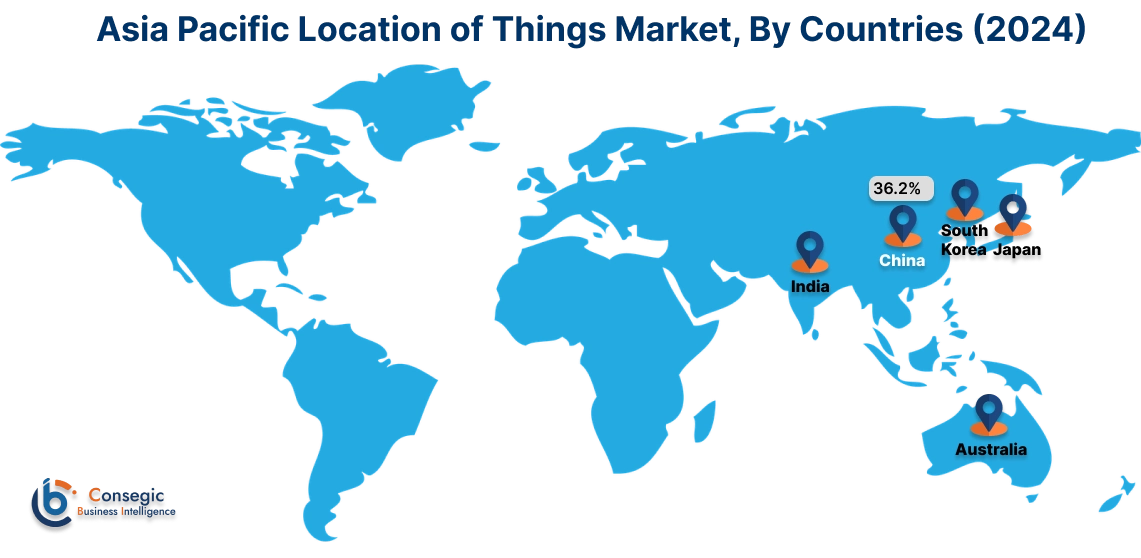
North America is estimated to reach over USD 49.29 Billion by 2032 from a value of USD 7.79 Billion in 2024 and is projected to grow by USD 9.67 Billion in 2025. The market in the region is driven due to robust infrastructure and high smartphone penetration, leading to higher usage of LoT for asset tracking.
- For instance, in June 2024, Samsara announced asset tags to connect physical items to the cloud environment. It allows businesses to connect smaller devices with the cloud, enabling location tracking.
Additionally, the location of things market analysis shows that the European market is driven by growing logistics, retail, and manufacturing sectors that need LoT for various applications including supply chain management, customer experience, and others. In Latin America, the market is rising due to the prevalence of smart city initiatives that require constant tracking and monitoring of assets that require constant tracking and monitoring of assets. In the Middle East and Africa, the market is driven by the rising retail sector, which requires asset management and proximity advertising among others.
Top Key Players & Market Share Insights:
The location of things industry is highly competitive with major players providing solutions and services to the national and international markets. Key players are adopting several strategies in research and development (R&D), product innovation, and end-user launches to hold a strong position in the global location of things market. Key players in the location of things industry include -
- Bosch Software Innovations GMBH (Germany)
- ESRI (US)
- Pitney Bowes, Inc. (US)
- Qualcomm Technologies, Inc. (US)
- Telogis (US)
- HERE Technologies (Netherlands)
- Google, Inc. (US)
- IBM Corporation (US)
- Microsoft Corporation (US)
- Navizon, Inc. (US)
Recent Industry Developments :
Partnerships and Collaborations:
- In September 2023, Samsung partnered with American Express and KB Kookmin to develop trackable payment cards. The IoT credit card enables cardholders to connect their card to a Galaxy smartphone and authenticate the location using Samsung’s Bluetooth Low Energy-enabled SmartThings Find platform.
Location of Things Market Report Insights:
| Report Attributes | Report Details |
| Study Timeline | 2019-2032 |
| Market Size in 2032 | USD 144.98 Billion |
| CAGR (2025-2032) | 30.4% |
| By Location Type |
|
| By Application |
|
| By End Use |
|
| By Region |
|
| Key Players |
|
| North America | U.S. Canada Mexico |
| Europe | U.K. Germany France Spain Italy Russia Benelux Rest of Europe |
| APAC | China South Korea Japan India Australia ASEAN Rest of Asia-Pacific |
| Middle East and Africa | GCC Turkey South Africa Rest of MEA |
| LATAM | Brazil Argentina Chile Rest of LATAM |
| Report Coverage |
|
Key Questions Answered in the Report
How big is the location of things market? −
Location of Things Market size is estimated to reach over USD 144.98 Billion by 2032 from a value of USD 22.74 Billion in 2024 and is projected to grow by USD 28.27 Billion in 2025, growing at a CAGR of 30.4% from 2025 to 2032.
What are the major segments covered in the location of things market report? +
The segments covered in the report are location type, application, and end user.
Which region holds the largest revenue share in 2024 in the location of things market? +
North America holds the largest revenue share in the location of things market in 2024.
Who are the major key players in the location of things market? +
The major key players in the market are Bosch Software Innovations GMBH (Germany), ESRI (US), HERE Technologies (Netherlands), Google, Inc. (US), IBM Corporation (US), Microsoft Corporation (US), Navizon, Inc. (US), Pitney Bowes, Inc. (US), Qualcomm Technologies, Inc. (US), and Telogis (US).
Overview
Reputation & Certifications


Our Services
- Market Intelligence & Forecasting
- Custom Research Solutions
- Market Entry Strategy
- Competitive Intelligence
- Customer Insights
- Industry Innovation Analysis
- Investment Advisory