Jump to Content
Track and Trace Solutions Market - Size, Share, Industry Trends, and Forecasts - (2026 - 2035)
Track and Trace Solutions Market Size:
Track and Trace Solutions Market is estimated to reach over USD 31.48 Billion by 2034 from a value of USD 7.95 Billion in 2025 and is projected to grow by USD 9.14 Billion in 2026, growing at a CAGR of 14.7% from 2026 to 2034.
Track and Trace Solutions Market Key Takeaways
- Rising e-commerce growth and demand for supply chain visibility are driving the market.
- Asia Pacific dominated the market due to rapid industrialization and manufacturing expansion.
- Software was the leading component segment.
- Pharmaceutical & biopharmaceutical was the largest end-use industry.
- RFID, IoT, blockchain, and AI are improving product traceability and authentication.
- Antares Vision, TraceLink, Zebra Technologies, OPTEL Group, and Siemens were key market players.
Track and Trace Solutions Market Scope & Overview:
Track and Trace solutions are integrated systems and technologies designed to monitor the movement and status of products throughout the supply chain, from production to the final consumer. These solutions utilize tools like serialization, barcodes, RFID, and cloud-based platforms to ensure transparency, regulatory compliance, and authenticity. Further, key trends driving the market include the rapid integration of advanced technologies like AI, IoT, and blockchain to enable real-time shipment visibility and predictive supply chain analytics. Also, there is a strong shift toward cloud-native SaaS platforms and stringent global regulatory mandates for serialization, which are compelling companies to adopt more transparent, end-to-end supply chain management systems.

Track and Trace Solutions Market Dynamics - (DRO):
Market Drivers:
Supply Chain Visibility and Rise of E-Commerce Drives the Market
The rapid rise of e-commerce has fundamentally reshaped consumer expectations, placing real-time supply chain visibility at the core of modern retail success. As customers increasingly demand fast, transparent delivery experiences, businesses are relying on tracking solutions to provide precise, step-by-step order monitoring from the loading dock to the doorstep. This visibility is essential for maintaining inventory accuracy and streamlining operations. By integrating real-time data into their logistics, companies can proactively manage disruptions, optimize delivery routes, and turn fulfillment into a competitive advantage that fosters long-term customer loyalty and brand trust.
- For instance, according to the U.S. Census Bureau, retail e-commerce sales in the United States were valued at USD 300.35 billion during the fourth quarter of 2024, representing a significant increase of 8.5% in comparison to the third quarter of 2023. The rise in e-commerce is expected to drive the demand for tracing solutions.
Thus, escalating e-commerce needs and the critical demand for transparent, real-time supply chain visibility contribute significantly to the rise in the track and trace solutions market size.
Market Restraints:
High Implementation Costs and Complexity in Integration are Limiting the Market Growth
High implementation costs and complex integration requirements significantly hinder the adoption of tracing solutions, particularly for small-to-medium enterprises and generic manufacturers with limited IT budgets. The initial financial burden includes substantial investments in hardware like IoT sensors and scanners, along with ongoing software licensing and maintenance fees. Further, beyond these costs, integration is complicated by the need to bridge modern digital platforms with aging legacy ERP and MES systems. The older systems often rely on proprietary data formats and lack standard APIs, requiring expensive custom middleware or extensive retrofitting of existing packaging lines to achieve interoperability. Consequently, companies frequently face prolonged validation timelines, ROI uncertainty, and operational disruptions, which hamper the market.
Market Opportunities:
Broadening Industry Adoption Drive Track and Trace Solutions Market Opportunities
The broadening adoption of tracking solutions across diverse sectors including food and beverage, cosmetics, automotive, and electronics is creating substantial market opportunities. As companies in these industries face mounting pressure to guarantee product authenticity, ethical sourcing, and consumer safety, they are increasingly investing in sophisticated serialization, RFID, and blockchain-enabled platforms. This transition allows organizations to move beyond basic identification to achieve granular end-to-end visibility, which significantly enhances recall management, operational efficiency, and brand protection. Consequently, providers who can offer scalable, cloud-native solutions capable of integrating these disparate industries into unified, transparent ecosystems are capturing long-term growth. Thus, the aforementioned market factors are expected to drive the market opportunities during the forecast period.
Track and Trace Solutions Market Segmental Analysis:
By Component:
Based on the component, the market is segmented into hardware, software, and services.
Trends in the Component:
- Hardware is increasingly interconnected via IoT, allowing devices like printers and scanners to report their own status, health, and usage patterns, which is driving the track and trace solutions market trends.
- There is a growing demand for advanced vision inspection and camera systems capable of handling reflective packaging, curved surfaces, and high-speed production lines with greater accuracy, which in turn drives the market.
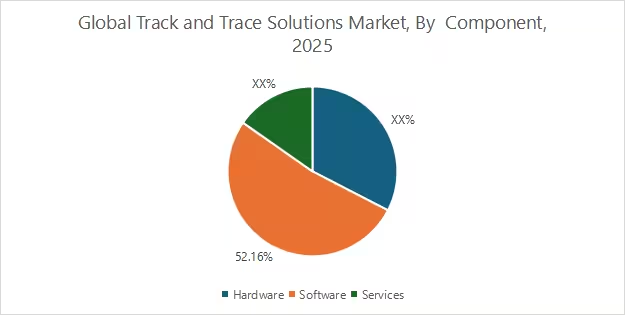
Software accounted for the largest revenue share of 52.16% in the year 2025 and is anticipated to register the fastest CAGR during the forecast period.
- Organizations are shifting toward agentic AI systems, which are virtual workforces capable of planning, executing, and adapting to complex tasks in real-time without constant human intervention, which subsequently propels the track and trace solutions market expansion.
- Further, to manage multi-site and multi-partner complexity, companies are prioritizing cloud-native, multi-tenant platforms that allow for seamless data exchange without the need for constant re-platforming.
- Furthermore, companies are adopting fine-tuned language models specialized for supply chain use cases, delivering higher accuracy in compliance and workflow automation, which in turn drives the track and trace solutions market trends.
- Thus, as per the track and trace solutions market analysis, domain-specific language models, agentic AI adoption, and others are driving the market.
By Technology:
Based on the technology, the market is segmented into barcode & 2D codes, RFID & NFC, GPS, cellular/IoT sensors, blockchain, and others.
Trends in the Technology:
- GPS data is being combined with telematics to predict vehicle maintenance needs, optimize delivery routes in real-time, and monitor driver safety metrics like harsh braking, which is expected to drive the track and trace solutions market demand.
- There is a growing reliance on cloud-based blockchain platforms that offer flexibility and lower cost-of-entry, making advanced tracking accessible to mid-sized enterprises, driving the track and trace solutions market share.
Barcode & 2D codes accounted for the largest revenue share in the year 2025.
- Organizations are increasingly implementing automated print-and-verify workflows that check code quality immediately during production to ensure compliance before items enter the supply chain.
- Further, scanning technology is moving into hands-free wearable devices and embedded sensors, supporting AI-guided workflows for workers on high-speed factory floors, which subsequently propels the market.
- Furthermore, 2D codes are acting as digital bridges, allowing consumers to scan a single code to access dynamic web content like nutrition, sustainability data, or promotions, which in turn drives the market.
- Thus, as per the track and trace solutions market analysis, growth in wearable scanning, verification at the source, and others are driving the market.
RFID & NFC is anticipated to register the fastest CAGR during the forecast period.
- Retailers and manufacturers are shifting RFID application at the factory source to gain visibility from the very start of the product lifecycle, which in turn drives the market.
- Further, RFID enables fully automated processes, such as walk-through checkout and real-time asset tracking, reducing manual labor and human-dependent scanning errors, in turn driving the track and trace solutions industry.
- Furthermore, organizations are deploying hybrid systems, combining RFID with QR codes to achieve a balance between cost-effectiveness, granular visibility, and universal scanability, which in turn drives the market.
- Therefore, based on analysis, the aforementioned trends are anticipated to boost the market during the forecast period.
By End User:
Based on the end user, the market is segmented into pharmaceutical & biopharmaceutical, medical, food & beverage, cosmetics, retail, logistics/transportation, and others.
Trends in the End User:
- Manufacturers are upgrading systems to integrate directly with e-commerce marketplaces, ensuring accurate inventory visibility for online retail, which in turn drives the track and trace solutions market growth.
- Brands are providing consumers with verifiable proof of ethical labor and environmental practices through traceable supply chains, in turn driving the market.
Pharmaceutical & biopharmaceutical accounted for the largest revenue share in the year 2025 and is anticipated to register a significant CAGR during the forecast period.
- IoT sensors are now standard for real-time monitoring of temperature-sensitive biologics, preventing spoilage and ensuring regulatory compliance.
- Further, companies are adopting blockchain to create immutable, tamper-proof audit trails, significantly reducing the risk of counterfeiting and diversion.
- Furthermore, systems are evolving to track highly complex, small-batch personalized therapies that require precise, batch-level traceability.
- Thus, based on analysis, the aforementioned factors are anticipated to boost the growth of the market during the forecast period.
Regional Analysis:
The regions covered are North America, Europe, Asia Pacific, Middle East and Africa, and Latin America.
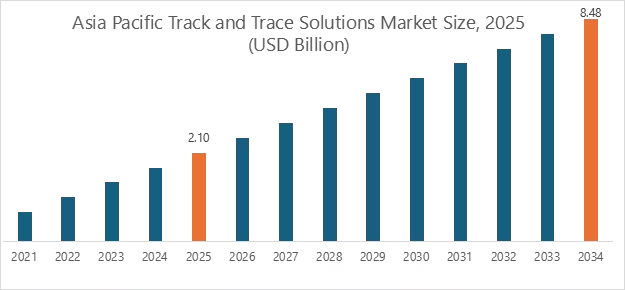
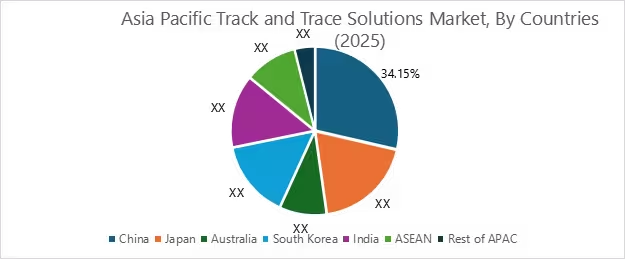
The Asia Pacific region was valued at USD 2.10 Billion in 2025. Moreover, it is projected to grow by USD 2.42 Billion in 2026 and reach over USD 8.48 Billion by 2034. Out of this, China accounted for the maximum revenue share of 34.15%. The market growth is mainly driven by rapid industrialization, expansion of the pharmaceutical and manufacturing sectors, and stringent government regulations. Additionally, rising demand for product authentication, the rise of e-commerce logistics, and an increasing focus on food safety and quality management are further accelerating market adoption across the region.
- For instance, in October 2022, Zebra Technologies launched its Partner Connect Location and Tracking Specialization to provide channel partners with the necessary tools and support to effectively sell and deploy RFID and real-time location systems (RTLS). This initiative aimed to empower resellers to drive sales while helping businesses leverage these technologies to achieve significant operational performance improvements.
North America is estimated to reach over USD 10.58 Billion by 2034 from a value of USD 2.67 Billion in 2025 and is projected to grow by USD 3.07 Billion in 2026. The North American market is primarily driven by stringent regulatory mandates and an intensifying focus on supply chain transparency to combat counterfeit products. Additionally, the market is fueled by the widespread adoption of cloud-based digital platforms, the need for enhanced recall management, and rising complexity of e-commerce logistics.
- For instance, in 2024, TraceLink achieved significant expansion across its customer (adding 231 new customers) and trading partner networks, driven by the launch of innovative no-code configuration tools and AI-enhanced features on its OPUS platform. These advancements have enabled companies to rapidly accelerate end-to-end supply chain digitalization and achieve greater connectivity across their ecosystems.
The regional trends analysis depicts stringent regulatory mandates, increasing need for supply chain transparency, and the prevention of counterfeit goods in Europe are driving the market. Additionally, the factors driving the market in the Middle East and African region are increasing need for supply chain transparency, rising concerns over counterfeit goods, and government initiatives aimed at modernizing digital infrastructure. Further, as per analysis, the need to combat widespread counterfeiting in the pharmaceutical and food sectors, coupled with the rising demand for supply chain visibility in the Latin America region, is driving the market.
Top Key Players & Market Share Insights:
The global track and trace solutions market is highly competitive, with major players providing solutions to the national and international markets. Key players are adopting several strategies in research and development (R&D), product innovation, and end-user launches to hold a strong position in the track and trace solutions industry. Key players in the market include-
- Antares Vision S.p.A.(Italy)
- TraceLink Inc.(U.S.)
- OPTEL Group (Canada)
- Zebra Technologies Corporation (U.S.)
- Siemens AG (Germany)
- Mettler-Toledo International Inc. (U.S.)
- SAP SE (Germany)
- Markem-Imaje (Switzerland)
- Axway (U.S.)
- Syntegon Technology (Germany)
Recent Industry Developments:
Product Launch
- In February 2025, Antares Vision Group launched Diamind Connect, which is a new platform designed to enhance supply chain digitalization, traceability, and customer engagement across the food, beverage, cosmetics, textile, and chemical sectors.
Clinical Communication and Collaboration Market Report Insights:
| Report Attributes | Report Details |
| Study Timeline | 2021-2034 |
| Market Size in 2034 | USD 31.48 Billion by 2034 |
| CAGR (2026-2034) | 14.7% |
| By Component |
|
| By Technology |
|
| By End User |
|
| By Region |
|
| Key Players |
|
| Report Coverage |
|
Key Questions Answered in the Report
How big is the track and trace solutions market? −
The track and trace solutions market is estimated to reach over USD 31.48 Billion by 2034 from a value of USD 7.95 Billion in 2025 and is projected to grow by USD 9.14 Billion in 2026, growing at a CAGR of 14.7% from 2026 to 2034.
What specific segmentation details are covered in the report? +
What specific segmentation details are covered in the report?
Which is the fastest segment anticipated to impact the market growth? +
In the market, RFID & NFC is the fastest-growing segment during the forecast period.
Who are the major players in the market? +
The key participants in the market are Antares Vision S.p.A. (Italy), TraceLink Inc. (U.S.), OPTEL Group (Canada), Zebra Technologies Corporation (U.S.), Siemens AG (Germany), Mettler-Toledo International Inc. (U.S.), SAP SE (Germany), Markem-Imaje (Switzerland), Axway (U.S.), Syntegon Technology (Germany), and others.
What are the key trends in the market? +
The market is being shaped by several key trends including rapid integration of advanced technologies like AI, IoT, and blockchain, which enable real-time shipment visibility and predictive supply chain analytics. Further, the market is driven by a strong shift toward cloud-native SaaS platforms and stringent global regulatory mandates.
Overview
Reputation & Certifications


Our Services
- Market Intelligence & Forecasting
- Custom Research Solutions
- Market Entry Strategy
- Competitive Intelligence
- Customer Insights
- Industry Innovation Analysis
- Investment Advisory