Jump to Content
Wearable Payment Market Size & Industry Share - Growth Trends & Forecasts (2026 - 2034)
Wearable Payment Market Size:
The Wearable Payment market size was valued at 75.56 (US$B) in 2025 and is projected to grow from 88.71 (US$B) in 2026 to 320.12 (US$B) by 2034, at a CAGR of 17.4% from 2026 to 2034, according to a recent report from Consegic Business Intelligence.
Wearable Payment Market Scope & Overview:
Wearable Payment Device refers to a wearable technology, like a smartwatch, fitness tracker, ring, or even clothing that is equipped with payment technology. This allows the user to make contactless payments directly from the wearable device. Wearable payment devices are versatile and can be used for contactless payments. Moreover, wearable payment offers a range of benefits including, ticketing for transport or events, access control, E-banking, payment platform, and others. The above benefits of wearable payment are primary determinants for increasing their deployment in transportation, retail, healthcare, and other applications.

Wearable Payment Market Dynamics - (DRO) :

Key Drivers:
Increasing Demand for Contactless Payment Solutions Boosts the Market
The growing consumer preference for contactless and convenient payment options is a major driver for the wearable payment market. Wearable payment devices, such as smartwatches, fitness bands, and rings with integrated NFC (Near Field Communication) or RFID (Radio Frequency Identification) technology, enable secure and quick transactions with a simple tap. This trend has gained momentum with the rise of digital wallets and mobile payment platforms, as consumers seek more efficient alternatives to cash and cards. Furthermore, the shift toward cashless economies in regions like North America, Europe, and parts of Asia has accelerated the adoption of wearable payment solutions, making them increasingly mainstream across retail, transportation, and hospitality sectors.
- For instance, in March 2024, Induslnd Bank launched All In 1 Payment Wearables namely Indus PayWear. It offers contactless payments through a ring, watch clasp, or sticker, all of which are NFC-enabled and require no charging. Users can manage their wearable, switch cards, and monitor transactions via the Indus PayWear app, which also provides security features like the ability to block or unblock the wearable.
Therefore, market trends analysis concludes that the rising technological advancement associated with wearable payment devices is proliferating the wearable payment market growth.
Key Restraints :
Concerns Over Security and Privacy Limits the Market
While wearable payment devices offer convenience, security and privacy concerns limit their widespread adoption. Since wearable payment devices store sensitive information and use wireless communication to transmit data, they are vulnerable to cyber threats like hacking and data breaches. Issues such as unauthorized access, data theft, and potential misuse of personal financial data are significant concerns for consumers and businesses alike. Additionally, regulations on data protection vary across regions, making it challenging for wearable payment providers to ensure compliance and uniform security standards globally. Thus, the analysis of market trends depicts that these concerns deter some users from adopting wearable payment solutions, restraining the wearable payment market expansion.
Future Opportunities :
Integration with Advanced Biometrics and Multi-Functionality Opens New Doors
Biometric scanners are of different kinds such as fingerprint scans, facial recognition, and heartbeat monitoring, which can be integrated into wearable transactions to enhance security. These unique identifiers offer a secure way to verify user identity, reducing the risk of unauthorized access or fraud. The evolution of wearable technology sees biometric authentication as a significant advancement in securing wearable payment systems. This not only improves user experience but also meets industry trends of contactless and mobile transactions, fulfilling consumer needs for secure and efficient financial management. Moreover, the integration of biometric technology adds an extra layer of security, ensuring that transactions are not only convenient but also safe.
- For instance, In March 2023 according to J.P. Morgan, the 2024 Formula 1 Miami Grand Prix is integrating J.P. Morgan Payments' biometric system for purchases. This system uses palm or facial recognition and will be used both in-store and online. The goal is to streamline the buying process, with transactions authenticated and processed in under a second. This innovative approach aligns with Formula 1's commitment to cutting-edge technology.
Hence, as per the market trends analysis, the rising integration of biometrics for improved security in wearable transactions is expected to promote wearable payment market opportunities during the forecast period.
Wearable Payment Market Segmental Analysis :
By Device Type:
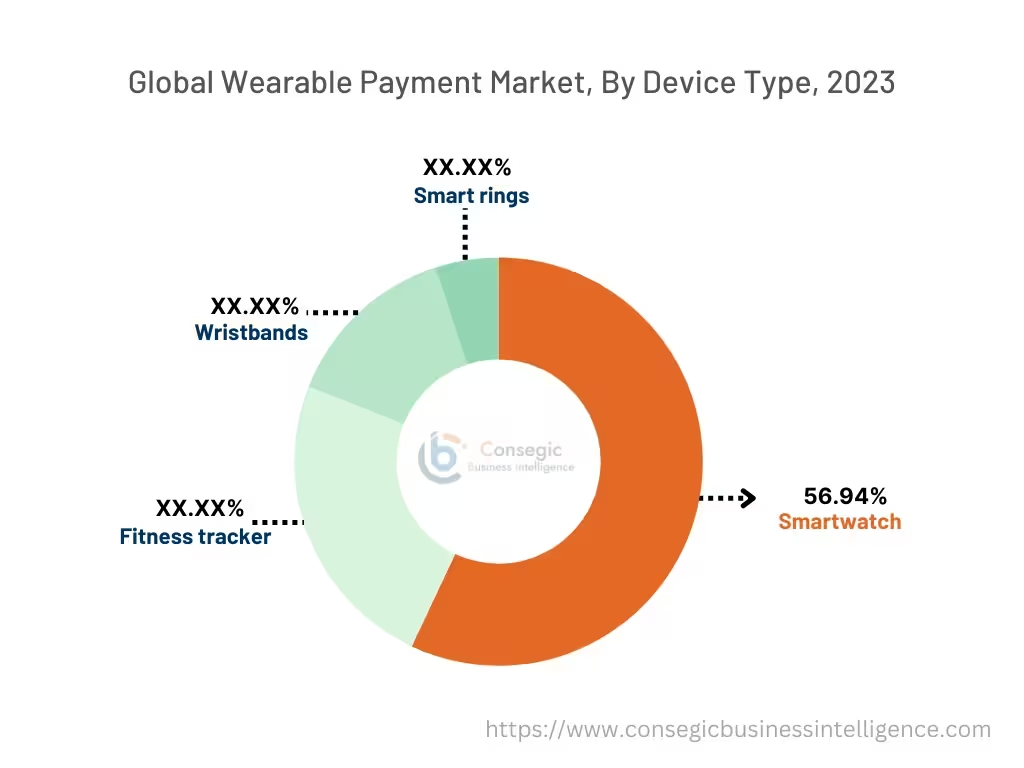
Based on the device type, the market is segmented into smart rings, wristbands, fitness tracker, and smartwatch.
The smartwatch segment accounted for the largest revenue share of 56.94% in the year 2023.
- A smartwatch refers to a device that enables users to conduct financial transactions.
- Many smartwatches support contactless payment systems like Google Pay and others.
- Moreover, the smartwatch segment offers a range of benefits including notification, security, convenience, speed, and fitness.
- For instance, according to the International Data Corporation (IDC), in Q3 2023, global wearable device shipments hit a record 148.4 million units, a 2.6% YoY growth. The rise of smaller brands and emerging categories, along with the popularity of smartwatches and earwear, contributed to this growth. The market continues to innovate, with sleek designs and health-tracking features driving its expansion.
- Thus, the rising popularity and adoption of smartwatches are driving the wearable payment market trends.
The fitness tracker segment is anticipated to register a significant CAGR during the forecast period.
- A fitness tracker refers to a wearable payment device that monitors health and fitness and makes financial transactions.
- Moreover, the primary benefits of a fitness tracker include monitoring heart health, measurable fitness progress, targeted training, sleep tracking, and others.
- For instance, in June 2020, Xiaomi launched the Mi Smart Band 5, a device that offers improved accuracy in fitness tracking, capabilities for monitoring women's health, stress evaluation, and even a remote shutter control among other functionalities.
- Therefore, the increasing innovation associated with fitness trackers is anticipated to boost the wearable payment market growth during the forecast period.
By Technology:
Based on the technology, the market is segmented into NFC, RFID, QR, and barcodes.
The NFC segment accounted for the largest revenue share of the total wearable payment market share in 2023 and is also anticipated to register the fastest CAGR during the forecast period.
- NFC, or Near Field Communication, in wearable payments, is a technology that enables quick and secure contactless transactions.
- Wearable devices like smartwatches or fitness trackers use an NFC chip to communicate with payment terminals, allowing users to make payments with a simple tap.
- Moreover, the primary benefits of a contactless payment system include versatility, integration with wearable devices, security, ease of use, data storage, and others.
- For instance, in April 2022, MagTek introduced the DynaProx series of touchless readers, entering a new era of touchless payments. Both the DynaProx and DynaProx BCR models are equipped with NFC technology, featuring a barcode camera capable of reading various 1D and 2D barcodes.
- Therefore, the growing integration and adoption of NFC technology in wearable and IoT devices are anticipated to boost the wearable payment market demand during the forecast period.
By Payment Mode:
Based on the payment mode, the market is segmented into credit cards, debit cards, mobile payments, and cryptocurrency.
The mobile payments segment accounted for the largest revenue share of the overall wearable payment market share in the year 2023.
- Mobile payment refers to a financial transaction made through a mobile device.
- Mobile payment allows the purchase of goods, services, and even money transfers through portable electronics like smartphones or tablets.
- Moreover, mobile payment offers a range of benefits including convenience, speed and efficiency, security, expanded payment options, effective financial management, and others.
- For instance, according to the Indian payments handbook 2023-2028, Payments made via UPI increased by 80% over the previous fiscal year. UPI accounted for more than 75% of the total transaction volume of India's retail digital payments in February 2023. In the first quarter of FY 2023–24, transaction volume reached 24.9 billion.
- Thus, the rising adoption of mobile payments is driving the wearable payment market demand.
The credit card segment is anticipated to register the fastest CAGR during the forecast period.
- A credit card refers to a financial tool issued by a bank or financial institution.
- Credit allows users to borrow funds to make purchases or get cash advances.
- Moreover, the primary benefits of credit cards include rewards, convenience, fraud protection, increased purchasing power, interest-free credit, travel benefits, and others.
- For instance, in March 2021, Axis Bank launched a Wear N Pay device offering a convenient mode of payment solution, featuring activation benefits, transaction limit, cashback, security, and others.
- Therefore, segmental trends analysis shows that the above factor is anticipated to boost the wearable payment market trends during the forecast period.
By End Use:
Based on the end use, the market is segmented into transportation, retail, healthcare, festivals and events, and others.
The retail segment accounted for the largest revenue share in the year 2023.
- In the retail sector, wearable devices including smartwatches or fitness bands are used to make contactless payments at retail stores.
- The technology offers a secure, convenient, and fast method for consumers to pay for their purchases without the need for cash or a card.
- Moreover, the use of wearable payment devices in the retail sector offers a retail offer range of benefits including efficiency, speed, security, convenience, and others.
- For instance, in September 2023, Pine Labs launched Mini, an innovative device that accepts both QR and Card payments. While most Point of Sale (PoS) devices in India are designed for debit/credit card users, Pine Labs has introduced a device that prioritizes QR codes and supports contactless card payments, specifically aimed at Small and Medium Enterprises (SMEs). This cost-effective product is anticipated to significantly impact digital payments.
- Thus, the rising utilization of wearable payment in the retail industry is driving the market.
The healthcare segment is anticipated to register the fastest CAGR during the forecast period.
- Healthcare segment regarding the application of wearable devices, such as smartwatches or fitness bands, to make contactless payments for health services. This includes payments for doctor's appointments, pharmacy bills, hospital charges, and more.
- The technology offers a secure, convenient, and efficient method for patients and healthcare providers to handle financial transactions, enhancing the overall healthcare experience.
- Moreover, the primary benefits of using wearable payment devices in the healthcare sector include reduced administrative burden, security, innovation, speed, and convenience.
- For instance, according to J.P. Morgan the COVID-19 pandemic has fast-tracked the use of contactless payments in various sectors, including healthcare. Hospitals have upgraded their systems to meet the high demand for electronic payments. For example, Boston Children's Hospital adopted a cashless payment strategy and saw significant improvements. As healthcare payments evolve, hospital leaders need to consider factors like the popularity of contactless payments, phased implementation, cross-functional collaboration, and others.
- Therefore, the rising application of wearable payment in the healthcare sector is anticipated to boost the market during the forecast period.
Regional Analysis:
The regions covered are North America, Europe, Asia Pacific, the Middle East and Africa, and Latin America.
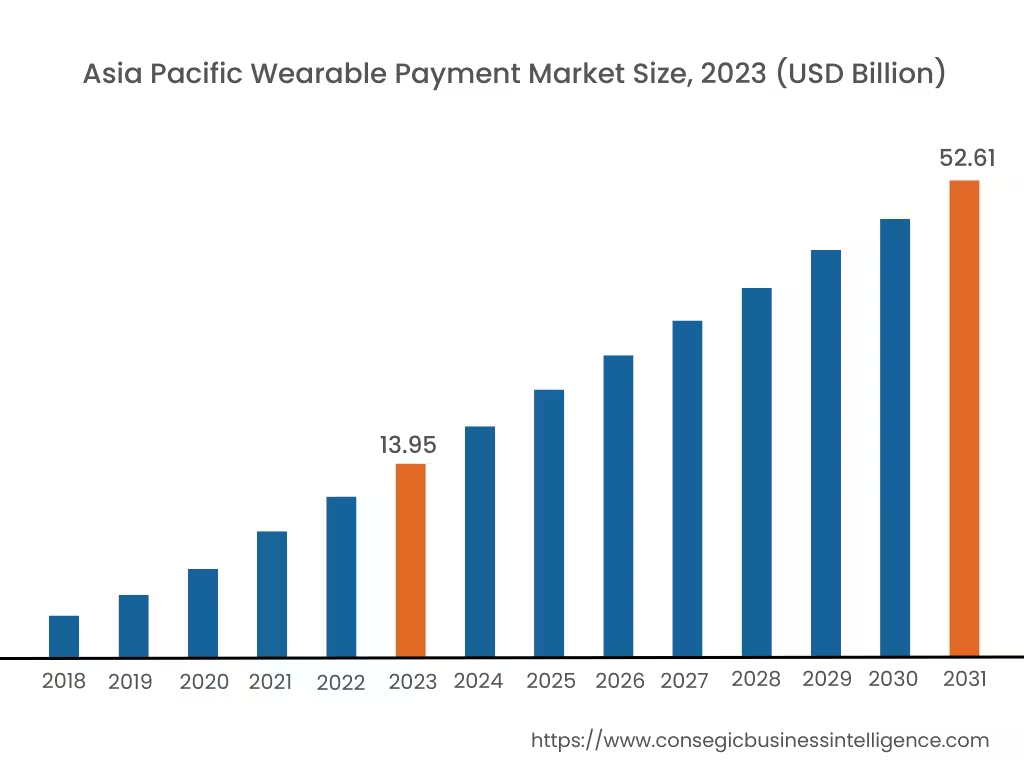
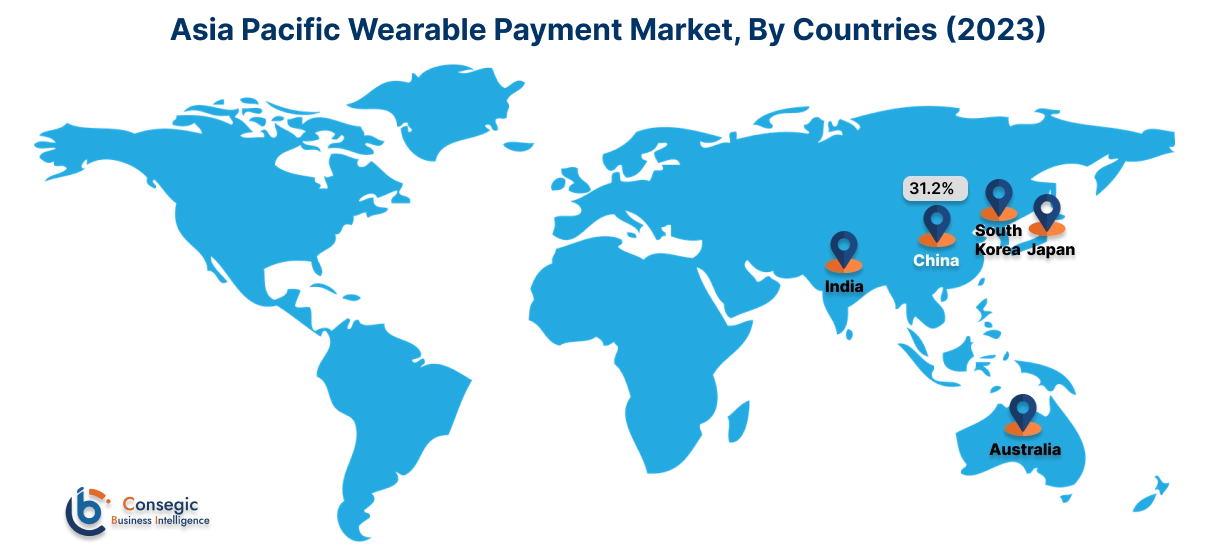
Asia-Pacific region was valued at USD 13.95 Billion in 2023. Out of this, China accounted for the maximum revenue share of 31.2%. Moreover, it is projected to grow by USD 16.19 Billion in 2024 and reach over USD 52.61 Billion by 2031. As per the wearable payment market analysis, the Asia-Pacific region's growing industrialization and development offer lucrative growth prospects for the market. Additionally, the prevalence of adoption rate of new technology in the region including mobile payments, cashless transactions, and digital payments, along with growing e-commerce are fostering the market.
- For instance, in November 2022, BillBox, a company that provides solutions in the payment and merchant ecosystem in India, introduced TapTap. This is a wearable device that enables contactless payments. The device was launched in collaboration with NSDL Payments Bank and Visa.
North America is estimated to reach over USD 74.76 Billion by 2031 from a value of USD 20.43 Billion in 2023 and is projected to grow by USD 23.65 Billion in 2024. North America holds a leading position in the wearable payment market, driven by the high adoption of digital payments and advanced wearable technologies in the U.S. and Canada. The region's tech-savvy population and major players like Apple, Google, and Fitbit have accelerated the adoption of wearable payment solutions, particularly in the retail and hospitality sectors. This is further supported by an established digital infrastructure and widespread acceptance of contactless payments. However, concerns over data privacy and cybersecurity remain challenges to wider adoption.
Europe is a significant market, with high adoption in the UK, Germany, and France. The region benefits from a mature digital payments landscape and supportive regulations, such as PSD2 (Revised Payment Services Directive), which enhances security for digital payments. Contactless payment adoption has been robust, especially in urban areas, fueling demand for wearables like smartwatches and fitness trackers with payment capabilities. However, variations in acceptance across smaller markets and concerns about data protection regulations can slow market progression.
The regional trends analysis depicts that the Middle East & Africa (MEA) region is seeing a steady rise in the wearable payment market, particularly in the UAE and Saudi Arabia, where digital transformation initiatives are underway. The region's increasing focus on cashless payment solutions, coupled with a growing tourism sector, is driving demand for wearable payment devices. The UAE's commitment to becoming a digital economy further supports the adoption of these technologies. However, limited infrastructure in certain areas of Africa and high device costs restrict the market's full potential. Latin America is an emerging market for wearable payments, led by Brazil and Mexico. The region's growth is fueled by an expanding digital payments landscape and increasing smartphone penetration. Government initiatives to encourage financial inclusion and the shift toward cashless transactions in urban centers support market growth. However, economic instability, low banking penetration in some areas, and limited access to wearable devices pose challenges to wearable payment market expansion in the region.
Top Key Players & Market Share Insights:
The wearable payment market is highly competitive with major players providing wearable payment devices to the national and international markets. Key players are adopting several strategies in research and development (R&D), product innovation, and end-user launches to hold a strong position in the global wearable payment market. Key players in the wearable payment industry include-
- Apple Inc. (United States)
- Jawbone (United States)
- Samsung Electronics Co., Ltd. (South Korea)
- Mastercard Incorporated (United States)
- Ringly, Inc. (United States)
- PayPal Holdings, Inc. (United States)
- Visa Inc. (United States)
- Google LLC (United States)
- Barclays plc (United Kingdom)
- Nymi Inc. (Canada)
Recent Industry Developments :
Partnerships, Mergers & Acquisitions:
- In January 2024, DIGISEQ, a company specializing in wearable payment technology, partnered with TAP2, a UK-based marketplace. Their partnership aims to offer customers around the globe access to a careful selection of wearable devices.
Wearable Payment Market Report Insights :
| Report Attributes | Report Details |
| Study Timeline | 2021-2034 |
| Market Size in 2034 | USD 320.12 Billion |
| CAGR (2026-2034) | 17.40% |
| Base Year | 2025 |
| By Device Type |
|
| By Technology |
|
| By Payment mode |
|
| By End Use |
|
| By Region |
|
| Key Players |
|
| North America | U.S. Canada Mexico |
| Europe | U.K. Germany France Spain Italy Russia Benelux Rest of Europe |
| APAC | China South Korea Japan India Australia ASEAN Rest of Asia-Pacific |
| Middle East and Africa | GCC Turkey South Africa Rest of MEA |
| LATAM | Brazil Argentina Chile Rest of LATAM |
| Report Coverage |
|
Key Questions Answered in the Report
How big is the Wearable Payment Market? −
In 2023, the Wearable Payment market was USD 54.72 billion.
What will be the potential market valuation for the Wearable Payment by 2031? +
In 2031, the market size of the Wearable Payment market is expected to reach USD 197.84 billion.
What are the segments covered in the Wearable Payment market report? +
The device types of gaming laptops, their technologies, payment modes, and end uses are the segments covered in this report.
Who are the major players in the Wearable Payment market? +
Apple Inc. (United States), Jawbone (United States), Samsung Electronics Co., Ltd. (South Korea), Mastercard Incorporated (United States), Ringly, Inc. (United States), PayPal Holdings, Inc. (United States), Visa Inc. (United States), Google LLC (United States), Barclays plc (United Kingdom), Nymi Inc. (Canada) are the major players in the Wearable Payment market.
Overview
Reputation & Certifications


Our Services
- Market Intelligence & Forecasting
- Custom Research Solutions
- Market Entry Strategy
- Competitive Intelligence
- Customer Insights
- Industry Innovation Analysis
- Investment Advisory