Jump to Content
Portable Electronics Market - Size, Share, Industry Trends, and Forecasts (2025 - 2032)
Portable Electronics Market Size:
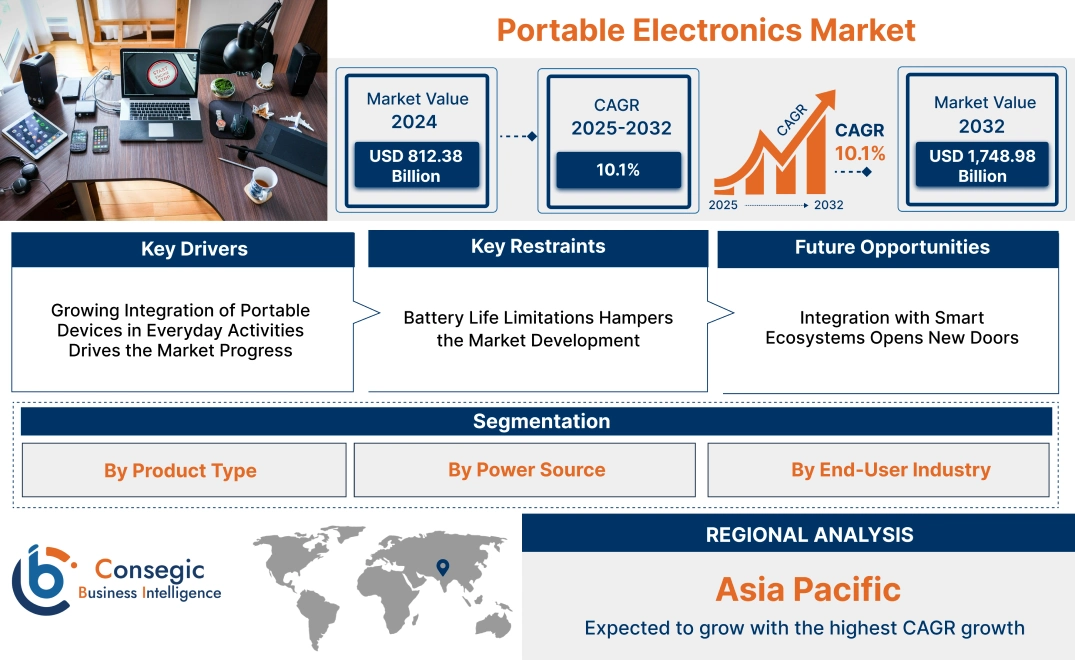
Portable Electronics Market size is estimated to reach over USD 1,748.98 Billion by 2032 from a value of USD 812.38 Billion in 2024 and is projected to grow by USD 879.63 Billion in 2025, growing at a CAGR of 10.1% from 2025 to 2032.
Portable Electronics Market Scope & Overview:
Portable electronics refer to compact and lightweight electronic devices designed for mobility and ease of use. These devices include smartphones, tablets, laptops, wearable devices, cameras, and portable gaming consoles, catering to both consumer and professional applications. They are engineered to provide functionality, connectivity, and performance on the go, ensuring convenience and versatility for users.
Portable electronics are characterized by features such as long battery life, wireless connectivity, and compact designs, making them suitable for various everyday tasks and entertainment needs. These devices often incorporate advanced technologies, including high-resolution displays, efficient processors, and intuitive user interfaces, to deliver seamless performance. Their compatibility with accessories and peripherals further enhances their usability and adaptability.
End-users of portable electronics include individual consumers, professionals, and businesses across industries such as healthcare, education, and entertainment. These devices play a significant role in modern lifestyles, providing tools for communication, productivity, and entertainment in both personal and professional settings.
Portable Electronics Market Dynamics - (DRO) :
Key Drivers:
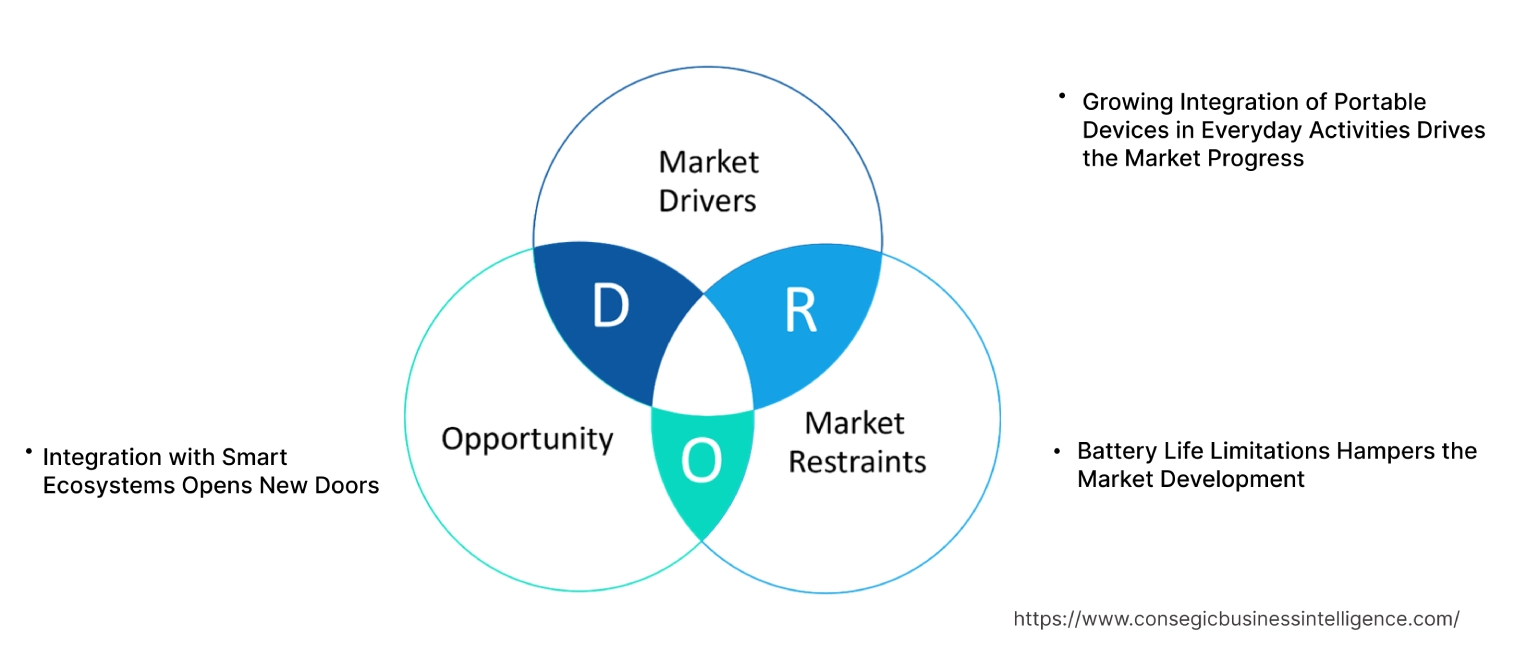
Growing Integration of Portable Devices in Everyday Activities Drives the Market Progress
Portable devices are increasingly embedded into daily life, offering seamless functionality for communication, productivity, and entertainment. Smartphones equipped with multi-core processors, high-resolution displays, and advanced connectivity technologies like 5G have become essential for navigation, social interaction, and work-related tasks. Wearables, such as fitness trackers and smartwatches, utilize sensors like accelerometers and heart rate monitors to provide health insights, enhancing personal wellness management. Additionally, portable power banks with fast-charging technologies support uninterrupted device usage, addressing the limitations of battery life. Devices like compact laptops integrate solid-state drives (SSDs) and high-performance GPUs for enhanced efficiency in remote work and digital content creation. As IoT integration grows, portable devices are increasingly interconnected with smart ecosystems, driving their adoption further. This reliance on portable electronics highlights their critical role in modern, tech-driven lifestyles, aligning with advancements in miniaturization and user-centric designs. Thus, the aforementioned factors are fueling the portable electronics market growth.
Key Restraints:
Battery Life Limitations Hampers the Market Development
Battery life continues to be a significant restraint for portable devices, despite advancements in battery technology. High-performance features such as 4K resolution displays, always-on connectivity, and resource-intensive applications drain batteries quickly, reducing device usability during extended periods without access to charging. This issue is particularly prominent for users in travel-heavy scenarios, outdoor activities, or remote areas where frequent recharging is impractical. While fast-charging solutions and power banks address some concerns, the inconvenience of managing battery life deter consumers from fully embracing advanced portable electronics. Furthermore, as portable devices become more compact, integrating larger batteries without compromising design becomes increasingly challenging. These limitations create hurdles for manufacturers aiming to enhance consumer satisfaction and usability, especially as modern lifestyles require long-lasting and reliable device performance. Thus, the above mentioned factors limit the portable electronics market demand.
Future Opportunities :
Integration with Smart Ecosystems Opens New Doors
The integration of portable devices with smart ecosystems is revolutionizing consumer interactions with technology, creating a seamless, interconnected experience. Devices like smartphones, smartwatches, and tablets now act as central hubs, controlling smart home appliances such as thermostats, lighting, and security systems through Wi-Fi or Bluetooth. For instance, smartwatches equipped with IoT capabilities interact with health monitoring systems, while smartphones manage entertainment systems via voice assistants like Alexa or Google Assistant. This interconnectivity extends to smart workplaces, where portable devices enable remote control of office infrastructure, such as smart conferencing systems and automated lighting. These advancements leverage protocols like Zigbee, Z-Wave, and Matter for efficient communication, driving their adoption across both residential and commercial sectors. As consumers increasingly embrace connected living, the demand for portable devices with enhanced compatibility and integration features continues to rise, fostering innovation and creating significant portable electronics market opportunities.
Portable Electronics Market Segmental Analysis :
By Product Type:
Based on product type, the market is segmented into smartphones, tablets, laptops, wearable devices, cameras, gaming consoles, and others.
The smartphones segment accounted for the largest revenue of the total portable electronics market share in 2024.
- The segment's dominance is attributed to advancements in AI-enabled features, foldable designs, and 5G connectivity, driving consumer adoption globally.
- Rising requirement for high-performance smartphones with extended battery life and superior camera quality enhances market penetration.
- Integration of IoT capabilities and seamless compatibility with wearable devices further supports the segment's leadership.
- Strong sales in developing economies, supported by declining smartphone prices and increased internet penetration, solidify the segment's position, contributing to the portable electronics market expansion.
The wearable devices segment is expected to grow at the fastest CAGR during the forecast period.
- The rapid growth is driven by increasing consumer focus on health monitoring and fitness, boosting adoption of smartwatches and fitness trackers.
- Innovations in wearable technology, such as ECG monitoring and blood oxygen level tracking, attract a diverse customer base.
- Expansion of connected ecosystems, including compatibility with smartphones and smart home systems, fuels demand for wearable devices.
- As per portable electronics market analysis, the segment's acceleration is supported by rising disposable income and consumer awareness of health trends.
By Power Source:
Based on power source, the market is segmented into battery-powered, solar-powered, and hybrid.
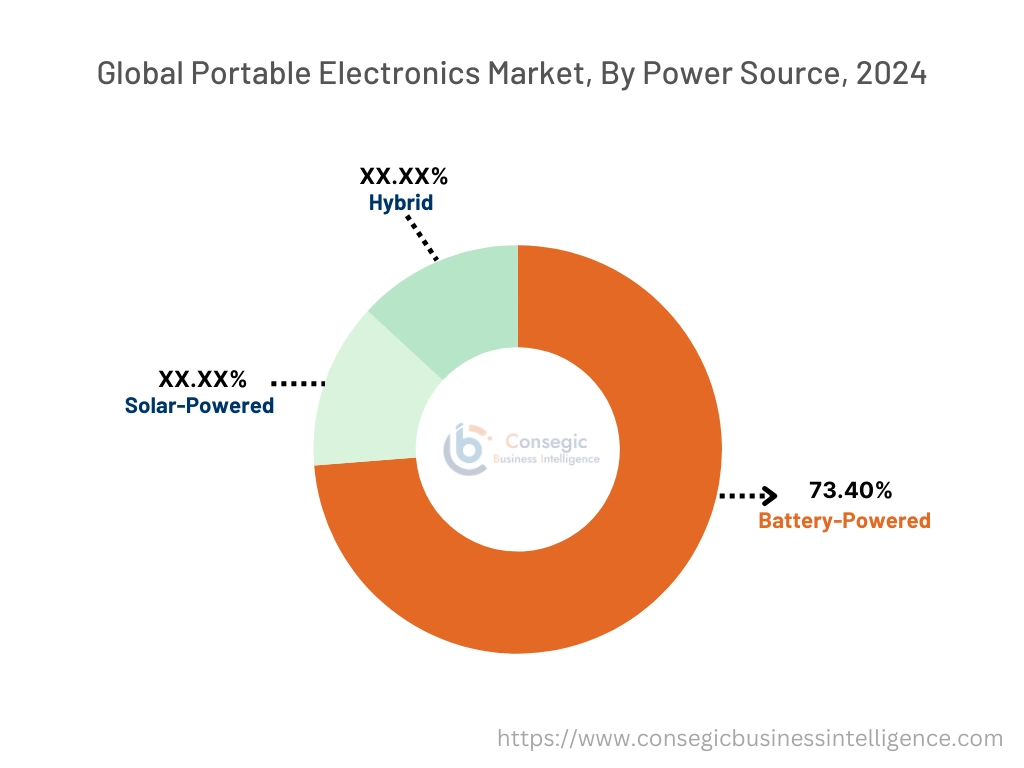
The battery-powered segment held the largest revenue of 73.40% of the total portable electronics market share in 2024.
- Battery-powered electronics dominate due to advancements in lithium-ion battery technology, offering extended battery life and faster charging capabilities.
- High consumer preference for portable devices with reliable power sources positions this segment as the largest contributor to the market.
- Adoption of power banks and wireless chargers complements the enlargement of battery-powered devices globally.
- As per the portable electronics market trends, the increasing use of energy-efficient components in portable devices further strengthens the segment's dominance.
The solar-powered segment is expected to register the fastest CAGR during the forecast period.
- Solar-powered devices are increasingly favored for outdoor applications, particularly in off-grid regions where renewable energy is critical.
- Rising environmental concerns and demand for sustainable energy solutions encourage manufacturers to innovate solar-powered consumer electronics.
- Government incentives and subsidies for renewable energy solutions bolster the adoption of solar-powered portable devices.
- As per market trends, the segment's growth is propelled by advancements in solar panel efficiency and integration with lightweight consumer electronics, fueling the portable electronics market growth.
By End-Use Industry:
Based on end-user industry, the market is segmented into consumer electronics, healthcare, automotive, industrial, defense, and others.
The consumer electronics segment accounted for the largest revenue share in 2024.
- Growing adoption of smart home devices, entertainment systems, and wearable technology drives the dominance of this segment.
- Consumer demand for innovative gadgets with multifunctional capabilities supports the extension of the consumer electronics sector.
- Continuous improvements in design and connectivity enhance the appeal of consumer electronics across global markets.
- As per the portable electronics market analysis, the proliferation of e-commerce platforms significantly contributes to the sales and market share of this segment.
The healthcare segment is anticipated to grow at the fastest CAGR during the forecast period.
- Healthcare applications for portable electronics, such as diagnostic devices and wearable monitors, are expanding with the rise of telemedicine and remote care.
- Miniaturization of medical devices and integration with AI-powered diagnostic tools support the rapid growth of this segment.
- Increasing investments in healthcare infrastructure and patient-centric care models fuel the adoption of portable healthcare devices.
- As per market analysis, the segment's growth is driven by rising chronic disease prevalence and the need for continuous health monitoring solutions, creating significant portable electronics market opportunities.
Regional Analysis:
The regions covered are North America, Europe, Asia Pacific, the Middle East and Africa, and Latin America.
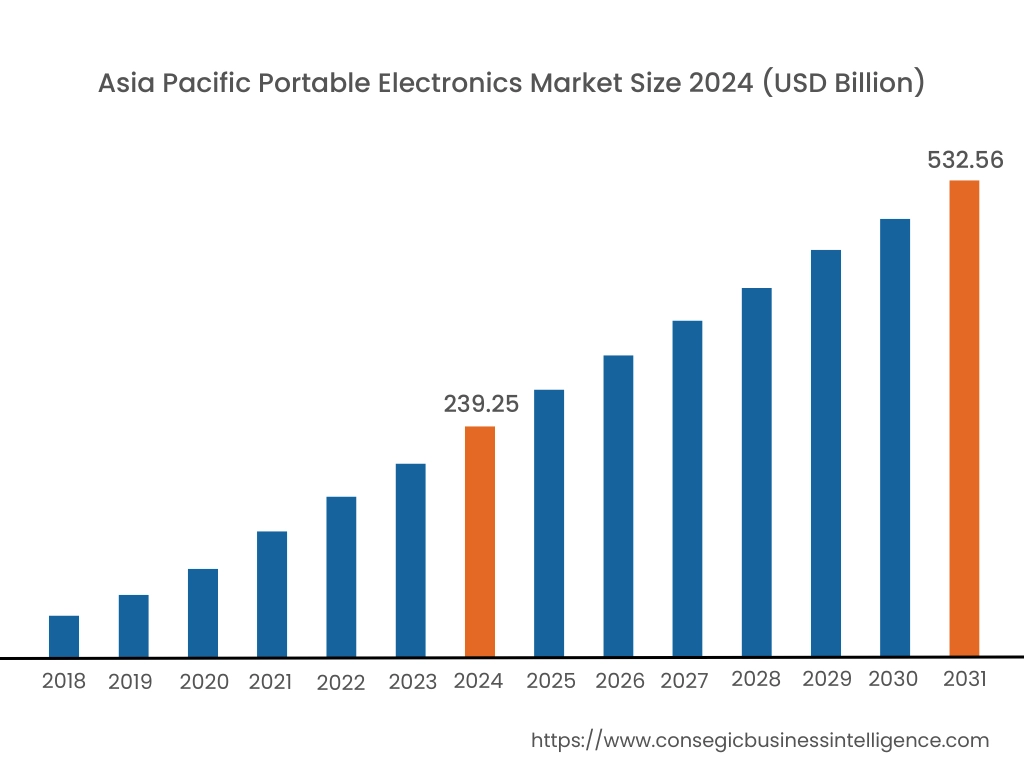
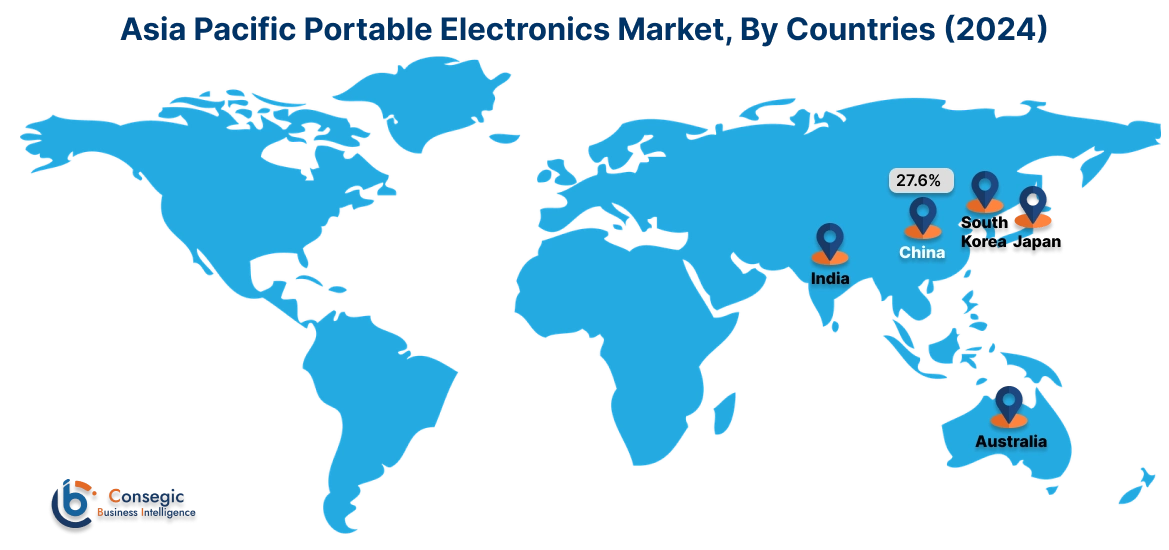
Asia Pacific region was valued at USD 239.25 Billion in 2024. Moreover, it is projected to grow by USD 259.79 Billion in 2025 and reach over USD 532.56 Billion by 2032. Out of this, China accounted for the maximum revenue share of 27.6%. The region is a key market for portable electronics, fueled by a large consumer base, rising disposable incomes, and strong manufacturing capabilities in countries like China, Japan, South Korea, and India. As per the market analysis, the proliferation of smartphones and tablets has intensified the need for innovative and affordable portable devices. Government initiatives promoting digitalization further influence portable electronics market demand.
North America is estimated to reach over USD 566.84 Billion by 2032 from a value of USD 269.47 Billion in 2024 and is projected to grow by USD 291.22 Billion in 2025. This region boasts a mature portable electronics market, driven by high consumer purchasing power and early technology adoption. The United States, in particular, has seen extensive integration of advanced technologies such as 5G connectivity and artificial intelligence in portable devices. A notable trend is the increasing demand for wearable electronics, such as smartwatches, which is expected to drive portable electronics market expansion.
Technological advancements, favorable government policies, and a tech-savvy population contribute to the growth of the portable electronics market in Europe. Countries like Germany, France, and the United Kingdom are at the forefront of adopting portable devices integrated with IoT and AI capabilities. Analysis indicates a growing trend towards miniaturized components in portable devices, enabling increased battery life.
The portable electronics market in the Middle East & Africa is fueled by urbanization, a young population, and increasing investments in digital infrastructure. Countries like the United Arab Emirates and South Africa are investing in advanced portable technologies to support digitalization efforts. Analysis suggests an increasing trend towards adopting portable electronics in sectors such as education and healthcare, enhancing accessibility and operational efficiency.
Increasing smartphone penetration, rising internet connectivity, and a growing middle class population are driving the need for portable electronics in the Latin America region. Brazil and Mexico are key contributors, with a significant portion of the population adopting smartphones and other portable devices. As per portable electronics market trends, government policies aimed at modernizing infrastructure and enhancing digital capabilities influence market trends.
Top Key Players and Market Share Insights:
The Portable Electronics market is highly competitive with major players providing products and services to the national and international markets. Key players are adopting several strategies in research and development (R&D), product innovation, and end-user launches to hold a strong position in the global Portable Electronics market. Key players in the Portable Electronics industry include -
- Apple Inc. (USA)
- Samsung Electronics Co., Ltd. (South Korea)
- HP Inc. (USA)
- Dell Technologies Inc. (USA)
- ASUSTeK Computer Inc. (Taiwan)
- Sony Corporation (Japan)
- LG Electronics Inc. (South Korea)
- Huawei Technologies Co., Ltd. (China)
- Xiaomi Corporation (China)
- Lenovo Group Limited (China)
Recent Industry Developments :
- In October 2024, TCL, in collaboration with T-Mobile, launched the TCL LINKPORT IK511, the first 5G RedCap device in North America. Powered by Qualcomm’s Snapdragon X35 5G Modem, this USB-C dongle offers faster, secure 5G connectivity for laptops and tablets on T-Mobile's standalone 5G network. It supports high-speed data transfer, advanced business features, and ensures compatibility with existing networks.
- In October 2024, Fujifilm announced the "FUJIFILM X-M5," the lightest model in its X Series mirrorless digital cameras, weighing approximately 355g. The X-M5 features a 26.1-megapixel back-illuminated sensor, AI-powered subject detection autofocus, and 6.2K/30P video recording capabilities. Its compact design and user-friendly features make it suitable for both beginners and photography enthusiasts.
- In September 2024, Samsung launched the Galaxy S24 FE in India, featuring a 6.7-inch Dynamic AMOLED 2X display, Exynos 2400e chipset, and a 50MP main camera. The Galaxy S24 FE offers AI-enhanced camera features, including Nightography and an Object-Aware Engine for vibrant photos. It also boasts a 4,700mAh battery and a 120Hz refresh rate display for smooth performance.
- In March 2024, Zebronics has launched the ZEB-Blitz C and ZEB-Havoc gaming headphones, designed to elevate audio experiences. Both feature Dolby Atmos, 50mm Neodymium drivers, vibrant multi-color lights, and lightweight designs for fatigue-free gaming. The ZEB-Blitz C offers high-fidelity audio via a Type-C port, while the ZEB-Havoc boasts a sleek suspension headband for added comfort and style. These innovations underscore Zebronics dedication to cutting-edge technology and user-focused design in gaming audio.
- In January 2024, MSI unveiled the Claw, the world’s first handheld gaming device powered by Intel Core Ultra processors, at CES 2024. Featuring Intel® Arc™ graphics, a 7-inch FHD touchscreen with a 120Hz refresh rate, and HyperFlow cooling technology, the Claw ensures smooth gameplay for AAA titles. Equipped with a 53Wh battery, Thunderbolt 4 connectivity, and ergonomic design, it delivers powerful, portable performance. The Claw supports both Windows and Android games via the MSI APP Player.
Portable Electronics Market Report Insights :
| Report Attributes | Report Details |
| Study Timeline | 2019-2032 |
| Market Size in 2032 | USD 1,748.98 Billion |
| CAGR (2025-2032) | 10.1% |
| By Product Type |
|
| By Power Source |
|
| By End-Use Industry |
|
| By Region |
|
| Key Players |
|
| North America | U.S. Canada Mexico |
| Europe | U.K. Germany France Spain Italy Russia Benelux Rest of Europe |
| APAC | China South Korea Japan India Australia ASEAN Rest of Asia-Pacific |
| Middle East and Africa | GCC Turkey South Africa Rest of MEA |
| LATAM | Brazil Argentina Chile Rest of LATAM |
| Report Coverage |
|
Key Questions Answered in the Report
What is the size of the Portable Electronics Market? −
Portable Electronics Market size is estimated to reach over USD 1,748.98 Billion by 2032 from a value of USD 812.38 Billion in 2024 and is projected to grow by USD 879.63 Billion in 2025, growing at a CAGR of 10.1% from 2025 to 2032.
What are the segments and subsegments covered in the Portable Electronics Market report? +
The market is segmented into product type (Smartphones, Tablets, Laptops, Wearable Devices, Cameras, Gaming Consoles, Others), power source (Battery-Powered, Solar-Powered, Hybrid), and end-user industry (Consumer Electronics, Healthcare, Automotive, Industrial, Defense, Others).
Which is the fastest-growing segment in the Portable Electronics Market? +
The healthcare segment is anticipated to grow at the fastest CAGR during the forecast period, driven by increasing investments in healthcare infrastructure and the demand for continuous health monitoring solutions.
Who are the key players in the Portable Electronics Market? +
Key players in the Portable Electronics Market include Apple Inc. (USA), Samsung Electronics Co., Ltd. (South Korea), Sony Corporation (Japan), LG Electronics Inc. (South Korea), Huawei Technologies Co., Ltd. (China), Xiaomi Corporation (China), Lenovo Group Limited (China), HP Inc. (USA), Dell Technologies Inc. (USA), and ASUSTeK Computer Inc. (Taiwan).
Overview
Reputation & Certifications


Our Services
- Market Intelligence & Forecasting
- Custom Research Solutions
- Market Entry Strategy
- Competitive Intelligence
- Customer Insights
- Industry Innovation Analysis
- Investment Advisory