Jump to Content
Metal Air Battery Market - Size, Share, Industry Trends, and Forecasts (2025-2032)
Metal Air Battery Market Size:
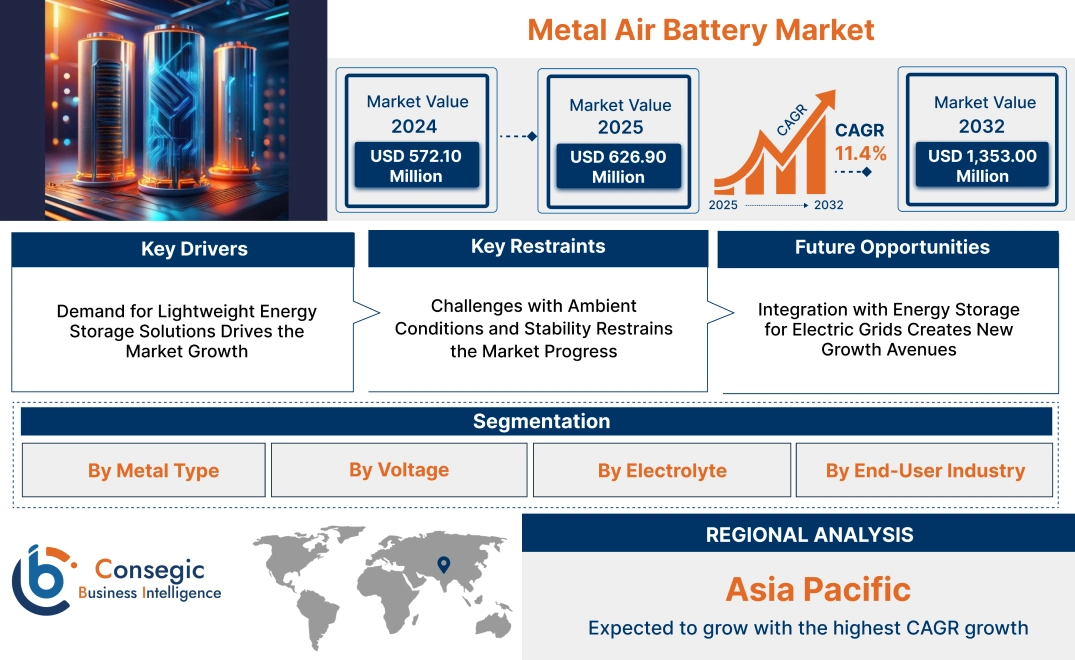
Metal Air Battery Market size is estimated to reach over USD 1,353.00 Million by 2032 from a value of USD 572.10 Million in 2024 and is projected to grow by USD 626.90 Million in 2025, growing at a CAGR of 11.4% from 2025 to 2032.
Metal Air Battery Market Scope & Overview:
A metal air battery is an advanced energy storage system that generates electricity through the reaction between a metal anode and oxygen from the air. These batteries are known for their high energy density and lightweight design, making them suitable for various applications, including electric vehicles, medical devices, and military equipment. They offer a sustainable energy solution by utilizing ambient oxygen as the cathode reactant, reducing the need for bulky electrode materials.
These batteries are available in different configurations, including zinc-air, aluminum-air, and lithium-air variants, each designed for specific performance requirements. They are engineered for long-lasting operation, efficient power delivery, and enhanced durability. Some models integrate advanced materials and electrolytes to improve stability and prevent corrosion, ensuring reliable performance in demanding environments.
End-users include industries such as automotive, aerospace, and electronics, where energy-efficient and high-capacity storage solutions are required. Metal air batteries play a significant role in advancing next-generation power sources and supporting the development of lightweight and high-performance energy storage systems.
Metal Air Battery Market Dynamics - (DRO) :
Key Drivers:
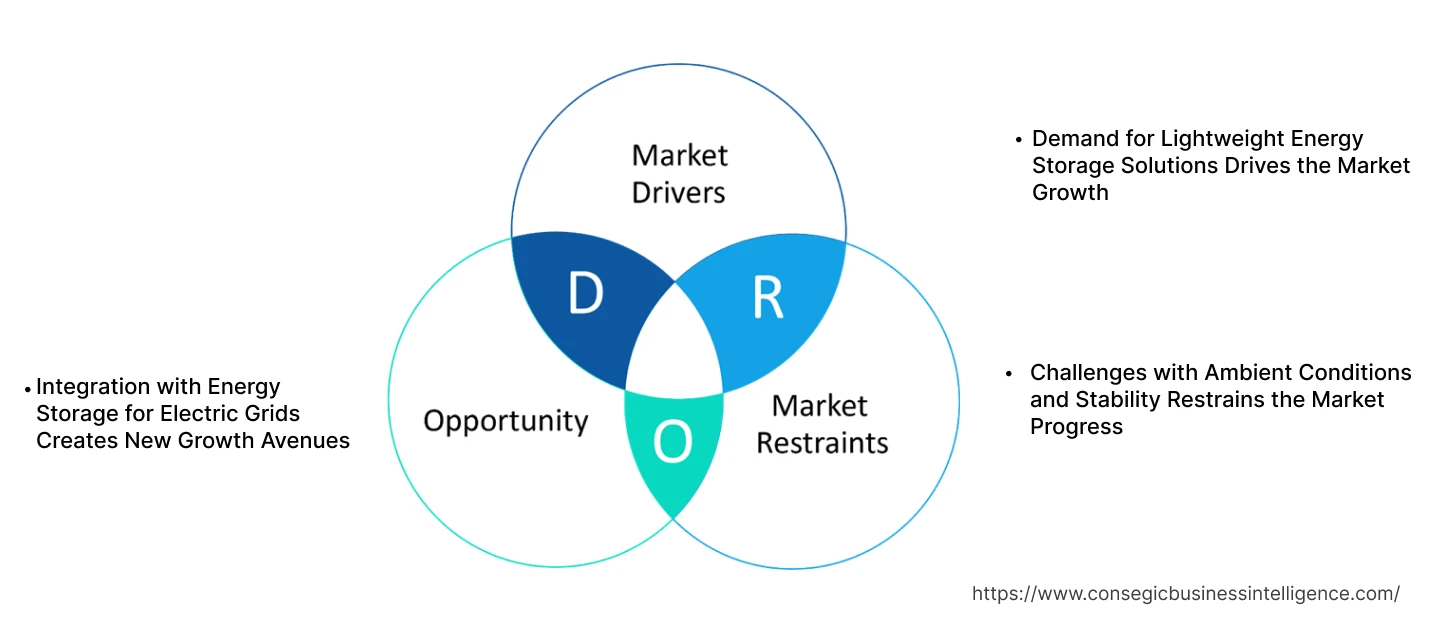
Demand for Lightweight Energy Storage Solutions Drives the Market Growth
The requirement for lightweight energy storage solutions is growing as industries like aerospace and automotive focus on improving efficiency and performance by reducing the weight of their systems. In these sectors, reducing weight is crucial for enhancing fuel efficiency, increasing speed, and improving overall performance. Metal-air batteries, with their high energy density and compact design, offer an ideal solution by providing a lightweight alternative to traditional energy storage systems. These batteries store more energy in a smaller and lighter package, making them highly attractive for applications where space and weight are critical, such as electric vehicles and aerospace systems. The ability of metal-air batteries to deliver high energy capacity without adding significant weight makes them a viable choice for industries seeking to optimize energy storage while maintaining or improving performance. As these sectors prioritize lightweight solutions, it boosts the metal air battery market growth.
Key Restraints:
Challenges with Ambient Conditions and Stability Restrains the Market Progress
Metal-air batteries are highly sensitive to environmental conditions, particularly moisture and humidity, which significantly degrade their performance. Exposure to moisture leads to the corrosion of the metal anode, causing a loss of capacity and efficiency. Similarly, fluctuations in temperature and humidity levels impact the stability of the electrolyte and the overall electrochemical reactions, reducing the battery’s reliability. This sensitivity makes metal-air batteries less viable for outdoor or long-term energy storage applications, especially in areas with high humidity or extreme weather conditions. The technology’s limitations in maintaining performance under such environmental stress reduce its attractiveness for industries like automotive, where durability and reliability are crucial. To expand the applicability of metal-air batteries, significant advancements in protective technologies, such as moisture barriers and enhanced sealing, are needed to improve their stability and ensure consistent performance in diverse conditions. Thus, the aforementioned factors limit the metal air battery market demand.
Future Opportunities :
Integration with Energy Storage for Electric Grids Creates New Growth Avenues
As the global shift towards renewable energy sources like solar and wind intensifies, the need for efficient energy storage solutions to balance supply and demand in electric grids grows. Metal-air batteries, with their high energy density, offer an excellent solution for this challenge. These batteries store large amounts of energy produced during peak renewable generation times and release it when demand exceeds supply or when renewable sources are unavailable. Their ability to store energy at a lower cost compared to traditional storage systems makes them ideal for grid-scale applications, where large volumes of energy need to be stored efficiently. By integrating metal-air batteries into energy storage systems, grid operators ensure a more reliable and stable energy supply, while supporting the increased penetration of renewable energy into the grid. This ability to help stabilize the grid and optimize renewable energy usage presents significant metal air battery market opportunities in the energy sector.
Metal Air Battery Market Segmental Analysis :
By Metal Type:
Based on metal type, the market is segmented into zinc, aluminum, lithium, magnesium, and others.
The zinc segment accounted for the largest revenue of the total metal air battery market share in 2024.
- Zinc-based metal air batteries are widely utilized due to their cost-effectiveness, stability, and established manufacturing processes, making them a preferred choice for various applications.
- These batteries exhibit high energy density and are commonly used in hearing aids, remote sensing systems, and primary power storage applications.
- Zinc-air technology benefits from its environmentally friendly composition, as zinc is an abundant and recyclable material, contributing to sustainability trends in battery development.
- As per metal air battery market analysis, the increasing adoption of zinc-air batteries in stationary power storage systems highlights their significance in energy storage applications.
The lithium segment is anticipated to witness the fastest CAGR during the forecast period.
- Lithium-air batteries offer superior energy density compared to traditional lithium-ion batteries, making them highly promising for electric vehicle and aerospace applications.
- The potential for lithium-air technology to deliver extended operational life and higher efficiency supports ongoing research and development efforts in the industry.
- These batteries are being explored for next-generation energy storage solutions, particularly in sectors that require lightweight yet powerful battery systems.
- Thus, advancements in lithium-air battery chemistry aim to address existing challenges related to rechargeability and cycle life, ensuring improved performance for commercial applications, further fueling the metal air battery market expansion.
By Voltage:
Based on voltage, the market is segmented into low voltage, medium voltage, and high voltage.
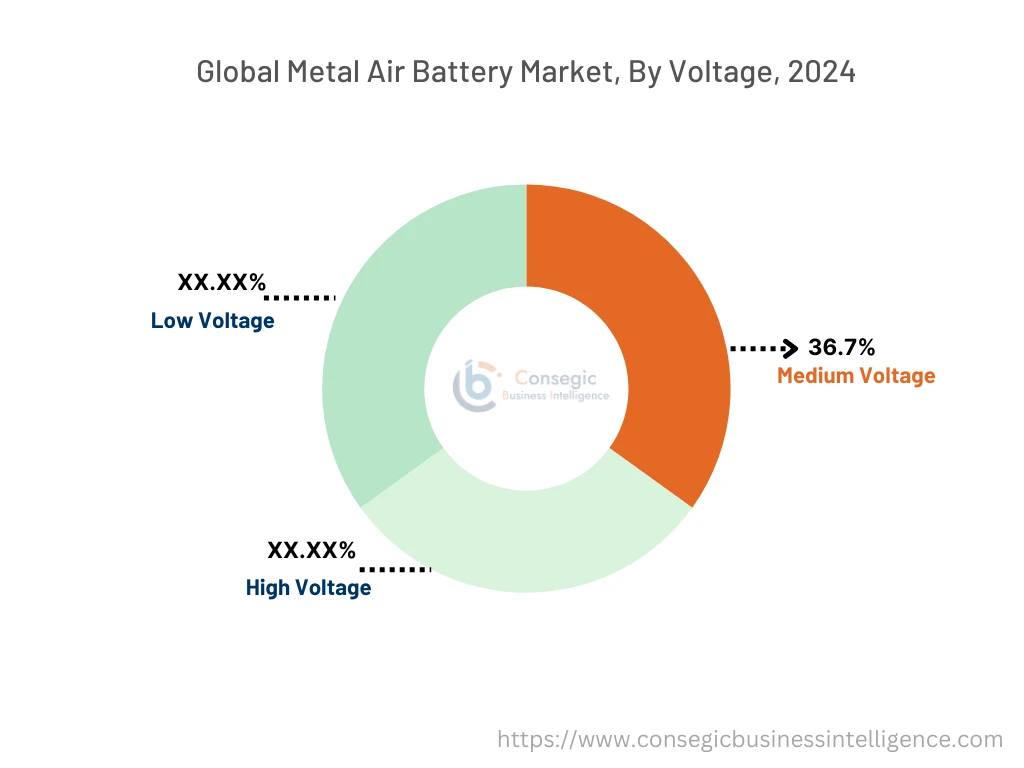
The medium voltage segment accounted for the largest revenue of 36.7% of the total metal air battery market share in 2024.
- Medium voltage metal air batteries are extensively utilized in energy storage solutions, consumer electronics, and industrial backup power applications.
- These batteries provide an optimal balance between energy output and operational stability, making them suitable for a wide range of portable and stationary applications.
- Medium voltage variants are increasingly integrated into grid-scale energy storage systems to enhance efficiency and ensure reliability during power fluctuations.
- As per metal air battery market analysis, ongoing advancements in battery design and material composition are expected to improve the efficiency of medium voltage metal air batteries across multiple industries.
The high voltage segment is anticipated to witness the fastest CAGR during the forecast period.
- High voltage metal air batteries are being developed for aerospace and defense applications, where long-lasting, high-power energy sources are required.
- These batteries demonstrate potential in electric aviation and unmanned aerial vehicles (UAVs), where high energy density and lightweight construction are critical factors.
- Research efforts are focused on improving the charge-discharge cycle of high voltage metal air batteries to ensure better performance and longevity.
- As per metal air battery market trends, the rising requirement for high-performance energy storage solutions in military and space applications is driving the development of high voltage battery systems.
By Electrolyte:
Based on electrolyte type, the market is segmented into liquid-based electrolyte, solid-based electrolyte, and polymer-based electrolyte.
The liquid-based electrolyte segment accounted for the largest revenue share in 2024.
- Liquid electrolytes are widely used in metal air batteries due to their high conductivity and ability to facilitate efficient ion transfer within the cell.
- These electrolytes are primarily employed in zinc-air and aluminum-air batteries, where their compatibility with existing battery designs ensures stable performance.
- The segment benefits from the well-established infrastructure for liquid electrolyte manufacturing, which supports large-scale battery production.
- As per market trends, ongoing improvements in liquid electrolyte formulations aim to enhance battery cycle life and efficiency, addressing performance limitations in traditional designs, driving the metal air battery market growth.
The solid-based electrolyte segment is anticipated to witness the fastest CAGR during the forecast period.
- Solid electrolytes offer significant advantages in terms of safety and durability, as they eliminate the risk of leakage and enhance battery stability.
- The adoption of solid-state electrolytes in lithium-air and magnesium-air batteries is gaining momentum due to their potential to improve energy density and extend battery life.
- Researchers are focusing on developing advanced solid electrolytes with higher ionic conductivity to overcome existing limitations in solid-state battery technology.
- Thus, as per the market trends, the transition toward solid-state energy storage solutions is expected to drive innovation in battery designs, expanding their application in high-performance sectors, fueling the metal air battery market demand.
By End-User Industry:
Based on end-user industry, the market is segmented into automotive, consumer electronics, aerospace & defense, industrial, and others.
The automotive segment accounted for the largest revenue share in 2024.
- Metal air batteries are being explored as potential alternatives to lithium-ion batteries for electric vehicles (EVs) due to their high energy density and lightweight nature.
- The segment benefits from the increasing focus on developing energy-efficient and long-range EV battery solutions to meet stringent emission regulations.
- Leading automotive manufacturers are investing in research and development efforts to enhance the commercial viability of metal air batteries for hybrid and fully electric vehicles.
- Thus, advancements in battery charging efficiency and cost reduction strategies are key factors driving the adoption of metal air technology in the automotive sector, contributing to the metal air battery market expansion.
The aerospace & defense segment is anticipated to witness the fastest CAGR during the forecast period.
- The aerospace sector is exploring metal air batteries for their potential to provide high energy density with reduced weight, making them suitable for electric aviation applications.
- Defense organizations are adopting these batteries for use in military-grade power systems, drones, and unmanned ground vehicles (UGVs).
- Metal air batteries offer longer operational life compared to conventional battery technologies, making them an ideal choice for defense and aerospace applications.
- As per metal air battery market trends, continued investment in lightweight, high-energy-density battery solutions is driving the expansion of metal air battery applications in aerospace and military sectors.
Regional Analysis:
The regions covered are North America, Europe, Asia Pacific, the Middle East and Africa, and Latin America.
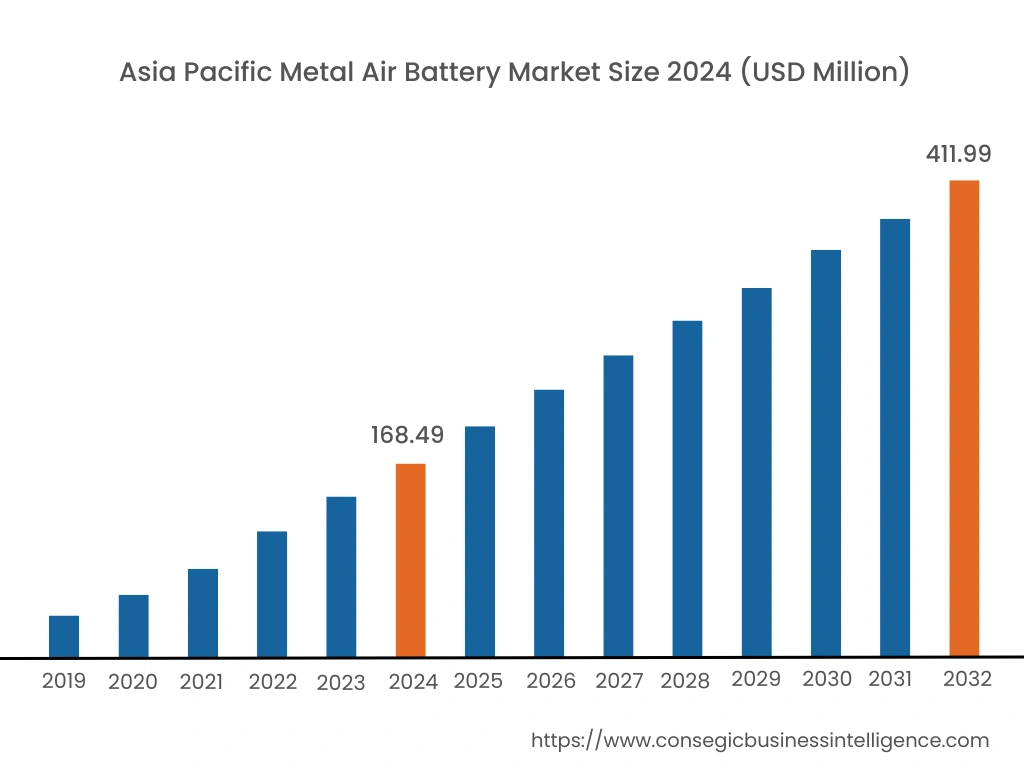
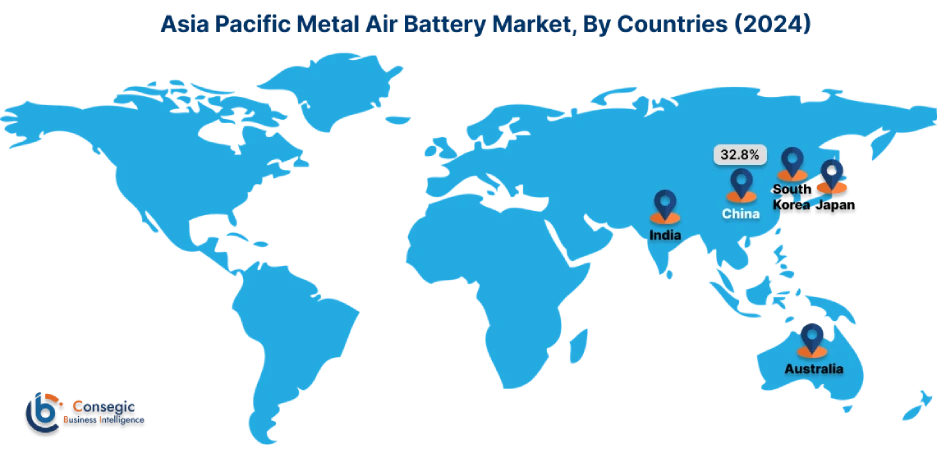
Asia Pacific region was valued at USD 168.49 Million in 2024. Moreover, it is projected to grow by USD 185.15 Million in 2025 and reach over USD 411.99 Million by 2032. Out of this, China accounted for the maximum revenue share of 32.8%. The Asia-Pacific region is experiencing rapid industrialization and urbanization, leading to increased demand for energy storage solutions in various sectors such as automotive, electronics, and renewable energy. Analysis indicates that countries like China and Japan, which account for over 50% of the total electric vehicles globally, are investing heavily in research and development to find solutions to existing battery problems, thereby driving the metal air battery market opportunities in this region.
North America is estimated to reach over USD 438.51 Million by 2032 from a value of USD 189.77 Million in 2024 and is projected to grow by USD 207.55 Million in 2025. In this region, there is a notable trend towards adopting metal-air batteries for renewable energy storage solutions. Analysis indicates that the abundance of raw materials like zinc and aluminum presents a favorable environment for developing cost-effective metal-air batteries. However, challenges such as limited cycle life and energy density compared to lithium-ion batteries need to be addressed for wider adoption in electric vehicles and grid-scale applications.
European countries are emphasizing sustainable energy solutions, leading to a significant trend in integrating metal-air batteries with renewable energy sources. Analysis suggests that advancements in battery materials, such as developing new anodes and electrolytes, are enhancing performance and longevity, aligning with the region's environmental objectives.
In the Middle East and Africa, there is growth in focus on offshore renewable energy projects, such as wind farms and floating solar installations, leading to increased need for metal-air batteries to store and manage energy generated from these sources. Analysis suggests that the region's commitment to diversifying energy portfolios and reducing reliance on fossil fuels is contributing to the adoption of advanced energy storage solutions.
Latin American countries are increasingly recognizing the potential of metal-air batteries in supporting renewable energy initiatives and providing reliable power solutions in remote areas. A notable trend is the exploration of metal-air batteries for stationary power applications, aiming to enhance energy access and sustainability. Analysis indicates that regional efforts to integrate renewable energy sources and improve grid stability are key factors influencing the market.
Top Key Players and Market Share Insights:
The Metal Air Battery market is highly competitive with major players providing products and services to the national and international markets. Key players are adopting several strategies in research and development (R&D), product innovation, and end-user launches to hold a strong position in the global Metal Air Battery market. Key players in the Metal Air Battery industry include –
- Phinergy (Israel)
- Log 9 Materials (India)
- Arotech Corporation (USA)
- PolyPlus Battery Company (USA)
- Fuji Pigment Co., Ltd. (Japan)
- GP Batteries International Limited (Hong Kong)
- ZAF Energy Systems, Inc. (USA)
- Duracell Inc. (USA)
Recent Industry Developments :
Partnerships & Collaborations:
- In October 2024, IIT Madras and Hindustan Zinc partnered to develop a 1 kWh electrically rechargeable Zinc-Air battery prototype, offering a cost-effective, durable alternative to imported lithium-ion batteries. With India’s growth in solar power production, efficient energy storage is crucial. Zinc-Air technology provides a safe, scalable, and resource-abundant solution, addressing cost and supply chain challenges of lithium-ion batteries.
Metal Air Battery Market Report Insights :
| Report Attributes | Report Details |
| Study Timeline | 2018-2032 |
| Market Size in 2032 | USD 1,353.00 Million |
| CAGR (2025-2032) | 11.4% |
| By Metal Type |
|
| By Voltage |
|
| By Electrolyte |
|
| By End-User Industry |
|
| By Region |
|
| Key Players |
|
| North America | U.S. Canada Mexico |
| Europe | U.K. Germany France Spain Italy Russia Benelux Rest of Europe |
| APAC | China South Korea Japan India Australia ASEAN Rest of Asia-Pacific |
| Middle East and Africa | GCC Turkey South Africa Rest of MEA |
| LATAM | Brazil Argentina Chile Rest of LATAM |
| Report Coverage |
|
Key Questions Answered in the Report
What is the size of the Metal Air Battery Market? −
The Metal Air Battery Market size is estimated to reach over USD 1,353.00 Million by 2032 from a value of USD 572.10 Million in 2024 and is projected to grow by USD 626.90 Million in 2025, growing at a CAGR of 11.4% from 2025 to 2032.
What are the key segments in the Metal Air Battery Market? +
The market is segmented by metal type (zinc, aluminum, lithium, magnesium, others), voltage (low voltage, medium voltage, high voltage), electrolyte (liquid-based electrolyte, solid-based electrolyte, polymer-based electrolyte), and end-user industry (automotive, consumer electronics, aerospace & defense, industrial, others).
Which segment is expected to grow the fastest in the Metal Air Battery Market? +
The high voltage segment is anticipated to witness the fastest CAGR during the forecast period, driven by the increasing adoption of hybrid and electric vehicles and the demand for energy storage in grid applications.
Who are the major players in the Metal Air Battery Market? +
Key players in the Metal Air Battery Market include Phinergy (Israel), Log 9 Materials (India), Arotech Corporation (USA), PolyPlus Battery Company (USA), Fuji Pigment Co., Ltd. (Japan), GP Batteries International Limited (Hong Kong), ZAF Energy Systems, Inc. (USA), Duracell Inc. (USA).
Overview
Reputation & Certifications


Our Services
- Market Intelligence & Forecasting
- Custom Research Solutions
- Market Entry Strategy
- Competitive Intelligence
- Customer Insights
- Industry Innovation Analysis
- Investment Advisory