Jump to Content
Paper Packaging Market - Size, Share, Industry Trends, and Forecasts (2024 - 2031)
Paper Packaging Market Size:
Paper Packaging Market size is growing with a CAGR of 3.5% during the forecast period (2024-2031), and the market is projected to be valued at USD 476.82 Billion by 2031 from USD 366.64 Billion in 2023.
Paper Packaging Market Scope & Overview:
Paper packaging refers to the use of paper-based materials to protect, store, and transport products. It includes various formats such as bags, boxes, wraps, and cartons, used across sectors such as food and beverages, healthcare, and consumer goods amongst others. Made from renewable resources such as wood pulp, this type of packaging is increasingly popular for its eco-friendliness and recyclability. Common types include kraft paper, known for its strength and durability; corrugated paper for heavy-duty packaging; cardboard for lightweight applications; and coated paper for moisture resistance and enhanced printability. Specialty papers, such as wax-coated or laminated paper, are also used for specific needs such as food wrapping. Its versatility allows customization in shape, and design, while it supports sustainability goals, appealing to eco-conscious consumers.
How is AI Impacting the Paper Packaging Market?
AI is significantly transforming the paper packaging market by automating quality control, optimizing packaging design to reduce material waste and costs, enhancing supply chain efficiency through predictive analytics and inventory management, and facilitating personalized, on-demand customization. These capabilities lead to improved efficiency, greater sustainability by minimizing environmental impact, and faster response to evolving consumer demands for customized and eco-friendly solutions. Further, the proliferation of Generative AI helps to generate hundreds of design variations in minutes and tests virtually, significantly speeding up the design process and allowing for quick adaptation to market trends or material availability.

Paper Packaging Market Dynamics - (DRO) :

Key Drivers:
Surge in Protective Packaging Solutions is Accelerating Paper Packaging Market Expansion
Protective packaging is a specialized type of packaging designed to safeguard products during transit and storage. It shields items from physical damage, moisture, dust, and other environmental factors. Key types include corrugated cardboard for cushioning and rigidity, kraft paper for wrapping and void fill, and molded pulp for fragile items such as glassware. Honeycomb paper structures are also used for heavy-duty protection. Its versatility allows customization for various product needs, while its cost-effectiveness and ease of handling enhance efficiency in logistics and storage operations.
In electronics, it's used for delicate components such as circuit boards and screens, providing cushioning and preventing damage. Moreover, in personal care, paper packaging safeguards fragile items such as cosmetics, perfumes, and skin care products from breakage and contamination. Additionally, with increased internet penetration, the convenience of online shopping, and owing to a wider range of products available, there is a rise in the E-commerce sector, resulting in a higher volume of shipments.
- According to SellersCommerce, a software company in the United States, the country’s eCommerce sales surpassed the USD 1 trillion threshold for the first time in 2022, reaching a total of USD 1.01 trillion, marking a 6.5% rise compared to the prior year. Thus, protective packaging ensures that products reach consumers in pristine condition, reducing the likelihood of damage and associated costs, and influencing the market positively.
Overall, the increasing need for protective packaging, particularly in the electronics and personal care sectors, coupled with the growth of e-commerce, is significantly boosting paper packaging market expansion.
Growing Demand from the Pharmaceutical Sector is Driving the Market.
The pharmaceutical sector focuses on researching, developing, and marketing drugs and medicines. Pharmaceuticals use various types of paper products for packaging. Folding cartons are widely used for tablets, capsules, and injectable vials, offering protection and space for regulatory labeling. Paper pouches and sachets are common for powdered medicines and small doses such as oral rehydration salts.
Moreover, blister card backings use coated paper for added durability and easy handling of unit doses. Additionally, specialty paper wraps, including moisture-resistant and laminated paper, are used for sterile instruments and bandages. An aging population with increased healthcare needs, the emergence of chronic diseases, and advancements in medical research and technology have led to growth in the pharmaceutical sector.
- According to an article published by Cross River Therapy, in 2024, a company specializing in providing Applied Behavior Analysis (ABA) therapy services, the United States spends more than USD 323 billion annually for prescription medications. Also, the global pharmaceutical sector is projected to expand at an annual rate of 4.7%. Thus, this has required materials for packaging that, positively impact paper packaging market trends.
Overall, the growing pharmaceutical sector is boosting the need for various paper-based packaging solutions, thus accelerating the global paper packaging market growth.
Key Restraints :
Growing Commercialization of Other Packaging Materials is Hampering the Paper Packaging Market Demand
The market faces significant competition from alternative packaging materials, particularly plastic and bioplastics. Traditional plastic packaging remains dominant due to its affordability, lightweight nature, and superior durability. Plastics also provide excellent moisture, gas, and impact resistance, qualities that are sometimes challenging for paper-based solutions to match.
Bioplastics, on the other hand, present an emerging challenge. These materials combine the benefits of plastic’s durability with enhanced environmental appeal, as they are derived from renewable sources and are biodegradable. They are increasingly adopted in sectors seeking sustainable alternatives without compromising on performance, especially for high-barrier applications such as food packaging. Paper material in packaging struggles in sectors where strength, water resistance, and cost-effectiveness are critical. Furthermore, fluctuating raw material prices, particularly for pulp and paper, impact the cost-competitiveness, further hindering the paper packaging market demand.
Overall, analysis shows that the market is constrained by competition from traditional plastics, emerging bioplastics, and fluctuating raw material costs, hampering the paper packaging market trends.
Future Opportunities :
Growing Focus on Sustainable Packaging is Creating Lucrative Paper Packaging Market Opportunities.
Sustainable packaging minimizes environmental impact by using eco-friendly materials and processes throughout its lifecycle. Recyclable paper material for packaging is collected and processed into new paper products, reducing waste. Biodegradable paper material for packaging, made from organic materials such as plant fibers, breaks down naturally over time, minimizing environmental impact. These sustainable options contribute to a circular economy and reduce reliance on harmful plastics.
Growing environmental concerns, particularly plastic pollution and climate change have prompted consumers to prioritize sustainable choices. Governments have also recognized the urgent need to address these issues, leading to the implementation of stricter regulations and incentives. This shift has insisted businesses adopt more eco-friendly practices, including sustainable packaging.
- In November 2024, UPM Specialty Papers and Eastman launched a new recyclable paper-based food packaging material with a compostable biopolymer coating. Paper-based food packaging materials are biodegradable and recyclable. Thus, the rising adoption of sustainable materials in packaging will require these innovative solutions, presenting potential for the market.
Overall, government stringent regulations and consumer requirements for sustainable solutions are creating lucrative paper packaging market opportunities.
Paper Packaging Market Segmental Analysis :
By Paper Type:
Based on paper type, the market is categorized into coated and uncoated.
Trends in the Paper Type:
- Innovation in paper coatings to enhance barrier properties and printability.
- Increasing adoption of uncoated paper type due to its recyclability.
The coated segment accounted for the largest market share in 2023.
- Coated paper is paper that has a thin layer of material applied to it during manufacturing to give it certain qualities. The coating is made from a variety of substances, including clay, polymers, and pigments.
- The smooth surface allows for high-quality printing, including sharp images and vibrant colors. Additionally, the coating provides better protection against moisture wear, and tears.
- Cereal boxes and candy wrappers use coated paper for their ability to protect the product and enhance branding. Perfume boxes, high-end cosmetic packaging, and gift boxes frequently utilize coated paper to create a premium and luxurious look. Rising disposable incomes and increasing emphasis on brand differentiation have led to an increase in premium products.
- For instance, according to an article published in The Economic Times, in 2024, The adoption of premium products, surged by over a third in volume and over fifty percent in value during the last two years. This has led to the increased need for coated paper, as it has a smooth surface and the ability to enhance branding and product appeal.
- Overall, the growing consumer need for premium products is driving the segment in the global paper packaging market growth.
The uncoated segment is expected to grow at the fastest CAGR over the forecast period.
- Uncoated paper is a type of paper that does not have any additional coating applied to its surface during manufacturing. Uncoated paper is rougher and more natural because it doesn't have a coating to fill in the fibers. The wood fibers are more exposed, giving it a more tactile feel.
- Moreover, it is more porous, making it more absorbent. This makes it a good choice for writing with a pen or pencil. Also, it is easier to read large amounts on that paper as it lacks a shiny finish. It is a good fit for projects that require folding.
- Uncoated paper reduces glare for text-heavy documents. Additionally, it has a higher post-printing resilience of the ink surface to scuffs and scratches.
- As per the market research analysis, the segment of uncoated paper for the upcoming years is driven by the rising need for sustainable packaging as it is more eco-friendly because it yields a higher percentage of fiber for recycling.
By Product Type:
The product type segment is categorized into boxes, bags & sacks, cups, wraps, and others.
Trends in the Product Type
- Rising adoption of floating paper bottlesas an innovative solution for beverages.
- Growing need for specialty products with materials such as greaseproof.
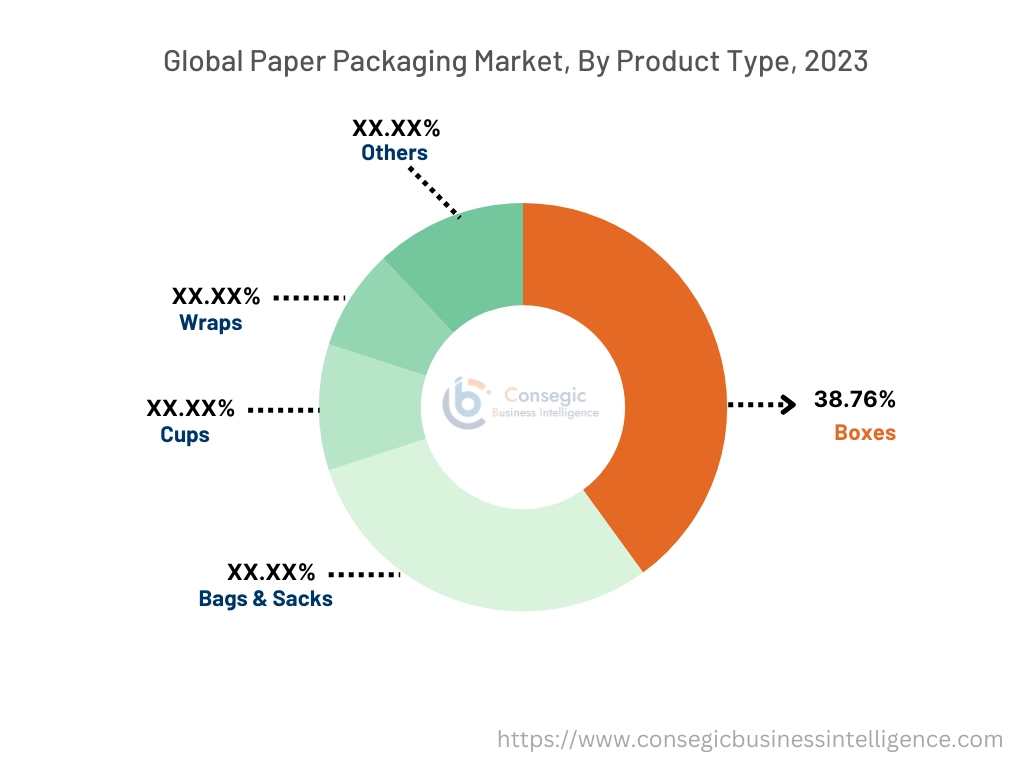
The boxes segment accounted for the largest market share of 38.76% in 2023.
- Paper boxes for packaging come in various types, each designed to suit specific needs. Common options include folding cartons, used widely in retail for lightweight products such as food or cosmetics. Corrugated boxes are ideal for shipping and heavy-duty storage due to their durability and cushioning.
- Rigid boxes are premium options used for luxury items such as electronics or jewelry, offering enhanced sturdiness and an elegant appearance. Set-up boxes, a type of rigid box, are pre-assembled and commonly used for gift packaging. Sleeve boxes, with a sliding design, provide a sleek, modern look for consumer goods.
- There is a growing need for electronic devices due to rising disposable incomes and changing lifestyles.
- For instance, according to the National Investment Promotion and Facilitation Agency of India, India's domestic production has grown at a compound annual growth rate of 13%, from FY17 to FY23. The export of electronic products experienced a remarkable rise of 45.69% in September 2024 compared to September 2023. This is driving the increased need for paper material for packaging purposes.
- Overall, the growing need for electronics is driving the segment of the boxes in the paper packaging industry.
The bags & sacks segment is expected to grow at the fastest CAGR over the forecast period.
- Paper bags are made from paper pulp, which is pressed into sheets or rolls of paper. The sheets are cut to dimensions, and folded over, and the open sides are glued together. Paper bags are commonly used for shopping, carrying groceries, and packaging various consumer goods such as clothing, books, and electronics.
- Whereas paper sacks are a type of bag made from one or more layers of paper. Commonly used for cement, chemicals, fertilizers, grains, seeds, pet food or animal feed, flour, rice, and sugar. They are also known as industrial paper bags, shipping sacks, or multi-wallpaper bags.
- Paper bags and sacks are made from virgin or recycled fibers, and they come in a variety of shapes, and printing designs. They are lightweight, durable, and come with handles for easy carrying.
- As per the market research analysis, governments worldwide imposing stricter regulations on the use of plastic bags is incentivizing the adoption of paper-based alternatives, fueling the segment for the upcoming years.
By End-Use Industry:
The end-use industry segment is categorized into food & beverage, electronics, personal care & cosmetics, healthcare & pharma, and others.
Trends in End-Use Industry
- The E-commerce boom is driving the adoption of durable and protective packaging for shipping.
- Growing the need for sustainable and premium paper-based packaging solutions in the personal care and cosmetics sector.
The food & beverage segment accounted for the largest market share in 2023.
- The food and beverage sector uses various paper material product types for packaging. Paper cartons are widely used for packaging liquid products such as milk, juice, and wine. Moreover, corrugated cardboard boxes are ideal for shipping and storing dry goods such as cereals, snacks, and canned food.
- Additionally, paper bags are used for carrying groceries, bakery items, and take-out food.Paper cups are commonly used for hot and cold beverages such as coffee, tea, and soft drinks. Furthermore, paper wrappers are used for packaging snacks, chocolates, and other small food items.
- They are coated with a waterproof lining to prevent leaks and maintain temperature. They are lightweight, recyclable, and are easily customized with branding. Rising disposable incomes, urbanization, and changing lifestyles have led to increased spending on food and beverages.
- For instance, according to the Bureau of Labor Statistics, in 2023, expenditure by consumers on food and non-alcoholic drinks rose by more than 12% in comparison to 2022. This includes processed foods, tetra-pack beverages, and packaged food items, thus driving the segment in the market.
- Overall, the analysis indicates that the increase in the food and beverage sector has significantly boosted the segment in the market.
The electronics segment is expected to grow at the fastest CAGR over the forecast period.
- Paper as a packaging material plays a vital role in the electronics sector, offering protective solutions for various products. Key types include corrugated boxes, widely used for shipping and storing electronics due to their strength and cushioning properties.
- Kraft paper wraps provide an economical option for protecting devices against scratches and minor impacts during transportation. Paperboard boxes, used for smaller electronics such as headphones or accessories, combine durability with a premium, customizable appearance.
- Molded pulp packaging, made from recycled paper, is increasingly popular for its sustainability and ability to securely cradle sensitive items such as smartphones and components. Paper envelopes with cushioning are used for mailing smaller items such as cables or memory cards, offering lightweight protection. Cardboard partitions and inserts ensure the safe separation of multiple items in one package, preventing damage from collisions. Additionally, anti-static paper packaging protects electronic components from electrostatic discharge, ensuring functionality.
- Technological advancements and growing requirements for smart devices are leading to an increase in the electronics sector which will drive the need for paper material products for packaging in the forecasted period.
Regional Analysis:
The regional segment includes North America, Europe, Asia Pacific, the Middle East and Africa, and Latin America.
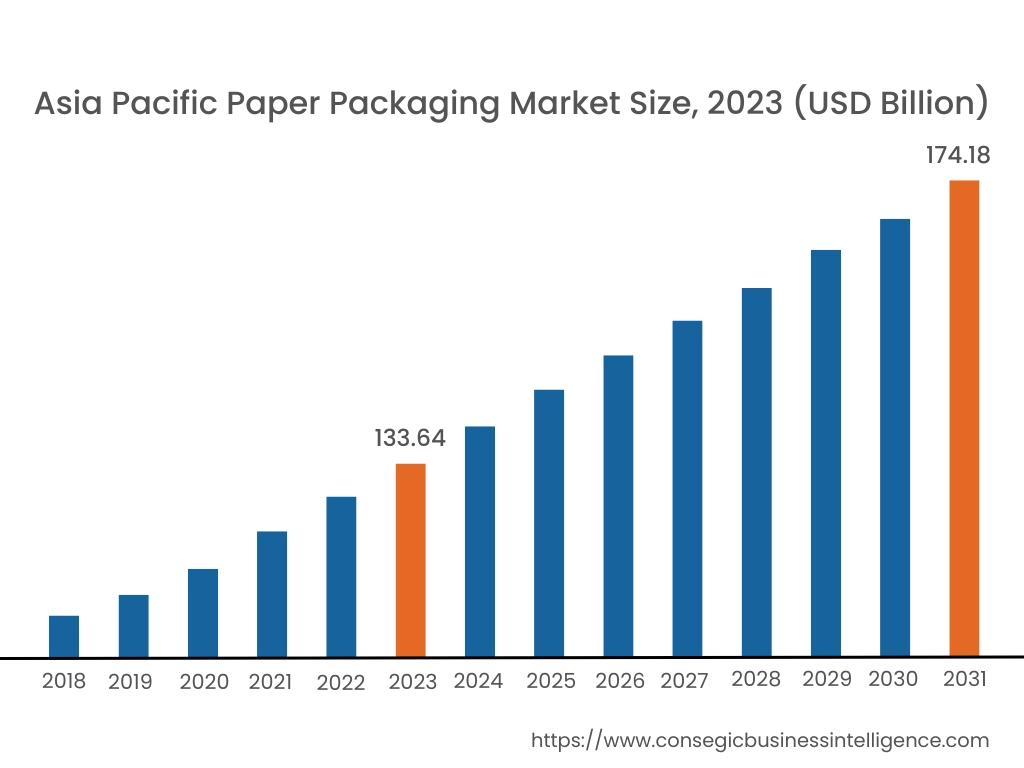
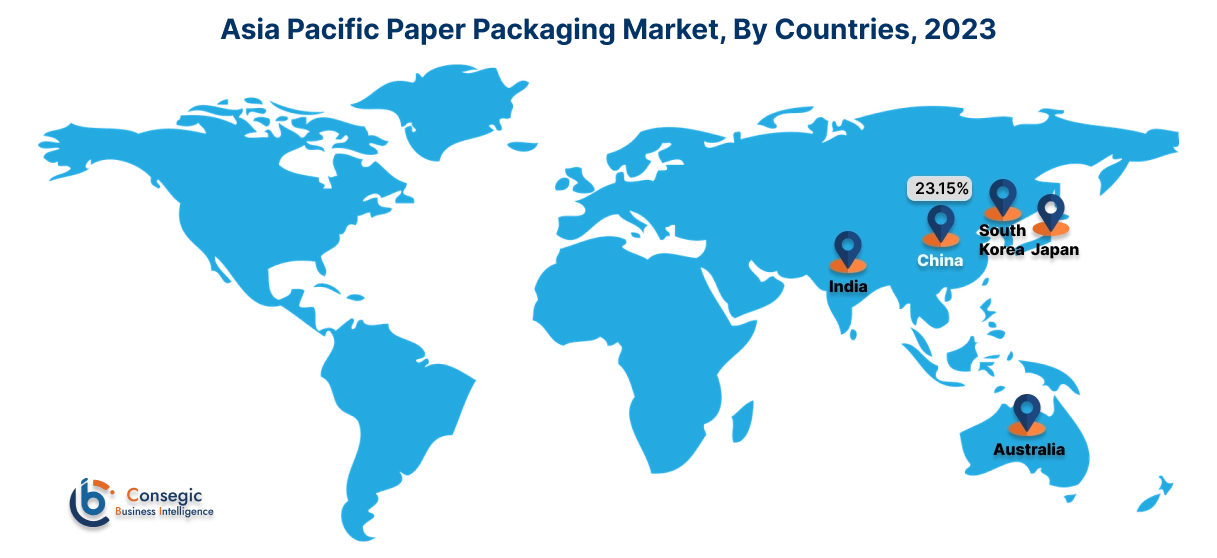
In 2023, Asia Pacific accounted for the highest paper packaging market share at 36.45% and was valued at USD 133.64 Billion and is expected to reach USD 174.18 Billion in 2031. In Asia Pacific, China accounted for the highest paper packaging market share of 23.15% during the base year of 2023. The dominance is driven by several key trends. Countries such as China and India have established extensive manufacturing facilities, creating high requirements, especially for industrial goods and exports. The growing e-commerce sector in APAC, driven by rising internet penetration, is increasing the need for corrugated boxes and cartons. Moreover, the region is becoming increasingly aware of environmental concerns.
- According to an article published by Keeo, a company specializing in eco-friendly food packaging solutions, the demand for sustainable packaging among consumers has surged to 81% by January 2023. Paper-based packaging, being recyclable and biodegradable, aligns with this growing trend.
Furthermore, low raw material and labor costs enable Asia Pacific manufacturers to produce paper products for packaging at competitive prices, fueling regional and global exports. Overall, the combination of economic increase, increasing consumer awareness, and favorable production costs positions the Asia-Pacific region as a dominant force in the global market.
In Europe, the paper packaging market is experiencing the fastest growth with a CAGR of 4.1% over the forecast period. The market is driven by several trends. The EU’s single-use plastics directive is pushing businesses to adopt paper-based packaging as a sustainable alternative. Moreover, Europe’s focus on recycling and waste reduction has increased the need for recyclable paper-based packaging solutions. Additionally, the robust European luxury goods market requires high-quality and aesthetically appealing paper-based packaging. Furthermore, European companies are adopting advanced manufacturing technologies, enabling the production of lightweight yet durable paper-based packaging products. Also, paper-based packaging, such as corrugated boxes and paper envelopes, is well-suiting e-commerce and logistics growth.
North America paper packaging market analysis states several factors are responsible for the progress of the market in the region. Companies are shifting towards paper products for packaging to align with corporate sustainability goals and consumer preferences. Moreover, increasing reliance on paper-based packaging for fast food, beverages, and fresh produce due to health-conscious consumers, further drives the market in the region. Additionally, North American consumers favor premium, customized packaging, driving adoption in niche paper-based packaging segments. Furthermore, the increase in e-commerce giants such as Amazon is driving the adoption of robust paper-based packaging solutions.
The Middle East and Africa (MEA) paper packaging market analysis states that the region is also witnessing a notable surge in paper-based packaging solutions. Rapid urban development and retail enlargement in countries such as the UAE and South Africa are boosting the requirements for paper-based packaging. As consumer preferences shift towards convenience and packaged food, the demand for paper-based packaging solutions such as cartons, boxes, and bags is increasing. Moreover, MEA’s role as an export hub for agricultural products requires durable and eco-friendly packaging. Policies to reduce plastic usage are gradually fostering the adoption of paper alternatives.
The Latin American paper packaging market is also emerging. Latin America’s significant agricultural exports drive the demand for paper-based transport packaging such as sacks and corrugated boxes. Moreover, emerging economies, such as Brazil and Mexico, are witnessing increased requirements for consumer goods and associated packaging. Additionally, rising investments in domestic paper mills enhance the availability and affordability of paper-based packaging solutions. Furthermore, as consumer preferences shift towards convenience and packaged food, the demand for paper-based packaging solutions such as cartons, boxes, and bags is increasing.
Top Key Players & Market Share Insights:
The paper packaging market is highly competitive with major players providing products to the national and international markets. Key players are adopting several strategies in research and development (R&D) and product innovation to hold a strong position in the global paper packaging market. Key players in the paper packaging industry include-
- Amcor Plc (Australia)
- DS Smith Plc (UK)
- Huhtamäki Oyj (Finland)
- Mondi Plc (UK)
- UPM-Kymmene Corp (Finland)
- WestRock Co. (U.S.)
- Sealed Air Corporation (U.S.)
- Tetra Pak (Switzerland)
- Pactiv Evergreen Inc (U.S.)
- Hood Packaging Corporation (U.S.)

Recent Industry Developments :
Capacity Expansion:
- In February 2024, Mondi announced a substantial increase in the production of its paper-based "EcoWicketBags" at its Szada facility in Hungary, primarily to address the escalating requirements for sustainable packaging alternatives within the home and personal care sector.
Product Launch:
- In September 2024, Colpac launched "Stagione Light", a new line of lightweight, recyclable paperboard food packaging within their popular "Stagione" range, designed to offer a more cost-effective option while maintaining the familiar shape and roll-top design.
Paper Packaging Market Report Insights :
| Report Attributes | Report Details |
| Study Timeline | 2018-2031 |
| Market Size in 2031 | USD 476.82 Billion |
| CAGR (2024-2031) | 3.5% |
| By Paper Type |
|
| By Product Type |
|
| By End-Use Industry |
|
| By Region |
|
| Key Players |
|
| North America | U.S. Canada Mexico |
| Europe | U.K. Germany France Spain Italy Russia Benelux Rest of Europe |
| APAC | China South Korea Japan India Australia ASEAN Rest of Asia-Pacific |
| Middle East and Africa | GCC Turkey South Africa Rest of MEA |
| LATAM | Brazil Argentina Chile Rest of LATAM |
| Report Coverage |
|
Key Questions Answered in the Report
How big is the Paper Packaging market? −
In 2023, the Paper Packaging market was valued at USD 366.64 Billion.
Which is the fastest-growing region in the Paper Packaging market? +
Europe is the fastest-growing region in the Paper Packaging market.
What specific segmentation details are covered in the Paper Packaging market? +
Product Type and End-Use Industry segmentation details are covered in the Paper Packaging market.
Who are the major players in the Paper Packaging market? +
Amcor Plc (Australia), DS Smith Plc (UK), Huhtamäki Oyj (Finland), Mondi Plc (UK), UPM-Kymmene Corp (Finland), WestRock Co. (U.S.), Sealed Air Corporation (U.S.), Tetra Pak (Switzerland), Pactiv Evergreen Inc (U.S.), and Hood Packaging Corporation (U.S.).
Overview
Reputation & Certifications


Our Services
- Market Intelligence & Forecasting
- Custom Research Solutions
- Market Entry Strategy
- Competitive Intelligence
- Customer Insights
- Industry Innovation Analysis
- Investment Advisory