Jump to Content
Permethrin Market - Size, Share, Industry Trends, and Forecasts (2025-2032)
Permethrin Market Size:
Permethrin Market size is estimated to reach over USD 1.66 Billion by 2032 from a value of USD 1.18 Billion in 2024 and is projected to grow by USD 1.21 Billion in 2025, growing at a CAGR of 4.4% from 2025 to 2032.
Permethrin Market Scope & Overview:
Permethrin is a synthetic pyrethroid compound widely used as an insecticide and acaricide in agriculture, public health, animal care, and household pest control. It functions by disrupting the nervous system of insects, offering rapid knockdown and long-lasting residual activity. Available in multiple formulations including liquids, creams, sprays, and powders, it is suitable for diverse application methods.
Key features include broad-spectrum efficacy, low water solubility, and chemical stability under standard storage conditions. Its effectiveness at low concentrations makes it cost-efficient, while its compatibility with other active agents enhances versatility in combined treatments. It is commonly applied to crops, clothing, insect-repellent products, and veterinary treatments.
Agricultural producers, pest control operators, and pharmaceutical manufacturers utilize the chemical for its reliability in managing a wide range of insect threats. Continued refinements in formulation enhance its precision and safety, supporting its use across industrial, commercial, and domestic sectors.
How is AI Transforming the Permethrin Market?
There is an emerging use of AI in the permethrin market. AI integration helps in optimizing manufacturing processes, improving pest management, and streamlining supply chains and logistics, along with precision agriculture. Moreover, AI-powered systems can speed up the discovery of new permethrin formulations, predict their effectiveness, and identify potential environmental impacts, thereby reducing development time and costs. In addition, AI-powered solutions help in predicting efficacy and safety, analyzing pest populations, and ensure more targeted and sustainable use of permethrin. Thus, the above factors are anticipated to boost the market growth in upcoming years.

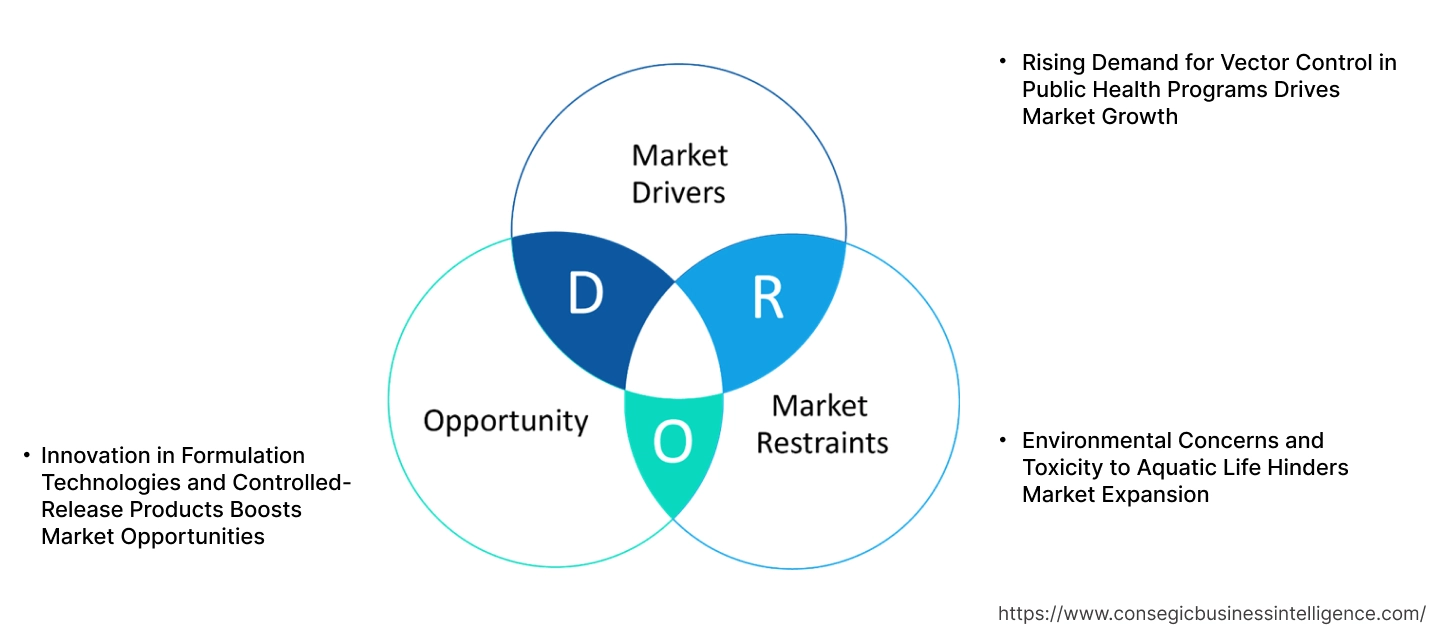
Permethrin Market Dynamics - (DRO):
Key Drivers:
Rising Demand for Vector Control in Public Health Programs Drives Market Growth
Public health initiatives increasingly emphasize vector control to reduce the transmission of diseases such as malaria, dengue, and Zika virus. Programs across various regions are adopting integrated pest management strategies, where chemical control plays a vital role. Permethrin, known for its effectiveness in controlling mosquitoes, ticks, and other disease vectors, remains a preferred choice in public health applications. Its broad-spectrum activity and residual efficacy contribute to its continued use in indoor residual sprays, insecticide-treated nets, and surface treatments. The demand for efficient, fast-acting insecticides has intensified with the resurgence of vector-borne diseases, prompting public agencies and health organizations to invest in scalable vector control tools. Regulatory approvals and endorsements by health authorities further support adoption in both urban and rural settings.
- For instance, in February 2022, researchers at the University of North Carolina and the Mbarara University of Science and Technology in Uganda investigated the tolerance of permethrin-treated baby wraps in preventing malaria infection in young children as a complementary tool. The wraps were found to be well-tolerated and acceptable in their endeavor. Furthermore, adverse casualties were infrequent and mild.
As governments and institutions continue to prioritize disease prevention, these applications strongly contribute to the permethrin market expansion.
Key Restraints:
Environmental Concerns and Toxicity to Aquatic Life Hinders Market Expansion
Even at low concentrations, runoff from agricultural or structural applications poses a threat to fish and invertebrates in surrounding ecosystems. This issue leads to stringent regulations that limit the use of permethrin in areas near water bodies. Additionally, concerns over bioaccumulation and long-term ecological impact prompt increased scrutiny from environmental agencies. The rising awareness of environmental sustainability has shifted stakeholder priorities, creating hesitancy among end users in sensitive environments. Consumer preferences are also shifting toward biodegradable and less persistent alternatives, reducing the demand for synthetic pyrethroids. As regulatory frameworks tighten and environmental advocacy gains momentum, manufacturers are compelled to reformulate or restrict product availability in certain regions. These factors collectively act as restraints, influencing application scope and affecting overall permethrin market growth.
Future Opportunities:
Innovation in Formulation Technologies and Controlled-Release Products Boosts Market Opportunities
Innovations offering improved safety, stability and targeted efficacy support prolonged residual action while minimizing application frequency, making them more practical for end users in agriculture, residential, and public health sectors. Controlled-release technologies reduce direct exposure, enhance user compliance, and optimize product performance across varied environments. The introduction of microencapsulation, nanoemulsions, and synergistic blends has improved permethrin's compatibility with other compounds, expanding its range of applications. Such improvements align with rising demand for efficient and safer pest control solutions across global markets. These advanced formulations also address regulatory and environmental concerns by reducing off-target impact and enhancing product stewardship. As end users increasingly seek value-added solutions that balance effectiveness and safety, the adoption of innovative delivery mechanisms is expected to drive sustained growth. These developments significantly contribute to the permethrin market opportunities.
Permethrin Market Segmental Analysis :
By Form:
Based on form, the market is segmented into liquid, powder, aerosol and others.
The liquid segment held the largest permethrin market share in 2024.
- Liquid formulations are widely used across agriculture, household pest control, and pharmaceutical-grade lice treatments.
- The need for easy-to-apply, fast-acting formulations is increasing in both domestic and professional pest control settings.
- Permethrin market analysis reveals that liquid formulations offer superior bioavailability and broader surface coverage compared to other forms.
- As per market trends, liquid-based insecticides are preferred for large-area spray applications in public health programs for their convenience.
The aerosol segment is expected to grow at the fastest CAGR during the forecast period.
- Aerosol-based products are gaining traction in consumer markets due to convenience and direct-use applications.
- The need for ready-to-use insect repellents and lice sprays is increasing, especially in urban and retail-driven regions.
- Segmental trends suggest a surge in demand for aerosolized treatments in the personal care and veterinary sectors.
- Thus, with growing consumer awareness of hygiene and pest prevention, aerosols are contributing to the permethrin market growth.
By Application:
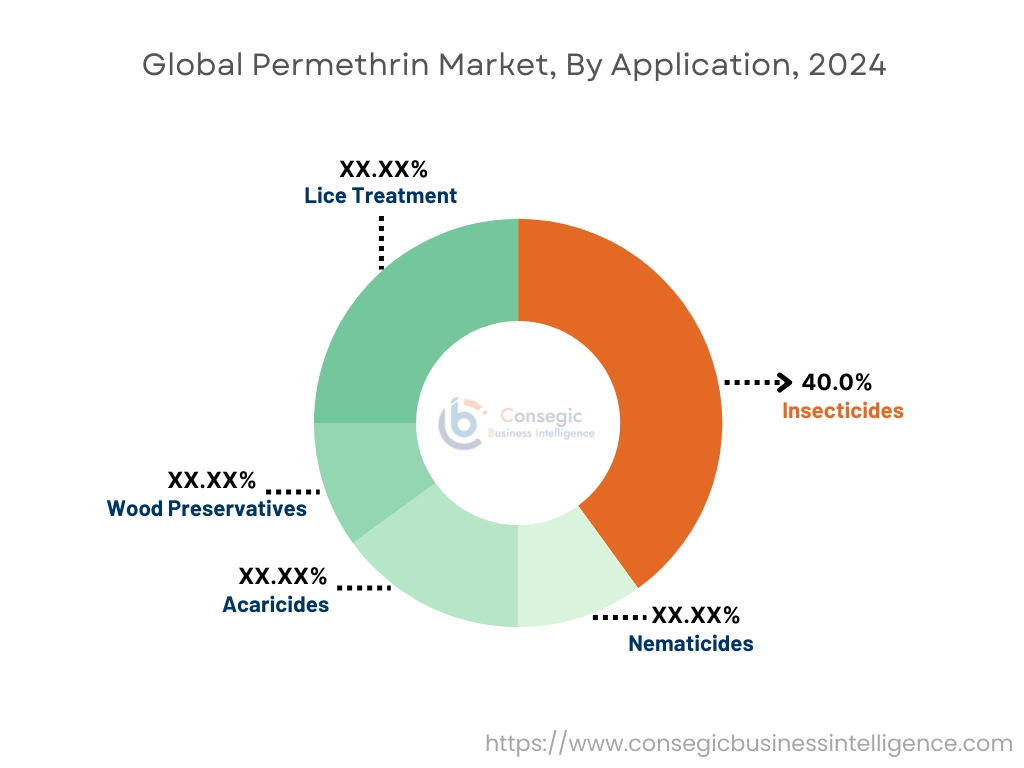
Based on application, the market is segmented into lice treatment, insecticides, nematicides, acaricides and wood preservatives.
The insecticides segment dominated the market at 40.0% in 2024.
- It is extensively used as a broad-spectrum insecticide in agriculture, vector control, and household pest management.
- The need for crop protection and vector-borne disease control is driving large-scale consumption of permethrin-based insecticides.
- Market analysis shows that regulatory support for vector control is enhancing its use in public health applications.
- As per the permethrin market trends, innovation in microencapsulated insecticides is needed for longer-lasting field efficacy.
The lice treatment segment is projected to witness the fastest CAGR in the forecast period.
- Permethrin is a first-line treatment for head lice and scabies in pharmaceutical applications.
- The need for over-the-counter (OTC) pediculicides is increasing due to high incidence among school-age children.
- Market trends show rising R&D into combination therapies and resistance-management formulations.
- Therefore, with greater awareness of personal hygiene and dermatological care, this segment is driving the permethrin market expansion.
By End User:
Based on end-use, the market is divided into agriculture, pharmaceuticals, veterinary & animal health, public health agencies, consumer goods & household, textiles and others.
The agriculture segment held the largest permethrin market share in 2024.
- It is widely applied in crop protection, particularly against aphids, beetles, and mites across grains, vegetables, and fruit crops.
- The need for effective, broad-spectrum insecticides is steady, particularly in Asia-Pacific and Latin America.
- Segmental trends reveal that pre- and post-harvest treatments continue to rely on pyrethroids.
- As per the permethrin market analysis, its incorporation in integrated pest management (IPM) programs is propelling segment growth.
The pharmaceuticals segment is expected to register the fastest CAGR during the forecast period.
- It is used in dermatological treatments for lice and scabies and is listed on the WHO Model List of Essential Medicines.
- The need for safe, effective topical anti-parasitic treatments is increasing globally, especially in developing countries.
- Permethrin market trends indicate strong potential in pediatric and geriatric formulations for topical administration.
- Thus, with the rise of resistant lice strains, continued innovation in permethrin delivery and efficacy is accelerating market demand.
Regional Analysis:
The regions covered are North America, Europe, Asia Pacific, the Middle East and Africa, and Latin America.
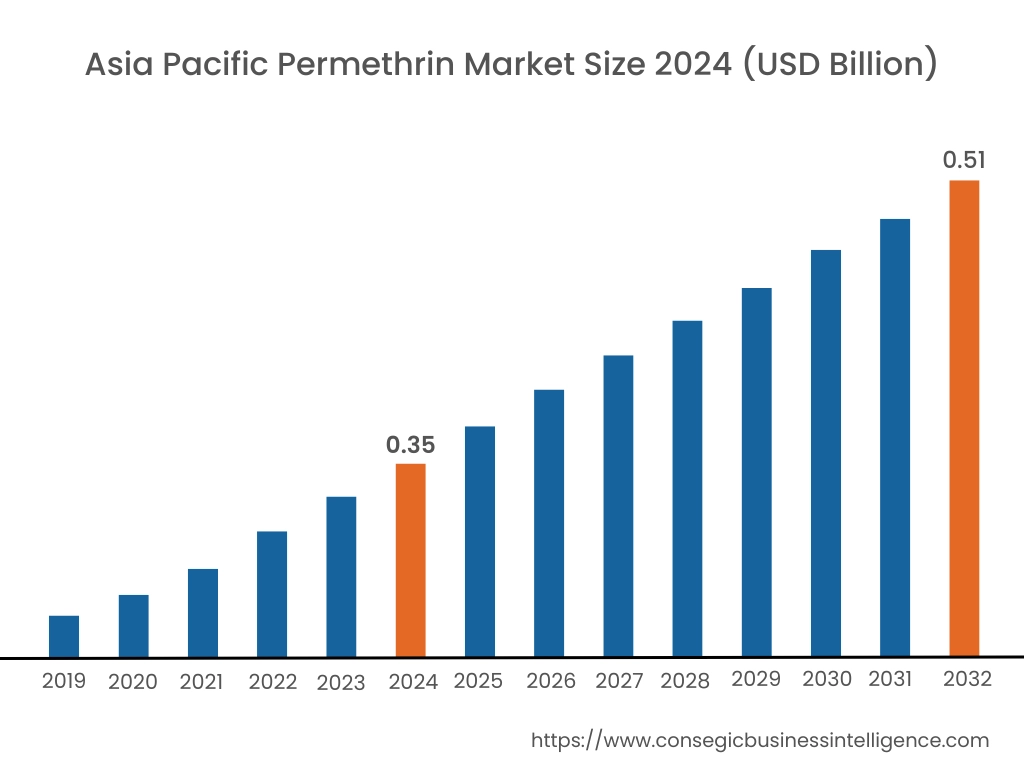
Asia Pacific region was valued at USD 0.35 Billion in 2024. Moreover, it is projected to grow by USD 0.36 Billion in 2025 and reach over USD 0.51 Billion by 2032. Out of this, China accounted for the maximum revenue share of 38.1%. Asia-Pacific stands out as the fastest-growing region in the global market, fueled by increasing requirement for vector control solutions and rising agricultural output. Countries such as India, China, and Southeast Asian nations are adopting these formulations to address malaria, dengue, and crop pest challenges. The expansion of urban centers and rising concerns over sanitation and pest-borne diseases further bolster the permethrin market demand. Regional growth is also supported by its affordability and effectiveness in both commercial farming and domestic pest management. Analysis suggests that broader access to public health campaigns and government-sponsored disease prevention initiatives will continue to accelerate market development.

North America is estimated to reach over USD 0.54 Billion by 2032 from a value of USD 0.39 Billion in 2024 and is projected to grow by USD 0.40 Billion in 2025. In North America, the market remains well-established and driven by the widespread use of the chemical in agriculture, residential pest control, and public health programs. The United States, in particular, has integrated the compound into mosquito control and lice treatment protocols, supported by regulatory clarity and a robust distribution framework. The high level of awareness surrounding vector-borne diseases and tick-borne illnesses contributes significantly to permethrin market demand in outdoor apparel and insect repellent segments. The region continues to witness growth due to ongoing research and application development, especially in integrating it into fabrics and protective gear.
Europe maintains a steady requirement, primarily through regulated agricultural and veterinary applications. While stricter environmental guidelines have limited certain uses, the market remains active due to the need for effective solutions against lice, mites, and crop-damaging insects. Countries like France, Spain, and Germany use permethrin under controlled conditions, particularly in livestock management and public hygiene programs. The analysis of the European market reveals a gradual shift toward lower-toxicity, high-efficacy formulations in line with environmental sustainability goals. Continued investment in integrated pest management approaches presents a moderate but stable permethrin market opportunity.
Latin America's market is shaped by a mix of agricultural requirements and public health challenges. Brazil, Argentina, and Mexico utilize permethrin in pest control programs targeting mosquitoes, ticks, and agricultural pests. The presence of tropical climates and recurring outbreaks of vector-borne diseases necessitate reliable and accessible insecticide options. Local manufacturers are also engaged in developing low-cost formulations to meet rural and semi-urban needs. Analysis indicates that improved distribution networks and education on proper usage will be vital to unlocking long-term value in the region.
In the Middle East and Africa, the usage is gradually rising in response to persistent public health threats and expanding agricultural activities. While regulatory frameworks are still evolving, government-led anti-malaria campaigns and donor-supported health programs have significantly contributed to market presence. The need for permethrin-treated mosquito nets and protective wear is growing across malaria-endemic regions. Analysis of this market highlights a need for enhanced awareness and infrastructure support, creating scope for future growth through partnerships and knowledge dissemination.
Top Key Players & Market Share Insights:
The permethrin market is highly competitive with major players providing products and services to the national and international markets. Key players are adopting several strategies in research and development (R&D), product innovation, and end-user launches to hold a strong position in the global permethrin market. Key players in the permethrin industry include –
- Bayer CropScience (Germany)
- SigmaAldrich (USA)
- BASF (Germany)
- Excel Crop Care (India)
- Shandong Weifang Rainbow Chemical (China)
- Syngenta (Switzerland)
- Geolife Agritech Pvt. Ltd. (India)
- FMC (USA)
- Prestige Consumer Healthcare, Inc. (US)
- Loveland Products, Inc. (US)
Permethrin Market Report Insights:
| Report Attributes | Report Details |
| Study Timeline | 2019-2032 |
| Market Size in 2032 | USD 1.66 Billion |
| CAGR (2025-2032) | 4.4% |
| By Form |
|
| By Application |
|
| By End-Use |
|
| By Region |
|
| Key Players |
|
| North America | U.S. Canada Mexico |
| Europe | U.K. Germany France Spain Italy Russia Benelux Rest of Europe |
| APAC | China South Korea Japan India Australia ASEAN Rest of Asia-Pacific |
| Middle East and Africa | GCC Turkey South Africa Rest of MEA |
| LATAM | Brazil Argentina Chile Rest of LATAM |
| Report Coverage |
|
Key Questions Answered in the Report
How big is the Permethrin Market? −
The global Permethrin market is estimated to reach over USD 1.66 Billion by 2032 from a value of USD 1.18 Billion in 2024, growing at a CAGR of 4.4% from 2025 to 2032.
What specific segmentation details are covered in the Permethrin Market report? +
The Permethrin market report includes specific segmentation details for form, application and end-use.
Which is the fastest-growing region in the Permethrin Market? +
Asia Pacific is the fastest-growing region in the Permethrin market. These trends are encouraged by the increasing need for vector control solutions and rising agricultural output.
Who are the major players in the Permethrin Market? +
The key participants in the Permethrin market are Bayer CropScience (Germany), SigmaAldrich (USA), Syngenta (Switzerland), Geolife Agritech Pvt. Ltd. (India), FMC (USA), Prestige Consumer Healthcare, Inc. (US), Loveland Products, Inc. (US), BASF (Germany), Excel Crop Care (India) and Shandong Weifang Rainbow Chemical (China).
Overview
Reputation & Certifications


Our Services
- Market Intelligence & Forecasting
- Custom Research Solutions
- Market Entry Strategy
- Competitive Intelligence
- Customer Insights
- Industry Innovation Analysis
- Investment Advisory