Jump to Content
Photonic Sensors Market Size & Industry Share - Growth Trends & Forecasts (2026 - 2034)
Photonic Sensors Market Size:
The Photonic Sensors market size was valued at 33,337.52 (US$M) in 2025 and is projected to grow from 37,271.34 (US$M) in 2026 to 90,972.36 (US$M) by 2034, at a CAGR of 11.8% from 2026 to 2034, according to a recent report from Consegic Business Intelligence.
Photonic Sensors Market Scope & Overview:
Photonic sensors use light instead of electrical currents to measure changes in their environment. These sensors operate through the interaction of light with various materials, providing highly sensitive and accurate data on parameters such as pressure, temperature, strain, and chemical composition. The benefits of photonics sensors include high sensitivity, immunity to electromagnetic interference, and the capability to function in extreme conditions. They are applied across various industries including healthcare for biomedical imaging, infrastructure for monitoring structural health, environmental monitoring for detecting pollution, and defense for secure communications.
How is AI Impacting the Photonic Sensors Market?
AI is revolutionizing the photonic sensor market by enhancing every stage of the product lifecycle. AI algorithms are used to optimize the design of complex photonic structures, accelerating research and development and enabling the creation of novel materials with improved performance. During manufacturing, AI-powered systems facilitate real-time quality control, defect detection, and yield optimization. Once deployed, AI analyzes the massive datasets generated by photonic sensors, extracting valuable insights for applications such as autonomous vehicles, medical diagnostics, and environmental monitoring. This synergy enhances sensor accuracy and sensitivity, reduces power consumption, and enables new capabilities, ultimately driving significant market growth.

Photonic Sensors Market Dynamics - (DRO) :
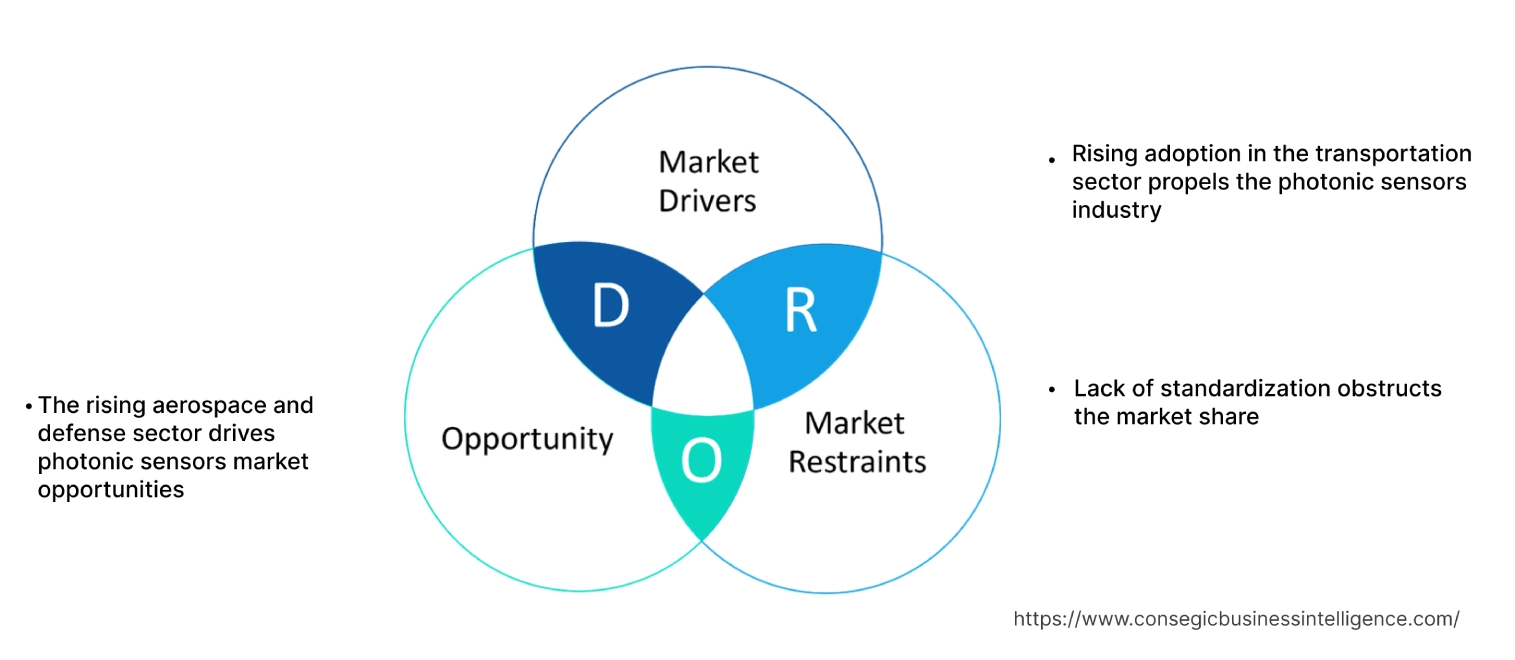
Key Drivers:
Rising adoption in the transportation sector propels the photonic sensors industry
Photonic sensors are gaining traction in the transportation industry due to their high sensitivity, fast response times, and enhanced measurement capabilities. These sensors utilize light to detect physical changes, such as strain, temperature, and pressure, with minimal interference from electromagnetic noise. In transportation, they offer benefits such as enhanced safety, real-time monitoring, and improved efficiency, particularly for vehicle diagnostics, infrastructure health monitoring, and autonomous systems. Their ability to operate in harsh environments and provide precise measurements makes them essential for advancements in vehicle automation and predictive maintenance.
- In July 2021, Samsung launched ISOCELL Auto 4AC an optical sensor for advanced automotive applications such as capturing images from different positions in vehicles.
Key Restraints :
Lack of standardization obstructs the market share
Varying specifications, communication protocols, and compatibility issues among different optical sensor systems create obstructions for widespread adoption across industries. This irregularity complicates integration into existing infrastructure, leading to increased costs and complexity for manufacturers.
Furthermore, the absence of standards slows down the development of global markets and impedes the scalability of optical sensors, limiting their potential impact. Therefore, the lack of standardization restrains the photonic sensors market trends.
Future Opportunities :
The rising aerospace and defense sector drives photonic sensors market opportunities.
Optical sensors offer advantages like enhanced accuracy, lightweight design, and resilience to harsh environmental conditions, making them ideal for applications in navigation, surveillance, and threat detection. As defense and aerospace companies prioritize advancements in autonomous systems and mission-critical equipment, demand for reliable, cutting-edge optical sensor solutions is set to rise, further driving innovation and market expansion in this segment.
- For instance, in November 2024, Xavveo, an autonomous vehicle sensor producer, raised USD 8.6 million to develop a photonic radar system.
Thus, the analysis states that the growing investments in aerospace and defense drive the photonic sensors market opportunities.
Photonic Sensors Market Segmental Analysis :
By Product:
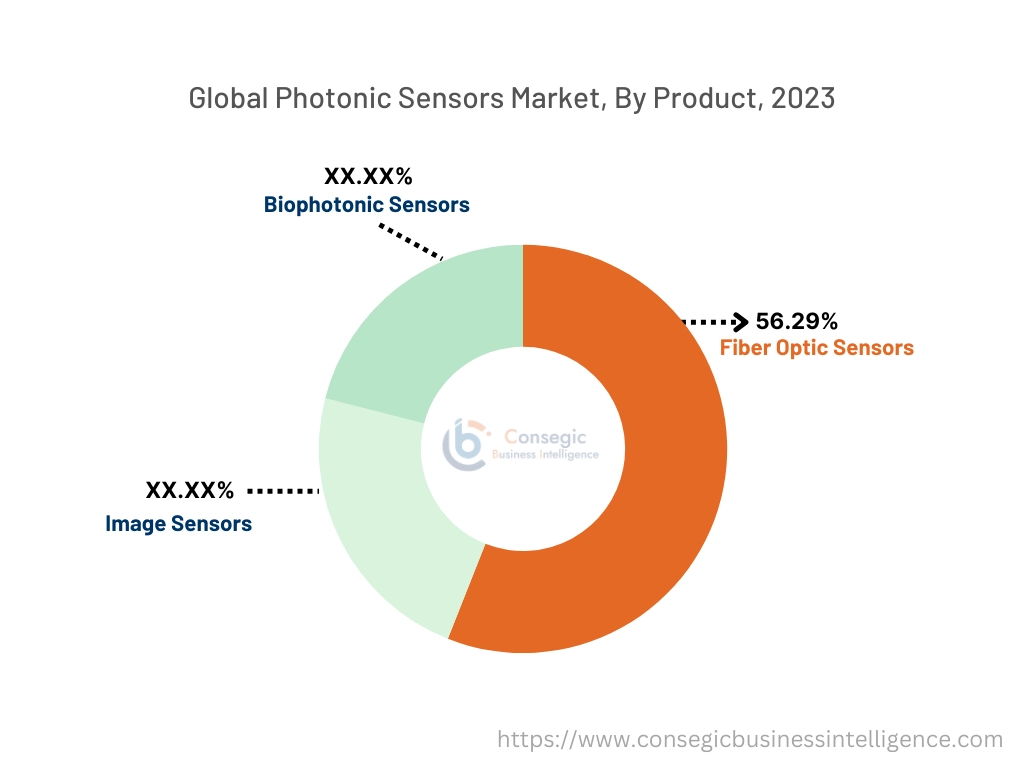
Based on the product, the market is segmented into fiber optic sensors, image sensors, and biophotonic sensors.
Trends in the product:
- The increasing trend for high-resolution images, low power consumption, and compact size are driving the shift toward image sensors in various applications.
- Image sensors are increasingly being integrated with artificial intelligence and machine learning capabilities to enhance image processing.
The fiber optic sensor accounted for the largest revenue share of 56.29% in 2023.
- Fiber optic sensors are devices that use light transmission through optical fibers to measure physical parameters like temperature, pressure, and strain.
- It offers high sensitivity, immunity to electromagnetic interference, long-distance sensing capability, and durability in harsh environments.
- They are commonly used in structural health monitoring, aerospace, oil and gas, healthcare, and environmental monitoring for precise, real-time data collection.
- In March 2021, Project44 acquired Ocean Insights, a photonics sensor provider, to improve tracking abilities by integrating it with Projet44’s platform and ecosystem.
- In conclusion, the analysis states that the rising investments in the fiber optic sensors segment are driving the photonic sensors market demand.
The biophotonic sensor is anticipated to register the fastest CAGR during the forecast period.
- Biophotonics sensor uses light-based technology to detect and analyze biological samples at a molecular level.
- They provide high sensitivity, non-invasive analysis, and real-time monitoring, and are capable of detecting low concentrations of biomolecules.
- It is widely used in medical diagnostics, drug development, disease detection, and others.
- In October 2023, Hamamatsu Photonics, a sensor producer, launched H10682-110W which is a highly sensitive photon-counting sensor for blood testing.
- Thus, the rising advancements associated with biophotonic sensors drive the growth of the photonic sensors market size.
By End-User:
Based on end-users, the market is segmented into aerospace and defense, transportation, manufacturing, healthcare, and energy and power.
Trends in the End User:
- Manufacturers are integrating fiber optic sensors and photonic solutions to enable real-time monitoring and maintenance to reduce downtime.
- Biophotonic technologies are being utilized to develop accurate point-of-care diagnostic devices for diseases and infections.
The transportation segment accounted for the largest revenue at x% of the overall photonic sensors market share in 2023.
- The transportation segment is the largest market for photonic sensors, which utilize light-based sensing for data collection and monitoring.
- It offers high accuracy, fast response, and resilience in challenging conditions, enhancing safety and efficiency.
- They are widely used for vehicle diagnostics, infrastructure monitoring, autonomous navigation, and traffic management.
- In May 2022, ST launched a second-generation optical sensor for driver monitoring systems in autonomous vehicles, which is affordable and reliable for safety systems.
- Therefore, the rising advancements associated with sensors for application in the transportation sector are driving the photonic sensors market size.
The aerospace and defense is anticipated to register the fastest CAGR during the forecast period.
- The aerospace and defense sector is a key end-user of photonic sensors, leveraging them for precision measurement and monitoring in critical environments.
- They provide high sensitivity, resistance to electromagnetic interferences, and durability in extreme conditions.
- It is commonly used in navigation systems, surveillance, threat detection, and structural health monitoring.
- For instance, Teledyne Technologies acquired the aerospace and defense businesses of Excelitas Technologies for USD 710 Million in 2024, which includes the optical systems business as well.
- In conclusion, the rising investments in the aerospace and defense sector for precision measurement and durability are driving the photonic sensors market trends.
Regional Analysis:
The regions covered are North America, Europe, Asia Pacific, the Middle East and Africa, and Latin America.
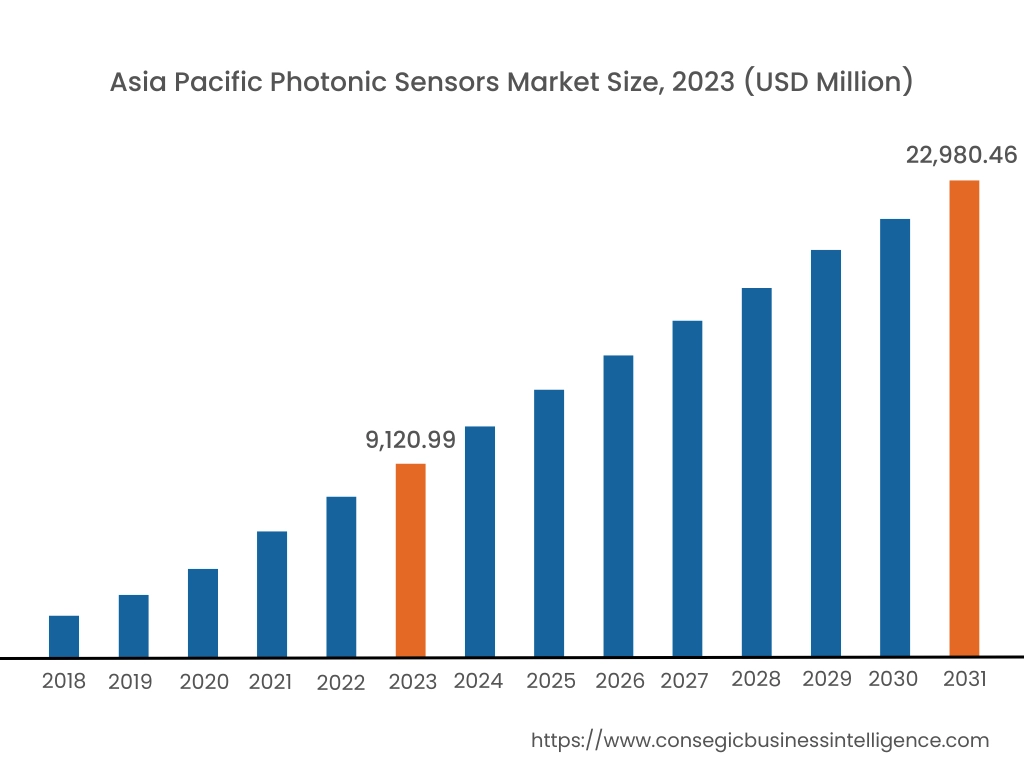
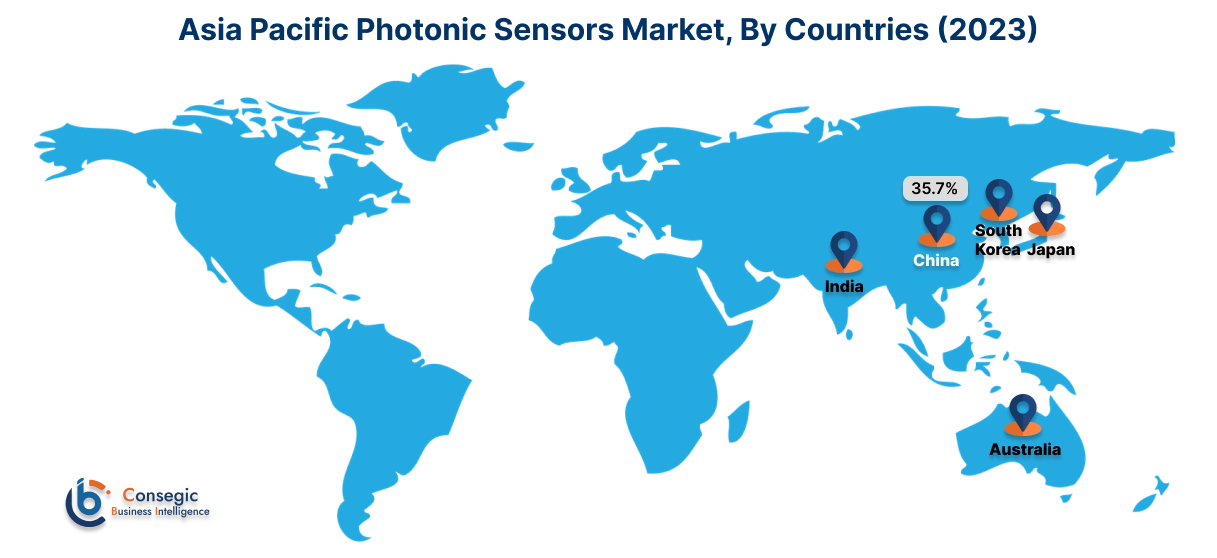
Asia Pacific region was valued at USD 9,120.99 Million in 2023. Moreover, it is projected to grow by USD 10,146.58 Million in 2024 and reach over USD 22,980.46 Million by 2031. Out of this, China accounted for the maximum revenue share of 35.7%. As per the photonic sensors market analysis, factors such as increasing requirement for enhanced security solutions and rising trend of wireless sensing technology in manufacturing, particularly in countries like China, India, and Japan, are further driving the growth. The rapid digitalization and rising requirement for real-time monitoring and maintenance for industries including manufacturing, transportation, and telecommunications, further accelerate the photonic sensors market expansion.
- According to Trading Economics, manufacturing production in China has seen a growth trajectory of 5.2 percent as compared to 2023, which in turn driving the trend.
North America is estimated to reach over USD 18,664.30 Million by 2031 from a value of USD 7,512.28 Million in 2023 and is projected to grow by USD 8,347.00 Million in 2024. The growth is driven by the increasing demand for automation in various industries such as automotive and industrial manufacturing for scalability and flexibility of the infrastructures. The rising government initiatives are further driving the adoption of photonic sensors, in turn contributing to the photonic sensors market growth.
- According to the International Organization of Motor Vehicle Manufacturers (OICA), 1.7 million vehicles were produced in the U.S., which is an increase of 6 percent compared to 2022, in turn driving the demand for photonic sensors.
The regional photonic sensors market analysis depicts that the increasing investments in Europe's energy sector is stimulating the trend and driving the photonic sensors market expansion. The primary factor driving the photonic sensors market demand in the Middle East and African region is the rising investments in the manufacturing industry. The increase in advancement of sensor technology, required for healthcare monitoring systems, is accelerating the growth of the photonic sensors market share in the Latin America region.
Top Key Players & Market Share Insights:
The photonic sensors market is highly competitive with major players providing services to the national and international markets. Key players are adopting several strategies in research and development (R&D), product innovation, and end-user launches to hold a strong position in the global photonic sensors market. Key players in the photonic sensors industry include -
- Honeywell International Inc. (US)
- Smart Fibres Ltd. (UK)
- OMRON Corporation (Japan)
- Samsung Electronics Co. Ltd (South Korea)
- Oxsensis Ltd (UK)
- A2 Photonic Sensors (France)
- Mitsubishi Electric Corporation (Japan)
- Baumer Holdings AG (Switzerland)
- Toshiba Corporation (Japan)
- Dongbu HiTek Co. Ltd. (South Korea)
Recent Industry Developments :
Product Launches:
- In September 2024, Sentea, a producer of advanced optical fiber sensor solutions, launched FBG (Fibre Bragg Grating) fiber sensor interrogator-on-chip with the inbuilt light source.
Photonic Sensors Market Report Insights :
| Report Attributes | Report Details |
| Study Timeline | 2021-2034 |
| Market Size in 2034 | USD 90,972.36 Million |
| CAGR (2026-2034) | 11.80% |
| Base Year | 2025 |
| By Product |
|
| By End-User |
|
| By Region |
|
| Key Players |
|
| North America | U.S. Canada Mexico |
| Europe | U.K. Germany France Spain Italy Russia Benelux Rest of Europe |
| APAC | China South Korea Japan India Australia ASEAN Rest of Asia-Pacific |
| Middle East and Africa | GCC Turkey South Africa Rest of MEA |
| LATAM | Brazil Argentina Chile Rest of LATAM |
| Report Coverage |
|
Key Questions Answered in the Report
How big is the Photonic Sensors Market? −
Photonic Sensors Market size is estimated to reach over USD 65,100.46 Million by 2031 from a value of USD 26,741.24 Million in 2023 and is projected to grow by USD 29,661.73 Million in 2024, growing at a CAGR of 11.8% from 2024 to 2031.
What specific segmentation details are covered in the Photonic Sensors market report? +
The photonic sensors market report includes specific segmentation details for product, end-user, and region.
Which is the fastest segment anticipated to impact the market growth? +
In the product segment, the biophotonics sector is the fastest-growing segment during the forecast period.
Who are the major players in the Photonic Sensors market? +
The key participants in the Photonic Sensors market are Honeywell International Inc. (US), Smart Fibres Ltd. (UK), Mitsubishi Electric Corporation (Japan), Baumer Holdings AG (Switzerland), Toshiba Corporation (Japan), Dongbu HiTek Co. Ltd. (South Korea), A2 Photonic Sensors (France), OMRON Corporation (Japan), Samsung Electronics Co. Ltd (South Korea), Oxsensis Ltd (UK).
Overview
Reputation & Certifications


Our Services
- Market Intelligence & Forecasting
- Custom Research Solutions
- Market Entry Strategy
- Competitive Intelligence
- Customer Insights
- Industry Innovation Analysis
- Investment Advisory