Jump to Content
Portable Consumer Electronics Market - Size, Share, Industry Trends, and Forecasts (2025 - 2035)
Portable Consumer Electronics Market Scope & Overview
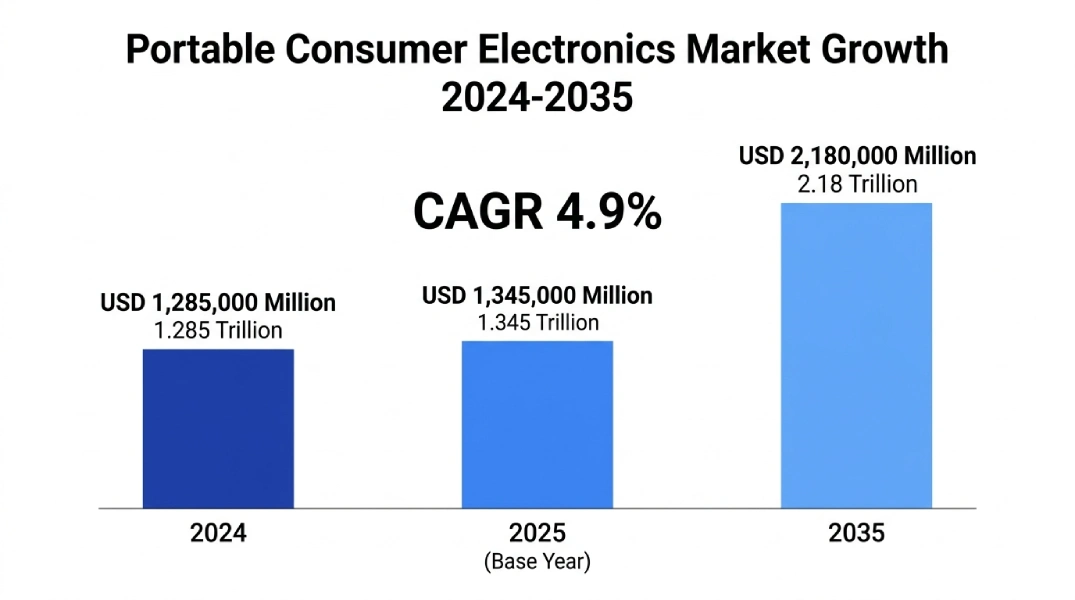
The worldwide portable consumer electronics market is an active and technologically advanced sector of the consumer technology industry which includes various categories of battery-powered, mobile electronics to be used by individuals such as smartphones, tablets, laptop computers, smart watches and fitness trackers, wireless earbuds and headphones, portable game consoles, e-readers, digital cameras, portable speakers, and power banks, with sustained innovation in miniaturization, processing capabilities, the inclusion of artificial intelligence, battery technology, wireless connectivity, and the design of user interfaces. The market is estimated to be USD 1,285,000 Million in 2024 and USD 1,345,000 Million in 2025 (base year) and it is projected to be expanded significantly to USD 2,180,000 Million in 2035. This growth trend is an expression of a compound annual growth rate (CAGR) of 4.9% over the forecast period of 2026 to 2035 due to revolutionary artificial intelligence integration that will enable on-device generative capabilities, the proliferation of 5G and emerging 6G connectivity, growing middle-class consumers in emerging markets, the integration of ecosystems generating multi-device household adoption, wearables and hearables demonstrating unusual growth trends, foldable and flexible display technology commercialization, and the convergence of computing, communication, entertainment, and health monitoring capabilities within more
The portable consumer electronics has radically changed the contemporary society by being the keyplace generator of interface between the consumer and digital ecosystems comprising applications, cloud-based services, content platforms, payment systems, and IoT ecosystems. The global penetration of smartphones has been 78 percent of the world population (or about 6.2 billion users in 2024) with the shift to portable-based computing being the norm in the personal computing market with laptop computers accounting 68 percent of overall PC shipments and tablet computers occupying their own niche with 580 million active users worldwide. Wearable technologies are showing unprecedented growth, with smart watch shipments going over 185 million units per year and wireless earbuds shipments hitting 475 million units per year as consumers have started to adopt always-connected, health-tracking, and audio-oriented portable devices to complete their smartphone ecosystems.
There is tremendous technological sophistication in the market, the flagship smartphones have advanced semiconductor technology with process technologies of 3-nanometers and over 16 billion transistors, feature multi-camera systems with computational photography algorithms, 120Hz display technologies, 5G modem systems with wireless speeds up to multi-gigabits, neural processing units (NPUs) with 15-35 trillion operations per second (TOPS) and battery capacities of 4,000-5,000 mAh which allows the phones to run full As of 2024, the installed base of smartphones is over 7.2 billion, tablets are over 1.6 billion, laptops are over 1.4 billion, wearables and hearables are over 1.3 billion and portable gaming and AR/VR devices are over 450 million.
Key Market Insights
- The portable consumer electronics market is projected to grow from USD 1,345,000 million in 2025 to USD 2,180,000 million by 2035, registering a CAGR of 4.9% (2026–2035)
- The market includes smartphones, tablets, laptops, smartwatches, wireless earbuds, portable gaming devices, cameras, and power banks, driven by continuous innovation in AI, battery technology, and wireless connectivity
- Smartphone adoption is very high, reaching about 78% of the global population (around 6.2 billion users), making it the core device in the digital ecosystem
- Wearables and hearables are rapidly growing, with smartwatch shipments exceeding 185 million units and wireless earbuds around 475 million units annually
- Growth is supported by AI integration, 5G/6G connectivity, expanding middle-class consumers in emerging markets, and multi-device ecosystems
Market Channel Distribution Analysis:
The portable consumer electronics market is led by four different distribution channels to the various customer segments that have varied purchasing behaviors, service expectations and value propositions. The overall market revenue allocation reveals a high level of channel type, product and regional market market variability:
Distribution Channel Breakdown (2025):
- Online Retailers and E-Commerce platforms: USD 524,550 Million (39.0% of the overall market value)
- Store Retail and Direct Sales: USD 349,700 Million (26.0% of market revenue)
- Retailers Multi-Brands Electronics: USD 308,050 Million (22.9% Market share)
- Other Channels (Telecom Carriers, Department Stores, Wholesale): USD 162.700 Million (12.1 of total market value)
In 2024, the research and development of portable consumer electronics worldwide is USD 185,000 Million, with Apple, Samsung, Huawei, Xiaomi, Qualcomm, and MediaTek (the biggest companies in the technology sector) allocating about 6.5-8.5 percentage of revenue to research and development of their products to meet the needs of the next generation with next-generation semiconductor design with 2-nanometer and 1-nanometer design process, advanced battery chemistry including solid-state research, artificial intelligence processors and N
It is the paradigm shift of the industry towards ecosystem integration and AI-first computing, where major manufacturers are building up extensive product portfolios that are designed to work interoperatively with each other. The move to AI-native and ambient computing makes portable devices the center of AI assistant, cross-device continuity, and spatial computing experiences, and cellular-enabled devices open the prospect of subscription-based services generating recurring revenue streams that can be added to the existing hardware sales.
Portable Consumer Electronics Market Dynamics (DRO)
Key Drivers:
AI Implementation and In-Device Processing Revolution.
This is because the most influential technological push is the fast adoption of artificial intelligence and machine learning functions into portable devices and changing how they will work as mere execution of simple tasks to intelligent assistance, predictive behavior, and autonomous optimization. Advanced smartphones include neural processing units (NPUs) (15-35 trillion operations per second (TOPS)) to support advanced on-device AI applications such as real-time language translation in 100+ languages, computational photography with scene optimization and image removal, natural language understanding in voice assistants, generative AI to create content, and personalized recommendations even without a cloud connection.
Incorporation of generative AI applications is the next stage, including real-time image generation, intelligent writing help, automated content generation, intelligent personal assistants, and customized learning experiences that produce attractive upgrade incentives to the point of making a market saturated. Already, processors with improved NPU functionality tailored to on-device execution of large language models have been introduced by leading chipmakers such as Qualcomm Snapdragon 8 Gen 3, Apple A18 Pro, and MediaTek Dimensity 9300 and indicate a shift toward the positioning of AI-first devices.
5G Network Proliferation and Next Generation Connectivity.
The implementation of 5G cellular networks around the world opens revolutionary opportunities to portable devices, with 5G subscriptions surpassing 1.9 billion globally as of 2024 and an estimated 5.6 billion subscriptions by 2029 representing 60 percent of all mobile subscriptions, 5G networks will provide high download speeds of 1-10 Gbps, low latency of less than 10 milliseconds, and support of 1 million devices per square kilometer, allowing the use of 5G networks in revolutionary applications such as cloud gaming with
The shift to 5G stimulates device replacement in the market, 5G-compatible smartphones will be 58% shipped in 2024 versus 19% in 2020, and 5G will unlock the new category of devices (such as 5G-connected laptops and 5G-enabled tablets with cellular access being a standard feature) and the new category of wearables (no smartphone dependency necessary to access the network and communicate and do apps).
Wearables and Hearables Ecosystem Growth.
Wearables such as smartwatches and fitness trackers and coupled with wireless earbuds and headphones are showing the best growth market segment at 9.5% CAGR, due to increasing health monitoring features, convenience factors and integration with the ecosystem. The total revenue of wearables and hearables will hit USD 188,300 Million in 2025, expected to surpass USD 300,000 Million in 2035, due to the adoption of always-connected health and audio companions by consumers.
The new wearables include all of the features of modern wearables such as heart rate variability, ECG, blood oxygen saturation, sleep staging analysis, and stress monitoring with electrodermal activity sensors, skin temperature, and emerging features of blood pressure estimation and blood glucose monitoring with advanced optical sensors. Apple Watch holds 36 percent of market share in smartwatch and charges high prices, offering medical certifications that allow FDA-approved atrial fibrillation detection and ECG.
Expansion in the Middle-Class and the Growth of the emerging markets.
The high growth in the market is due to the growth of the middle-class segments in the emerging economies especially in Asia-Pacific, Latin America and Africa as the population acquires disposable incomes and decisions to purchase the devices at reduced prices creating first-time buyers as well as multi-device household consumers. As in 2024, the global middle class numbered over 3.5 billion, forecasts suggest it will rise to 5.3 billion in 2030, in which 88 percent of the growth is concentrated in the Asia-Pacific region.
Smartphone penetration in major emerging markets indicates that there is a huge headroom, with nations such as India (smartphone penetration 54%), Indonesia (68%), Philippines (62%), Nigeria (48%), and Brazil (71%) having high growth opportunities as 4G and 5G network coverage spreads, and devices prices drop as a result of stiff competition among Chinese vendors such as Xiaomi, OPPO, and Vivo, as well as Realme, which provide feature-rich devices at USD 150-300 prices to reach mass-market.
Key Restraints:
Saturated Markets and Long Replacement Periods in the developed markets.
The greatest market constraint is created through the saturation of the smartphone market in developed economies where 85-95 penetration levels are exhibited coupled with a long replacement cycle of the devices as the technological advances offer a decreasing marginal utility to the average consumer. The replacement cycles of Smartphones in the developed markets are now 36-42 months as opposed to 24-30 months in the past as the camera quality, processing power, and display technology in Smartphones has been marginal enough to warrant the replacement expenses of USD 700-1,200 of the premium Smartphones.
The highest smartphone shipments of 1.46 billion units were reported in 2016, and it is now estimated at 1.17 billion units in 2023-2024, which can be explained by the maturity on the market and increased duration of ownership. The saturation effect generates issues for manufacturers who rely on volume growth, leading to a move towards services revenues, ecosystem lock-in, high-end segment focus and entering adjoining categories such as wearables and hearables that exhibit superior growth patterns.
Components Supply Chain Vulnerabilities and Geopolitical Tensions.
The portable electronics market has been exhibiting a high degree of susceptibility to supply chain risks on essential products such as semiconductors, displays, batteries and rare earth elements with production being centralized in certain geographic areas that exposes the market to geopolitical risks. The 2020-2022 world semiconductor crisis proved the industry fragility whereby the shortage of chips limited the production of devices and led to a rise in prices, and U.S.-China technology tensions created a back of uncertainty in component availability and market access.
About three-quarters of the smartphone production, 85 percent of the laptop computers, and 90 percent of the tablets are produced in the Asia-Pacific region, mainly China with intricate supply chains, involving more than one country, to source components, making it susceptible to trade disputes, regulatory changes, and regional upheavals to continue operations and cost structures.
Sustainability Pressures and Environmental Regulations.
The increasing regulatory provisions with respect to electronic waste, planned obsolescence and environmental sustainability pose compliance issues and cost burden to manufacturers. The Right to Repair initiative by the European Union, the introduction of USB-C, and new demands regarding removable batteries and extended software support timelines raise the cost of manufacturing but may decrease the possibility of flexibility of design and differentiation of products.
The world e-waste creation was 53.6 million metric tons in 2024, with portable electronics contributing significantly, which would impose regulatory strains on the extended producer responsibility programs, design to recycle-ability aspects, and circle economic endeavors to solve environmental issues but may also raise the price and complexity of products.
Future Opportunities:
Foldable and Flexible Display Technology Mass Market.
Foldable tablets and phones offer a high level of innovation opportunity, whereby the devices with flexible OLED displays have a compact form factor, which can be expanded to tablet dimensions once unfolded. Foldable smartphone devices reached 19.5M unit shipment in 2024 with a nascent base CAGR of 45% and major brands Samsung, Huawei, OPPO, and Motorola delivering a wide variety of form factors such as book-style folds, clamshell folds, and threefold folds.
With further improvements in manufacturing yields and decreased component costs, foldable devices might reach mainstream usage by 2028-2030 timeframe, with the cost falling to USD 600-900 range that fits in a wider range of consumer groups, and offer a refreshing change to the mature smartphone market with its differing user experiences that combine smartphone portability with tablet functionality.
Integration of Augmented Reality and Spatial Computing.
A combination of portable technology with augmented reality brings a paradigm shift of opportunity in regard to new forms of interaction and category of applications. State-of-the-art smartphones add LiDAR scanners, high-resolution depth cameras, and AR systems that allow a user to access applications such as virtual furniture placement, navigation overlay, educational experiences, and games that combine digital and real worlds, with dedicated AR glasses being an emerging category that may eventually be used to supplement, or even replace smartphones in some situations.
Ecosystems Health and Wellness Monitoring Ecosystem Expansion.
Wearables are no longer fitness tracking gadgets but all-in-one health tracking platforms, and medical-grade measurements have been designed to track ECG, blood oxygen levels, blood pressure, and new non-invasive glucose monitoring using advanced optical sensors, depending on regulatory approvals. The world digital health market will reach USD 295,000 Million in 2024, which poses a significant potential to portable devices as the main health monitoring devices, especially in chronic disease management, preventive care applications, and the integration of the portable device into healthcare provider systems to allow remote patient monitoring and early intervention programs.
Market Segmentation Analysis
By Product Category: Device Type Analysis
Smartphones: Strong Market leaders.
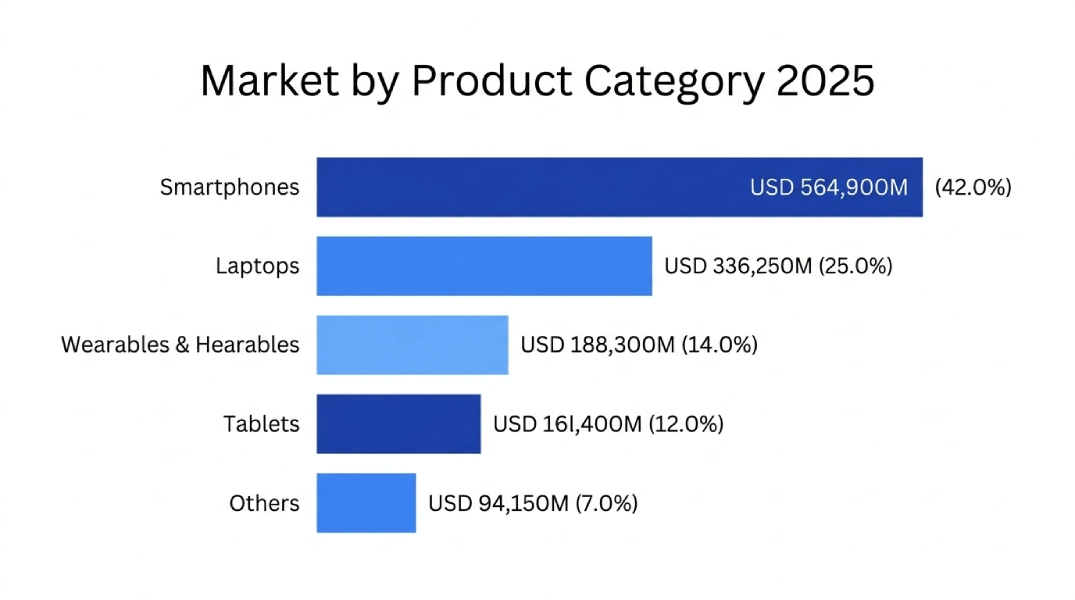
Smartphones have strong market leadership at USD 564,900 Million or 42.0 of the total market value in 2025, which is expected to be USD 915,600 Million in 2035 with a 4.9 percent CAGR. Although the smartphone market is becoming mature in developed economies, it continues to be the heart of the personal technology ecosystem and innovation in camera systems incorporates computational photography, display technology with 120Hz OLED screens, processing capabilities with 3-nanometer chips, AI capabilities with neural processing units, and connection capabilities with 5G, keeping consumer demand and the high-end segment growing.
The smartphone market in the world is very segmented with the premium phones (>USD 600) taking 22% of the unit shipments but 58% of the revenue with the mid-range phones (USD 200-600) being 48% of the units though only 32% of the revenue and the entry-level phones (USD 200) making 30% of the units but 10% of the revenue. This distribution shows a high level of profitability concentration in the segment of premium segment dominated by Apple (48% of premium market) and Samsung (32%), with Chinese makers, such as Xiaomi, OPPO, and Vivo, playing a fierce battle in the middle of the price range and entry-level market.
Laptop Computers: Work and Education Necessity.
The laptop computers capture USD 336,250 Million (25.0% of market value) of the market value meeting the professional, educational and personal computing requirements with a form factor of as small as 13-inch weighting less than 2.5 pounds to mobile workstations with form factor of 17-inch and desktop-performance. The COVID-19 crisis drove the use of laptops as a means of remote work and study, and the market is expected to stabilize at high levels as the hybrid work structure is maintained and education establishments retain digital educational facilities.
Tablets: Content Consumption and Creativity Platform.
Tablet is USD 161,400 Million (12.0% of market value), with its own separate space between smartphones and laptops as a content consumption, digital art creation, note-taking, and educational tools. Apple iPad has 38% of the market share with high-end models with embedded M-series processors that provide the performance of laptops in tablet form factors, and Android tablets cater to the middle and low-end markets with Google and Samsung as the major Android platforms.
Wearables and Hearables: Fastest Growing Segment
The wearables such as smartwatches and fitness trackers, alongside the wireless earbuds and headphones, have USD 188,300 Million (14.0% of market value) that is increasing at 9.5% CAGR due to the ability to monitor health, convenient features and integration with ecosystems. Apple Watch dominates 36% of smartwatch market and AirPods dominates wireless earbud market with 28% share, with an all-inclusive health monitoring, calls and data, and flawless ecosystem making premium placement.
Other Portable Electronics
Other products such as handheld gaming consoles, e-readers, digital cameras, and portable speakers add up to USD 94,150 Million (7.0% of market value), and specific usage can be found in Nintendo Switch continuing to lead portable gaming, Amazon Kindle continuing to dominate the e-reader market, and dedicated cameras to meet the needs of professional and amateur photographers needing more than what smartphone cameras can offer.
By Price Segment Analysis
Premium Segment (>USD 600): Concentration of Profitability.
Premium products generate USD 564,900 Million (42.0% of market value) based on only 18-22% of unit volumes indicating a high level of concentration in profits, and consumer response as to high-end devices due to advanced features, brand status, integration into the ecosystem and extended lifespan of the device through high-end construction and extended software support.
Mid- Range Segment (USD 200-600): Volume Growth Driver.
Mid-range gadgets (a full USD 511,200 Million or 38.0 percent of market value) have strong feature bundles such as 5G connectivity, multiple-camera arrays, OLED displays, sufficient AI processing units and high-end design elements at affordable prices that have propelled their volume in the new markets and affordability upgrades of consumers of low-end devices in the developed markets.
Entry-level Segment (Less than USD 200): Market Access.
At USD 268,900 Million (20.0% of the market value) entry-level devices are used by price-sensitive customers, and by first-time buyers in the emerging economies to provide them with basic features such as 4G connectivity, rudimentary camera systems, sufficient performance to support communication and simple applications to make smartphones usable across a broad range of economic markets.
Regional Market Analysis
Asia-Pacific: Manufacturing Center and the largest market.
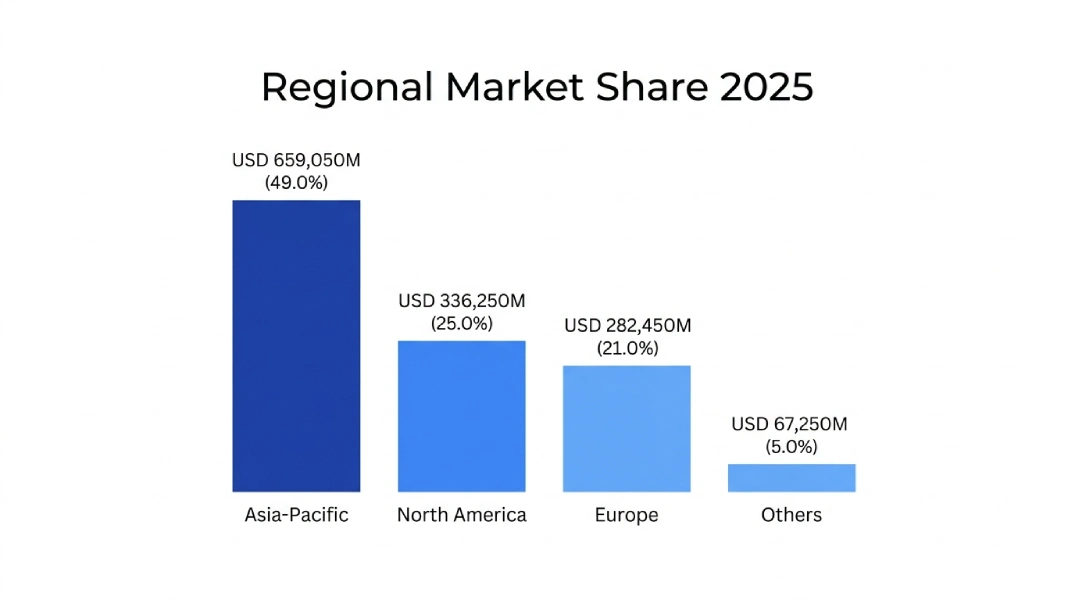
Asia-Pacific portable consumer electronics market has USD 659, 050 Million market value of USD 49.0% of the global market value and is expected to grow to USD 1,068,200 Million by 2035 at 5.0% CAGR. China both controls regional demand at 48.5% of market value, both as the large consumption market of 1.4 billion population and the fast-growing middle market, as well as the manufacturing hub of about 75 percent of smartphone output, 85 percent of laptop computers, and 90 percent of tablets to supply the global market.
India has 18.0% of market value in Asia-Pacific, which is an outstanding growth potential with smartphone penetration of 54% with vast room of expansion, young population with median age of 28 years, and government policies such as Make in India and Digital India facilitating the domestic manufacturing and technology adoption. The smart phone market in the country has had 12-15% annual growth due to the first-time buyers, the need to replace features phones, and the increasing 4G/5G network coverage into rural country.
The southeast Asian countries such as Indonesia, Vietnam, Thailand and Philippines are also 22.0% market value in the region with robust demography such as youthful population, urbanization process, increasing mid-level market consumption and the presence of digital infrastructure facilitating the adoption of e-commerce and the implementation of digital payment systems that allow easy acquisition of devices.
North America: Leader of Innovations and high end market.
In 2025, the North American portable consumer electronics market captured USD 336,250 Million of the total global market value (25.0 percent), and is expected to experience growth to USD 523,600 Million at 4.5 percent CAGR by 2035. United States, at 89.0 percent of regional demand, has been one of the most prolific spenders on electronics with an annual spending of approximately USD 1,250 each person and high preference on higher end devices with Apple iOS holding 58 percent of the smartphone market share compared to the 28 percent in the rest of the world.
Technological leadership has been demonstrated by the presence of Apple, Intel, Qualcomm and NVIDIA companies that drive innovation in the processors, connectivity, graphics technologies and AI frameworks, and have well-developed retail platforms such as Apple Stores, Best Buy, and fully-developed e-commerce platforms that enable customers to conveniently purchase and receive extensive after-sales support such as technical support and device protection programs.
Europe: Sustainability Leadership and Quality Focus.
European portable consumer electronics market has the highest market value of USD 282,450 Million in 2025 with projections of growth to USD 436,000 Million in 2035 at 4.4% CAGR. Germany is 22.0 percent of the regional market worth, and the United Kingdom has 19.0 percent and France 18.0 percent and the other European countries make up 41.0 percent of the regional demand.
European market has particular features such as the presence of a robust regulatory environment with the help of EU directives such as the Right to Repair, USB-C standardization and data privacy (GDPR), consumer focus on quality and durability rather than on frequent replacement, and sustainability leadership, such as extended producer responsibility, recycling programs, and the principles of the cyclical economy that impact the industry globally and influence the development of new materials and design strategies.
Other Regions
Latin America has USD 40,350 Million (3.0% of world market), top countries being Brazil and Mexico, which are strong in terms of growing middle-class populations and increasingly strong digital infrastructure, and Middle East and Africa with USD 26,900 Million (2.0%), which is showing signs of growth due to the growing coverage by mobile network and the decreasing device prices and government digitisation efforts supporting technology adoption across various economic segments.
Competitive Landscape and Key Market Players
Market Leadership and Strategic Positioning
Apple Inc. (United States)- Leader of the Premium Ecosystem.
Apple is a leader in the high-end market with projected 2024 revenue of portable electronics of USD 285,000-310,000 Million, which includes iPhone (USD 195,000 Million), iPad (USD 29,000 Million), Mac (USD 35,000 Million), and Wearables/Accessories (USD 38,000 Million). The company has a premium positioning with average selling prices of over USD 900 per unit, which is 18% of the world smartphone revenue with the 16% unit share.
Apple has a competitive strength through vertically integrated hardware-software ecosystem, proprietary silicon design, comprising A-series and M-series processors and offering industry leader performance per watt, holistic services platform with USD 85,000 Million annual revenues, customer satisfaction ratings of over 95% and customer retention rates of over 90% that generate strong ecosystem lock-in effects and recurring revenue opportunities.
Samsung Electronics (South Korea) - Diversified Innovation Leader.
Samsung has the greatest market share of 19-21% across all types of portable electronics with projected revenue of USD 145,000-165,000 Million, dominates Android smartphone segment with 21% global market share, has 80% market share in foldable devices, 18% market share in tablet market, and 11% market share in smartwatch. Some of the competitive advantages that the company has are vertical integration in manufacturing of semiconductors, display manufacturing, memory printing and supplying components to allow the company to enjoy cost leadership and technology.
Xiaomi Corporation (China) - Value and Ecosystem Enlargement.
Xiaomi has a global market share of about 12-13% of smartphone market through aggressive pricing and growing IoT system, USD 45,000-55,000million estimated revenue in 2024 with smartphones, laptops, wearables, and smart home devices. The Smartphone x AIoT strategy of the company promotes smartphone as the center of the entire ecosystem of connected tools such as power banks, scooters, air purifiers, smart home appliances, as a strategy to create customer retention in the ecosystem.
Other Important Market players:
- Lenovo Group Limited (China/Hong Kong) - The world leader in the PC market with 24 percent share, ThinkPad and Yoga portfolios.
- HP Inc. (United States) 21 percent PC market share, commercial and consumer leadership in laptops.
- Dell Technologies (United States) - 17% PC market share, enterprise market,direct sales model.
- OPPO and Vivo (China) - 18-20% smartphone share, good new market presence.
- Huawei Technologies (China) - The high-end smartphone and laptop producer, the development of the HarmonyOS ecosystem.
- Amazon (United States) - domination in the e-reader market (Kindle), increasing penetration of tablets and smart speakers.
Recent Industry Developments
On-Device Processing and Artificial Intelligence Integration (2024-2025)
Large companies released AI-based smartphones and PCs with advanced neural processing units to support generative AI on the device. Context-aware support, writing functionality, image recognition, and real-time language translation are available in Apple Intelligence integrated between iPhone, iPad, and Mac, whereas Samsung Galaxy AI provides live translation, photo editing, productivity options, and health insights, which are essential steps towards AI-first positioning of devices and developing compelling upgrade programs.
Diversification Portfolio Expansion and Enduring Routine (2024-2025)
Major producers increased the range of products in the foldable devices with higher durability and lower costs. Samsung released Galaxy Z Fold 6 and Z Flip 6 with more advanced hinge systems and minimized creases, Google released Pixel Fold with integration throughout the Android ecosystem, and Motorola released Razr 50 series with more focused consumer penetration and prices dropping to USD 800-1,000 levels.
Innovation Research Areas Advanced Semiconductor Manufacturing and Performance Breakthroughs (2024-2025)
The leaders in the industry, such as Apple (A18 Pro), Qualcomm (Snapdragon 8 Gen 3), and MediaTek (Dimensity 9300) showed processors produced on 3-nanometer and 4-nanometer process nodes, which achieve 20-30% performance improvements, 15-25% power efficiency improvements, and higher AI capabilities than the previous generation, and feature advanced capabilities such as real-time ray tracing, 8K video recording, and on-device large language model execution.
Circular Economy Programs and Sustainability Initiatives (2024-2025)
Large producers launched extensive sustainability strategies, such as Apple products under a carbon-neutral line aiming at achieving 2030, Samsung Galaxy for the Planet with recycled materials, and Dell circular design, addressing the needs of regulatory bodies and the interests of the targeted consumer groups with the production of eco-friendly products and providing trade-ins, refurbishment, and recycled materials as solutions to the problem of e-waste.
Portable Consumer Electronics Market Report Insights
| Report Attributes | Report Details |
|---|---|
| Study Timeline | 2022-2035 |
| Base Year | 2025 |
| Forecast Period | 2026-2035 |
| Market Size in 2025 | USD 1,345,000 Million |
| Market Size in 2035 | USD 2,180,000 Million |
| CAGR (2026-2035) | 4.9% |
| By Product Category | Smartphones (42.0%), Laptops (25.0%), Tablets (12.0%), Wearables & Hearables (14.0%), Others (7.0%) |
| By Price Segment | Premium >USD 600 (42.0%), Mid-Range USD 200-600 (38.0%), Entry-Level |
| By Distribution | Online/E-Commerce (39.0%), Brand Stores (26.0%), Multi-Brand Retailers (22.9%), Others (12.1%) |
| By Region | Asia-Pacific (49.0%), North America (25.0%), Europe (21.0%), Others (5.0%) |
| Key Players | Apple, Samsung, Lenovo, Xiaomi, OPPO, Vivo, HP, Dell, Huawei, Amazon |
| Report Coverage |
|
Key Questions Answered in the Report
What is the size of the Portable Consumer Electronics market? −
The portable consumer electronics market has been characterized by high growth potential, with an annual growth forecast of USD 1,345,000 Million in 2025 and USD 2,180,000 Million in 2035 at 4.9% CAGR representing ongoing growth due to integration of artificial intelligence that will enable users to generate on-device to facilitate on-the-go services and further growth of compelling upgrade cycles, widespread 5G connectivity with subscriptions reaching 5.6 billion by 2029 and making cloud gaming.
What is the most developing sector within the Portable Consumer Electronics market? +
The Asia-Pacific is not only the largest but also one of the fastest-growing regional markets due to the huge consumer base in China, manufacturing dominance in producing 75 percent of the smartphones globally, India with its huge potential growth as the smartphone penetration reaches 54 percent and a median age of 28 years with the creation of a huge headroom of expansion, aggressive competition between Chinese manufacturers producing smartphones with features at USD 150-300, price-sensitive groups, as evidenced by the many government programs, such as Digital India.
What are the most dominant market growth drivers in 2035? +
Micro drivers of growth include incorporation of artificial intelligence with neural processors providing 15-35 TOPS enabling on-device AI features such as computational photography, real-time translation, and generative content creation, the expansion of 5G networks, which enables cloud gaming and AR experiences, IoT coordination between devices, and smart ecosystem integration, integration of artificial intelligence in camera technology, display technology, battery life, and processing power, which keeps consumer interest in the product despite market maturity in developed economies.
What are the obstacles of market growth? +
Some of the challenges are market saturation in developed economies where smartphone penetration is over 85-95% and replacement cycles are over 36-42 months long, creating a volume growth constraint since incremental gains are insufficient to justify USD 700-1,200 replacement costs, the vulnerability of component supply chains, which creates pressure on semiconductors, displays, and batteries with production being concentrated in certain areas, environmental regulation such as the EU Right to Repair directive, USB-C standardization, and removable battery compel many to raise manufacturing costs.
What innovation opportunities are available by 2035? +
The opportunities substantially include foldable and flexible displays, manufacturing advances allowing price reduction to USD 600-900-range, integration of augmented reality, advanced depth cameras and AR frameworks enabling applications merging digital and real worlds, health monitoring expansion with medical-grade measurements including ECG, blood pressure estimation, and non-invasive glucose monitoring with wearable devices creating comprehensive health platforms, generative artificial intelligence, advanced semiconductor manufacturing with 2-nanometer and 1-nanometer manufacturing nodes with significant performance and efficiency gains, sustainable materials and circular economy programs addressing environmental issues.
Overview
Reputation & Certifications


Our Services
- Market Intelligence & Forecasting
- Custom Research Solutions
- Market Entry Strategy
- Competitive Intelligence
- Customer Insights
- Industry Innovation Analysis
- Investment Advisory