Jump to Content
Post Quantum Cryptography Market - Size, Share, Industry Trends, and Forecasts (2025-2035)
Post Quantum Cryptography Market Size:
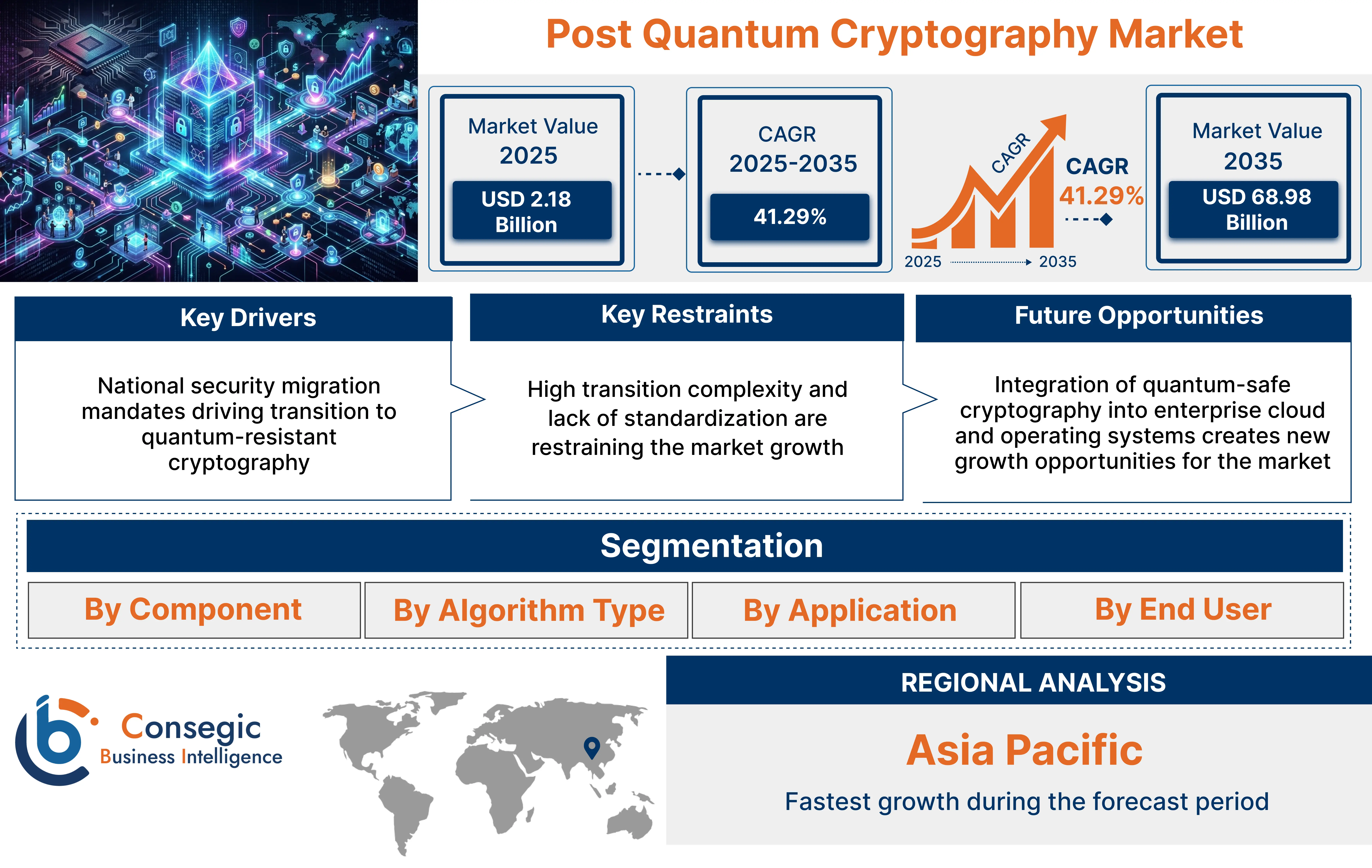
Post Quantum Cryptography Market size is estimated to reach over USD 68.98 Billion by 2035 from a value of USD 1.54 Billion in 2024 and is projected to grow by USD 2.18 Billion in 2025, growing at a CAGR of 41.29% from 2025 to 2035
Post Quantum Cryptography Market Scope & Overview:
Post quantum cryptography can be defined as a set of cryptographic algorithms that have been designed to provide security for digital communications in the face of potential attacks from quantum computers. Such cryptographic algorithms have been designed to provide security for data, networks, and identities in the face of potential attacks from quantum computers. The cryptographic algorithms have been designed for use in banking systems, government systems, healthcare systems, military systems, as well as cloud computing systems.
The market for post quantum cryptography is growing due to the growing need to address the risks associated with quantum computing. Governments and enterprises are preparing for long-term data protection and regulatory compliance. Ongoing research, standardization activities, and inclusion in existing security standards are all contributing to market adoption.
Post Quantum Cryptography Market Size & Forecast
- 2024 Market Size : USD 1.54 Billion
- 2025 Market Size : USD 2.18 Billion
- 2035 Projected Market Size : USD 68.98 Billion
- CAGR (2025-2035) : 41.29%
- Largest Market in 2025 : North America
How is the Post Quantum Cryptography Market Affected by AI?
AI uses machine learning to analyze cryptographic algorithms and identify potential vulnerabilities, which strengthens the development of quantum-resistant encryption methods. Also, AI helps researchers simulate quantum attack scenarios and test algorithm resilience under complex threat models.
Additionally, AI supports faster cryptographic key generation and optimization by processing large mathematical datasets, which improves performance efficiency. Furthermore, AI allows for the automated analysis of threat intelligence, where AI can identify new risks associated with the development of quantum computing. This ensures that appropriate upgrades are made in anticipation of future security threats.
Post Quantum Cryptography Market Dynamics - (DRO):
Key Drivers:
National security migration mandates driving transition to quantum-resistant cryptography
The post quantum cryptography market is expanding due to formal migration requirements issued by national security authorities. Quantum computing advancements present long-term risks to conventional public-key cryptography. As a result, the development of transition frameworks by various government agencies to manage systems that handle classified and sensitive information.
- For example, in May 2025, the National Security Agency updated the transition expectations under the Commercial National Security Algorithm Suite 2.0 document, which deals with the transition towards the adoption of quantum-resistant cryptography.
Therefore, transition frameworks issued by the government are responsible for creating a market for post quantum cryptography solutions.
Key Restraints:
High transition complexity and lack of standardization are restraining the market growth
Post quantum cryptography requires replacing or upgrading existing encryption systems. Many organizations rely on legacy infrastructure. Migration involves system redesign, testing, and validation. This increases cost and implementation time. Global standards are still evolving. Lack of uniform guidelines creates uncertainty for enterprises. Companies hesitate to invest until standards are fully stabilized. Limited technical expertise also slows adoption.
Therefore, high transition complexity and standardization gaps are restraining the post quantum cryptography market expansion.
Future Opportunities:
Integration of quantum-safe cryptography into enterprise cloud and operating systems creates new growth opportunities for the market
The growing risk of future quantum attacks is increasing the need for practical migration to quantum-resistant cryptographic systems. Enterprises are preparing to update encryption protocols across cloud platforms, operating systems, and enterprise applications. The integration of post-quantum algorithms into popular software platforms makes it easier for the deployment and adoption of the technology.
- For example, in August 2025, Microsoft announced advances in the integration of post-quantum cryptography into the Windows and Azure platforms in August 2025 as part of the quantum-safe security strategy, which will facilitate the migration of businesses to quantum-resistant encryption.
Thus, the integration of quantum-safe encryption into popular platforms helps to fuel the adoption and deployment of the technology.
Post Quantum Cryptography Market Segmental Analysis:
By Component:
Based on component, the post quantum cryptography market is segmented into solutions and services.
Trends in the Component:
- The growing threat of cyber-attacks using quantum computing is creating the need for advanced cryptographic solutions.
- The need to prepare for migration planning and cryptographic risk assessment is creating the need for professional service solutions.
Solutions accounted for the largest revenue share in the year 2024.
- Quantum-resistant encryption, secure communication, and key management are some of the cryptographic solutions that protect organizations from future threats.
- Organizations are investing in advanced cryptographic solutions to replace their existing cryptographic infrastructure, which might be vulnerable to future threats.
- In addition, the development of standards for post-quantum cryptographic algorithms is helping to deploy cryptographic solutions
- Furthermore, the increasing trend in the banking, defense, and government sectors is helping to grow the market segment.
- Thus, increasing cybersecurity risks and regulatory initiatives are driving dominance of solutions.
Services are anticipated to register the fastest CAGR during the forecast period.
- Services include consulting, risk assessment, integration, and migration support. They help organizations transition to quantum-safe systems.
- Many enterprises require expert guidance to identify vulnerable cryptographic assets. This supports segment growth.
- Additionally, the complexity of replacing legacy encryption systems is increasing reliance on managed services.
- Further, continuous monitoring and compliance requirements are accelerating service adoption.
- Therefore, as per the market analysis, rising need for migration support and strategic advisory is expected to boost the services segment during the forecast period.
By Algorithm Type:
Based on algorithm type, the post quantum cryptography market is segmented into lattice-based, code-based, hash-based, multivariate, and isogeny-based.
Trends in the Algorithm Type:
- The emphasis on standardizing quantum-resistant algorithms is fueling the market for lattice-based cryptography.
- The requirement to develop more robust digital signature and key exchange mechanisms is boosting the hash-based and code-based cryptography market.
Lattice-Based accounted for the largest revenue share in the year 2024.
- Lattice-based algorithms are widely considered strong candidates for post-quantum security. They support encryption and digital signatures.
- These algorithms offer strong security with relatively efficient performance. This makes them suitable for enterprise deployment.
- Additionally, many standardization bodies have selected lattice-based schemes for quantum-resistant frameworks.
- Further, increasing integration into VPNs, secure messaging, and cloud security platforms is supporting segment growth.
- Thus, as per the post quantum cryptography market analysis, strong security foundation and regulatory support are driving dominance of lattice-based algorithms.
Hash-Based is anticipated to register the fastest CAGR during the forecast period.
- Hash-based algorithms are mainly used for digital signatures. They provide high security assurance.
- These algorithms rely on well-tested hash functions. This increases trust and reliability.
- Additionally, growing demand for secure authentication systems is supporting segment growth.
- Further, adoption in firmware signing and blockchain applications is accelerating implementation.
- Therefore, as per the market analysis, rising need for secure digital signatures and authentication is expected to boost the hash-based segment during the forecast period.
By Application:
Based on application, the post quantum cryptography market is segmented into network security, application security, data encryption, digital signatures, and key management.
Trends in the Application:
- The increasing need to secure enterprise networks against future quantum threats is driving demand for network security applications.
- The growing importance of protecting sensitive data and long-term stored information is supporting adoption of data encryption solutions.
Network Security accounted for the largest revenue share in the year 2024.
- Network security applications focus on securing communication channels and preventing unauthorized access. They protect data in transit.
- Organizations are upgrading VPNs and secure communication protocols to quantum-resistant standards. This improves long-term protection.
- Additionally, rising cyber threats targeting enterprise networks are supporting segment growth.
- Further, adoption across banking, telecom, and government sectors is increasing deployment.
- Thus, as per the post quantum cryptography market analysis, rising need for secure communication infrastructure is driving dominance of network security.
Digital Signatures are anticipated to register the fastest CAGR during the forecast period.
- Digital signatures ensure authenticity and integrity of digital transactions. They are critical for secure communication.
- Post-quantum digital signature algorithms protect against future quantum attacks. This increases trust in digital systems.
- Additionally, increasing use in e-governance and financial transactions is supporting segment growth.
- Further, demand for secure software and firmware updates is accelerating adoption.
- Therefore, as per the market analysis, rising need for secure authentication and transaction validation is expected to boost the digital signatures segment during the forecast period.
By End User:
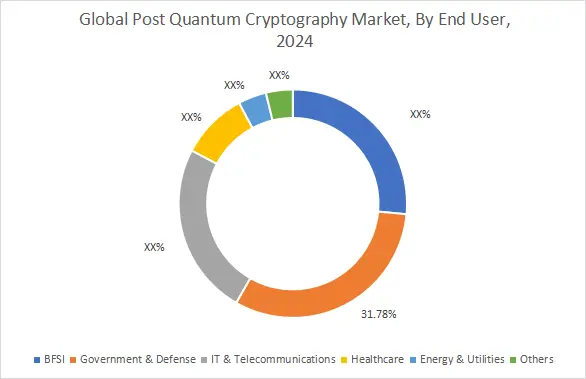
Based on end user, the post quantum cryptography market is segmented into BFSI, government & defense, IT & telecommunications, healthcare, energy & utilities, and others.
Trends in the End User:
- The increasing volume of digital financial transactions is driving early adoption in the BFSI sector.
- The growing concern over national security and protection of classified data is supporting deployment in government and defense.
Government & Defense accounted for the largest revenue share of 31.78% in the year 2024.
- Government and defense organizations handle highly sensitive and classified information. They require long-term data protection.
- Post quantum cryptography helps secure military communications and intelligence systems. It protects against future quantum threats.
- Additionally, national cybersecurity strategies are prioritizing migration to quantum-resistant algorithms.
- Further, increasing investments in secure communication infrastructure are supporting segment growth.
- Thus, as per the post quantum cryptography market analysis, high security requirements and strategic initiatives are driving dominance of government & defense.
BFSI is anticipated to register the fastest CAGR during the forecast period.
- BFSI institutions manage critical financial data and digital transactions. They face high cyber risk exposure.
- Post quantum solutions help protect payment systems and digital banking platforms. This improves customer trust.
- Additionally, regulatory pressure for stronger data protection is supporting adoption.
- Further, rising use of online banking and mobile payments is increasing the need for advanced encryption.
- Therefore, as per the market analysis, growing digital financial activity and compliance needs are expected to boost the BFSI segment during the forecast period.
Regional Analysis:
North America, Europe, Asia Pacific, the Middle East and Africa, and Latin America are the regions of coverage.
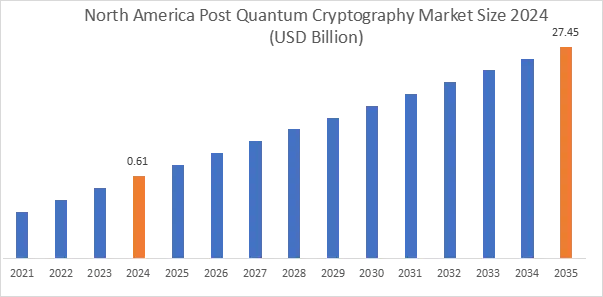
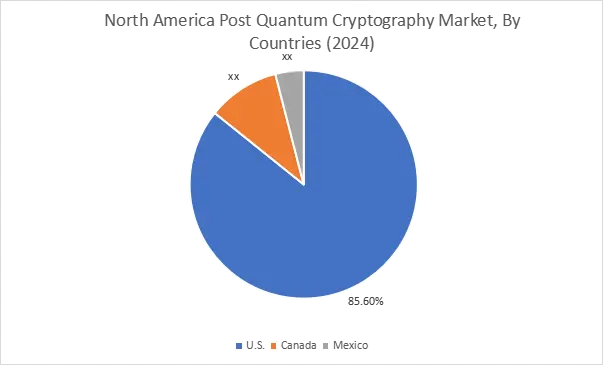
In 2024, North America accounted for the highest market share at 39.80% and was valued at USD 619.08 Million, and is expected to reach USD 27.45 Billion by 2035. In North America, the U.S. accounted for the highest market share of 85.60% during the base year of 2024. North America post-quantum cryptography market growth is supported by federal cybersecurity mandates and formal standardization of quantum-resistant algorithms in the United States. Government bodies, defense contractors, and financial organizations are in the process of planning their transition to post-quantum cryptography to avoid the risks posed by quantum computing, and this is fueling the market.
- For instance, the S. National Institute of Standards and Technology released the post-quantum encryption standards, including CRYSTALS-Kyber for key establishment and CRYSTALS-Dilithium for digital signatures.
In Asia Pacific, the post quantum cryptography market is experiencing the fastest growth with over the forecast period. Asia Pacific post-quantum cryptography market growth is supported by national quantum technology missions and government-led cybersecurity transition planning across India, Japan, and South Korea. Financial institutions, telecom services, and public sector networks are starting to consider migration from classical encryption technology to quantum-resistant technology for ensuring long-term integrity of data, and this is creating market growth opportunities.
- For example, in February 2026, the Department of Science and Technology released a report titled "Report of the Task Force on Post-Quantum Cryptography Migration," detailing the migration plan for post-quantum cryptography for the country. This report is evidence of institutional movement towards post-quantum security adoption in the region.
Europe post-quantum cryptography market growth is supported by robust data protection regulations and digital sovereignty policies implemented in Germany, France, and the Nordic countries. Public sector networks and financial institutions are evaluating quantum-safe encryption frameworks to protect long-term confidential data and cross-border digital infrastructure.
Latin America post-quantum cryptography market growth is supported by digital banking expansion and increasing cybersecurity governance in Brazil, Argentina, and Chile.
Middle East & Africa post-quantum cryptography market growth is supported by national cybersecurity strategies and critical infrastructure protection programs in the UAE and Saudi Arabia.
Top Key Players & Market Share Insights:
The global quantum cryptography market is highly competitive, with major technology providers, cyber security firms, and quantum research organizations providing quantum-resistant encryption services to businesses and government organizations in local and international markets. Major firms are employing various business growth strategies in research, development, standardization of cryptographic algorithms, and integration of platforms to sustain themselves in the global quantum cryptography market. The key players operating in the post quantum cryptography market are:
- IBM Corporation – U.S.
- Microsoft Corporation – U.S.
- Google LLC – U.S.
- Thales Group – France
- ID Quantique SA – Switzerland
- Quantinuum Ltd. – UK
- PQShield Ltd. – UK
- ISARA Corporation – Canada
- SandboxAQ – U.S.
- CryptoNext Security SAS – France
Recent Industry Developments:
- In March 2026, Thales successfully implemented a world’s first in remotely upgrading deployed 5G SIMs and eSIMs with post-quantum cryptography using crypto agility.
- In August 2024, IBM reported that it developed cryptographic algorithms that were chosen as the world’s first post-quantum cryptography standards by NIST. The milestone strengthens IBM’s leadership in quantum-safe security and accelerates enterprise readiness for quantum-resistant encryption.
Post Quantum Cryptography Market Report Insights:
| Report Attributes | Report Details |
|---|---|
| Study Timeline | 2019-2035 |
| Market Size in 2035 (USD Billion) | USD USD 68.98 Billion |
| CAGR (2025-2035) | 41.29% |
| By Component |
|
| By Algorithm Type |
|
| By Application |
|
| By End User |
|
| By Region |
|
| Key Players |
|
| Report Coverage |
|
Key Questions Answered in the Report
How big is the post quantum cryptography market? −
The post quantum cryptography market size is estimated to reach over USD 68.98 Billion by 2035 from a value of USD 1.54 Billion in 2024 and is projected to grow by USD 2.18 Billion in 2025, growing at a CAGR of 41.29% from 2025 to 2035.
Which segmentation details are covered in the post quantum cryptography report? +
The post quantum cryptography report includes specific segmentation details for component, algorithm type, application, end user, and regions.
Which is the fastest segment anticipated to impact the market growth? +
BFSI segment projected to grow at the fastest CAGR, driven by rising demand for advanced encryption in online banking and mobile payments.
Who are the major players in the post quantum cryptography market? +
The key participants in the post quantum cryptography market are IBM Corporation (U.S.), Microsoft Corporation (U.S.), Google LLC (U.S.), Thales Group (France), ID Quantique SA (Switzerland), Quantinuum Ltd. (UK), PQShield Ltd. (UK), ISARA Corporation (Canada), SandboxAQ (U.S.), CryptoNext Security SAS (France), and others.
What are the key trends in the post quantum cryptography market? +
Market driven by quantum safe government initiatives, rising enterprise awareness, and integration of quantum resistant security algorithms.
Overview
Reputation & Certifications


Our Services
- Market Intelligence & Forecasting
- Custom Research Solutions
- Market Entry Strategy
- Competitive Intelligence
- Customer Insights
- Industry Innovation Analysis
- Investment Advisory