Jump to Content
Quinoline Market - Size, Share, Industry Trends, and Forecasts (2025-2032)
Quinoline Market Size:
Quinoline Market size is growing with a CAGR of 3.9% during the forecast period (2025-2032), and the market is projected to be valued at USD 503.82 Million by 2032 from USD 372.25 Million in 2024. Additionally, the market value for the 2025 attributes to USD 385.45 Million.
Quinoline Market Scope & Overview:
Quinoline is an aromatic heterocyclic organic compound with the chemical formula C9H7N. Its structure consists of a benzene ring attached to a pyridine ring at two adjacent carbon atoms. This colorless hygroscopic liquid, which darkens upon exposure to air, possesses a characteristic odor. Primarily derived from coal tar, the compound serves as a building block in the synthesis of a wide array of compounds. The compound is categorized into 2-Methylquinoline, 2-Phenylquinoline, Quinoline-8-Carboxylic Acid, Fluoroquinolones, 4-Aminoquinolines, and Others. These compounds are generally available in powder and liquid form. They find their application in pharmaceutical products, agrochemical products, dye & pigments, solvents, and others.
How is AI Impacting the Quinoline Market?
AI is impacting the quinoline market, particularly in the field of chemical synthesis and drug discovery. AI-driven algorithms streamline the design and optimization of quinoline derivatives, predicting reaction outcomes and identifying optimal synthetic pathways with greater accuracy and speed than traditional methods. This accelerates the development of new quinoline-based compounds for pharmaceuticals, agrochemicals, and specialty chemicals. Furthermore, AI enhances quality control in manufacturing by enabling real-time monitoring and anomaly detection, ensuring higher purity and consistency. By reducing R&D cycles and improving production efficiency, AI is fostering innovation and potentially lowering costs within the quinoline market.

Quinoline Market Dynamics - (DRO) :
Key Drivers:
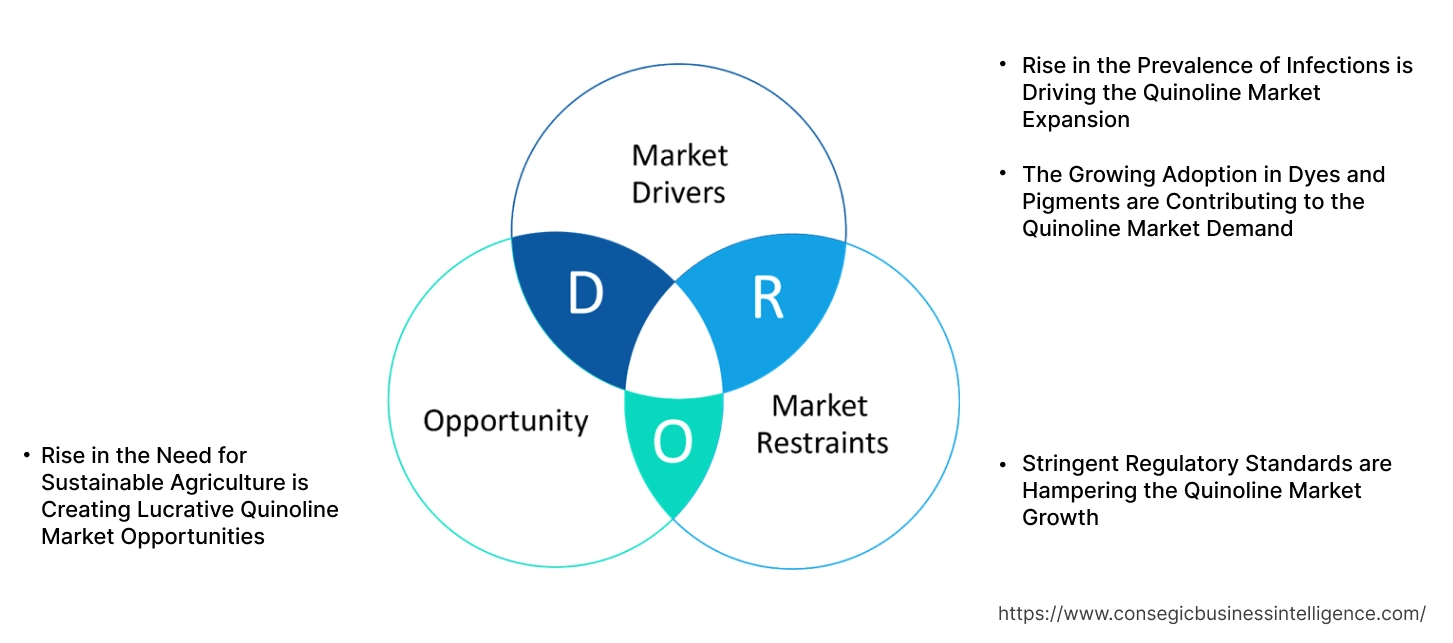
Rise in the Prevalence of Infections is Driving the Quinoline Market Expansion.
An infectious disease is an illness resulting from the presence and growth of pathogenic (disease-causing) biological agents in an individual host organism. These agents, known as pathogens, include bacteria, viruses, fungi, and others. Quinoline derivatives, particularly fluoroquinolones, represent a significant class of antibiotics employed in the treatment of numerous infections. Fluoroquinolones are effective against various pathogens and are used to treat infections such as urinary tract infections (UTIs), respiratory tract infections (including pneumonia and bronchitis), skin and soft tissue infections, intra-abdominal infections, and some sexually transmitted infections. Furthermore, the burden of malaria necessitates the continued production and utilization of quinoline-based antimalarial drugs like quinine and its synthetic analogs. As the prevalence of both bacterial and parasitic infections persists, the demand for effective therapeutics is rising.
For instance,
- The data from the World Health Organization states that, in 2022, the number of malaria cases worldwide reached 249 million, representing an increase of 5 million compared to the 244 million cases reported in 2021.
Thus, the rise in the number of bacterial and parasitic infections is driving the growth of the market.
The Growing Adoption in Dyes and Pigments are Contributing to the Quinoline Market Demand.
The unique chemical structure of the compound allows it to serve as a key intermediate for the synthesis of high-performance dyes and pigments. The derivatives of the compound contribute to enhanced thermal and photostability, making them ideal for use in various industries. The compound also acts as a chemical intermediate in the synthesis of other, more complex dyes, particularly some cyanine, and photopigments. The development of these complex dyes with enhanced methods reduces the reaction time and enhances the yield.
For instance,
- The data published in NCBI, states that the synthesis of Thiazole Orange (TO) and Oxazole Yellow (YO) dyes, with quinoline structures through quaternized heterocycles, is enhanced by microwave-assisted methods, significantly reduces the reaction time by 10 min and improves yield for these monomethine dyes by 90%.
Thus, the adoption of these compounds in dyes and pigments enhances the quinoline market demand.
Key Restraints:
Stringent Regulatory Standards are Hampering the Quinoline Market Growth.
Stringent regulations are important in order to ensure safety and environmental protection. Simultaneously, they also create hurdles for businesses involved in the development of innovative technologies and products. The process of obtaining regulatory approvals for the commercialization and development of various derivatives is time-consuming as well as expensive. It requires testing and thorough documentation. This lengthy approval process leads to delays in the market entry of innovative products. Furthermore, the dynamic nature of these regulations provides uncertainty and risk for businesses. This leads to discouraging investment in new technologies. This uncertainty hinders market entry. Moreover, stringent regulations also restrict the availability of certain compounds in specific markets, thereby limiting their widespread adoption. Thus, these regulations are hindering the growth of the quinoline industry.
Future Opportunities :
Rise in the Need for Sustainable Agriculture is Creating Lucrative Quinoline Market Opportunities.
Traditional agricultural methods mainly rely on chemical fertilizers and pesticides, leading to harmful environmental consequences. It emphasizes practices that conserve natural resources, minimize pollution, promote biodiversity, and ensure the long-term health of the land and ecosystems. Research is exploring the development of quinoline-based agrochemicals, such as pesticides and herbicides, that are more targeted and effective at lower concentrations, thus reducing the overall chemical load on the environment. The rise in investment in sustainable agriculture is influencing the adoption of quinoline.
For instance,
- According to AgTech Media Group LLC, it is estimated that USD 260 billion will be invested in sustainable agriculture in developing economies by 2030.
Additionally, integrating these solutions within broader sustainable farming systems, alongside practices like integrated pest management and crop rotation, creates lucrative quinoline market opportunities.
Quinoline Market Segmental Analysis :
By Type:
Based on the type, the market is categorized into 2-Methylquinoline, 2-Phenylquinoline, Quinoline-8-Carboxylic Acid, Fluoroquinolones, 4-Aminoquinolines, and Others.
Trends in the type:
- There is a rise in the development of novel fluoroquinolones for better tissue penetration and efficacy.
The fluoroquinolones segment accounted for the largest market share in 2024 and is expected to grow at the fastest CAGR over the forecast period.
- Fluoroquinolones are a class of broad-spectrum synthetic antibiotics containing the quinoline ring system with a fluorine atom attached, which enhances their antibacterial activity.
- They are crucial for treating a variety of bacterial infections, including respiratory, urinary tract, skin, and intra-abdominal infections, by inhibiting bacterial DNA gyrase and topoisomerase IV, enzymes essential for DNA replication and repair.
- Various research studies are also conducted to study the herbicidal activity of these compounds.
- Additionally, many manufacturers are introducing novel fluoroquinolone-based medications for the treatment of various conditions that are caused because of bacteria.
- For instance, in 2024, Fonseca Biosciences gained U.S. rights for XTORO, a finafloxacin 0.3% otic suspension, leveraging a fluoroquinolone antibiotic to specifically treat swimmer's ear.
- Thus, the growing development of novel treatments for various infections and ongoing research and development for fluoroquinolones-based herbicides is creating opportunities for the segment.
By Form:
Based on the form, the market is categorized into powder and liquid.
Trends in form:
- The ease of handling and transportation of liquid form as solvents for various chemical processes enhances the use of this solution.
The liquid segment accounted for the largest market share of the year 2024 and is expected to grow at the fastest CAGR over the forecast period.
- Quinoline, at standard ambient conditions, exists as a hygroscopic, colorless liquid that darkens upon exposure to air.
- This physical state is crucial for its role as a fundamental building block and processing agent across various industrial applications.
- Its liquid form facilitates ease of handling, storage, and transportation in bulk quantities, making it a preferred medium for initial chemical reactions and subsequent synthesis of numerous downstream products.
- Various manufacturers are offering compounds in liquid form for various applications.
- For instance, Refine Chemical Co., Ltd. provides quinoline with a 98% assay. The compound finds its application as a precursor for cardiotonic agents, acids, solvents, and preservatives, in the pharmaceutical synthesis of niacin and 8-hydroxyquinoline drugs, in printing/dyeing for cyanine and photopigments, in rubber production, and in agriculture for pesticides like 8-hydroxyquinoline.
- Thus, the rise in the use of the liquid form of the compound for various applications and the formulation of new derivatives creates potential for the expansion of the segment in current and in the coming years.
By Application:
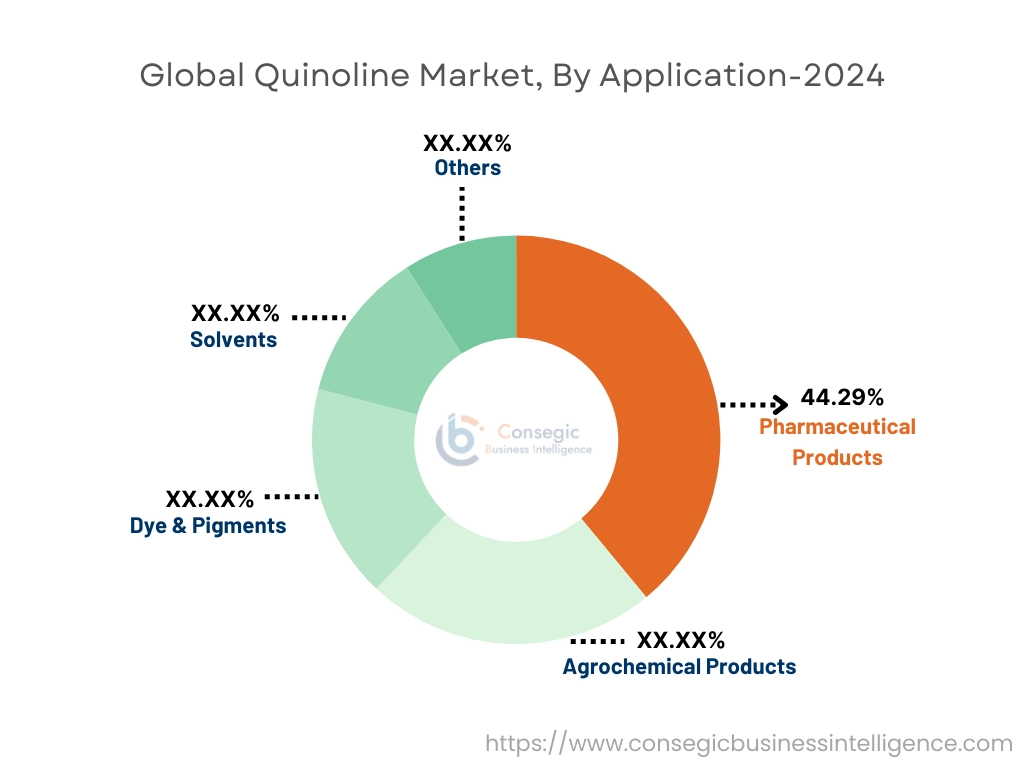
Based on the application, the market is categorized into pharmaceutical products, agrochemical products, dye & pigments, solvents, and others.
Trends in the Application:
- There is a rise in trends for tailored solutions based on individual conditions, leveraging advanced technologies and personalized formulations.
- The growing trend for novel solutions for disease and pest control is influencing the use of quinoline derivatives.
The pharmaceutical products segment accounted for the largest Quinoline market share of 44.29% in the year 2024.
- Quinoline serves as a foundational structural motif in a vast array of pharmaceutical products.
- The derivatives are crucial in the treatment of infectious diseases, with fluoroquinolones representing a major class of broad-spectrum antibiotics effective against numerous bacterial pathogens.
- Furthermore, the quinoline ring is central to several antimalarial drugs, which target different stages of the malaria parasite's life cycle.
- Beyond infectious diseases, quinoline-based compounds are actively investigated and utilized for their potential in treating other conditions, such as cancer (acting as kinase inhibitors or DNA intercalators), inflammation, and neurological disorders.
- Additionally, new antimicrobial medications are approved for cattle and swine.
- For instance, in 2024, the S. Food and Drug Administration's approval of Pradalex (pradofloxacin injection) solution marks a significant advancement in veterinary medicine, providing a new fluoroquinolone antibiotic for the targeted treatment of specific respiratory diseases in cattle and swine.
- Thus, as per the market analysis, the rise in the use and approval of medications is driving the quinoline market expansion.
The agrochemical products segment is expected to grow at the fastest CAGR over the forecast period.
- Quinoline's application in agrochemical products is significant and expanding, driven by the need for effective crop protection.
- As a versatile chemical scaffold, the compound serves as the foundation for various pesticides, including herbicides like quinclorac and quinotrione, which target weed control in crucial crops such as rice.
- Additionally, quinoline derivatives exhibit potent fungicidal activity, with compounds like tebufloquin and quinoxyfen playing a vital role in managing fungal diseases in cereals, fruits, and vegetables.
- The insecticidal properties of certain compounds, demonstrated by flometoquin's efficacy, further highlight the molecule's utility in reducing a broad spectrum of agricultural pests.
- Thus, as per the quinoline market analysis, the rise in the use of effective crop protection solutions is driving the growth of the segment in the coming years.
Regional Analysis:
The regional segment includes North America, Europe, Asia Pacific, the Middle East and Africa, and Latin America.
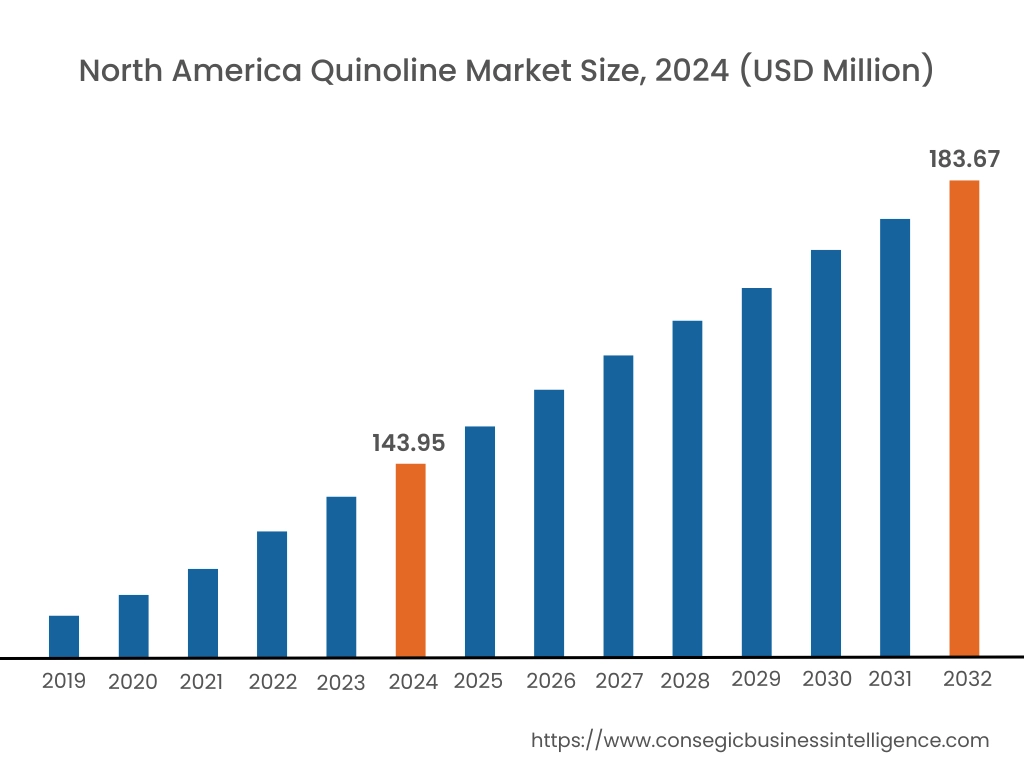
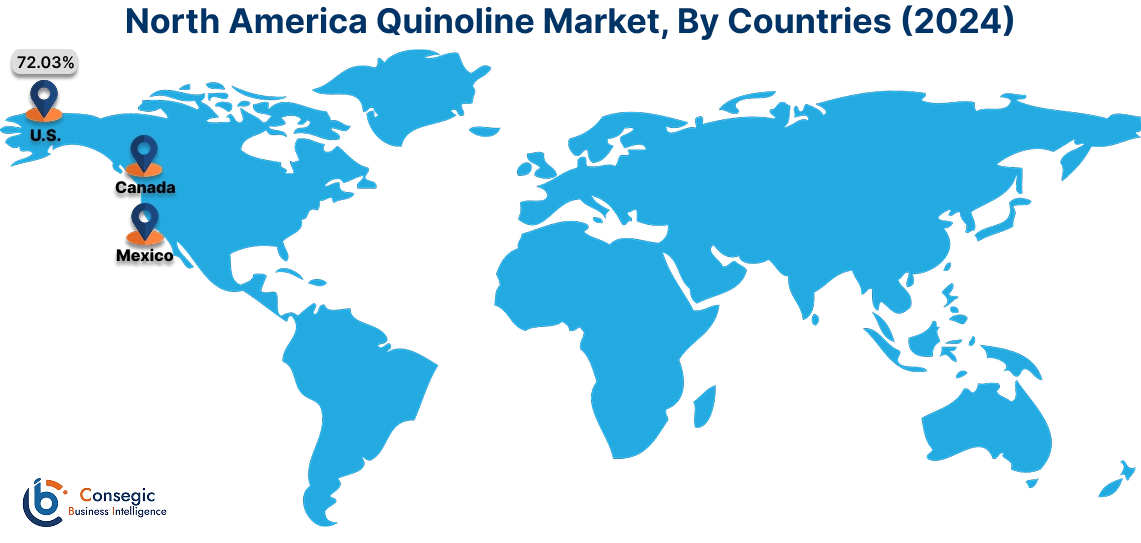
In 2024, North America accounted for the highest Quinoline market share at 38.67% and was valued at USD 143.95 Million and is expected to reach USD 183.67 Million in 2032. In North America, the U.S. accounted for the highest market share of 72.03% during the base year of 2024. The North American market for Quinoline is driven by factors such as a robust pharmaceutical sector, a growing aging population, and increasing consumer awareness of health and wellness. The region is a major hub for research and development, leading to the discovery and commercialization of innovative ingredients. Additionally, the rise in the prevalence of infectious conditions such as UTIs creates a significant societal and personal burden, with a substantial number of medical visits in the United States. These factors influence the use of quinoline in this region.
For instance,
- The data published by NCBI, in 2023, states that UTIs occur at least 4 times more frequently in females than males. Approximately 40% of women in the United States will develop a UTI during their lifetime. Recurrences are common, with nearly 50% of patients experiencing a second infection within a year.
Thus, the rise in the prevalence of infectious diseases in this region is influencing the quinoline market growth in this region.
Asia Pacific is experiencing the fastest growth with a CAGR of 5.1% over the forecast period. In the Asia Pacific region, sustainable agriculture is gaining a significant rise, focusing on eco-friendly practices and minimizing environmental impact. Quinoline and its derivatives are being explored for their potential role in this shift. Research indicates that quinoline-based compounds offer next-generation pesticides, herbicides, and even fertilizers that are safer and more targeted, thus reducing the overall chemical burden on agricultural ecosystems in the region. Additionally, the unique properties of the quinoline scaffold enable the development of diverse agrochemicals aimed at protecting crops from a wide range of threats, contributing significantly to modern agricultural practices. Thus, as per the market analysis, the rise in the use of this compound provides potential in the Asia Pacific region in the coming years.
In Europe, quinoline derivatives, most notably Quinoline Yellow, maintain a steady demand within the region's well-established textile, coatings, and plastics industries. European manufacturers prioritize high-quality and specialized dyes and pigments, where the vibrant properties of the colorants are valued. Furthermore, stringent environmental regulations in Europe necessitate a focus on cleaner production methods and potentially the development of more sustainable quinoline-based colorants, influencing innovation within this application area. Thus, as per the market analysis, the adoption of these compounds in dyes and pigments offers quinoline market trends in this region.
The Middle East and Africa (MEA) region is witnessing a surge in the demand for Quinoline, driven by factors such as rising disposable incomes and the use of solvents for various applications. The rise in the use of solvents supports sectors such as pharmaceuticals (including antimalarials and antibiotics) and potentially specialty chemicals used in manufacturing processes. As industrialization progresses and manufacturing activities expand, the need for effective solvents in processes such as resin production and metallurgical applications contributes to the increased demand. Thus, as per the quinoline market analysis, the use of quinoline in various manufacturing activities creates quinoline market trends in this region.
In Latin America, fluoroquinolones offer several factors in treating infectious diseases, particularly where resistance to older antibiotics is prevalent. Their broad-spectrum activity is valuable for managing various bacterial infections, including respiratory and urinary tract infections, common in the region. The trend for oral formulations provides convenience for outpatient treatment, reducing the need for hospitalization in some cases. Moreover, for certain severe infections or when dealing with multidrug-resistant pathogens, fluoroquinolones represent a crucial therapeutic option where other alternatives are limited, potentially improving patient outcomes. Thus, as per the market analysis, the aforementioned factors are driving the growth of the market in this region.
Top Key Players and Market Share Insights:
The global Quinoline market is highly competitive with major players providing precise products to the national and international markets. Key players are adopting several strategies in research and development (R&D) and product innovation to hold a strong position in the global Quinoline market. Key players in the Quinoline industry include-
- Merck KGaA (Germany)
- Refine Chemical Co.,Ltd. (China)
- Tokyo Chemical Industry Co., Ltd. (Japan)
- Thermo Fisher Scientific Inc (United States)
- BOC Sciences (United States)
- Ensince Industry Co., Ltd (China)
- TAIYO Fine Chemicals Co., Ltd. (China)
- Otto Chemie Pvt Ltd (India)
- Shrey Dye Chem Industries (India)
- Lanxess AG (Germany)
Quinoline Market Report Insights:
| Report Attributes | Report Details |
| Study Timeline | 2019-2032 |
| Market Size in 2032 | USD 503.82 Million |
| CAGR (2025-2032) | 3.9% |
| By Type |
|
| By Form |
|
| By Application |
|
| By Region |
|
| Key Players |
|
| North America | U.S. Canada Mexico |
| Europe | U.K. Germany France Spain Italy Russia Benelux Rest of Europe |
| APAC | China South Korea Japan India Australia ASEAN Rest of Asia-Pacific |
| Middle East and Africa | GCC Turkey South Africa Rest of MEA |
| LATAM | Brazil Argentina Chile Rest of LATAM |
| Report Coverage |
|
Key Questions Answered in the Report
How big is the Quinoline market? −
In 2024, the Quinoline market is USD 372.25 Million.
Which is the fastest-growing region in the Quinoline market? +
Asia Pacific is the fastest-growing region in the Quinoline market.
What specific segmentation details are covered in the Quinoline market? +
Type, Form, Application segmentation details are covered in the Quinoline market.
Who are the major players in the Quinoline market? +
Merck KGaA (Germany), Refine Chemical Co.,Ltd. (China), Ensince Industry Co., Ltd (China) are some of the major players in the market.
Overview
Reputation & Certifications


Our Services
- Market Intelligence & Forecasting
- Custom Research Solutions
- Market Entry Strategy
- Competitive Intelligence
- Customer Insights
- Industry Innovation Analysis
- Investment Advisory