Jump to Content
Respiratory Care Devices Market Size & Industry Share - Growth Trends & Forecasts (2026 - 2034)
Respiratory Care Devices Market Size:
The Respiratory Care Devices Market is expected to expand from 26,536.53 (US$M) in 2025 to 28,341.01 (US$M) in 2026, and is forecast to surpass 47,971.73 (US$M) by 2034, growing at a CAGR of 6.8% between 2026 and 2034, according to a recent report from Consegic Business Intelligence.
Respiratory Care Devices Market Scope & Overview:
Respiratory care devices are medical devices designed to help diagnose, monitor, and treat respiratory conditions and diseases. These devices mechanically control or help patients to breathe while delivering a fixed amount of oxygen. These devices support patients with breathing difficulties caused by chronic conditions like asthma, chronic obstructive pulmonary disease, sleep apnea, or acute illnesses such as respiratory infections or pneumonia. There are different types of respiratory care devices such as Continuous Positive Airway Pressure (CPAP) and Bilevel Positive Airway Pressure (BiPAP) devices, ventilators, nebulizers, pulse oximeters, and others. Advancements in respiratory care devices such as portable oxygen concentrators, 3D printer ventilators, smart nebulizers and more are driving the market.

Respiratory Care Devices Market Dynamics - (DRO) :
Key Drivers:
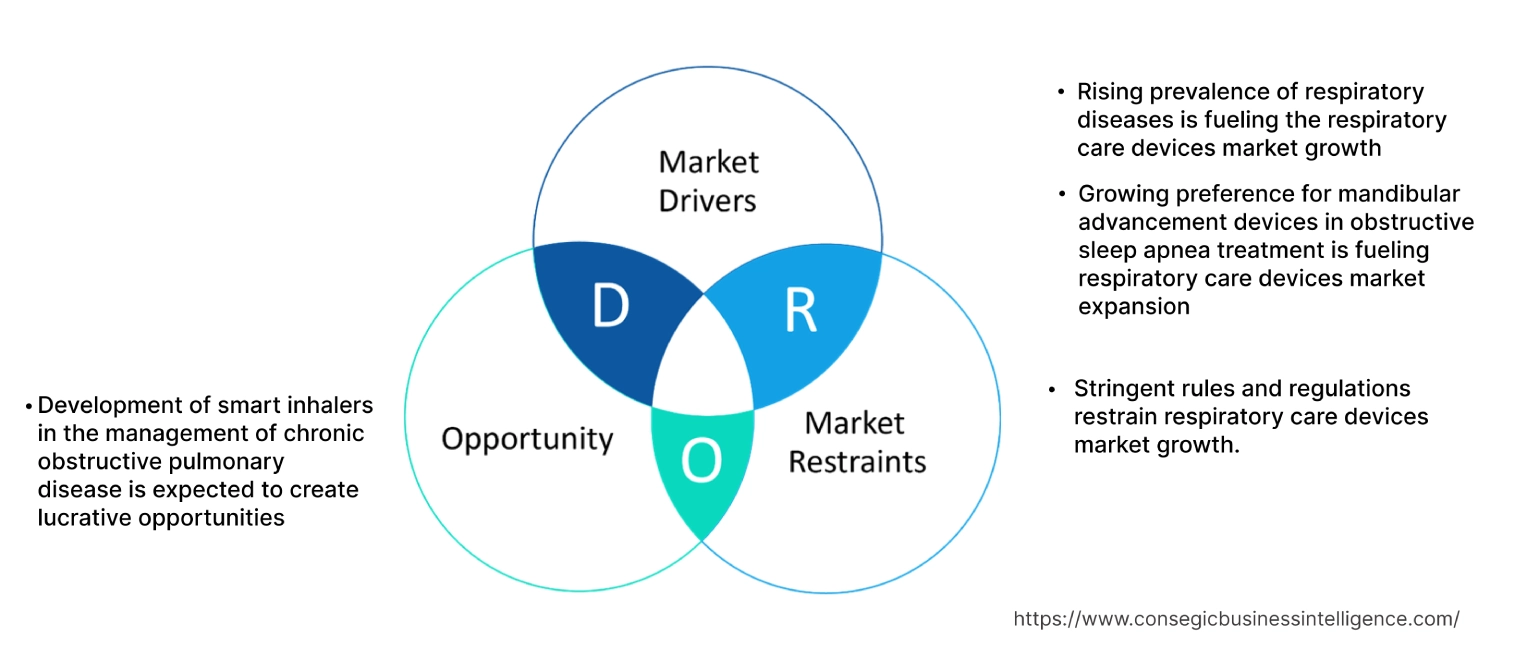
Rising prevalence of respiratory diseases is fueling the respiratory care devices market growth.
Increasing cases of respiratory diseases such as chronic obstructive pulmonary disease, asthma, and others are driving the respiratory care devices market demand. Asthma is a respiratory condition in which a person's airways become inflamed, narrow, and swell and produce extra mucus, which makes it difficult to breathe. Respiratory care devices such as nebulizers, dry-powder inhalers, and others are used in the treatment of asthma.
- In 2021, according to the S. Centers for Disease Control and Prevention, there were a total of 24,963,874 asthma patients in the United States. Among asthma patients, 4,675,475 are children and 20,288,399 are adults. Additionally, the number of patients is expected to increase leading to the growing need for respiratory care devices
Thus, the growing patients of with asthma is driving the respiratory care devices industry to effectively treat the condition.
Growing preference for mandibular advancement devices in obstructive sleep apnea treatment is fueling respiratory care devices market expansion.
Mandibular advancement devices are respiratory care devices that play a crucial role in the treatment of sleep apnea, particularly obstructive sleep apnea (OSA). Obstructive sleep apnea is a common respiratory condition in which a person’s breathing repeatedly stops and starts during sleep. CPAP devices are primarily used to provide respiratory care in Obstructive sleep apnea patients. Mandibular advancement devices are effective and non-alternative to CPAP devices providing effective respiratory care, and driving growth in the market.
- In 2021, according to the Sleep Science Journal, mandibular advancement devices improve nighttime oxygenation at all levels of obstructive sleep apnea severity in adult patients. It is also beneficial in patients with adverse health consequences of obstructive sleep apnea such as hypertension, excessive daytime sleepiness, and others, p
Thus, mandibular advancement devices are effective in the treatment of obstructive sleep apnea further boosting the respiratory care devices market expansion.
Key Restraints :
Stringent rules and regulations restrain respiratory care devices market growth.
Respiratory care devices are used for treating respiratory conditions like asthma, sleep apnea, and others. They are subject to stringent regulatory standards to ensure patient safety and efficacy. Government bodies like the European Commission classify these devices into different classes and according to that the manufacturers should adhere to rules and regulations. Respiratory care devices such as ventilators, CPAP, and others are classified into Class IIa and Class IIb depending on the degree of invasiveness and the setting in which they are used.
- According to the European Union, the Class IIa and Class IIb ventilators involve the assessment of the full manufacturer’s quality management system. They also require an on-site audit and regular surveillance audits at least annually.
These rules and regulations restrict market growth by increasing the time and expense needed to bring new devices to market.
Future Opportunities :
Development of smart inhalers in the management of chronic obstructive pulmonary disease is expected to create lucrative opportunities.
The development of smart inhalers in the management of chronic obstructive pulmonary disease opens new respiratory care device market opportunities by combining respiratory therapy with digital health solutions. Chronic obstructive pulmonary disease is a common lung disease causing restricted airflow and breathing problems. These smart inhalers give users real-time feedback and reminders to take their medicine as directed in the treatment of chronic obstructive pulmonary disease.
- In 2024, according to the International Journal of Engineering Research and Science & Technology, smart inhalers have a button mechanism that connects with a digital platform. The button records the date, time, and drug dose every time the inhaler is used. It is especially helpful for treating chronic obstructive pulmonary disease when taking medicine regularly is essential for good management.
Thus, smart inhalers are an innovative approach in the treatment of chronic obstructive pulmonary disease accelerating the respiratory care devices market opportunities.
Respiratory Care Devices Market Segmental Analysis :
By Product Type:
By product type, the respiratory care devices market is divided into CPAP and BiPAP devices, ventilators, nebulizers, and others.
Trends in the Product Type:
- In the latest market trends, CPAP and BiPAP devices are being developed using vortex airflow technology.
- There is a rise in the adoption of smart-technology nebulizers for the effective management of diseases as per the latest respiratory care devices market trends.
The CPAP and BiPAP devices accounted for the largest revenue share in the year 2023.
- CPAP (Continuous positive airway pressure) and BiPAP (Bilevel positive airway pressure) devices are respiratory care devices in which CPAP provides constant air pressure, while BiPAP offers two pressure settings.
- These devices are most commonly used for the treatment of obstructive sleep apnea. Obstructive sleep apnea is a common respiratory condition in which a person’s breathing repeatedly stops and starts during sleep.
- CPAP devices are used to provide respiratory care in Obstructive sleep apnea patients which ensure steady airflow, preventing airway collapse during sleep. It improves oxygenation thereby reducing risks of respiratory complications and ensuring effective respiratory care.
- For instance, in 2024, researchers at the University of Cincinnati developed a new Continuous positive airway pressure (CPAP) device that takes advantage of vortex airflow technology. It will accelerate respiratory devices market demand by controlling obstructive sleep apnea through the better direction of airflow toward the nostrils increasing patient compliance.
- Thus, CPAP and BiPAP devices are driving market growth in respiratory care devices by introducing innovative approaches.
The nebulizers in the product type are expected to grow at the fastest CAGR over the forecast period.
- A nebulizer is a device used to administer medication in the form of a mist that is inhaled into the lungs through a mouthpiece or mask.
- It is one of the primary respiratory care devices used for the treatment of chronic obstructive pulmonary disease, asthma, and others.
- Apart from traditional nebulizers, the development of smart technology nebulizers is improving timely interventions and patient outcomes.
- These smart technology nebulizers are palm-sized, lightweight, and virtually silent. They also rapidly deliver a dose using breath-actuated smart technology that adapts to a patient’s normal breathing pattern.
- For instance, in 2024, Liquida expands collaboration with Taiwan’s Pharmosa Biopharm for smart-technology nebulizers. This agreement is for the development and commercialization of L606. L606 is an inhaled, sustained-release formulation of treprostinil administered smart technology nebulizer, a device for respiratory care.
- Thus, nebulizers are rapidly emerging respiratory care devices in current trends driving market proliferation.
By Application:
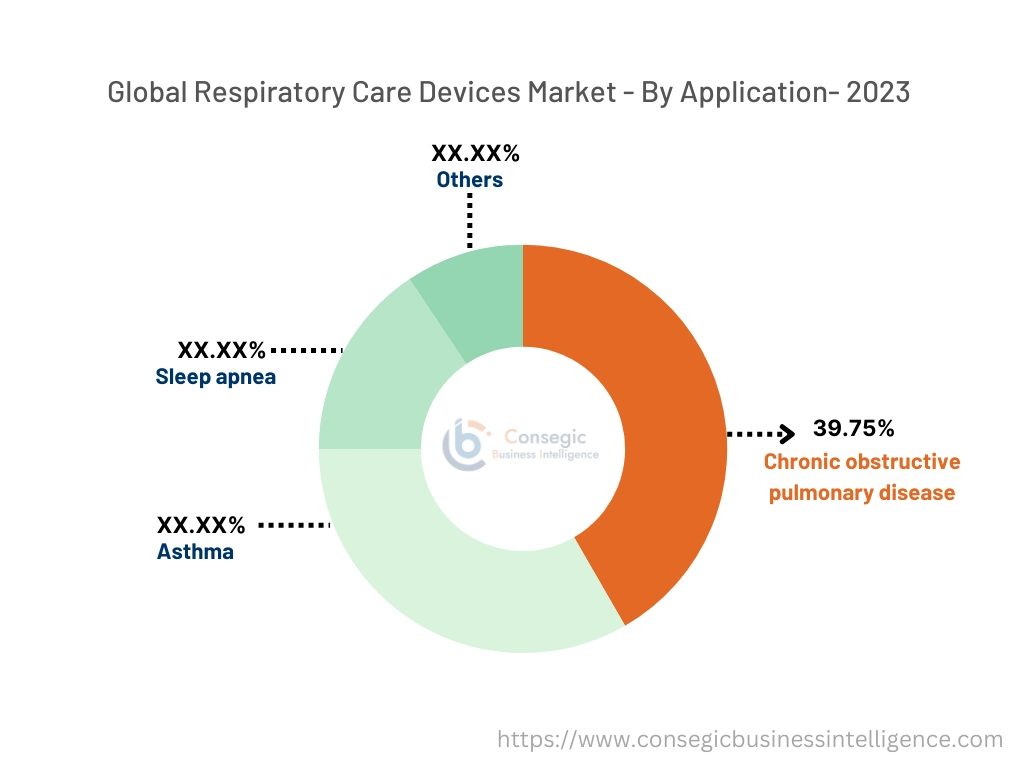
By application, the respiratory care devices market is divided into chronic obstructive pulmonary disease, sleep apnea, asthma, and others.
Trends in Application:
- In current market trends, there is a rise of innovative therapies complimenting existing respiratory care devices in the treatment of chronic obstructive pulmonary disease.
- The development of portable oxygen concentrators for the treatment of asthma is improving patient outcomes as per the latest respiratory care devices market trends.
Chronic obstructive pulmonary disease accounted for the largest revenue share of 39.75% in the year 2023.
- Chronic obstructive pulmonary disease is one of the most prevalent diseases globally, with smoking, air pollution, and aging populations being significant contributors. The increasing incidence, particularly in low- and middle-income countries, drives the market for respiratory care devices.
- Respiratory care devices, including metered-dose inhalers, dry-powder inhalers, and nebulizers are the cornerstone for delivering bronchodilators and corticosteroids in chronic obstructive pulmonary disease management.
- In recent years, there have been many advancements in existing devices used for chronic obstructive pulmonary disease, driving the market through enhanced treatment options and improved patient outcomes.
- For instance, in 2024, Aptar Pharma collaborated with Cambridge Healthcare Innovations to commercialize the Quattrii dry powder inhaler. It offers a unique solution for delivering medium to high payloads of formulation to the lungs in the treatment of chronic obstructive pulmonary disease, further boosting the respiratory care devices market.
- Thus, respiratory care devices play a crucial role in the treatment and management of chronic obstructive pulmonary disease through enhanced treatment options and improved patient outcomes.
The Asthma in the application is expected to grow at the fastest CAGR over the forecast period.
- Asthma is a chronic disease that affects the airways of the lungs, mainly treated by respiratory care devices including nebulizers, inhalers, portable oxygen concentrators, and others.
- These devices deliver bronchodilators and corticosteroids directly impacting the lungs ensuring rapid symptom relief and long-term control.
- Portable oxygen concentrators and emergency rescue inhalers are vital for managing sudden asthma attacks.
- In 2024, Inogen launched Rove 4 Portable oxygen concentrator, delivering the highest oxygen output in the Lightest Weight 4-Setting. It will provide immediate relief to asthma patients during acute exacerbations, driving growth in respiratory care devices.
- Thus, the use of innovative respiratory care devices in asthma is increasing in the latest trends, ensuring timely interventions and improved patient outcomes.
Regional Analysis:
The regional segment includes North America, Europe, Asia Pacific, the Middle East and Africa, and Latin America.
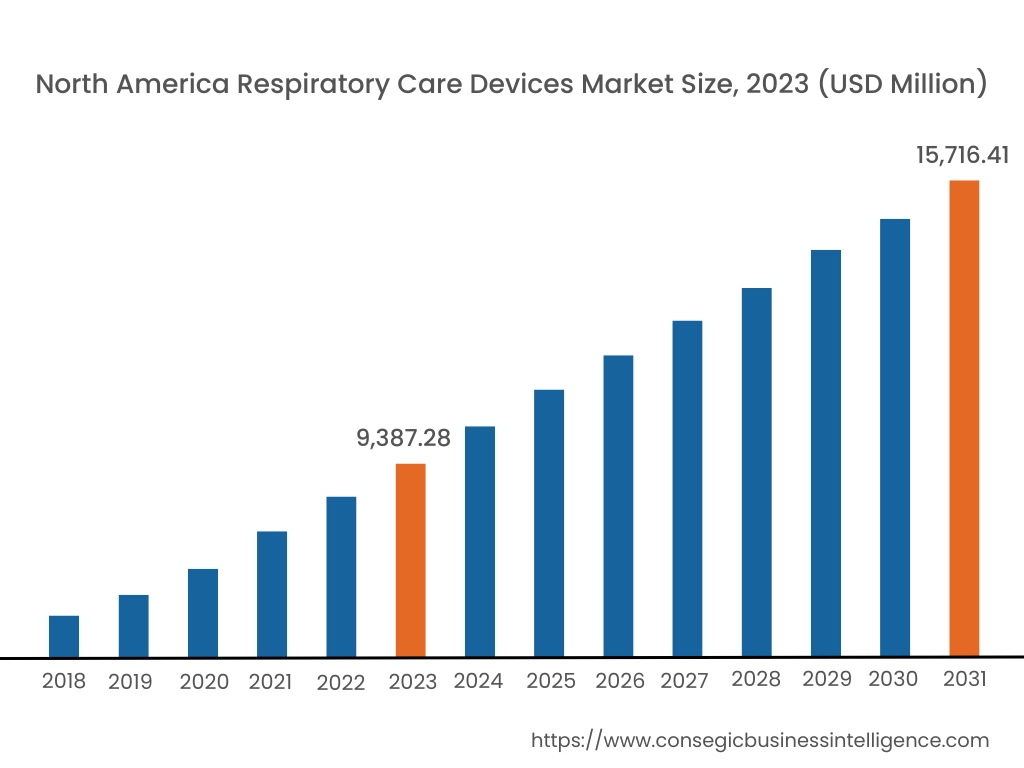
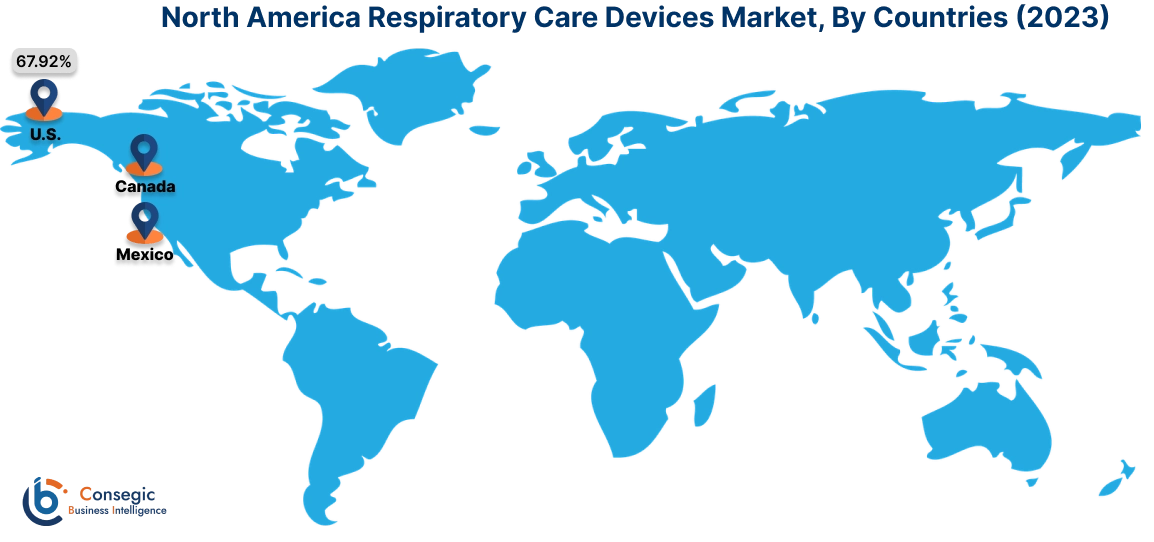
In 2023, North America accounted for the highest market share at 39.85% and was valued at USD 9,387.28 Million and is expected to reach USD 15,716.41 Million in 2031. In North America, the U.S. accounted for the highest market share of 67.92% during the base year of 2023. The respiratory care devices market share in North America is experiencing significant growth primarily driven by the high prevalence of respiratory diseases such as chronic obstructive pulmonary disease, asthma, sleep apnea, and others. The leading North American medical device companies like Medtronic, ResMed, Baxter, and more are continuously bringing innovation in the current respiratory care devices further fueling the market. Additionally, innovations like portable oxygen concentrators and smart-technology nebulizers are gaining traction, providing more personalized and effective respiratory care.
- In 2024, according to the American Lung Association, more than 35 million people living in the U.S. live with a chronic lung disease like asthma and chronic obstructive pulmonary disease. Asthma affects 26.8 million Americans, including 4.5 million children, and accounts for millions of emergency department visits each year.
Thus, according to the respiratory care devices market analysis, North America is expected to dominate the global respiratory care devices market supported by the rising prevalence of respiratory diseases and technological advancements.
Asia-Pacific is expected to witness the fastest CAGR over the forecast period of 7.4 % during 2024-2031. As per the respiratory care devices market analysis, Asia-Pacific is experiencing robust respiratory care devices market growth. It is particularly driven by the rising prevalence of chronic conditions like chronic obstructive pulmonary disease, and asthma, the growing number of elderly populations, and rising pollution levels. Countries like China, India, and Japan are major contributors to the respiratory devices market share due to rising elderly populations and the high burden of these diseases. The COVID-19 pandemic also led to increased use of ventilators and oxygen therapy devices in both hospital and home care settings. Indian pharmaceutical companies like Cipla, Alkem, and more are entering into the respiratory care devices market to cater to the rising need for respiratory care.
- In 2022, Alkem launched its first inhalation device – Innohaler, for asthma and chronic obstructive pulmonary disease patients in India. Innohaler is a dry powder inhaler that administered the drug effectively in the lungs in each inhalation, driving the respiratory care devices industry's proliferation in India.
Thus, market analysis shows that the Asia-Pacific region is expected to grow faster, capitalizing on both demand and technological advancements in the respiratory care devices market.
According to market analysis, Europe is experiencing significant respiratory care devices market growth, driven by the increasing prevalence of respiratory diseases such as chronic obstructive pulmonary disease, asthma, and sleep apnea. Factors such as the aging population, rising air pollution levels, and high smoking rates contribute to the growing demand for advanced respiratory care solutions. The region has a well-established healthcare infrastructure, enabling early diagnosis and treatment of respiratory conditions. Technological advancements including portable and non-potable invasive devices, are further propelling the market proliferation. The shift towards home healthcare and remote patient monitoring, supported by favorable government policies and reimbursement frameworks, has also fueled the adoption of respiratory care devices.
The industry for respiratory care devices in the Middle East and Africa region is experiencing steady potential, primarily driven by the rising prevalence of respiratory diseases such as asthma, chronic obstructive pulmonary disease, and tuberculosis. Contributing factors include increasing air pollution, smoking rates, and a growing aging population prone to respiratory conditions. However, the market expansion is somewhat constrained by limited healthcare infrastructure and economic disparities across the region. The COVID-19 pandemic significantly accelerated the need for ventilators and oxygen therapy devices, highlighting the need for improved respiratory care systems. Governments and private healthcare providers are investing in upgrading medical facilities and importing advanced respiratory care devices to meet patient needs in this region as per market analysis.
As per market analysis, the industry for respiratory care devices in Latin America is expanding due to the increasing burden of respiratory illnesses such as asthma, chronic obstructive pulmonary disease, and acute respiratory infections. The region’s aging population and rising exposure to risk factors like air pollution, smoking, and occupational hazards have heightened the demand for respiratory care solutions. While countries like Brazil, Mexico, and Argentina lead in healthcare infrastructure, many others face challenges such as limited access to advanced medical devices and uneven resource distribution. Growing awareness about respiratory health, combined with an increasing preference for home-based healthcare solutions, is also driving the market in this region.
Top Key Players & Market Share Insights:
The Global respiratory devices market includes several key players known for their significant contributions.
- Koninklijke Philips N.V (Netherlands)
- Medtronic (United States)
- Drägerwerk AG & Co. KGaA (Germany)
- Siemens Healthcare Private Limited (Germany)
- Medline Industries (United States)
- ResMed (United States)
- Fisher & Paykel Healthcare Limited. (New Zealand)
- GE HealthCare (United States)
- Hill-Rom Services PTE Ltd. (United States)
- Baxter (United States)
Recent Industry Developments :
Partnerships and Collaborations:
- In 2024, Modivcare partnered with Tenovi to deliver Adherium’s Hailie® Smart inhalers, for enhanced care of patients with chronic respiratory diseases. These smart inhalers are respiratory care devices that directly address the medication adherence issue by tracking. They also reduce exacerbations in asthma and chronic obstructive pulmonary disease
Launches:
- In 2024, Baxter International has launched its next-generation airway clearance system. The Vest advanced pulmonary experience (APX) system, is one type of respiratory care device aimed at supporting therapy for individuals with chronic lung conditions, driving the respiratory care devices market proliferation.
- In 2024, Getinge launched the Servo-c mechanical ventilator in India. Servo-c is a respiratory care device that offers functionalities for personalized respiratory treatments and smart fleet management, eliminating the need for proprietary disposables. It features CO2 monitoring and Servo Compass for insights into lung mechanics and gas exchange, driving innovation in the respiratory care devices market.
Respiratory Care Devices Market Report Insights :
| Report Attributes | Report Details |
| Study Timeline | 2021-2034 |
| Market Size in 2034 | USD 47,971.73 Million |
| CAGR (2026-2034) | 6.80% |
| Base Year | 2025 |
| By Product Type |
|
| By Application |
|
| By Region |
|
| Key Players |
|
| North America | U.S. Canada Mexico |
| Europe | U.K. Germany France Spain Italy Russia Benelux Rest of Europe |
| APAC | China South Korea Japan India Australia ASEAN Rest of Asia-Pacific |
| Middle East and Africa | GCC Turkey South Africa Rest of MEA |
| LATAM | Brazil Argentina Chile Rest of LATAM |
| Report Coverage |
|
Key Questions Answered in the Report
How big is the Respiratory Care Devices Market? −
Global respiratory care devices market size is estimated to reach over USD 39,379.63 Million by 2031 from a value of USD 23,556.54 Million in 2023, growing at a CAGR of 6.8% from 2024 to 2031.
What specific segmentation details are covered in the Respiratory Care Devices Market report? +
The Respiratory Care Devices Market report includes specific segmentation details for product type and application.
Which is the fastest-growing region in the Respiratory Care Devices Market? +
Asia Pacific is the fastest-growing region in the Respiratory Care Devices Market.
Who are the major players in the Respiratory Care Devices Market? +
The key participants in the Respiratory Care Devices market are Koninklijke Philips N.V (Netherlands), Medtronic (United States), ResMed (United States), and Fisher & Paykel Healthcare Limited. (New Zealand), GE HealthCare (United States), Hill-Rom Services PTE Ltd. (United States), Baxter (United States), Drägerwerk AG & Co. KGaA (Germany), Siemens Healthcare Private Limited (Germany), Medline Industries (United States) States), EDAT TMS (France), Hologic Inc (United States), Avanos Medica Inc (United States).
Overview
Reputation & Certifications


Our Services
- Market Intelligence & Forecasting
- Custom Research Solutions
- Market Entry Strategy
- Competitive Intelligence
- Customer Insights
- Industry Innovation Analysis
- Investment Advisory