Jump to Content
Self-Learning Neuromorphic Chip Market Size & Industry Share - Growth Trends & Forecasts (2026 - 2034)
Self-Learning Neuromorphic Chip Market Size:
Self-Learning Neuromorphic Chip Market size is estimated to reach over 5,074.65 (US$M) by 2034 from a value of 829.03 (US$M) in 2025 and is projected to grow by 1,013.9 (US$M) in 2026, growing at a CAGR of 22.3% from 2026 to 2034, according to a recent report from Consegic Business Intelligence.
Self-Learning Neuromorphic Chip Market Scope & Overview:
Self-learning neuromorphic chips utilize physical artificial neurons for performing computations and are optimized to mimic structure and functionality of the human brain. Moreover, chips offer a range of benefits including fast execution speed, robustness against local failures, ability to learn, enhanced image and speech recognition, and improved energy efficiency among others. The aforementioned benefits are key determinants for increasing its utilization in automotive, consumer electronics, healthcare, robotics, aerospace & defense, and other industries in turn driving the self-learning neuromorphic chip market size.

Self-Learning Neuromorphic Chip Market Dynamics - (DRO) :
Key Drivers:
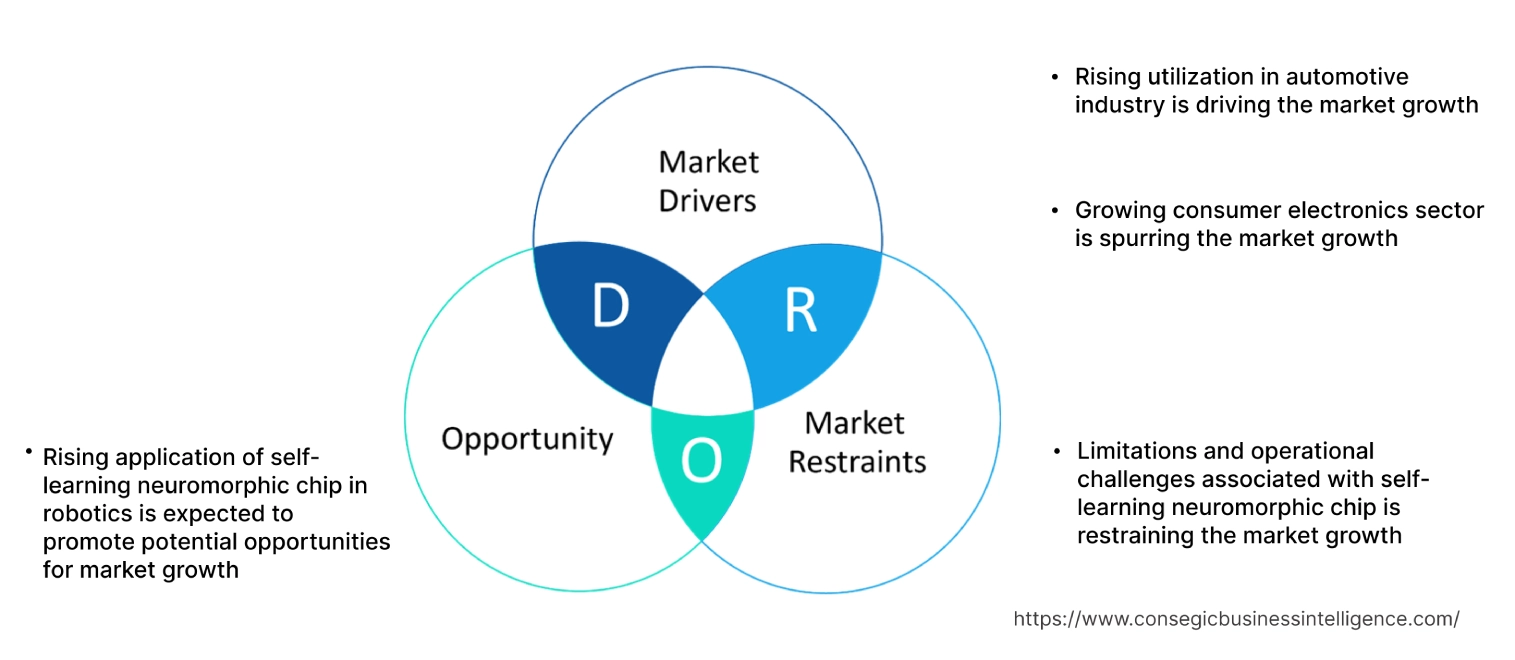
Rising utilization in automotive industry is driving the market growth
Self-learning neuromorphic chips are primarily used in the automotive industry, particularly in ADAS (advanced driver assistance system) applications including lane detection, sign recognition, driver attention tracking, obstacle detection, and others. Moreover, neuromorphic chip have the ability to integrate dynamic vision sensing and event-driven computing, in turn providing real-time, highly integrated, and low-power dynamic vision solutions for edge perception, which makes it ideal for deployment in the automotive sector for autonomous driving among others fueling the self-learning neuromorphic chip market share.
Factors including increasing production of automobiles, advancements in autonomous driving systems, and growing demand for enhanced automobile control and safety solutions are key prospects driving the adoption of self-learning neuromorphic chip market size.
- For instance, according to the International Organization of Motor Vehicle Manufacturers, the total volume of automotive production across the world reached up to 85.01 million in 2022, depicting an incline of 6% as compared to 80.14 million in 2021.
- Further, according to the European Automobile Manufacturers Association, total passenger car production in the EU reached 10.9 million in 2022, witnessing an increase of 8.3% in contrast to 2021.
Thus, the increasing automotive production is driving the deployment in automobile ADAS applications, in turn proliferating the self-learning neuromorphic chip market share.
Growing consumer electronics sector is spurring the market growth
Self-learning neuromorphic chips are utilized in the consumer electronics industry for application in a range of smart devices including smartphones, smart lighting, smart cameras, and other smart appliances. The chips are usually integrated in smart consumer devices for image recognition, speech & voice recognition, and signal processing applications among others. Moreover, the benefits include ultra-low power consumption, fast response time, low cost, and others are key determinants for driving its integration in smart consumer devices.
Factors including growing penetration of smart devices, technological progressions in consumer electronics including AI, and rising demand for energy-efficient devices are primary aspects fostering the growth of the consumer electronics sector share.
- For instance, according to the Association of German Banks, the manufacturing and sales of electronics sector in Germany observed a significant progress of 10% in 2021 in comparison to 2020.
- Additionally, according to GSM Association, the adoption of smartphones in the Italy is projected to reach 81% by 2025, depicting an increase from 77% in 2021.
Therefore, the evolution of consumer electronics sector is driving the integration in smart consumer devices for image recognition, signal processing, and speech and voice recognition applications, in turn boosting the self-learning neuromorphic chip market growth.
Key Restraints :
Limitations and operational challenges associated with self-learning neuromorphic chip is restraining the market growth
The implementation of chips is often associated with certain limitations and operational challenges, which are primary factors limiting the self-learning neuromorphic chip market expansion. For instance, the market require specialized hardware and software to imitate the behavior of biological neurons and synapses, which requires a deep understanding of neuroscience along with the ability to design and build complex systems. The complex structure of neuromorphic chip makes it challenging for implementation as it is difficult to flawlessly replicate a particular behavior in one system.
Meanwhile, chips depict similarities to human brain and processing capabilities, which in turn raises ethical and social concerns. Additionally, chips are also associated with issues related to speed and accuracy along with dependability in particular applications including voice recognition, where noise interference may cause erroneous data input.
Hence, the above limitations and operational challenges related to self-learning neuromorphic chip are constraining the self-learning neuromorphic chip market expansion.
Future Opportunities :
Rising application of self-learning neuromorphic chip in robotics is expected to promote potential opportunities for market growth
The rising application in robotics is expected to present potential prospects for the progress of the self-learning neuromorphic chip market. The deployment of robotics and automation is increasing at a rapid speed in recent years. Self-learning type neuromorphic chip are often used in robotics sector for application in diverse visual tasks such as navigation, motion estimation, localization, object recognition, tracking, and others in turn propelling the self-learning neuromorphic chip market opportunity.
Factors including the rising the growing industrialization, expansion of industrial manufacturing facilities, and growing trend of industrial automation fueled by Industry 4.0 are among the primary aspects driving the robotics sector.
- For instance, according to the International Federation of Robotics, the installation of industrial robots installed in factories across the world reached up to 517,385 units in 2021, depicting a significant progress of 31% in comparison to 2020. Additionally, robot installations in Europe reached up to 84,302 new units in 2021, witnessing an increase of 24% as compared to 2020.
Therefore, the rising trend towards adoption of robotics is further increasing the utilization of chips for deployment in diverse visual tasks such as navigation, motion estimation, localization, object recognition, and tracking, in turn promoting self-learning neuromorphic chip market opportunities during the forecast period.
Self-Learning Neuromorphic Chip Market Segmental Analysis :
By Functionality:
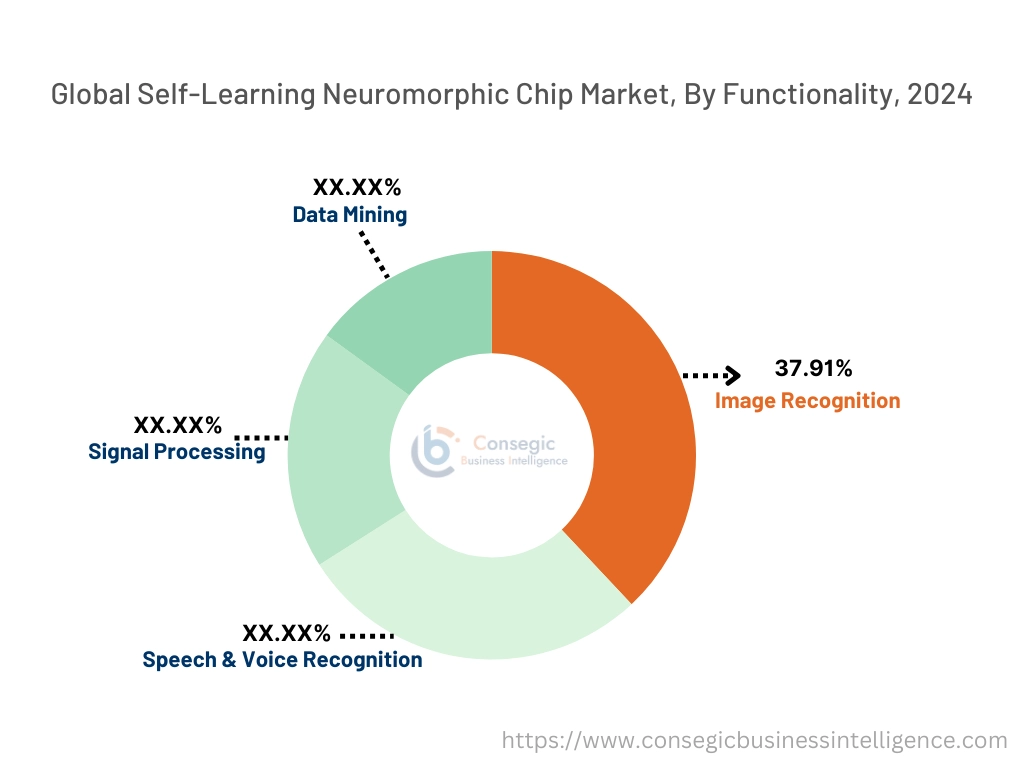
Based on the functionality, the market segmented bifusrcated into image recognition, speech & voice recognition, signal processing, and data mining, and others.
The image recognition segment accounted for the largest revenue share of 37.91% in the year 2024.
- Image recognition refers to the process of identifying an object or a feature in an image or video. Self-learning chip are used for performing image recognition in several machine-based visual tasks, such as performing image content search, guiding self-driving cars, autonomous robots, and accident-avoidance systems, medical imaging, security surveillance systems, facial recognition systems, and others.
- Moreover, the trend towards rising adoption of image recognition in automotive, healthcare, consumer electronics, defense, and other industries is driving the self-learning neuromorphic chip market demand.
- For instance, in June 2023, the Los Alamos National Laboratory developed new artificial synapses for neuromorphic computing for performing several functionalities including image recognition. The neuromorphic computing system obtained an image recognition accuracy of 94.72%.
- Therefore, as per the analysis, the rising research and development activities associated with neuromorphic computing for image recognition is a prime factor proliferating the progress of the segment.
The speech & voice recognition segment is anticipated to register the fastest CAGR during the forecast period.
- Speech recognition involves the process of converting spoken language into written text, which enables transcription and text-based analysis. Meanwhile, voice recognition is designed to identify and authenticate individuals based on distinctive vocal characteristics.
- Additionally, neuromorphic chip capable of performing speech and voice recognition functionalities are primarily used in consumer electronics, automotive, and other industrial sectors.
- For instance, in October 2022, Polyn Technology introduced NeuroVoice, an analog neuromorphic chip that is capable of performing both voice detection and voice extraction functionalities operating at 100 µW power with inference performance in 20 µsec.
- Thus, as per the analysis, the rising innovations associated with self-learning neuromorphic chip capable of performing speech and voice recognition is a vital factor expected to drive the self-learning neuromorphic chip market demand during the forecast period.
By End-User:
Based on the end-user, the market is segregated into automotive, consumer electronics, healthcare, robotics, aerospace & defense, and others.
The automotive segment accounted for the largest revenue share in the year 2024.
- The trends including increasing production of automobiles, advancements in autonomous driving systems, and growing adoption of electric vehicles are driving the automotive segment.
- For instance, according to the China Association of Automobile Manufacturers, the overall manufacturing of passenger cars in China reached 14.8 million units in January-August 2022, demonstrating a YoY progress of 14.7%.
- Thus, according to the self-learning neuromorphic chip market analysis, the increasing automotive production is driving the market adoption for utilization in automobile ADAS applications including lane detection, driver attention tracking, obstacle detection, and others, in turn driving the self-learning neuromorphic chip market trend.
The consumer electronics segment is expected to witness the fastest CAGR during the forecast period.
- The growth trend of consumer electronics segment is attributed to several factors including growing penetration of smart devices, technological progressions in consumer electronics including AI, and rising popularity of wearable devise, among others.
- Self-learning chip are primarily integrated in smart consumer devices for image recognition, speech & voice recognition, and signal processing applications, among others.
- For instance, SynSense is a manufacturer that offers SPECK series and XYLO series of neuromorphic chip in its product portfolio that is specifically designed for use in consumer electronics devices including wearables, smart lighting, and smart appliances, among others.
- Thus, as per the analysis, the rising development in consumer electronics sector is projected to drive the self-learning neuromorphic chip market trend during the forecast period.
Regional Analysis:
The regional segment includes North America, Europe, Asia Pacific, Middle East and Africa, and Latin America.
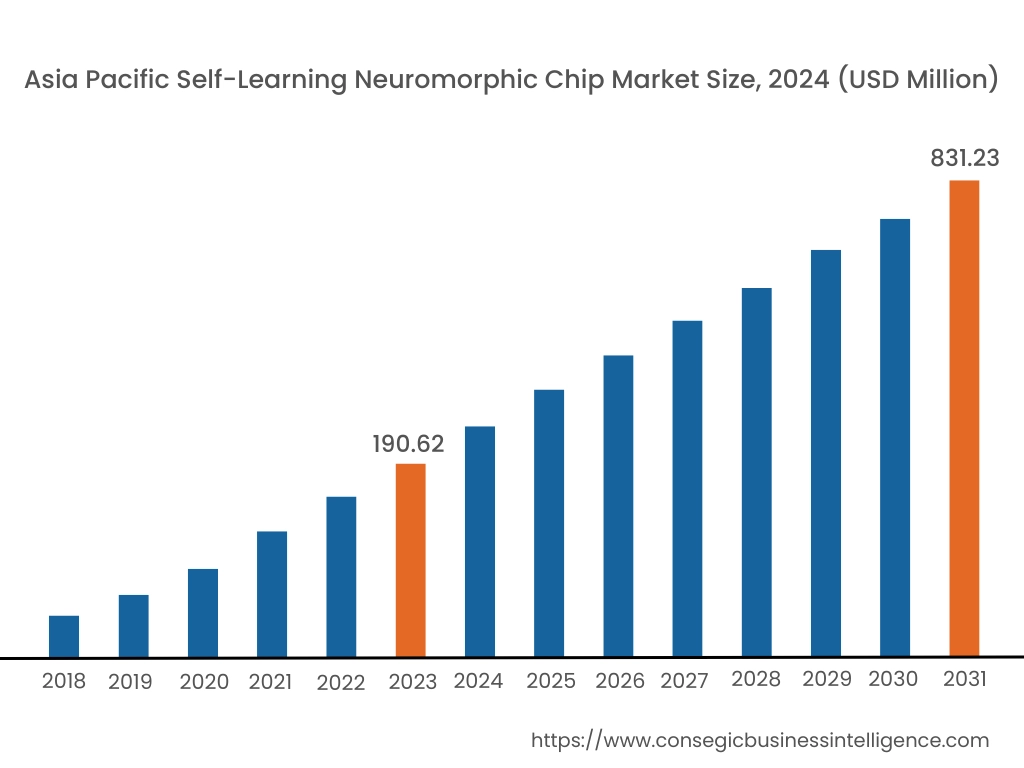
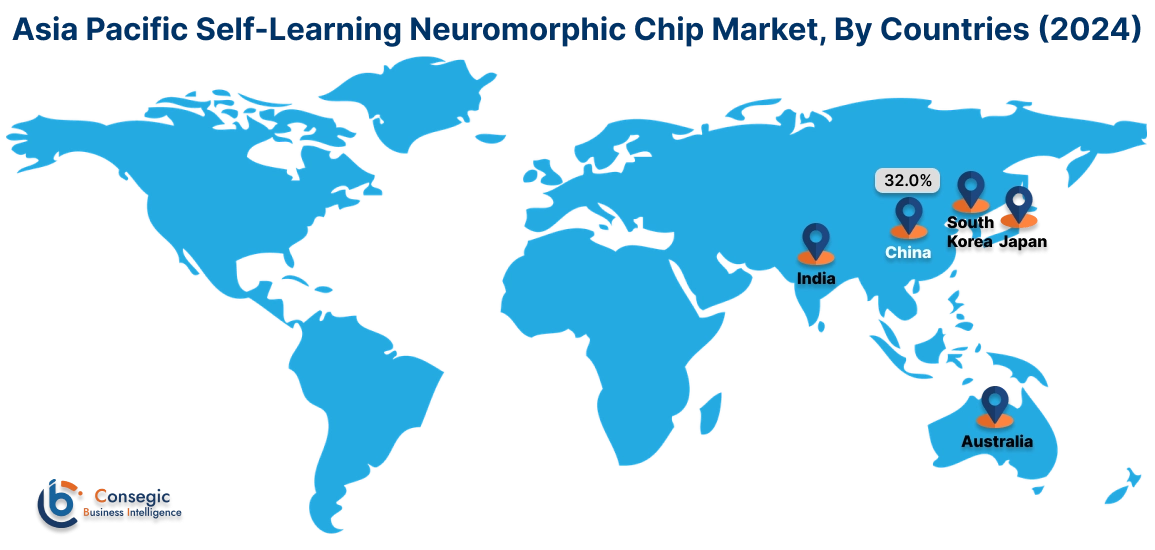
Asia Pacific region was valued at USD 190.62 Million in 2024. Moreover, it is projected to grow by USD 225.60 Million in 2025 and reach over USD 831.23 Million by 2032. Out of this, China accounted for the maximum revenue share of 32.0%. As per the analysis, the increasing pace of industrialization and development is creating lucrative growing prospects for the market in the region. Additionally, key trends including the evolution of various industries including robotics, consumer electronics, automotive, and others are driving the self-learning neuromorphic chip industry in the Asia-Pacific region.
- For instance, according to the International Federation of Robotics, the installation of industrial robots in China reached 268,195 units in 2021, witnessing a strong progress of 51% as compared to 2020. Meanwhile, installation of industrial robots in Japan reached 47,182 units in 2021, depicting an increase of 22% as compared to 2020. Self-learning chips are primarily used in the robotics sector for application in diverse visual tasks such as navigation, motion estimation, localization, object recognition, tracking, and others.
Therefore, the growing robotics sector in the Asia-Pacific region is anticipated to drive the utilization of chips, thereby proliferating self-learning neuromorphic chip market growth in the region during the forecast period.
North America is estimated to reach over USD 1,572.67 Million by 2032 from a value of USD 792.02 Million in 2024 and is projected to grow by USD 849.28 Million in 2025. According to the self-learning neuromorphic chip market analysis, the North American region is primarily driven by its deployment in automotive, aerospace & defense, healthcare, and other sectors. Moreover, the increasing automotive production and rising utilization in automobiles ADAS applications are among the significant factors driving the market in the region.
- For instance, according to the International Organization of Motor Vehicle Manufacturers, the automobile production in the North America reached 14.79 million in 2022, depicting a progress of 10% in comparison to 2021.
Thus, the evolution of automotive sector is boosting the deployment of neuromorphic chip for applications including lane detection, driver attention tracking, obstacle detection, and others, in turn accelerating market in the North American region.
In addition, rising investments in air defense systems and medical imaging are projected to boost the market in North America during the forecast period.
Self-Learning Neuromorphic Chip Market Competitive Landscape:
The global self-learning neuromorphic chip market is highly competitive with major players providing chips to the national and international markets. Key players are adopting several strategies in research and development (R&D), product innovation, and end-user launches to hold a strong position in the self-learning neuromorphic chip industry. Key players in the self-learning neuromorphic chip market include-
- Intel Corporation
- General Vision Inc.
- Numenta
- GrAI Matter Labs
- Polyn Technology
- SynSense
- IBM Corporation
- BrainChip Inc.
- Hewlett Packard Enterprise Development LP
- Samsung
Recent Industry Developments:
- In March 2023, Polyn Technology launched VibroSense, an ultra-low power neuromorphic chip optimized for predictive maintenance. The chip is capable of performing pre-processing of vibration data on the sensor node while addressing key challenges of Industrial IoT.
Self-Learning Neuromorphic Chip Market Report Insights :
| Report Attributes | Report Details |
| Study Timeline | 2021-2034 |
| Market Size in 2034 | USD 5,074.65 Million |
| CAGR (2026-2034) | 22.30% |
| Base Year | 2025 |
| By Functionality |
|
| By End-User |
|
| By Region |
|
| Key Players |
|
| North America | U.S. Canada Mexico |
| Europe | U.K. Germany France Spain Italy Russia Benelux Rest of Europe |
| APAC | China South Korea Japan India Australia ASEAN Rest of Asia-Pacific |
| Middle East and Africa | GCC Turkey South Africa Rest of MEA |
| LATAM | Brazil Argentina Chile Rest of LATAM |
| Report Coverage |
|
Key Questions Answered in the Report
What is self-learning neuromorphic chip? −
Self-learning neuromorphic chips utilize physical artificial neurons for performing computations and are optimized to mimic structure and functionality of the human brain.
What specific segmentation details are covered in the self-learning neuromorphic chip report, and how is the dominating segment impacting the market growth? +
For instance, by functionality segment has witnessed image processing as the dominating segment in the year 2024, owing to the increasing utilization of self-learning neuromorphic chip for performing image recognition in multiple industries including automotive, healthcare, consumer electronics, defence, and others.
What specific segmentation details are covered in the self-learning neuromorphic chip market report, and how is the fastest segment anticipated to impact the market growth? +
For instance, by end-user segment has witnessed consumer electronics as the fastest-growing segment during the forecast period due to rising adoption of self-learning neuromorphic chip for application in smartphones, smart lighting, smart cameras, and other smart appliances.
Which region/country is anticipated to witness the highest CAGR during the forecast period, 2025-2032? +
Asia-Pacific is anticipated to register fastest CAGR growth during the forecast period due to rapid pace of industrialization and growth of multiple industries such as robotics, automotive, consumer electronics, and others.
Overview
Reputation & Certifications


Our Services
- Market Intelligence & Forecasting
- Custom Research Solutions
- Market Entry Strategy
- Competitive Intelligence
- Customer Insights
- Industry Innovation Analysis
- Investment Advisory