Jump to Content
Unmanned Surface Vehicle Market - Size, Share, Industry Trends, and Forecasts (2025-2035)
Unmanned Surface Vehicle Market Size:
Unmanned Surface Vehicles Market size is estimated to reach over USD 4.85 Billion by 2035 from a value of USD 1.68 Billion in 2024 and is projected to grow by USD 1.85 Billion in 2025, growing at a CAGR of 10.13% from 2025 to 2035
Unmanned Surface Vehicles Market Scope & Overview:
Unmanned surface vehicles (USVs) are autonomous or remotely controlled surface platforms used for surveillance, reconnaissance, charting, and inspection missions in various maritime environments. The unmanned surface vehicle market includes various hardware, propulsion, communication, and control software that facilitate remote or autonomous operation of the platform. The integration of satellite communication, radar, and LiDAR, along with processing capabilities, provides real-time navigation, obstacle avoidance, and control capabilities to the unmanned surface vehicle.
Growth of the unmanned surface vehicle market is supported by rising demand for maritime security and surveillance and increasing naval modernization programs. Adoption of autonomous technologies in offshore energy and oceanographic research is expanding deployment. USVs improve operational efficiency and reduce human exposure to hazardous marine environments. Long-duration missions with reduced operational expenses are driving the unmanned surface vehicle market in the military and commercial maritime sector.
Unmanned Surface Vehicle Market Size & Forecast
- 2024 Market Size : USD 1.68 Billion
- 2025 Market Size : USD 1.85 Billion
- 2035 Projected Market Size : USD 4.85 Billion
- CAGR (2025-2035) : 10.13%
- Largest Market in 2025: North America
How is the Unmanned Surface Vehicle Market Affected by AI?
AI improves unmanned surface vehicle operations through machine learning and sensor fusion technologies that process navigation and surveillance data with higher accuracy. Radar, LiDAR, sonar, GPS, and on-board camera integration can aid in real-time decision-making and minimize the chances of collisions.
In addition to this, AI can aid in route planning, obstacle detection, and target tracking in fluctuating sea conditions. Predictive analytics can improve maritime surveillance and aid in semi-autonomous vessel operations.

Unmanned Surface Vehicles Market Dynamics - (DRO):
Key Drivers:
Rising naval modernization programs and maritime security concerns accelerate procurement of unmanned surface vehicles
Growing geopolitical tensions, maritime boundary disputes, and increasing emphasis on naval preparedness are strengthening investments in fleet modernization programs. The defense authorities are spending more on autonomous surface platforms to improve maritime domain awareness, surveillance, mine countermeasure operations, and anti-submarine warfare operations.
- For instance,in March 2026, Navantia proposed a strategic naval cooperation agreement with Denmark to support Denmark’s upcoming frigate acquisition program and its plans to expand its naval fleet starting in 2030. The proposal pointed to the growing trend in naval modernization initiatives as European and NATO allies build up their maritime capabilities through industrial cooperation, system integration, and support solutions.
Therefore, the growing trend in naval modernization initiatives and maritime security priorities fuels the expansion of the unmanned surface vehicle market.
Key Restraints:
High capital investment and system integration costs limit large-scale deployment
The development and deployment of sophisticated unmanned surface vehicles require a high level of capital investment in terms of sophisticated navigation software, propulsion modules, and communication systems, as well as high-performance sensor payloads. The integration of these systems with defense networks makes the engineering process more intricate and time-consuming.
Therefore, high upfront investment and integration expenses are restraining broader adoption of unmanned surface vehicles.
Future Opportunities:
Advancements in autonomous navigation systems and sensor integration enhance mission endurance and reliability
Technological advances in autonomous navigation systems, satellite communication networks, and multi-sensor fusion systems have been instrumental in enhancing the capabilities of unmanned surface vehicles. The current unmanned surface vehicles have been equipped with the latest technologies, including radar systems, LiDAR systems, electro-optical systems, and sonar systems, which enable unmanned surface vehicles to perform with precision and awareness in different marine environments.
- For instance, in February 2026, HMM and HD Hyundai announced one of the largest AI autonomous navigation projects in February 2026, which focused on integrating the latest technologies with machine learning systems for the safe navigation of vessels. The announcement marked one of the major steps towards the development of autonomous navigation systems.
Hence, rapid technological progress in navigation systems and sensor integration is strengthening operational reliability and supporting growth of the unmanned surface vehicle market.
Unmanned Surface Vehicles Market Segmental Analysis:
By Type:
On the basis of type, the Unmanned Surface Vehicles market is segmented into autonomous and semi-autonomous.
Trends in the type:
- The increasing emphasis on reducing crew exposure in high-risk maritime missions is strengthening the demand for fully autonomous surface platforms.
- The integration of AI-enabled navigation, obstacle avoidance, and mission planning systems is accelerating the transition toward higher autonomy levels.
The autonomous systems was responsible for the highest revenue share in 2024.
- Autonomous unmanned surface vehicles use sensors, satellite communications, and advanced control algorithms to operate independently without any human intervention.
- The growing deployment of autonomous platforms for intelligence, surveillance, and reconnaissance missions is supporting segment dominance.
- Moreover, naval modernization programs focused on distributed maritime operations are increasing procurement of fully autonomous vessels.
- Further, improvements in maritime situational awareness and real-time data transmission are strengthening operational efficiency.
- Thus, rising demand for persistent and low-risk maritime operations is driving the leadership of the autonomous segment.
It is anticipated that the semi-autonomous systems will exhibit the highest compound annual growth rate (CAGR) during the forecast period.
- Semi-autonomous unmanned surface vehicles operate in remote supervision while carrying out their navigation and mission parameters.
- The reduced acquisition costs compared to autonomous unmanned vehicles are supporting the growth of emerging naval forces.
- Furthermore, the growing trend of using remote-controlled unmanned surface vehicles in port security and coastal surveillance is contributing to segment growth.
- Moreover, the upgrading trend from conventional patrol vessels to semi-autonomous unmanned vessels is supporting fleet transformation strategies.
- Therefore, cost-efficiency and operational flexibility are expected to accelerate growth of the semi-autonomous segment.
By Size:
On the basis of size, the market is divided into small, medium, and large unmanned surface vehicles.
Trends in the Size:
- Rising requirement for compact and deployable platforms for coastal and harbor surveillance is supporting demand for small-sized vehicles.
- The increasing need for long-endurance missions in open-sea operations is strengthening the development of medium and large platforms.
Medium size represented the highest revenue share in 2024.
- Medium platforms offer balanced endurance, payload capacity, and operational range for multi-mission roles.
- The increasing use of medium USVs for mine countermeasures and ISR operations is aiding the dominance of this segment.
- Furthermore, the prospect of using medium USVs for integrating different payloads, including sonar devices, radar devices, and communication devices, is aiding adoption
- Moreover, naval forces are focusing on deploying USVs with multiple capabilities, including independent operation and operation with manned vessels.
- Thus, operational flexibility and mission adaptability are supporting the leadership of the medium segment.
Small size is anticipated to exhibit the most rapid compound annual growth rate (CAGR) throughout the forecast period.
- Small USVs are increasingly used for short-range reconnaissance, hydrographic surveys, and port monitoring.
- The ease of deployment from larger vessels and land-based platforms is aiding rapid adoption.
- Furthermore, the reduced costs of production and maintenance are aiding adoption for different commercial and research purposes.
- Further, technological miniaturization of sensors and communication systems is enhancing platform capabilities.
- Therefore, compact design and cost advantages are expected to drive accelerated growth of the small segment.
By Application:
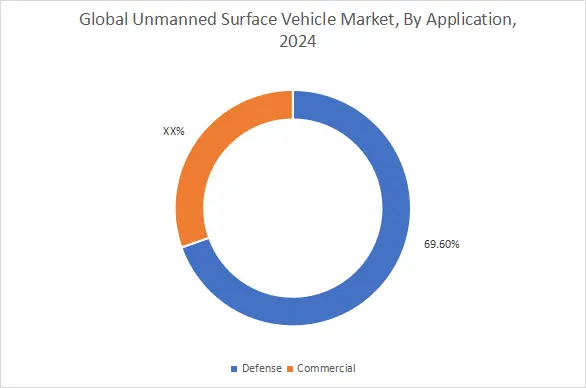
On the basis of application, the unmanned surface vehicles market is divided into defense and commercial.
Trends in the Application:
- The increasing focus on maritime domain awareness and naval modernization is strengthening defense sector adoption.
- Growing demand for oceanographic research and offshore infrastructure monitoring is supporting commercial deployment.
Defense accounted for the largest revenue share of 69.6% in the year 2024.
- Unmanned surface vehicles are widely deployed for ISR, mine countermeasures, anti-ship warfare, communication gateway operations, and other naval missions.
- The increasing integration of USVs into network-centric warfare strategies is strengthening defense adoption.
- Moreover, the rising need for persistent maritime surveillance in contested waters is supporting long-endurance deployments.
- Furthermore, investments in autonomous swarm technologies and remote combat are also contributing to segment dominance.
- Hence, strategic maritime security initiatives and fleet modernization programs are fueling segment leadership in the defense domain.
Commercial application is anticipated to register the fastest CAGR during the forecast period.
- USVs are increasingly used for weather and environmental monitoring, hydrographic surveys, and offshore infrastructure inspection.
- The expansion of offshore oil and gas exploration activities is strengthening demand for autonomous inspection platforms.
- Moreover, the rising focus on marine environmental protection and climate research is supporting long-duration survey missions.
- Further, port authorities and logistics operators are deploying USVs for automated monitoring and security operations.
- Therefore, expanding maritime industrial activities and digital ocean mapping initiatives are expected to accelerate commercial segment growth.
Regional Analysis:
North America, Europe, Asia Pacific, the Middle East and Africa, and Latin America are the regions of coverage.
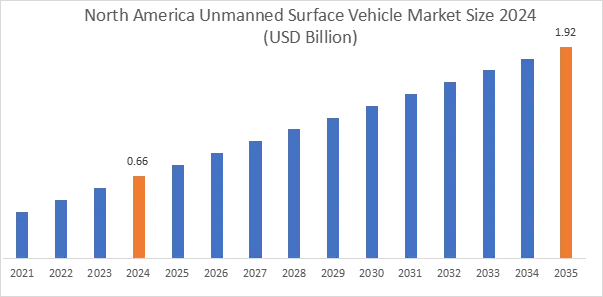
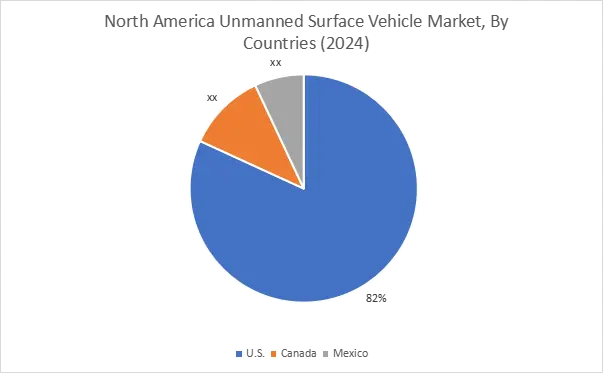
In 2024, North America accounted for the highest market share at 39.5% and was valued at USD 0.66 Billion, and is expected to reach USD 1.92 Billion by 2035. In North America, the U.S. accounted for the highest market share of 82% during the base year of 2024. growth is being bolstered by robust naval modernization initiatives undertaken by the US Navy, focusing on distributed maritime operations, autonomous surface fleets, and multi-domain command integration. Defense agencies are allocating greater budgets towards unmanned platforms, focusing on intelligence, surveillance, reconnaissance, mine countermeasures, and secure communication.
- For instance, in March 2026, Northrop Grumman won a contract modification worth USD 225 million from the US Navy for developing and providing training systems and courseware for E-130J Phoenix II aircraft as part of the TACAMO recap program.
Asia Pacific market is expected to experience the highest growth rate during the forecast period. The growth is attributed to rapid naval force development and modernization in China, India, Japan, and Korea to reinforce maritime dominance and deterrence potential in these regions. Governments are increasingly investing in procurement of autonomous maritime systems to improve ISR operations, ASW preparedness, and coastal surveillance.
- For example, the Stockholm International Peace Research Institute stated that China increased its nuclear warhead stockpile from 500 to 600 between 2024 and 2025, an increase of 20%.
Europe unmanned surface vehicle market growth is supported by naval modernization programs in the UK, France, and Norway. Rising investment in maritime surveillance and border security is supporting deployment of autonomous vessels.
Latin America unmanned surface vehicle market growth is supported by maritime monitoring programs in Brazil and Mexico. Governments are strengthening coastal security and illegal fishing surveillance activities.
Middle East and Africa unmanned surface vehicle market is driven by investments in maritime security in the UAE and Saudi Arabia. The expansion of ocean research and monitoring projects in South Africa is also contributing to the growth of the unmanned surface vehicle market.
Top Key Players & Market Share Insights:
The unmanned surface vehicle market is a competitive market with major defense companies and marine technology companies delivering unmanned and semi-autonomous unmanned surface vehicles for naval and marine applications both at the national and international levels. The companies are focusing on fleet modernization contracts, technology partnerships, and cross-border collaborations to improve their market position. Key participants in the market for unmanned surface vehicles include:
- L3Harris Technologies, Inc. – US
- Kongsberg Gruppen ASA – Norway
- Teledyne Technologies Incorporated – US
- Textron Inc. – US
- Elbit Systems Ltd. – Israel
- Thales Group – France
- Atlas Elektronik GmbH – Germany
- BAE Systems plc – UK
- Exail Technologies – France
- Saab AB – Sweden
Recent Industry Developments:
Funding
- In March 2026, Mahi unveiled a demonstration unmanned surface vehicle (USV) designed to accelerate real-world testing of autonomous maritime defense systems.
- In March 2026, the VigilanSea Project was initiated to design and develop an autonomous network of maritime systems that will bring together unmanned surface vessels and aerial drones to provide persistent surveillance and reconnaissance capabilities.
- In February 2026, Greek SAS Technology and UK’s Sigmund Naval & Marine pitched new modular USV designs (7m patrol to 26m strike vessels) to the Hellenic Navy, featuring 70+ knot speeds, swarm ops, EO/IR sensors, and NATO weapons for Aegean ISR and defense.
Unmanned Surface Vehicles Market Report Insights:
| Report Attributes | Report Details |
|---|---|
| Study Timeline | 2019-2035 |
| Market Size in 2035 (USD Billion) | USD 4.85 Billion |
| CAGR (2025-2035) | 10.13% |
| By Type |
|
| By Size |
|
| By Application |
|
| By Region |
|
| Key Players |
|
| Report Coverage |
|
Key Questions Answered in the Report
How big is the unmanned surface vehicles market? −
The unmanned surface vehicles market size is estimated to reach over USD 4.85 Billion by 2035 from a value of USD 1.68 Billion in 2024 and is projected to grow by USD 1.85 Billion in 2025, growing at a CAGR of 10.13% from 2025 to 2035.
Which segmentation details are covered in the unmanned surface vehicles report? +
The unmanned surface vehicle report includes detailed segmentation based on type, size, application, and regions.
Which is the fastest segment anticipated to impact the market growth? +
Commercial segment projected to register the fastest CAGR, driven by rising use in monitoring, surveys, offshore inspection, and port security.
Who are the major players in the unmanned surface vehicles market? +
The key participants in the unmanned surface vehicles market are L3Harris Technologies, Inc. (US), Kongsberg Gruppen ASA (Norway), Teledyne Technologies Incorporated (US), Textron Inc. (US), Elbit Systems Ltd. (Israel), Thales Group (France), Atlas Elektronik GmbH (Germany), BAE Systems plc (UK), Exail Technologies (France), and Saab AB (Sweden), among others.
What are the key trends in the unmanned surface vehicles market? +
Market influenced by naval modernization, AI enabled autonomous navigation, and multi sensor integration.
Overview
Reputation & Certifications


Our Services
- Market Intelligence & Forecasting
- Custom Research Solutions
- Market Entry Strategy
- Competitive Intelligence
- Customer Insights
- Industry Innovation Analysis
- Investment Advisory