Jump to Content
Artificial Heart Market Size & Industry Share - Growth Trends & Forecasts (2026 - 2034)
Artificial Heart Market Size:
The Artificial Heart Market is expected to expand from 3,045.65 (US$M) in 2025 to 3,465.95 (US$M) in 2026, and is forecast to surpass 9,749.01 (US$M) by 2034, growing at a CAGR of 13.8% between 2026 and 2034, according to a recent report from Consegic Business Intelligence.
Artificial Heart Market Scope & Overview:
The artificial heart is a mechanical pump that replaces the heart and is used to keep a person alive while they wait for a donor's heart. It is placed in the chest to replace a damaged heart or diseased heart. It is classified into two types mainly heart-lung machine and mechanical heart. The heart-lung machine is a mechanical pump that maintains a patient's blood circulation and oxygenation during heart surgery. Mechanical hearts, which include total artificial heart (TAH) and ventricular assist devices (VADs), are machines that are capable of replacing or assisting the pumping action of the heart for prolonged periods without causing excessive damage to the blood components. It is used as a temporary solution for individuals who are on a waiting list for a heart transplant. Patients with advanced damaged heart or heart failure are the target audience for the market.

Artificial Heart Market Dynamics - (DRO) :
Key Drivers:
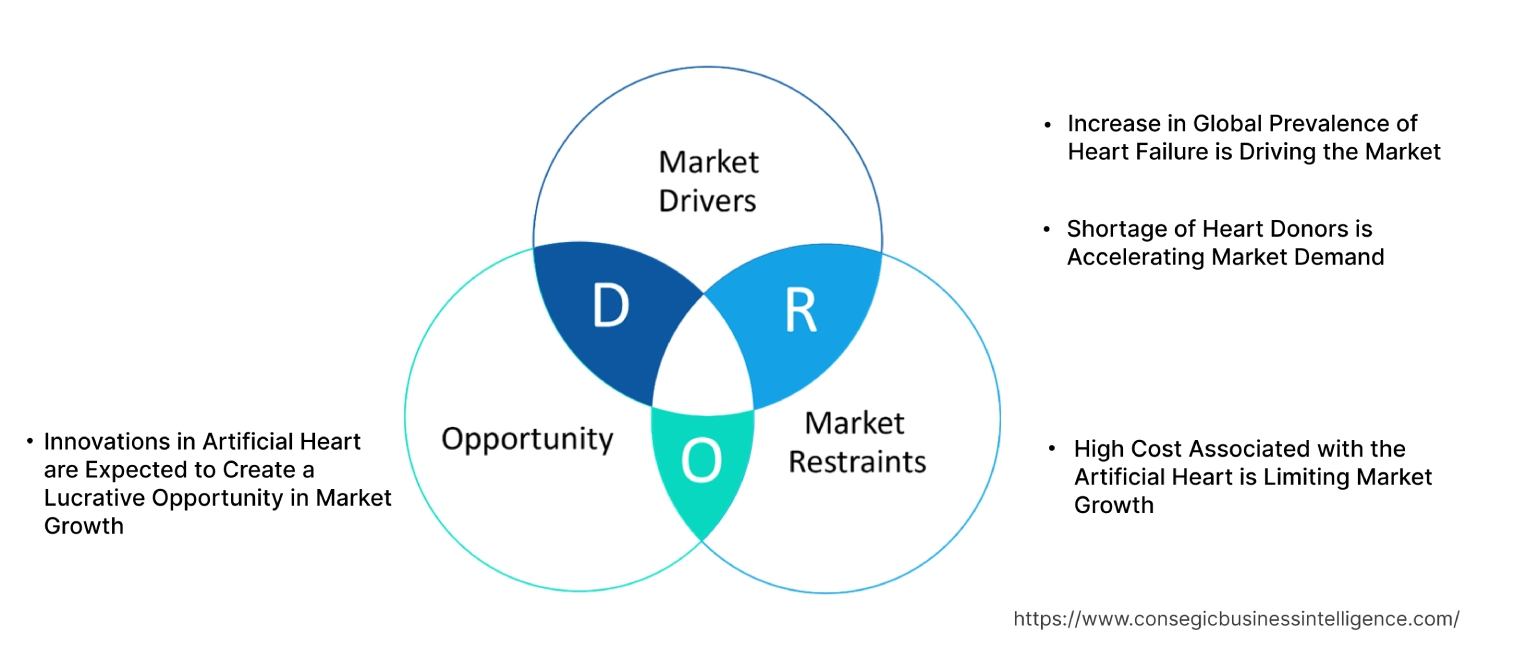
Increase in Global Prevalence of Heart Failure is Driving the Market
Heart failure, a condition where the heart struggles to pump blood effectively, is a significant health issue that is steadily increasing. Factors contributing to the increasing prevalence of heart failure are the aging population who are more susceptible to age-related heart conditions, making them more likely to develop heart failure. Additionally, lifestyle choices such as smoking, excessive alcohol consumption, and poor diet contribute significantly to the development of this condition. Moreover, underlying medical conditions like diabetes, hypertension, and coronary artery disease further elevate the risk of heart failure. The impact of heart failure is far-reaching, leading to reduced quality of life, increased healthcare costs, and a substantial growth in mortality rates.
- For instance, In 2023 according to the National Center of Biotechnology Information, heart failure is a rapidly growing public health issue with a prevalence of 64 million people globally.
As more individuals suffer from heart failure, the need for effective treatment options grows, leading to an increase in the need for advanced solutions. Thus, the analysis of the artificial heart market trend depicts that, due to the increased prevalence of heart failure, the artificial heart market share is increasing significantly.
Shortage of Heart Donors is Accelerating Market Demand
Heart transplantation remains the most preferred solution for treating end-stage heart failure, but the limited availability of donor organs poses a major obstacle. This disparity between the number of patients in need of a transplant and the available donor organs has led to a growing reliance on artificial heart technology. These devices offer a promising solution, providing life-sustaining support for patients awaiting a suitable donor heart or serving as a long-term therapy for those ineligible for transplantation.
- In 2022 according to the National Center of Biotechnology Information, the annual number of heart transplants worldwide has steadily increased, surpassing 5,000 annually, with over half of these procedures performed in the United States. However, the annual number of transplants is constrained by the limited availability of donor organs, as the demand significantly exceeds the supply.
As the requirement for heart transplants continues, the artificial heart market demand is poised for substantial artificial heart market growth in the coming years. Hence, as per the artificial heart market analysis, because of the shortage of donor hearts, the artificial heart industry demonstrated market expansion.
Key Restraints :
High Cost Associated with the Artificial Heart is Limiting Market Growth
The increased cost of novel devices remains a significant restraint to widespread adoption. The complex manufacturing processes, specialized materials, and ongoing maintenance requirements contribute to the substantial expense associated with these devices. This high cost limits accessibility, particularly for individuals in regions with lower-income populations or less developed healthcare systems.
The increased cost is due to their superior performance, which translates to increased patient benefits and reduced healthcare costs in the long run. However, the initial investment required for development and production remains substantial, hindering the adoption of these devices. The average cost ranges from USD 54,000 to USD 98,000, posing a significant financial burden on patients and their families.
Even in developed nations, insurance coverage for these devices is inadequate, further limiting accessibility. Hence, the high cost continues to be a major obstacle to the development of the market and the widespread adoption of this life-saving technology.
Future Opportunities :
Innovations in Artificial Heart are Expected to Create a Lucrative Opportunity in Market Growth
Ongoing innovations are poised to create significant artificial heart market opportunities. Advancements in materials science, optimized design, and biocompatibility are leading to the development of more durable, efficient, and patient-friendly devices. These innovations have the potential to reduce complications, improve long-term outcomes, and expand the patient population eligible for artificial heart implantation.
Innovation in optimizing artificial heart function involves combining centrifugal rotary pump and magnetic levitation (MAGLEV) technologies to create a biventricular system. This innovation includes a single pump rotor that pumps blood to the body and lungs. The pump's unique impellers are capable of producing high physiological blood flows with low power consumption. Additionally, the pumps have no bearings, and the magnetic levitation improves its durability.
Heart failure is a global epidemic affecting at least 26 million people, with 6.2 million adults in the United States, and is still increasing in prevalence. Heart transplantations are reserved for those with severe heart failure and are limited to fewer than 6,000 procedures per year. This innovation is expected to prolong the waiting time of patients with heart failure to get a suitable donor's heart.
- In 2024 BiVACOR Inc., a medical device company, developed BiVACOR TAH, which is an innovative artificial heart with improved durability, power, and adaptability. It has a simple design and contains a single motor and a single magnetically levitated rotor. This device pump operation is driven by a smart controller that adapts to changes in patient activity and cardiac output demand leading to increasing market need for innovative solutions.
Owing to the aforementioned factors, innovation in this sector is expected to present lucrative artificial heart market opportunities.
Artificial Heart Market Segmental Analysis :
By Product Type:
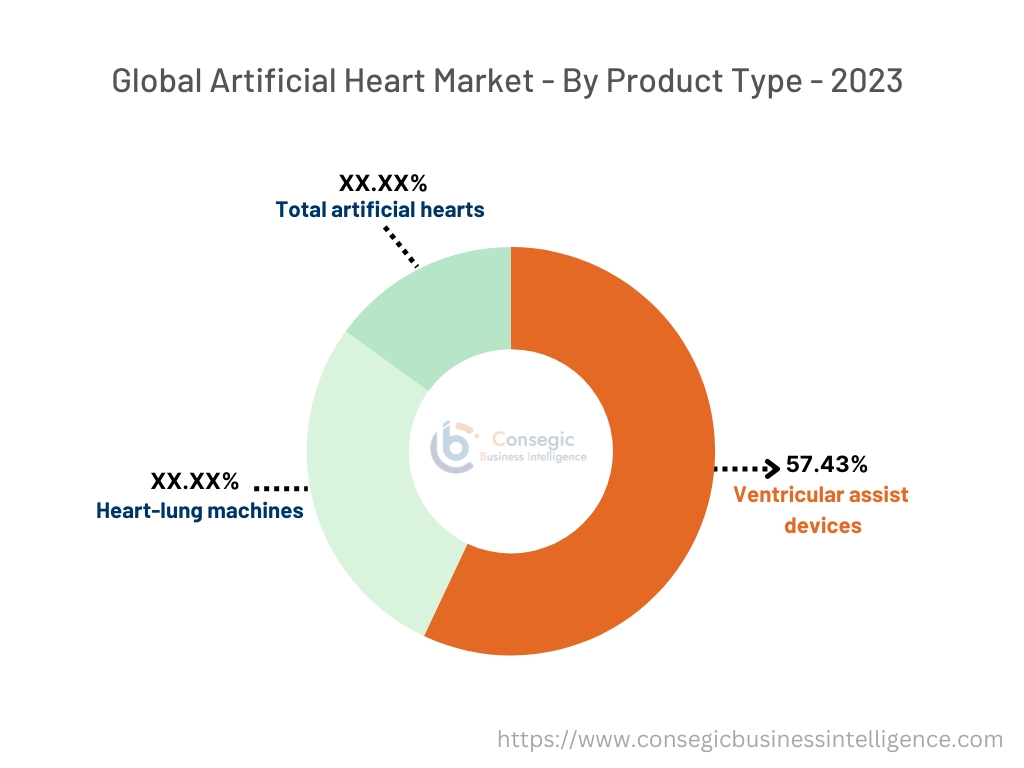
Based on product type the segment is categorized into heart-lung machines, total artificial hearts, and ventricular assist devices.
Trends in the Product Type:
- Increasing adoption of TAH due to improved technological advancements such as reliability, durability amongst others
Ventricular assist devices accounted for the largest artificial heart market share of 57.43% in the year 2023.
- A ventricular assist device (VAD) is a mechanical pump that helps a weakened heart pump blood. It can be used as a bridge to heart transplantation or as a long-term solution for patients with advanced heart failure.
- The dominance is primarily attributed to their widespread application as a bridge to heart transplantation or as a long-term solution for patients with advanced heart failure.
- The higher prevalence of single-ventricular heart failure conditions, such as ischemic cardiomyopathy, makes VADs a suitable treatment option.
- Additionally, the established technology and extensive clinical experience associated with VADs contribute to their market dominance. The versatility of VADs, which can be utilized for both short-term and long-term support, further enhances their appeal.
- With 22,000 devices implanted to date in America and 2500 new implant cases occurring annually, patients demonstrate a 70% to 80% survival rate.
- In 2023, according to the National Center of Biotechnology Information, the use of a left ventricular assist device (LVAD) is growing in popularity.
- Thus, as per the analysis of segmental trends, the ventricular assist device market is expected to foster growth, due to its increased efficiency.
The total artificial heart segment is anticipated to register the fastest CAGR during the forecast period.
- A TAH is a mechanical device that replaces both the left and right ventricles of the human heart. It is designed to take over the pumping function of a failing heart, providing continuous blood flow to the body.
- It offers superior benefits compared to other types such as ventricular assist devices due to its ability to fully replace the native heart, providing optimal blood flow and cardiac output.
- As TAHs become more reliable, durable, and effective, they are increasingly being considered as a viable treatment option for patients with end-stage biventricular heart failure.
- In 2022, according to a study published in Nature Review Cardiology Journal, TAH has so far been successfully implanted in 1,700 patients globally, as a temporary life-saving technology.
- Additionally, as per the analysis of segmental trends, ongoing research and development efforts are focused on improving the design, performance, and long-term durability of TAHs, further fueling artificial heart market growth.
By End-Use:
Based on the end-use segment is categorized into Hospitals and Ambulatory Surgical Centers.
Trends in the End Use:
- Hospitals are well-equipped to provide the advanced care and monitoring necessary for patients with artificial hearts
- Ambulatory surgical centers focus on providing a patient-centered experience, which is beneficial for individuals receiving artificial heart devices.
The hospitals as an end-use account for the largest market share for the year 2023.
- Hospitals dominate the market due to the complex nature of artificial heart procedures and the specialized care required for patients who require artificial hearts.
- The implantation of artificial hearts necessitates advanced surgical expertise, specialized infrastructure, and intensive post-operative care, all of which are readily available in hospital settings.
- Hospitals are also at the forefront of medical research and development, driving innovation and participating in clinical trials.
- Additionally, hospitals are well-versed in regulatory compliance and reimbursement mechanisms, ensuring patient safety and facilitating the adoption of cardiovascular technology.
- In 2021, A surgical team at Duke University Hospital, led by Drs. Jacob Schroder and Carmelo Milano, successfully implanted a new-generation artificial heart in a 39-year-old man with heart failure, becoming the first hospital in North America to perform the procedure.
- Thus, an analysis of segmental trends concludes that the use of this device in the hospital sector is dominating the market.
The Ambulatory Surgical Centers segment is anticipated to register the fastest CAGR during the forecast period.
- Ambulatory Surgical Centers (ASCs) are poised to experience significant growth in the market. Advancements in minimally invasive surgical techniques, coupled with the cost-effectiveness and patient-centric approach of ASCs, are driving this trend.
- Less invasive procedures lead to shorter recovery times, reduced hospital stays, and lower overall costs. Additionally, ASCs often offer a more convenient and personalized patient experience.
- As the healthcare industry continues to evolve, ASCs are expanding their range of services to include more complex procedures.
- In 2023, according to Cardiovascular Business, to reduce the healthcare costs associated with straightforward, minimally invasive cardiovascular procedures, more and more ambulatory surgical centers (ASCs) and office-based labs (OBLs) are opening all over the United States. These outpatient centers often perform the same procedures as hospital-based cath labs at about half the cost.
- Thus, the segmental trend of artificial heart market analysis depicts that there is an increase in the adoption of this device in the research sector for R&D purposes.
Regional Analysis:
The regions covered are North America, Europe, Asia Pacific, the Middle East and Africa, and Latin America.
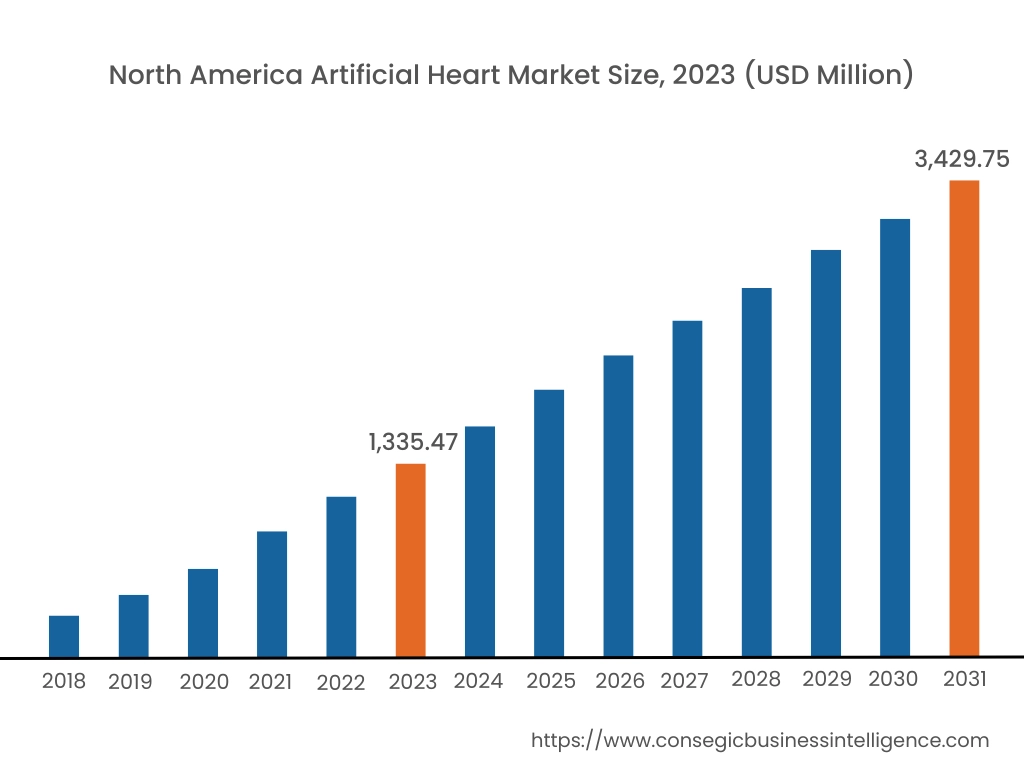
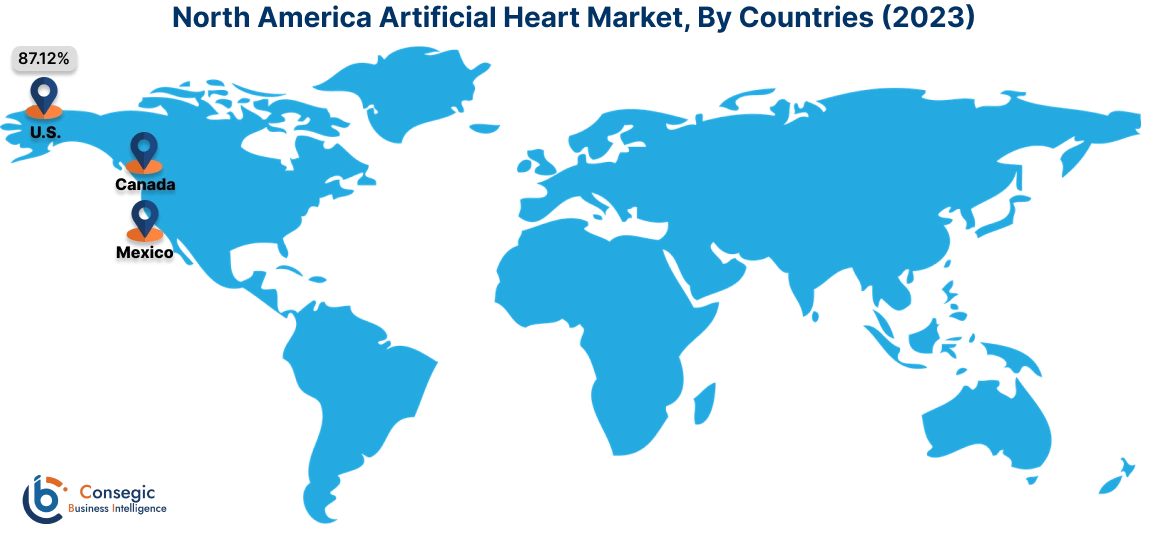
In 2023, North America accounted for the highest market share at 56.45% and was valued at USD 1,335.47 Million, and is expected to reach USD 3,429.75 Million in 2031. In North America, the U.S. accounted for the highest market share of 87.12% during the base year of 2023. There are increased number of individuals suffering from heart disease in North America. Thus, as the prevalence is rising, more patients especially in the United States are being observed to undergo heart transplantation. With the limited availability of donor hearts, artificial hearts have become a crucial option for patients who are not eligible for transplantation or are waiting for a transplant. Hence, due to this, there is a growing need for this device among heart disease patients in North America.
- In 2022, according to a study published in the American Journal of Heart Transplantation, 4,446 new adult candidates were added to the heart transplant waiting list in the United States. This shows that there is an increase in the need for artificial hearts in the United States.
Hence, due to the increase in the prevalence of heart diseases and the increase in heart transplantation candidates, the artificial heart market trend is fostering growth in North America.
Asia Pacific is expected to witness the fastest CAGR over the forecast period of 16.5% during 2024-2031. The Cardiac care infrastructure in the Asia Pacific is rapidly improving, marked by an increasing number of cardiology specialty centers. Governments in countries like China, Australia, India, and others are investing heavily in advanced medical technology such as artificial hearts. The investment in developing this device not only enhances the quality of life but also contributes to higher survival rates for individuals undergoing cardiac surgery.
Furthermore, nearly 500,000 Australians live with heart failure. The grants provided by the government will increase the manufacturing rate of this device and help reduce the mortality rate.
- In 2022 according to the Department of Health and Aged Care, the Albanese Government is providing USD 50 million to develop and commercialize the world's most advanced artificial heart, a technology that could reduce deaths from heart failure globally and contribute USD 1.8 billion to Australia and Australian society. Thus, due to the provision of government grants, there is increased development of this device in the Asia Pacific region.
Thus, as per the regional trend analysis, due to investment by the government, the artificial heart market demand is expected to have a great opportunity in the Asia Pacific region.
Europe plays a significant role in the market. The region boasts a strong healthcare infrastructure, with world-class hospitals and advanced medical research institutions. The European Heart Network estimates more than 10 million people in the EU are likely to be affected by heart failure. Furthermore, European governments are trying to improve the commercialization of artificial hearts to help patients with heart failure.
Additionally, another European project is developing this device using soft robotics in the Netherlands. This project is funded by EIC's Pathfinder program, HybridHeart, and is trying to create artificial muscles that mimic the contraction of the heart's natural muscles. Thus, this leads to the artificial heart market expansion in Europe, due to innovation and government initiatives.
Heart transplantation continues to be the gold standard therapy for advanced heart failure in Latin America. Nonetheless, heart transplantation still is a limitation in the region. Latin America is still facing challenges such as a shortage of donors and poor medical infrastructure. Thus, due to this several patients get their clinical status worsened by waiting for a heart transplant.
The application of mechanical circulatory support devices in Latin America aims to help stabilize patients who develop severe heart conditions and help them receive a heart in the short term, serving as a bridge therapeutic strategy. Thus, the artificial heart market expansion in Latin America is still in development.
The increasing diagnosis of congenital heart diseases (CHDs) in the Middle East and Africa highlights a growing need for advanced cardiac care, particularly for pediatric patients. While ventricular assist devices (VADs) offer a promising solution to support heart function in children with CHD, limited access to specialized pediatric cardiac surgery remains a significant restraint in the region. Countries like Ethiopia are actively working to train local surgeons and improve cardiac care for children with CHD, aiming to reduce preventable deaths by 2030. However, the scarcity of skilled pediatric cardiac surgeons in the region continues to hinder the development of a robust artificial heart industry. Despite these hurdles, the future of the market in the Middle East and Africa holds promise, driven by increasing healthcare investments and growing awareness of the need for advanced cardiac therapies.
Top Key Players & Market Share Insights:
The Artificial Heart Market is highly competitive with major players providing products and services to the national and international markets. Key players are adopting several strategies in research and development (R&D), product innovation, and end-user launches to hold a strong position in the Global Artificial Heart Market. Key players in the Market include-
- BiVACOR Inc. (United States)
- SynCardia Systems, LLC (United States)
- Abbott. (United States)
- LivaNova PLC (United Kingdom)
- CARMAT (France)
- Realheart (Sweden)
Recent Industry Developments :
Investment:
- In 2024, BiVACOR Inc., a clinical-stage medical device company, received a grant from Monash University's Artificial Heart Frontiers Program supported by the Australian Government's Medical Research Future Fund, to support clinical trials for its total artificial heart.
- In 2023 according to the European Commission, ArtOfHeart, partly funded by the European Innovation Council (EIC), is investing €38 million to conduct clinical and pre-clinical testing of an artificial heart.
New Launches:
- In 2023, CARMAT, designer and developer of artificial heart, announced the first implant of the Aeson® artificial heart as a therapeutic alternative for patients suffering from advanced biventricular heart failure. CARMAT announced the first implantation of the Aeson® heart in a patient suffering from a cardiac tumor. Furthermore, CARMAT has reached the milestone of 50 implants of its Aeson® heart since inception and achieved sales of €2.8 million in 2023.
- In 2023, a preliminary proxy statement had been filed with the Securities and Exchange Commission by Altitude Acquisition Corp. for its proposed merger with Picard Medical, Inc. and SynCardia Systems LLC. In 2024, SynCardia Systems, LLC., a Picard Medical Company, proudly announces that the U.S. Patent and Trademark Office (USPTO) has allowed claims of its groundbreaking patent application "Next Generation Total Artificial Heart" covering next-generation designs.
Artificial Heart Market Report Insights :
| Report Attributes | Report Details |
| Study Timeline | 2021-2034 |
| Market Size in 2034 | USD 9,749.01 Million |
| CAGR (2026-2034) | 13.80% |
| Base Year | 2025 |
| By Product Type |
|
| By End Use |
|
| By Region |
|
| Key Players |
|
| North America | U.S. Canada Mexico |
| Europe | U.K. Germany France Spain Italy Russia Benelux Rest of Europe |
| APAC | China South Korea Japan India Australia ASEAN Rest of Asia-Pacific |
| Middle East and Africa | GCC Turkey South Africa Rest of MEA |
| LATAM | Brazil Argentina Chile Rest of LATAM |
| Report Coverage |
|
Key Questions Answered in the Report
How big is the Artificial Heart Market? −
Artificial Heart Market size is estimated to reach over USD 6,615.06 Million by 2031 from a value of USD 2,365.76 Million in 2023, growing at a CAGR of 13.8% from 2024 to 2031.
Which is the Largest region in the Artificial Heart Market? +
North America is the Largest region in the Artificial Heart Market.
Which holds the fastest-growing market share for the Artificial Heart Market? +
Asia Pacific is the fastest-growing region in the Artificial Heart Market.
What specific segmentation details are covered in the Artificial Heart Market? +
Product Type and End-Use are the segments that have been covered in the Artificial Heart Market.
Who are the major players in the Artificial Heart Market? +
BiVACOR Inc. (United States), SynCardia Systems, LLC (United States), LivaNova PLC (United Kingdom), Abbott. (United States), CARMAT (France), Realheart (Sweden) are major players.
Overview
Reputation & Certifications


Our Services
- Market Intelligence & Forecasting
- Custom Research Solutions
- Market Entry Strategy
- Competitive Intelligence
- Customer Insights
- Industry Innovation Analysis
- Investment Advisory