Jump to Content
ATM Managed Services Market Size & Industry Share - Growth Trends & Forecasts (2026 - 2034)
ATM Managed Services Market Size & Insights
The ATM Managed Services Market size was valued at 8.72 (USB) in 2025 and is projected to grow from 9.15 (USB) in 2026 to 15.63 (US$B) by 2034, at a CAGR of 6.9% from 2026 to 2034, according to a recent report from Consegic Business Intelligence.
The ATM managed services market is driven by several factors, including the rising adoption of smart and automated ATMs, increasing debit card usage and financial inclusion initiatives in developing regions, growing need for enhanced end-to-end security and anti-skimming protection, and the strategic push by banks to optimize uptime across wide-scale offsite and onsite terminal networks.
ATM Managed Services Market Statistics:
- Current Market Size: USD 8.72 Billion
- Forecast Market Size: USD 15.63 Billion
- CAGR: 6.9%
- Largest Segment: Banks and financial institutions accounted for the largest revenue share in the market in 2025.
- Fastest-Growing Segment: The independent ATM deployers (IADs) segment is anticipated to register the fastest CAGR during the forecast period.
- Largest Geographic Market: Asia Pacific
- Fastest-Growing Geography: Asia Pacific
- Major Companies: NCR Atleos (USA), Euronet Worldwide Inc. (USA), Diebold Nixdorf Incorporated (USA), Hitachi Payment Services (India), Fiserv Inc. (USA), CMS Info Systems Ltd. (India), The Brink’s Company (USA), FIS Global (USA), Hyosung TNS (South Korea), Cennox (United Kingdom), and others.
- Key Technological/Commercial Development: Integration of AI-Driven Predictive Maintenance & Monitoring, Migration to Cloud-Based ATM Platforms, Escalating Cybersecurity & Anti-Skimming Measures, Outsourcing of Non-Core Banking Operations, and Expansion of Smart ATMs & Interactive Capabilities.

Key Growth Drivers in the ATM Managed Services Market
Cost Optimization and Operational Efficiency
- Reduced Overhead Expenditures: Financial institutions are actively outsourcing non-core operational responsibilities to significantly lower the high capital and operational expenditures associated with maintaining dedicated in-house ATM support teams.
- Economies of Scale: Managed Service Providers (MSPs) provide highly cost-effective lifecycle management, ranging from secure cash replenishment to routine field maintenance, allowing regional and global banks to benefit from shared operational efficiencies. By leveraging consolidated vendor networks, institutions achieve lower per-unit support costs than they could independently.
- Focus on Core Competencies: Offloading burdensome ATM infrastructure management frees up internal banking personnel, allowing organizations to redirect valuable human and capital resources toward primary financial services, digital innovation, and strategic client engagement. This alignment fosters improved long-term organizational productivity and competitiveness.
- Maximized Network Uptime: Constant remote monitoring combined with automated alert systems ensures that hardware issues are detected and addressed before they cause prolonged outages. Maintaining high terminal availability directly protects institutional revenue streams and prevents customer churn.
Technological Advancements and Fleet Modernization
- AI and Predictive Analytics: The integration of advanced machine learning algorithms and remote telemetry allows service providers to forecast hardware malfunctions before they result in physical breakdowns. This capability optimizes repair cycles, considerably lowers emergency dispatch costs, and maximizes machine availability.
- Cloud-Based Platforms: The steady transition from legacy systems to cloud-based infrastructure offers banks enhanced scalability, improved data accessibility, and seamless integration with broader digital and mobile banking networks. Cloud architectures also simplify software deployments and firmware updates across distributed fleets.
- Adoption of Smart Cash Recyclers: The deployment of advanced multifunctional ATMs that automatically accept, validate, sort, and recycle deposited cash significantly reduces traditional cash handling, storage, and armored car logistics costs. This technology keeps cash moving efficiently within the local ecosystem without requiring frequent physical interventions.
- Next-Generation User Interfaces: Incorporating contactless payment technology, NFC capabilities, touchscreens, and multimedia features successfully attracts modern consumers who expect intuitive, digital-first interactions. These upgrades help aging physical terminal networks remain relevant alongside modern mobile banking applications.
Rising Focus on Security and Compliance
- Advanced Threat Protection: Increasing sophistication in card skimming, jackpotting, and digital fraud forces financial institutions to rapidly deploy robust anti-skimming mechanisms, biometric verification methods, and end-to-end transaction encryption. Managed service providers specialize in deploying these multi-layered defense frameworks across entire fleets simultaneously.
- Strict Regulatory Mandates: Constantly evolving compliance standards regarding consumer data safety, EMV card migration, and security firmware make expert managed services critical for avoiding heavy regulatory penalties. Banks rely on specialized partners to ensure their entire hardware and software stack remains fully compliant without internal friction.
- Physical and Cybersecurity Convergence: Modern security strategies require linking physical terminal protection with real-time cybersecurity monitoring to establish a unified defense against advanced criminal syndicates. MSPs provide integrated oversight that bridges the gap between physical hardware security and digital network protection.
- Risk Mitigation: Outsourcing reduces individual bank liability by assigning complex compliance obligations, routine security audits, and network protection to seasoned security experts. This shifts the operational burden of risk management away from the financial institution onto specialized providers.
Changing Consumer Demographics and Expansion
- Demand for 24/7 Self-Service Convenience: Modern consumers increasingly expect round-the-clock, frictionless access to banking services, intensifying the reliance on dependable, automated terminal networks. Service providers ensure that these consumer touchpoints remain operational, secure, and accessible at all hours.
- Growth of Independent ATM Deployers (IADs): Independent deployers are expanding rapidly into convenience stores, retail chains, and transit hubs, heavily relying on comprehensive ATM managed services to keep their decentralized, widespread fleets running profitably. This retail-centric expansion creates substantial new revenue streams for the managed services sector.
- Financial Inclusion Initiatives: Government and corporate drives to extend basic banking infrastructure into rural, semi-urban, and underserved geographies create strong demand for reliable, portable, and easily managed remote ATM units. Managed services provide the logistical support required to operate profitably in geographically challenging locations.
- Enhanced Customer Experience (CX): Banks increasingly view reliable self-service channels as an extension of their brand reputation, using ATM managed services to guarantee high transaction success rates and seamless user interactions. Delivering consistent, trouble-free terminal experiences directly builds customer loyalty and long-term brand retention.
ATM Managed Services Market Opportunities
Expansion into Underserved and Rural Geographies
- Targeting Semi-Urban and Rural Areas: Financial institutions and independent deployers have significant opportunities to extend basic banking infrastructure into rural and remote regions. Managed service providers facilitate this expansion by handling the heavy logistics of remote monitoring, cash provisioning, and maintenance.
- Government-Backed Financial Inclusion: Alignment with national initiatives aimed at boosting rural banking access offers lucrative long-term contracts for managed service providers. These initiatives require reliable, portable, and easily managed remote ATM deployment.
- Deployment of Mobile and Micro-ATMs: The rising demand for alternative banking channels creates opportunities to deploy mobile ATM units and micro-terminals in remote communities or temporary event spaces.
Technological Integration and Next-Gen Software Solutions
- AI-Driven Predictive Maintenance: Service providers can leverage advanced machine learning and real-time telemetry to proactively identify hardware faults. This shift from reactive repair to predictive maintenance considerably lowers service costs and creates high-margin service tier opportunities.
- Cloud-Based Platform Migration: Transitioning legacy terminal networks to flexible cloud architectures allows vendors to offer centralized software updates, seamless multi-vendor integration, and lower infrastructure overhead for banks.
- Development of Customized Niche Software: Creating specialized software modules tailored for regional banking networks, alternative currency systems, or specialized transactions, such as localized digital-to-cash or gold exchanges, offers a distinct competitive advantage.
Diversification into Value-Added Services and Retail Partnerships
- Retail and Non-Traditional Placements: Partnering with retail chains, convenience store networks, transit hubs, and entertainment complexes allows independent deployers to place smart ATM terminals in high-traffic retail environments.
- Targeted Advertising and Branding: Beyond basic cash delivery, ATMs serve as interactive digital billboards. Vendors have substantial opportunities to integrate targeted marketing campaigns, screen advertisements, and dynamic coupon printing directly into the user interface.
- Multi-Functional Self-Service Kiosks: Expanding terminal capabilities to handle non-cash functions, such as utility bill payments, insurance micro-payments, and government document printing, transforms standard ATMs into multi-utility financial hubs.
- Data Analytics and Consumer Insights: Providing client banks with deep, aggregated analytics on local consumer behavior, peak transaction times, and cash demand patterns offers high-value advisory revenue streams.
Challenges faced by ATM Managed Services Industry
Rapid Rise of Digital Payments and Cashless Alternatives
- Expansion of Mobile Wallets and UPI: The accelerated adoption of digital payment systems, peer-to-peer transfers, and Unified Payments Interface (UPI) platforms significantly reduces the overall demand for physical cash transactions. This shift directly reduces the long-term utilization rates of traditional ATM infrastructure.
- Government-Driven Cashless Initiatives: Various national digital economy pushes actively promote electronic transactions over cash, encouraging consumers and merchants to bypass physical currency. Consequently, financial institutions may delay investments in physical ATM terminal expansion or ATM managed services.
- Changing Consumer Preferences: Younger demographics increasingly favor contactless, cardless, and mobile-first financial interactions, leading to lower foot traffic at standard cash dispensing terminals. This behavioral shift creates long-term uncertainty regarding the return on investment for physical ATM fleets.
- Decline in High-Volume Cash Sectors: Traditional retail cash usage continues to contract as e-commerce and digital point-of-sale systems dominate commerce. This broader macro trend reduces the urgency for banks to scale or extensively outsource cash-heavy infrastructure operations.
High Initial Capital Expenditure and Setup Costs
- Expensive Fleet Modernization: Upgrading legacy ATM hardware to support modern smart functionalities, cash recycling, and biometric verification requires substantial upfront investments. These high capital costs can discourage smaller financial institutions or credit unions from adopting comprehensive managed service packages.
- Integration Complexity with Legacy Systems: Merging modern managed cloud platforms with aging, heterogeneous core banking infrastructure involves complex technical overhauls. These intricate integration hurdles often lead to prolonged deployment timelines and unexpected initial expenditures.
- Financial Limitations for Smaller Banks: Regional and community banks operate on tighter financial margins, making full-scale infrastructure outsourcing or advanced software integration financially burdensome. Consequently, smaller players often prefer maintaining minimal in-house support instead of committing to long-term contracts for ATM managed services.
Data Privacy, Cybersecurity Risks, and Complex Compliance
- Rigid and Evolving Regulatory Compliance: Financial institutions face a broad range of localized and international security regulations regarding data storage, customer privacy, and transaction logging. Navigating these complex, ever-shifting legal frameworks creates constant operational friction for service providers.
- Liability Allocation Challenges: Determining legal and financial accountability during a security breach or system outage between the client bank and the third-party managed service provider remains legally complicated. This ambiguity can cause hesitation among banks considering complete infrastructure outsourcing.
- Cross-Border Data Transfer Hurdles: Operating multinational managed service fleets requires adherence to strict cross-border data residency laws. Complying with these varied regional privacy mandates increases administrative overhead and limits scalable service delivery.
Operational Challenges and Logistical Bottlenecks
- Supply Chain Disruptions for Hardware Parts: Global shortages of microchips, specialized sensors, and physical replacement components can severely delay maintenance cycles and emergency repairs. These supply chain bottlenecks often lead to prolonged terminal downtime and breaches of service-level agreements (SLAs).
- Logistical Complexities in Remote Areas: Managing physical cash replenishment, security escort logistics, and rapid on-site maintenance in rural or remote geographic sectors remains costly and logistically difficult. These high field service expenses can impact the profit margins of managed service providers.
- Multi-Vendor Coordination Friction: Integrating software and hardware components from different manufacturers creates compatibility challenges that complicate routine firmware updates. Resolving these technical conflicts requires specialized coordination, adding delays and friction to ongoing network maintenance.
ATM Managed Services Market Segmentation Analysis
By Service Type: Cash Management Leads Due to High Operational Complexity and Cost Optimization Pressures
Cash Management: The cash management segment accounted for the largest revenue share in the market in 2025.
Cash management holds a dominant share within the market, driven by the critical need for precise cash forecasting, secure replenishment logistics, and minimized inventory holding costs. Financial institutions heavily outsource these operations to specialized managed service providers to leverage advanced predictive algorithms, reduce armored car dispatch expenses, and optimize cash circulation across widespread terminal networks. Furthermore, the integration of smart cash recycling technologies has increased the importance of this segment by automating validation and reducing physical cash handling overhead.
ATM Monitoring
This segment includes real-time telemetry, remote diagnostics, and proactive alert systems designed to track terminal health, transaction flows, and operational status around the clock. By utilizing centralized monitoring tools, service providers can instantly detect anomalies, hardware warnings, or communication drops, enabling rapid remote intervention before minor issues escalate into costly physical breakdowns.
ATM Maintenance and Repair
This segment includes both routine preventative maintenance and emergency on-site field repairs, which are vital for preserving terminal longevity and ensuring continuous uptime. Managed service providers utilize expert technicians and optimized spare-parts supply chains to swiftly resolve mechanical, electrical, and software malfunctions, directly protecting institutional revenue and minimizing SLA penalties.
Security Management: This segment is anticipated to register a significant CAGR during the forecast period.
This segment includes the deployment of advanced anti-skimming mechanisms, biometric authentication, physical surveillance integration, and end-to-end transaction encryption focused on shielding physical and digital assets from rising financial crimes. As criminal groups employ increasingly sophisticated tactics like jackpotting and malware attacks, financial institutions rely on managed security protocols to protect sensitive data and maintain strict regulatory compliance.
Incident Management
This segment includes structured identification, logging, categorization, and swift resolution of operational faults, software glitches, or user disputes reported across the ATM fleet. Centralized incident management desks provide single-point-of-contact support, ensuring rapid ticket escalation and coordinated resolution across multi-vendor hardware and software environments.
Network Management
Network management ensures secure, high-speed, and encrypted communication channels between automated teller machines and core banking servers. Providers oversee robust connectivity protocols, manage firewalls, handle secure IP routing, and ensure seamless data transmission, safeguarding sensitive financial transactions against interception and network downtime.
By Deployment Mode: Cloud-Based Deployment Leads Due to Improved Scalability, Real-Time Monitoring, and Reduced Infrastructure Overhead
Cloud-based: This segment accounted for the largest revenue share in the atm managed services market share in 2025, and it is anticipated to register the fastest CAGR during the forecast period.
Cloud-based deployment holds the largest share in the ATM managed services industry, propelled by the financial sector's rapid shift away from rigid legacy architectures toward flexible, scalable digital frameworks. Cloud platforms empower financial institutions and managed service providers to centrally manage distributed ATM fleets, roll out software updates seamlessly, and leverage real-time telemetry for instant performance tracking. Furthermore, cloud infrastructure significantly lowers capital expenditures by eliminating the need for expensive on-site server upkeep, while providing the robust data security, AI integration capabilities, and agility required to maintain high terminal uptime.
On-premise
On-premise deployment is primarily used by large-scale financial institutions, central banks, and organizations operating under strict regulatory frameworks or data sovereignty mandates that require localized control over hardware and transaction software. On-premise models offer maximum customization and direct internal governance over sensitive data networks compared to cloud-hosted environments.
By ATM Type: On-Site ATMs Lead Due to High Customer Trust, Branch Integration, and Lower Security Risks
On-Site ATMs: The on-site ATMs segment accounted for the largest revenue share in the market in 2025.
On-site ATMs hold a dominant share in the market, since they are directly installed at or within bank branches. This positioning allows financial institutions to leverage existing branch security infrastructure, lower cash transit vulnerabilities, and provide immediate face-to-face assistance to customers facing transaction errors. Furthermore, on-site units serve as a primary physical channel for high-value banking transactions, regular deposits, and account updates, benefiting from steady organic foot traffic.
Off-Site ATMs
Off-site ATMs are deployed in high-density public areas such as shopping malls, airports, transit stations, and convenience hubs to maximize consumer accessibility beyond banking hours. While they require heavier reliance on third-party ATM managed services for remote monitoring, cash logistics, and physical security, they also help banks expand brand visibility and capture transaction fees in high-traffic commercial zones.
White-Label ATMs: This segment is anticipated to register the fastest CAGR during the forecast period.
Owned and operated by non-banking financial entities or independent service providers, white-label ATMs do not display any specific bank's branding. They play an essential role in driving financial inclusion across semi-urban and rural regions. Managed service providers maintain these units entirely, enabling any bank's customers to withdraw cash while charging interchange fees that sustain the independent operating model.
Brown-Label ATMs
Brown-label ATMs represent a popular hybrid model where third-party service providers lease and manage the hardware, while a designated sponsor bank handles cash management and core network connectivity. These units typically feature the sponsor bank's logo, allowing financial institutions to rapidly scale their geographic reach and density without incurring the full capital expenditure of direct hardware ownership.
Mobile ATMs
Mobile ATMs are mounted on specialized vehicles or deployable trailers to provide temporary banking access during large public events, natural disasters, seasonal tourism surges, or in remote regions lacking permanent infrastructure. Though representing a smaller market share, this segment relies significantly on specialized managed services for wireless network stability, satellite connectivity, and secure mobile cash transit management.
By End User: Banks and Financial Institutions Lead Due to Large-Scale Infrastructure Management, Strict Security Compliance, and Cost Optimization Demands
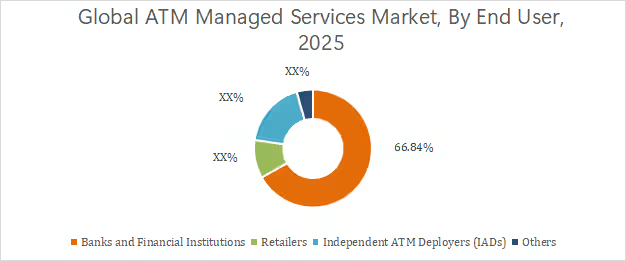
Banks and Financial Institutions: This segment accounted for the largest revenue share of 66.84% in the market in 2025.
Banks and financial institutions hold the dominant share in the ATM managed services industry since they manage extensive, nationwide networks of automated teller machines that require constant maintenance, secure cash logistics, and 24/7 monitoring. To reduce the heavy overhead expenses associated with maintaining dedicated internal support teams, institutions increasingly outsource their terminal fleets to specialized managed service providers. This strategic shift enables banks to optimize operational costs, ensure rigid adherence to evolving financial regulations and EMV security mandates, and reallocate internal resources toward core financial services and digital customer engagement.
Retailers
Retailers are increasingly adopting managed automated terminal solutions to host self-service cash and payment kiosks within supermarkets, convenience stores, and shopping malls. By leveraging ATM managed services, retail operators can offer customers convenient cash access and transaction services without requiring internal technical expertise, further driving store engagement while third-party providers handle cash replenishment and system troubleshooting.
Independent ATM Deployers (IADs): This segment is anticipated to register the fastest CAGR during the forecast period.
Independent ATM deployers operate large fleets of white-label or off-site terminals independent of traditional banking institutions, heavily depending on outsourced ATM managed services to run their decentralized infrastructure profitably. Since IADs lack proprietary branch networks or internal repair crews, they rely entirely on managed service partners for real-time network monitoring, rapid field maintenance, regulatory compliance, and software updates across scattered geographic locations.
ATM Managed Services Market Regional Breakdown
North America:
North America is estimated to reach over USD 4.52 Billion by 2034 from a value of USD 2.54 Billion in 2025, and it is projected to grow to USD 2.66 Billion in 2026.
According to the ATM managed services market analysis, North America holds a significant share of the global market, primarily driven by financial institutions outsourcing legacy network operations to decrease costs, along with the integration of advanced technologies like contactless transactions, biometric authentication, and cryptocurrency-enabled kiosks.
United States
The United States is the primary country in the North American market, driven by major banks and Independent ATM Deployers (IADs) increasingly outsourcing cash management, software maintenance, and first/second-line maintenance. Strategic retail partnerships, such as placing surcharge-free smart ATMs in convenience store chains and big-box retailers, and predictive maintenance tools are heavily lowering operational overheads.
Canada
Canada features a highly consolidated banking sector that heavily utilizes ATM managed services to maintain high network uptime and strict regulatory compliance. The focus centers on secure remote monitoring, robust cybersecurity software management, and expanding electronic journal systems to optimize offsite banking infrastructure.
Europe:
Europe holds a significant share of the global ATM managed services industry, focused heavily on fleet optimization, security upgrades, and sustainability. Banks across the region are increasingly utilizing shared-ATM networks and ATM-as-a-Service models to reduce duplicate physical infrastructure and trim operational footprints in line with environmental guidelines.
Germany
Germany's ATM managed services market expansion is driven by a strong preference for cash security, strict regulatory compliance, and banks outsourcing cash management and routine maintenance to third-party providers. German financial institutions leverage ATM managed services to automate cash replenishment, enhance endpoint security against sophisticated physical and digital fraud, and upgrade aging hardware fleet architectures.
United Kingdom
The United Kingdom ATM managed services industry is characterized by a high degree of banking digitization, yet cash access remains a critical regulatory priority to protect rural and vulnerable demographics. Managed service providers play an essential role here in running shared hub networks, supporting cash-withdrawal protection initiatives, and integrating advanced cash-recycling technologies.
Asia Pacific: Most Dominant and Fastest Growing Region
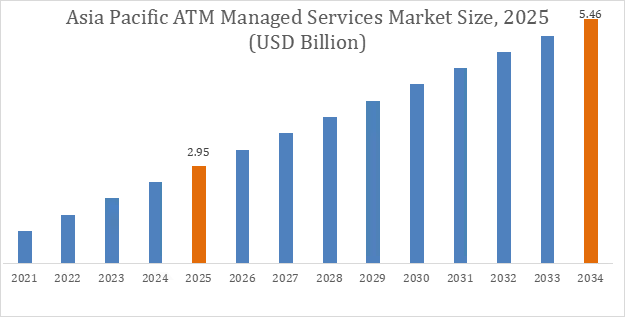
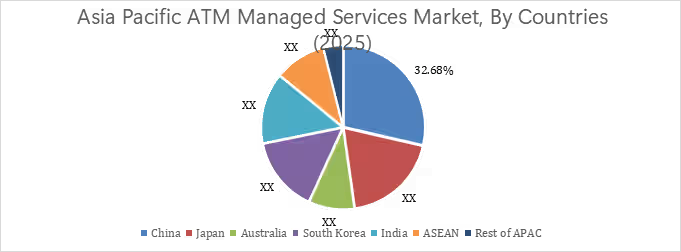
Asia Pacific region was valued at USD 2.95 Billion in 2025. Moreover, it is projected to grow to USD 3.11 Billion in 2026 and reach over USD 5.46 Billion by 2034. Out of this, China accounted for the maximum revenue share of 32.68%.
The Asia-Pacific region holds the largest share in the global market for ATM managed services, propelled by massive economic development, rising banked populations, and government initiatives promoting financial inclusion and rural banking infrastructure. Banks increasingly outsource operations to third-party vendors to manage large-scale fleets cost-effectively.
China
China dominates a substantial share of the Asia-Pacific market. Driven by massive state and commercial bank initiatives, China features an extensive network of technology-integrated and smart ATMs. Financial institutions heavily rely on managed service frameworks to oversee expansive urban and rural deployments, optimize remote cash forecasting, and integrate biometric verification features.
India
India represents one of the fastest-growing markets, propelled by ongoing financial inclusion policies and expanding semi-urban/rural banking infrastructure. With independent managed service providers taking over vast fleets of white-label and bank-branded ATMs, providers focus heavily on uptime optimization, automated cash management, and handling high transaction volumes.
Japan
Japan's ATM managed services market growth is characterized by advanced cash-recycling ATMs and strict compliance frameworks. Banks utilize ATM managed services to streamline maintenance routines, reduce labor costs amidst a shrinking workforce, and introduce seamless software updates for remote monitoring.
South Korea
South Korea exhibits robust demand for ATM managed services, characterized by urban demographic, heavy preference for self-service banking, and high penetration of smart, contactless-enabled terminals managed through a robust outsourcing framework.
Latin America:
The ATM managed services market trends in Latin America are primarily driven by the rising retail and independent ATM expansions, combined with the growing need for robust cash logistics and inflation-mitigation strategies across major economies like Brazil, Argentina, and Chile. Regional banks are increasingly partnering with third-party vendors to secure offsite kiosks in retail spaces, transit hubs, and commercial centers. Focus areas include mobile-integrated functionalities, cash-recycling hardware, and robust security management to mitigate fraud across volatile economic landscapes.
Middle East and Africa:
The Middle East and Africa region exhibits a highly diverse market landscape. While the Middle East focuses on deploying luxury smart ATMs with advanced biometrics and interactive features in urban hubs, African markets concentrate on expanding banking access to rural communities, leveraging outsourced management to guarantee uptime, secure remote terminals, and navigate complex cash logistics. Growing urban populations, retail center expansion, and constant need for reliable, secure cash-dispensing networks in commercial and tourist hubs are further driving the ATM managed services market demand in this region.
Leading Companies in the ATM Managed Services Market
- NCR Atleos
- Euronet Worldwide Inc.
- Diebold Nixdorf Incorporated
- Hitachi Payment Services
- Fiserv Inc.
- CMS Info Systems Ltd.
- The Brink’s Company
- FIS Global
- Hyosung TNS
- Cennox
Recent Developments Among Companies in the ATM Managed Services Market
Acquisitions
- In March 2026, CMS Info Systems announced the acquisition of Financial Software and Systems (FSS) ATM managed services business. The transaction transfers about 8,000 ATMs and underlying customer contracts to CMS, increasing its total managed portfolio to nearly 39,000 units. Aimed at scaling operations and expanding relationships with major private sector banks, the acquisition aligns with CMS's broader strategy to capitalize on ongoing market consolidation, as financial institutions increasingly transition toward larger, unified outsourcing partners.
- In February 2026, Brink's Company reached an agreement to acquire NCR Atleos, with the aim of merging Brink's global cash management capabilities and logistics network with NCR Atleos' extensive independent ATM fleet, along with its ATM management and services expertise.
ATM Managed Services Market Report Insights:
| Report Attributes | Report Details |
| Study Timeline | 2021-2034 |
| Market Size in 2034 | USD 15.63 Billion |
| CAGR (2026-2034) | 6.9% |
| Base Year | 2025 |
| By Service Type |
|
| By Deployment Mode |
|
| By ATM Type |
|
| By End User |
|
| By Region |
|
| Key Players |
|
| North America | U.S. Canada Mexico |
| Europe | U.K. Germany France Spain Italy Russia Benelux Rest of Europe |
| APAC | China South Korea Japan India Australia ASEAN Rest of Asia-Pacific |
| Middle East and Africa | GCC Turkey South Africa Rest of MEA |
| LATAM | Brazil Argentina Chile Rest of LATAM |
| Report Coverage |
|
Key Questions Answered in the Report
How big is the ATM managed services market? −
The ATM managed services market was valued at USD 8.72 billion in 2025 and is projected to grow to USD 15.63 billion by 2034.
Which is the fastest-growing region in the market? +
Asia-Pacific is the region experiencing the most rapid growth in the market.
What specific segmentation details are covered in the ATM managed services report? +
The report includes specific segmentation details for service type, deployment mode, ATM type, end user, and region.
Who are the major players in the market? +
The key participants in the market are NCR Atleos (USA), Euronet Worldwide Inc. (USA), Diebold Nixdorf Incorporated (USA), Hitachi Payment Services (India), Fiserv Inc. (USA), CMS Info Systems Ltd. (India), The Brink’s Company (USA), FIS Global (USA), Hyosung TNS (South Korea), Cennox (United Kingdom), and others.
Overview
Reputation & Certifications

Our Services
- Market Intelligence & Forecasting
- Custom Research Solutions
- Market Entry Strategy
- Competitive Intelligence
- Customer Insights
- Industry Innovation Analysis
- Investment Advisory