Shopping used to start with a search bar. In 2026, it increasingly starts with a conversation. People are asking AI assistants what to buy, letting algorithms decide what they see first and in a growing number of cases, letting AI complete the purchase entirely. This isn't a distant forecast — it's already showing up in billions of dollars of retail revenue. Here's what's actually happening, with real examples from companies tracking the shift in real time.
AI Consumer Behaviour 2026: The Big Picture
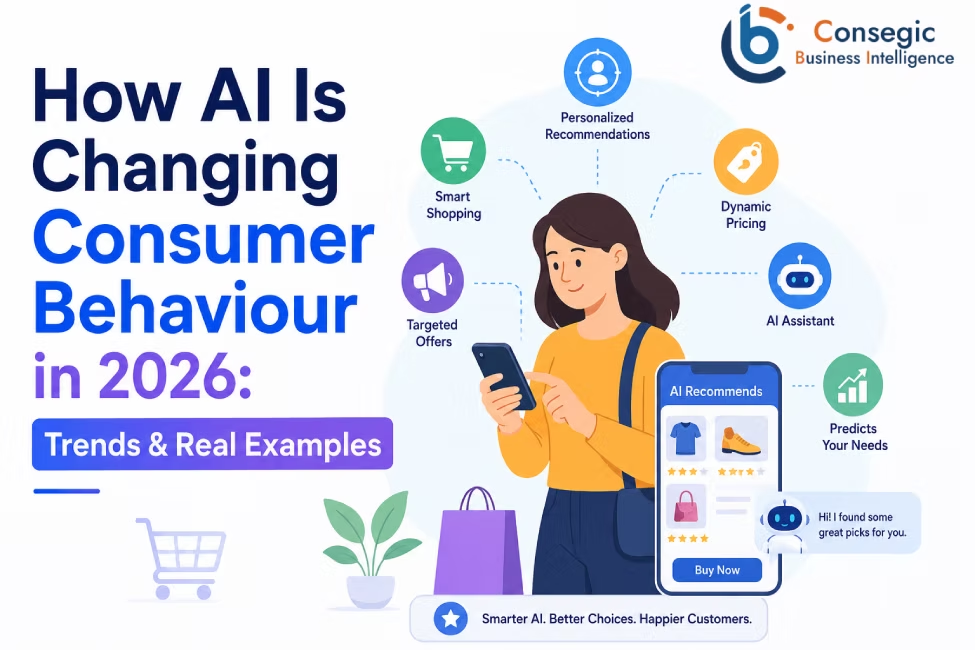
The defining changes this year is that AI has moved from a background recommendation engine to an active participant in the buying decision. Industry research describes AI shifting from quietly improving search results to directly answering questions, comparing products and in some cases finalizing purchases inside the same interface where the conversation started. For brands, that means the old funnel — discover, research, compare, buy — is collapsing into a single AI-mediated interaction.
- Shopping Assistants Are Now Driving Real Revenue
The clearest evidence that AI is reshaping buying behaviour isn't a survey — it's company earnings calls. Amazon has said its Rufus shopping assistant is on pace to generate roughly $10 billion in incremental annualized sales, with customers who use it about 60% more likely to complete a purchase. Walmart's comparable tool, Sparky, is reportedly driving order values around 35% higher among the shoppers who use it, according to comments from Walmart's CEO. Amazon has since folded Rufus into a broader tool called Alexa for Shopping, unifying product research and purchasing across its app, website and Echo devices — a sign that conversational shopping is becoming core infrastructure rather than a side feature.
- The Search Bar Is Losing Ground to the Chat Box
A growing share of consumers now starts product research inside AI chat tools rather than a traditional search engine. Someone asking ChatGPT for a phone recommendation under a certain budget can click straight through and buy it without leaving the conversation. Retail-industry leaders point to this as the fastest-moving shift of the year — AI assistants are increasingly being asked to plan meals, build gift lists and surface products from a sentence of context rather than a string of keywords. Surveys from Adobe found that nearly half of consumers planned to use AI for holiday shopping research and the volume of retail site traffic arriving from AI chat referrals has grown dramatically.
- Personalization Has Gotten Sharper and More Controversial
AI-driven personalization is now precise enough to noticeably move sales. Some research puts the conversion lift from AI-tailored recommendations as high as 70% compared to generic offers, since modern systems can factor in stated preferences, browsing context and even inferred intent rather than just past purchase history. But that precision is creating friction: in the same research, only about 4 in 10 consumers felt the personalization benefits were worth what they gave up in privacy. Consumers want relevant recommendations, but they're increasingly sceptical of how much data that relevance requires — which is pushing brands toward clearer, more transparent data practices rather than quietly invisible tracking.
- How AI Affects Consumers Day to Day
Beyond big purchases, AI is reshaping smaller daily habits. Price-tracking tools now monitor products automatically and alert shoppers when a price drops, removing the need to manually check listings. Livestream shopping — much of it powered by AI-driven recommendation and targeting — is projected to reach roughly $50 billion in the US, blending entertainment and purchasing in a way that didn't exist a few years ago. And a large share of teenagers — close to half, according to Pew Research data — now use AI chatbots multiple times a week, which means the habits forming in this age group are likely to define mainstream buying behaviour within a few years, not decades.
- Trust Signals Are Moving from Reviews to AI Answers
Consumers used to rely heavily on star ratings and written reviews. Increasingly, they're relying on what an AI assistant says about a product instead. Qualtrics research found that only about 3 in 10 consumers now bother explaining why they stopped buying from a brand, meaning the old signal of direct customer feedback is fading just as AI-driven sentiment monitoring is scaling up to fill the gap. Companies are also starting to use AI-generated synthetic personas — virtual consumers built from real demographic and behavioural data — to simulate how actual customer segments might react to a product or price change before it ever reaches real shoppers.
- Economic Caution Is Reshaping What AI Gets Used For
A new economic feeling has set afoot, driving consumers in a different direction for their AI-assisted shopping. Where earlier the role for AI in shopping had been mainly for inspiration and discovery, consumers are now turning to AI for their efficiency-related needs-shopping around, cutting down unnecessary spending, or doing less research on more common, necessary items. This suggests a movement away from the initial story of AI as discovery-and-inspiration engine toward AI as defense-to make their money work harder.
AI's Impact on Buying Behaviour: What Brands Should Take Away
The throughline across all of these shifts is that AI is no longer just influencing buying behaviour from behind the scenes — it's actively present at the moment of decision. A product's visibility inside an AI assistant's answer is starting to matter as much as where it ranks in a traditional search result. Brands that keep their product information clear, accurate and easy for AI systems to interpret are positioned to benefit from this shift; those that don't risk becoming invisible inside the very tools their customers are now using to shop.