Customer expectations are shifting more quickly than at any point before. Technological improvements, economic changes, changing lifestyles and the drive towards sustainability have all contributed to changes in purchasing behaviour. Instead of it being an issue of quality versus price, businesses are now faced with the challenge of 'What do the consumers actually want?
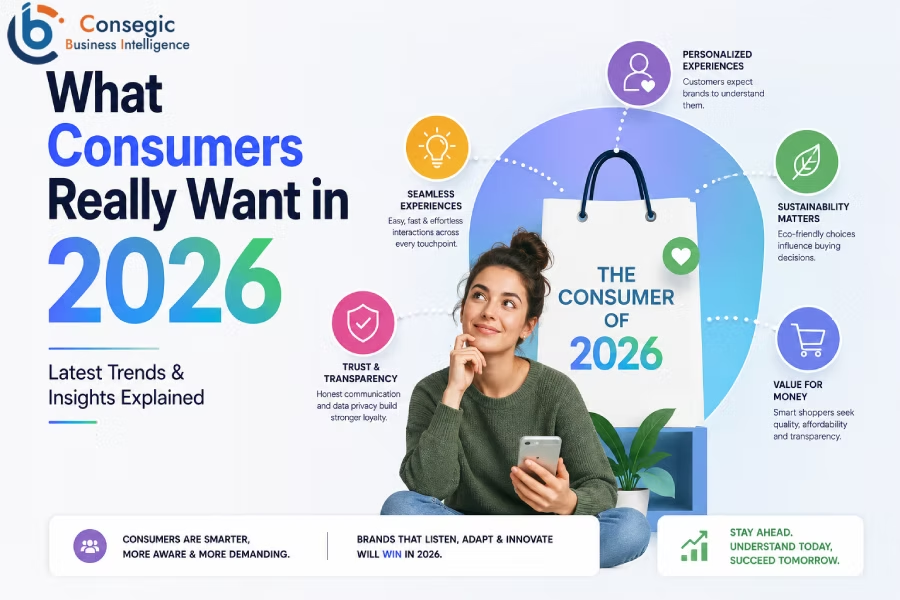
Consumers in 2026 are intelligent, discerning and experience-oriented. Consumers are interested in products and services that are convenient, personalized, transparent and provide value. Businesses, in order to survive in today's dynamic environment, must know and meet consumer' demands.
So, what do consumers truly want in 2026? Let's have a look at the current consumer behaviours that affect industries all over the world.
Consumers Want Personalized Experiences
This is arguably the most obvious consumer trend for 2026 – personalization. Today's consumer does not respond well to generic advertisements or one-size-fits-all products, instead, they want brands to recognize and respond to individual needs and wishes.
Brands are using artificial intelligence and analysis of big data to recommend products and to tailor journeys and content to the consumer. Customers feel more valued whether shopping in-store or browsing a website or app, if the service is designed for them.
Today, for many consumers, personalization has evolved from a 'nice to have' to a 'must have'.
Convenience remains an Important Aspect of Purchasing Decisions
Customers of today have busy lives and thus place significant value on convenience. Time-saving or simplifying products and services stand a good chance in today's market.
Quick delivery times, simple purchasing processes via online shops and payment systems, and a flexible return policy are becoming more important purchasing factors. Customers expect to have the same simple experience across all touch points.
This is leading to an increase in subscription services, auto-reordering and digital self-service. It is the services and products which simplify the customer's life, and which are available to the customer, that are generally able to create loyalty.
Transparency and Trust are Becoming Increasingly Important
Consumers in 2026 research their purchases much more than in the past. They want to know where the product originates, how it's manufactured and whether the company's business practices are ethical.
Trust can be built on transparency. Customers are entitled to expect companies to be transparent regarding costs, production methods and their sustainability practices, and to protect customer data.
Companies that are transparent and demonstrate accountability are preferred by consumers over companies that hide their business operations. Trust is the most valuable asset in today's information age.
Sustainability is affecting Purchasing Behaviour
Sustainability is now not an isolated trend but a key purchase influencer across a range of markets. Consumers are highly attentive to environmental responsibility, packaging, the efficient use of resources, and the ethical integrity of a company. More and more are actively seeking goods that are good for them, and good for the Earth, although consumers do not necessarily choose sustainable products over cheaper alternatives every time. As awareness continues to grow, consumers are looking for goods and services which deliver sustainability together with quality, affordability, and practicality. Sustainability is set to remain one of the top consumer trends through 2026.
Consumers demand a Seamless Omnichannel Experience
The line between online and physical shopping is blurring. Consumers jump from website to app to physical store to social media network without a second thought when making a purchase decision. A customer might discover a product on social media, look for information on the Internet, go to the store to check out the product and then purchase it through a mobile app. These experiences must connect smoothly for the customer.
A smooth omnichannel experience is key for increasing customer satisfaction and loyalty. Omnichannel companies are able to understand and fulfill the needs of their customers through all channels of communication, improving customer satisfaction and loyalty boosters.
The Nature of Value is Shifting
Value has long been tied to price. In 2026, value is far broader. Factors in addition to price-including quality, durability, convenience, customer service, and the customer experience-are now often considered. Customers are willing to pay premium price to feel that their purchase will give them a better value over time.
This incentive should guide companies towards thinking about customer satisfaction long term and in terms of not simply the lowest price as a key competitive element. Companies that can communicate their value proposition well will be winners.
Digital Interactions Influence Consumer Purchasing Decisions
Digital touchpoints are more important than ever before in informing consumers about potential purchases and in influencing their buying decisions. Social media, online reviews, videos and product recommendations have a great influence on customer behaviour.
Word of mouth and genuine product reviews are more persuasive than advertising for consumers. User recommendation is usually more persuasive than company recommendation because they seem more credible and meaningful.
Companies have to communicate with consumers in social media to develop strong communities and relationships.
Health and Wellness remain the Focus of Consumer Interests
The interest in health and wellness continues to play a major role in a wide range of industries such as the food and beverage sector, the beauty industry and the fitness market. Consumers want to enhance their well-being through quality products and innovative services that contribute to a better quality of life. The health and wellness trend is evident not only in dedicated product categories, but increasingly affects numerous sectors.
Companies are offering healthier product alternatives, focusing on services and products that promote well-being. The increasing focus on wellness is part of a broader trend toward pro-active lifestyle management and self-care.
Technology becomes an Invisible Supporter
The consumers like to adopt technology which adds ease rather than more burden in their lives. Technology might not be the sole thing that customers are fond of, but its value. AI, smart devices, automation, and virtual agents are not something that consumers don't see very often in their daily lives. They anticipate this technology to help them get more in less time and with more personalization. Many applications which become highly successful do it without being noticeable, thus increasing customer satisfaction and efficiency. The human aspect plays a huge role as well.
Despite all the technological advancements, it is more than ever important for customers. Good quality of customer service, emotional bonding, sincere communication has a significant effect on customer loyalty. Customers want to feel recognized and heard. The businesses with the highest rate of customer loyalty maintain a perfect balance between technological effectiveness and human interaction. Human interaction may become an even more important competitive advantage than technology itself as it becomes more pervasive.
What Do Consumers Want in 2026: The Big Picture
Observing the consumer trends of 2026, one can see a clear pattern: consumers demand personalization, transparency, sustainability and convenience in their interactions, and they want to feel like valued customers whose needs and wants are understood across all touch points.
Technology is undeniably part of modern consumerism, but consumers are primarily interested in the results it can bring to their lives. Ultimately, people want products and services that can simplify their lives, improve their quality of life, save them time, support their well-being, and help them to make educated purchasing decisions.
Conclusion
A thorough understanding of consumer behaviour is now more crucial for businesses than ever before. The current consumer trends of 2026 show a strong shift toward personalization, transparency, sustainability, convenience and a customer-focused approach. Companies that are adept at satisfying these changing demands will be rewarded by increasing customer loyalty and business growth in the future. Consumers will always demand the products and services that they are interested in, but for the company that listens, invents prudently, and consistently provides honest value, success is inevitable. Consumer demand, in essence, is very straightforward. They want products and services that make their lives simpler, more fulfilled and easier.