Spend any time on the floor of today's factory, warehouse, or hospital and the definition of 'automated' and 'human' is far more fluid than it used to be. And when we review 2026 trends in robotics and automation, the key development isn't merely the increase in the number of robots in use, but: it's that robots, software agents and human workers are increasingly operating side by side, often on the same task, at the same time. That blending is reshaping not just how work gets done, but what work even looks like going forward.
Physical AI Moves from Lab to Factory Floor
For years, the most exciting robotics breakthroughs stayed largely confined to research labs and trade-show demos. That's changing fast. Industry leaders have started calling 2026 the moment "physical AI" goes mainstream, as robots gain the ability to perceive their surroundings, reason about a task and adapt their actions in real time rather than simply executing pre-programmed motions.
A recent survey found that more than half of global business leaders already use some form of physical AI in their operations and that figure was expected to climb sharply over the next two years as adoption shifts from pilot projects to standard practice.
Humanoid robots are the most visible symbol of this shift. Automakers including Hyundai, Audi and BMW have begun testing humanoid robots on production lines, betting that a human-shaped machine can slot into spaces and tasks originally designed for human bodies without redesigning entire facilities. Most of this activity is still concentrated in pilots and data collection rather than full-scale deployment, but the trajectory is clear: humanoids are moving from novelty to genuine industrial tool.
Underneath the headlines, less glamorous but arguably more consequential changes are also underway. Collaborative robots, or cobots, no longer need the heavy safety cages that once separated them from human coworkers, thanks to better sensors and updated safety standards. Machine vision and edge computing are letting robots make decisions locally, on the factory floor, instead of waiting on a distant server.
And the convergence of information technology with operational technology, long discussed as a someday goal, is now a practical requirement for anyone building a connected, data-driven production line.
Why Companies Are Automating Faster Than Ever
Several forces are pushing automation adoption rather than just enabling it. Persistent labour shortages are one of the biggest drivers; manufacturers in the United States alone report well over a million open positions and automation has become less a productivity bonus and more a basic operational necessity. Reshoring and nearshoring trends, fuelled by geopolitical tension and fragile global supply chains, are adding pressure too, since rebuilding domestic manufacturing capacity at competitive cost is difficult without leaning heavily on robotics.
Cost is also no longer the barrier it once was. Robots-as-a-Service models let small and mid-sized businesses access automation without large upfront capital investments, while pre-engineered, easier-to-program systems have lowered the technical expertise needed to deploy them. The result is that automation, once mostly the domain of large automotive and electronics manufacturers, is spreading into logistics, food production, healthcare support and retail fulfillment.
This is also where agentic AI enters the picture. Combining the pattern-recognition strengths of analytical AI with the adaptability of generative AI, agentic systems let robots plan their own paths and respond to unplanned obstacles instead of relying on rigid, pre-scripted instructions. That capability underpins the rise of so-called "lights-out" operations, where robots run entire shifts, often overnight, with little or no direct human supervision. A handful of e-commerce warehouses already operate this way today, picking, sorting, and staging orders so that human staff can simply hit the ground running each morning.
What This Means for the Future of Automation Jobs
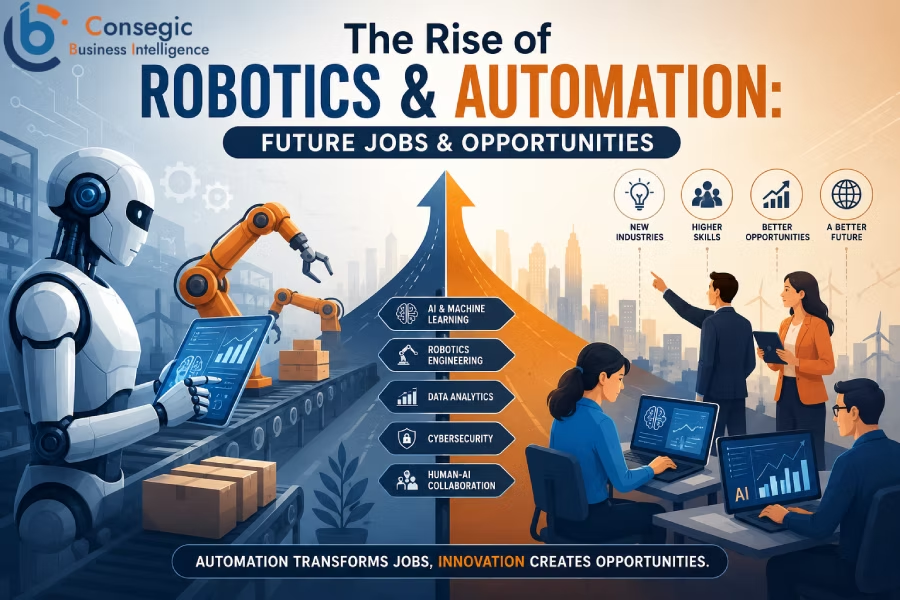
The honest answer to what all this means for the future of automation jobs is that it's neither the mass unemployment some feared nor the painless transition others hoped for. The World Economic Forum's most recent Future of Jobs research projects that by 2030, roughly 170 million new roles will be created globally even as around 92 million existing ones are displaced, a net gain of about 78 million jobs worldwide. That headline number sounds reassuring, but it obscures an important detail: the people losing jobs and the people filling new ones are rarely the same individuals, working in the same places, with the same skills.
Routine, predictable tasks remain the most exposed. Administrative and clerical roles, basic data entry and repetitive assembly-line work continue to shrink as automation absorbs them. But the demand is soaring most quickly in the fields of AI and data-analysis, cyber security, green energy and health, where there will be plenty of human judgement, direction and flexibility required. Jobs working with, directing or managing automated processes rather than competing against them, have so far demonstrated remarkable longevity.
Where the Discussion on AI and Jobs Future Is Heading
The broader conversation around AI and jobs future prospects has shifted noticeably over the past year. Fewer people are asking whether AI will affect employment and more are asking how quickly organizations can adapt to it. Employers expect a substantial share of workers' core skills to change by the end of the decade and job postings requiring AI-related skills have grown dramatically faster than the overall market. Workers who develop fluency in working with AI tools and robotic systems are commanding meaningful wage premiums over peers without those skills.
None of this guarantees a smooth transition. Surveys of business leaders themselves remain split, with many expecting AI to displace jobs even as a smaller share expect it to create new ones and several Future of Jobs Report scenarios warn of a future where automation outpaces the ability of education and reskilling systems to keep up.
The practical takeaway for workers, businesses and policymakers alike is the same: the technology curve isn't slowing down and the organizations and individuals who treat reskilling as an ongoing investment, rather than a one-time fix, are the ones most likely to come out ahead. Robotics and automation aren't eliminating the need for human work; they're redefining what kind of work is worth doing.