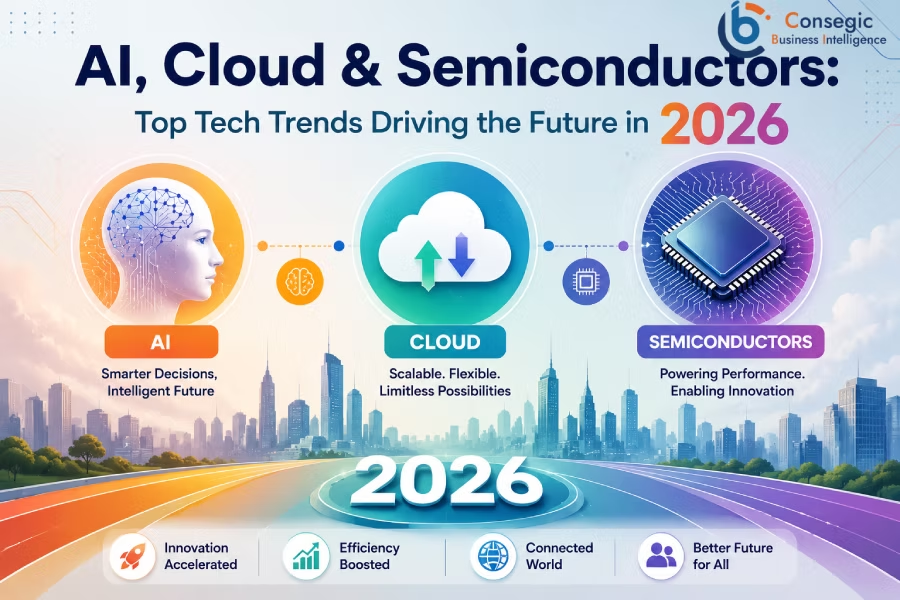
One of the most disruptive periods of the tech sector in decades is under way as artificial intelligence, cloud computing, and semiconductors fuse to create the next era of digital transformation. Smart applications and self-governing machines are being developed, and high-performance datacentres and future computing power are being created in response to advances in AI, cloud computing and semiconductor technology which are revolutionizing industries and businesses on a global scale. Companies are investing in the AI capability, cloud infrastructure and semiconductor technology so that they can remain competitive in 2026; and demand for computing power is at levels unthinkable just a few years ago with the relationships between AI, cloud computing and semiconductors continuing to grow exponentially with growth potential available to businesses who are aware of these changing trends.
AI Boom Reshapes Technology Investment
Artificial Intelligence has already progressed past its infancy and has been recognized as a key business imperative by companies worldwide. AI is being integrated into business operations ranging from customer service and manufacturing processes to software development, health care, and finance.
The increased demand for computing infrastructure due to a surge in the popularity of generative AI, intelligent agents and more advanced machine learning models can be traced to the high demand they place on storage, network and compute. This growing requirement of hardware is translating into investment across the technology sector, with businesses procuring more powerful and advanced semiconductors, upgrading their data centers to larger ones, and availing more robust and powerful cloud infrastructure to keep pace. The demand for AI compute will continue to grow, serving as a critical growth driver for the technology sector.
AI Cloud Computing Trends Accelerate
An important AI cloud computing trend for 2026 will see cloud providers transforming from mere providers of infrastructure into intelligent AI ecosystems, which not only include compute power but also data management solutions, AI models and tools for AI development.
Businesses would increasingly opt for AI solutions provided on cloud because doing so would require fewer up-front capital investments for hardware, thus allowing organizations to deploy the latest AI capabilities without requiring massive initial hardware outlay. The proliferation of AI computing will also foster increased adoption of multi-cloud and hybrid cloud architectures by companies looking for resilience, performance and access to varied specialized AI services on more flexible platforms. Cloud computing will be an increasingly important element in deploying AI driven applications.
AI Infrastructure is Being Built Now
The technology underlying future AI applications extends beyond current computing hardware. Advanced and modern AI applications demand more specialized computing infrastructure capable of huge, high-intensity computations. The increased investment of technology companies in data centers for AI applications, networked systems for processing, and advanced hardware could lead to more capital expenditures by cloud service providers as they aim to meet the rapidly rising demand for AI compute power. It will also see a growth in distributed data processing capabilities with AI infrastructure extending to the edge computing, thereby enabling less time for response. The synergy between edge infrastructure, AI applications and cloud computing will create a larger and more scalable platform for technology.
Semiconductor Industry Reaches New Heights
Semiconductor is arguably the biggest beneficiary of the AI revolution as it underpins AI applications, cloud services, and intelligent computing platforms. The industry is expected to achieve historical growth levels in 2026 driven by the demand for specialized processors (AI accelerators) as well as memory solutions and other components that will be required to build next generation AI hardware. Unlike earlier growth phases, when it was demand from mobile phones and PCs, the current technology boom is being driven by the investment into AI infrastructure, with high performance chips used in training and inference for AI applications emerging as one of the most valuable technology components. Increased demand will prompt more investment in production capacity, and innovation across the sector in order to stay ahead.
Custom AI Chips Gaining Momentum
Custom AI chips represent a further trend which will define the semiconductor sector. Beyond general purpose processors like GPUs used for multiple applications and tasks, organizations are now commissioning their own specialized chips tailored to their particular AI workloads to reduce cost and optimize performance. This would make for a higher degree of specialization of hardware in terms of meeting individual organizational requirements and it can be expected that the demand for customized chip design will grow in parallel to the growing range of AI applications.
Data Centers Becoming Strategic Assets
Data centers are one of the most critical components of the modern technology landscape, supporting as they do cloud services, AI applications, and business digitalization initiatives. The colossal amounts invested in the expansion of data centers by leading technology companies can be attributed to the enormous demand from AI. Such investments will continue to fuel future technological expansion. Data centers are also being re-designed and upgraded to handle the increasing demand of AI with features such as more efficient cooling, denser storage configurations and more power-efficient architecture, especially with the continuing rise in popularity of AI computing.
Sustainability Becoming a Technology Imperative
The expansion of AI hardware brings with it a number of challenges, one of which is the amount of power being consumed. It is estimated that the growing demand for cloud-based AI compute could lead to further strains on global energy resources. Technology companies are now focused on how this challenge can be addressed, including through a rise in demand for more power efficient hardware, and greater investment in renewable energy to support these energy intensive operations. Future hardware innovations will likely focus not only on computational power but also power efficiency to ensure long term sustainability.
Geopolitics and Technology Sovereignty Taking Importance
With semiconductors, cloud computing and AI gaining status as critical national assets, governments are now looking toward sovereignty and security of technology infrastructure. A number of countries are already investing in domestic production capabilities of semiconductors as well as developing their own cloud services, while governments around the world are investing more in AI research and development. The interaction between politics and technology is increasingly expected to define industry growth in coming years.
What Businesses Can Expect Going Forward
Businesses will face an array of challenges and opportunities at the convergence of AI, cloud computing and semiconductors. The companies that can implement these technologies well will enjoy a competitive advantage in efficiency, customer service and new avenues of revenue. However, companies will also face the challenge of increasing expenses with hardware, staffing and security risks. Success in the digital age will come with technology investments in scalability, and the willingness to adopt new technologies.
Conclusion
The technology world in 2026 is being shaped by a powerful synergy of artificial intelligence, cloud computing and semiconductors. AI is propelling demand for new computing hardware at unprecedented rates; cloud services are turning into innovation hubs while semiconductor makers are at the fore of creating new technological components to support it. This unique convergence of technology is leading to a more intelligent, complex and adaptive world of technology. As AI cloud computing moves forward and the innovation in semiconductors continues unabated, the business that recognize and capitalize on this synergy will be able to shape the next age of digital creativity.