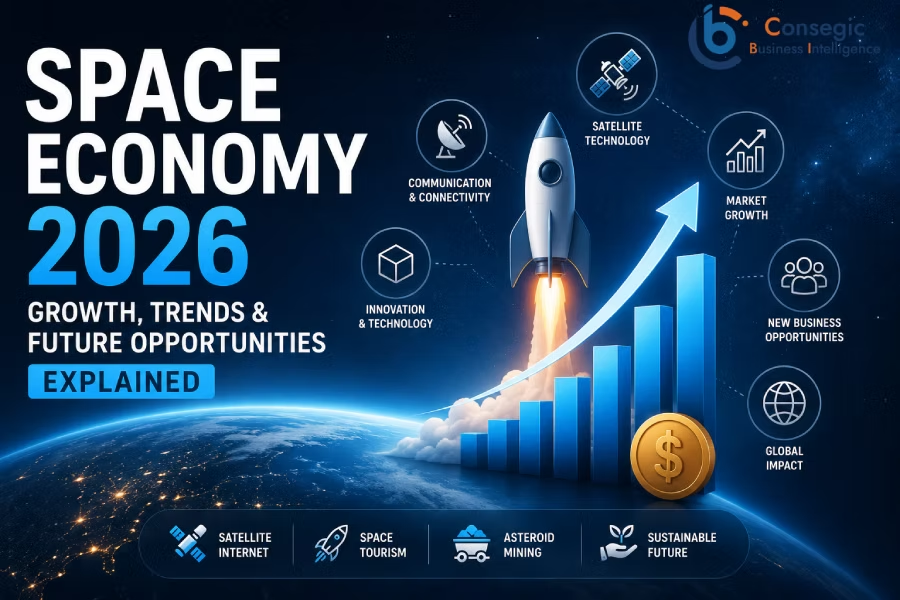
For decades, space was treated as the domain of governments and a handful of legacy contractors. That picture has changed dramatically. The space economy 2026 outlook points to an industry that has matured into a genuine commercial sector, one where falling launch costs, sovereign demand and new revenue models are reshaping how value is created beyond Earth's atmosphere. Analysts now estimate the global space economy at somewhere between $460 billion and $630 billion this year, depending on how broadly the sector is defined and most major forecasters agree it is on a credible path toward $1 trillion to $1.8 trillion within the next decade.
A Market Finally Living Up to the Hype
Every few years, observers have called the space sector at an "inflection point," only to watch enthusiasm cool. The 2020-2022 wave of SPAC-driven public listings is a cautionary example: many companies that went public on ambitious projections later traded well below their initial valuations.
What makes the current cycle look different is the mix of ingredients now in place. Government buyers are signing multi-year procurement contracts rather than one-off deals. Commercial operators are generating recurring revenue from services rather than one-time hardware sales. And recent public offerings, including Voyager Technologies and Firefly Aerospace, alongside major acquisitions such as Amazon's purchase of Globalstar, suggest capital markets see durable business models rather than speculative bets.
This shift from selling hardware to selling outcomes is one of the most important undercurrents in the sector. Instead of simply building and launching a satellite, companies increasingly sell the insight, connectivity, or capability that the satellite enables. Earth-observation firms package data and analytics as subscription services. Communications companies sell guaranteed connectivity rather than transponder capacity. This change matters because it expands the addressable market well beyond traditional satellite operators and creates the kind of recurring income that makes the industry attractive to long-term investors, not just venture capital chasing the next big idea.
What's Driving Space Industry Growth Right Now
Several forces are converging to drive space industry growth in 2026 and none of them is operating in isolation.
The most foundational is the continued collapse in launch costs. Reusable rockets have pushed the price of putting a kilogram into orbit down by roughly 90 percent compared with the shuttle era, and that cost curve is expected to keep bending downward. Cheaper access to orbit is what makes capital-intensive ideas like mega-constellations, in-orbit servicing, and even early-stage space manufacturing financially viable rather than purely experimental.
Satellite broadband is the clearest commercial beneficiary. Low Earth orbit connectivity services are reportedly growing at 25 to 30% annually and direct-to-device satellite connectivity, which lets ordinary smartphones connect straight to satellites without special hardware, is opening an entirely new consumer market. Companies pursuing this space, often in partnership with mobile carriers, are betting that ubiquitous connectivity will become as expected as cellular coverage is today.
Government and defense spending is another major engine, and arguably the most predictable one. National security programs in the United States, including proliferated satellite architectures tied to missile-defense initiatives, are reinforcing demand for resilient systems and rapid satellite refresh cycles.
Japan, South Korea and several Middle Eastern governments are similarly investing in sovereign earth-observation, secure communications and space-situational-awareness capabilities as part of broader national resilience strategies. China continues building out state-directed mega-constellations of its own. None of this spending is purely defensive; it filters down into manufacturing contracts, supply chains and dual-use technologies that commercial firms can build on.
Consolidation is also reshaping the competitive landscape. In Europe, conversations around restructuring the satellite operations of major players reflect a recognition that a fragmented industry struggles to compete globally. In the United States, vertical integration, where companies try to control more of the value chain from spacecraft manufacturing to mission services, is becoming a common strategic response to a market that rewards scale and reliability over isolated technical wins.
Where the Opportunities Lie
Looking at the future of space economy growth, a few areas stand out as particularly investable or worth watching closely.
Earth observation remains a fragmented but fast-growing segment, with more than 150 companies competing to turn imagery and radar data into usable insights for agriculture, insurance, infrastructure monitoring and disaster response. Because this segment hasn't consolidated the way launch services have around a small number of dominant providers, there's still meaningful room for differentiated players to carve out a niche.
In-orbit and space-based computing is moving from speculative concept toward genuine economic scrutiny. Rather than imagining sprawling data centers in orbit, the near-term opportunity is narrower: processing earth-observation or surveillance data directly on a satellite before it's transmitted back to Earth, which can reduce bandwidth needs and latency for time-sensitive missions.
Space tourism and commercial space stations, while still a smaller slice of the overall economy, continue to attract investment as launch costs fall and private operators look toward life after the International Space Station, which is expected to be retired by the early 2030s. Meanwhile, lunar exploration and resource programs, driven by renewed national interest in the Moon as a strategic and scientific destination, are creating contracts for landers, rovers, and surface infrastructure that didn't exist a decade ago.
For investors and businesses outside the traditional aerospace world, the more interesting angle may be the software and analytics layer sitting on top of all this infrastructure. Building hardware remains capital-intensive and slow to scale, but turning the data those satellites generate into usable products, dashboards, alerts and risk models, often offers a faster, less capital-hungry path to revenue.
A Sector Worth Watching Closely
The space economy in 2026 looks less like a speculative frontier and more like an emerging infrastructure layer for the global economy, one that touches telecommunications, agriculture, defense, logistics and climate monitoring simultaneously. Growth won't be uniform across every segment; launch services have already consolidated around a few dominant players, while earth observation and downstream analytics remain wide open.
What seems clear is that the industry has moved past proving space could be commercially useful and is now focused on proving it can be commercially durable. For anyone tracking where the next decade of technology-driven growth might come from, this is a sector that deserves a permanent spot on the watchlist.