The 52nd G7 Summit wrapped up on June 17 in Évian-les-Bains, the French lakeside town where the original G7-adjacent gatherings trace some of their roots. Hosted by President Emmanuel Macron, the three-day summit brought together leaders from the United States, Canada, the United Kingdom, Germany, France, Italy and Japan, alongside the European Union. France also invited India, Kenya, Brazil, Egypt and South Korea to participate in outreach sessions, an unusually broad guest list that reflected this year's central theme: the world's biggest problems can no longer be solved by seven countries alone.
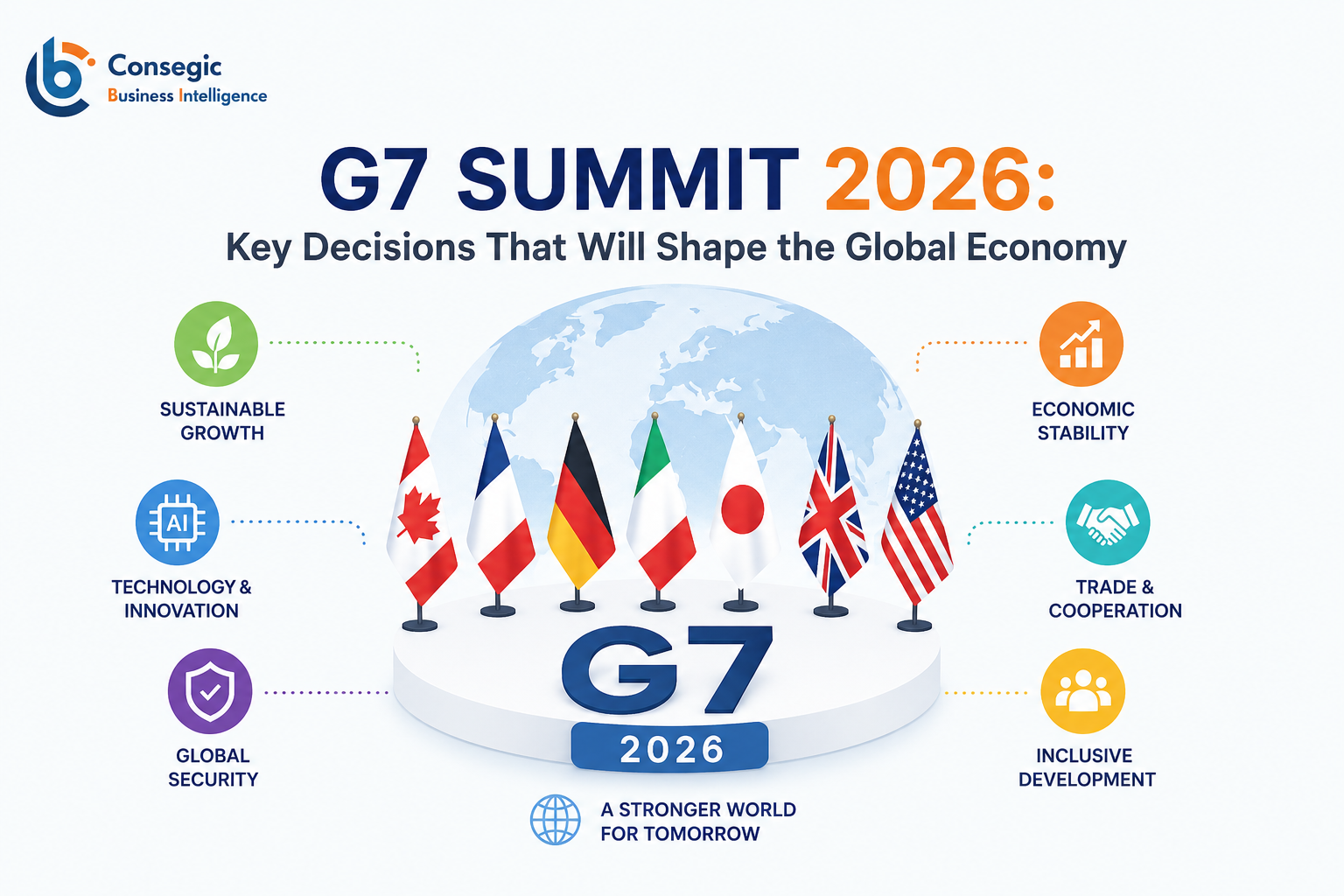
By the time it closed, leaders had adopted nine separate declarations, covering everything from Ukraine to Ebola funding. But underneath the long list of statements, a handful of decisions stand out as genuinely consequential for the global economy over the next several years.
-
A Coordinated Push on Global Economic Imbalances
This was the centerpiece of France's presidency and arguably the summit's most economically significant outcome. Macron used the gathering to spotlight what he has called "unsustainable" mismatches between global trade and capital flows- pointing in particular at China's surging export surplus, which has climbed to a record amid weak domestic demand and aggressive manufacturing output, alongside chronic US deficits and sluggish European investment.
Leaders agreed that correcting these imbalances requires cooperation rather than unilateral action, while also committing to protect domestic industries and jobs and to avoid sliding into fresh trade wars or financial instability. They assigned the IMF a central role in monitoring these imbalances and guiding the response, with further discussions expected to carry over into this year's G20 summit in Miami. It's a notably softer position than the G7's traditional defense of free trade and it signals that members see managed coordination, not confrontation, as the more realistic path forward- even if the language papers over real disagreements between Washington and its partners on tariffs.
-
Critical Minerals Cooperation
With clean energy, defense manufacturing and AI hardware all competing for the same narrow set of inputs, critical minerals have become one of the sharpest economic security issues of the decade. Leaders agreed on the importance of working together to reduce dependencies on any single supplier, a thinly veiled reference to the concentration of rare-earth processing capacity. Earlier trade-ministerial talks in Paris had already flagged how vulnerable these supply chains are to disruption and to market-distorting practices abroad and the Évian declaration builds on that groundwork, though it stops short of creating a binding new institution.
For businesses in EV manufacturing, semiconductors, and renewable energy, this is one of the decisions most likely to translate into concrete policy over the coming year, from stockpiling rules to incentives for diversified mining and refining capacity outside of the current dominant suppliers.
-
Energy Security and the Strait of Hormuz
The summit took place against the backdrop of fresh Middle East tensions, including disruption risk around the Strait of Hormuz, the waterway that carries a large share of the world's seaborne oil. Leaders called for the immediate and unconditional reopening of the strait and framed it as a step toward addressing the broader threats posed by Iran's nuclear and ballistic programs and regional destabilization efforts. Energy ministers also discussed maritime security and market stability more broadly, an issue with direct relevance for European economies that remain especially exposed to swings in energy prices.
Any durable resolution here would ease one of the more acute near-term risks to global energy markets; continued instability would do the opposite and could quickly become the dominant economic story of the second half of 2026.
-
AI Governance and Digital Protections for Children
Following on from the 2025 AI Action Summit in Paris, G7 leaders used Évian to advance a narrower but politically resonant piece of AI policy: protecting children online. This includes adapting how AI chatbots interact with younger users, alongside broader work with major technology companies to accelerate safe deployment of AI. France also brought civil society groups and the private tech sector directly into the discussions, an approach officials described as essential given how fast both regulation and innovation are moving.
This is a smaller-bore decision than the imbalances or minerals declarations, but it matters for the technology sector specifically: it signals that age verification, content safeguards and platform design requirements are likely to become a more coordinated, cross-border regulatory push rather than a country-by-country patchwork.
-
Ukraine: Increased Military and Energy Support
With Ukrainian President Volodymyr Zelensky in attendance, G7 leaders reaffirmed their commitment to Ukraine's freedom, sovereignty and territorial integrity and agreed to increase military support including air defense capabilities, additional systems and interceptors and long-range capabilities. They also committed to supporting Ukraine's energy resilience and increasing pressure on Russia's war effort, including sanctions targeting Russian oil and gas.
The economic angle here is straightforward: further sanctions on Russian energy exports have knock-on effects for global oil and gas markets and continued military spending commitments add to fiscal pressure across member economies already managing high debt loads.
-
International Development Financing
Leaders reaffirmed support for international solidarity and committed to developing new tools to mobilize private financing for development and the protection of the most vulnerable, an area where official aid budgets have been shrinking even as financing needs for climate adaptation and sustainable development keep growing. The summit also produced a response to the emerging Ebola situation, with G7 members committing over one billion dollars in funding alongside UN efforts.
What This Means Going Forward
No single declaration from Évian rewrites the global economic order on its own. The tone throughout was coordination and "shared diagnosis" rather than binding new mechanisms- a deliberate choice by the French presidency to keep dialogue open with all partners, including a US administration that has its own, sometimes divergent, priorities heading into its G20 presidency later this year.
Still, three threads are worth watching closely: whether the IMF-led work on macroeconomic imbalances produces anything more concrete by the time leaders reconvene at the G20 in Miami this December; whether the critical minerals language turns into actual diversification of supply chains away from concentrated sources; and whether the fragile understanding on the Strait of Hormuz holds. Any one of those could end up mattering more to markets over the next twelve months than the summit's nine declarations combined.