The 2026 factory floor is worlds away from the one our grandfathers used to clock into. Today's machines not only follow instructions, they can sense, predict, learn and react. This revolution from static automation to dynamic and intelligent manufacturing is changing the economics of production across the board- from giant auto makers to smaller electronics assembly houses. This is smart machinery.
From Automation to Autonomous Intelligence
For decades, "automation" meant a machine repeating a fixed task, faster and cheaper than a human hand. Industry 4.0 has blown that definition apart.
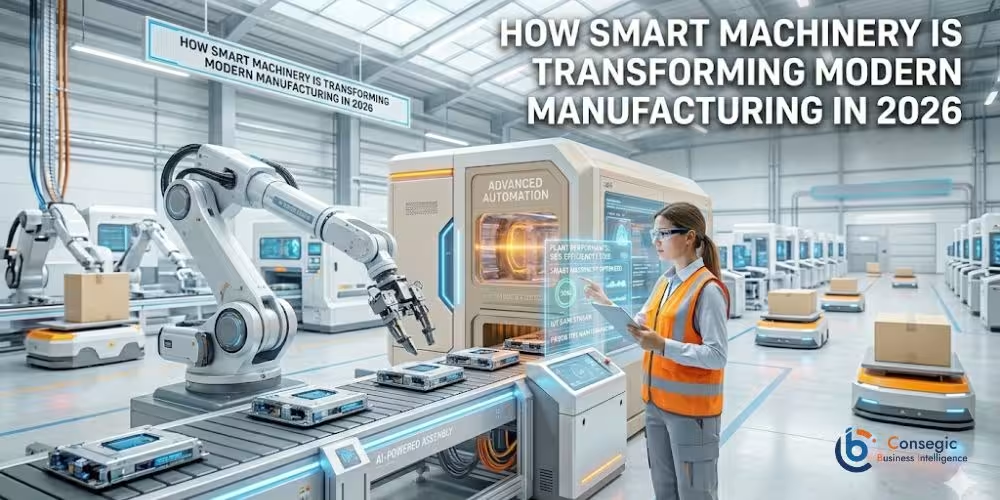
So, what does a smart factory look like in 2026? It’s an organism. Where machines, enterprise software and the supply chain are tightly integrated using AI, IIoT (Industrial Internet of Things), cloud computing and real-time analysis. This produces a manufacturing environment that doesn’t just respond to commands- but predicts what commands it should be given next.
Whereas an automated plant might respond to a predetermined condition, a smart plant predicts the need, adapts to changes and even fixes itself. It is this transformation from automated to autonomous intelligence which separates the best of manufacturers from those that will soon find themselves hopelessly left behind.
The IIoT: Giving Machinery a Nervous System
At the heart of every smart factory lies the Industrial Internet of Things. Thousands of machines, belts, production lines all have sensors embedded in them which continuously feed information up into MES, ERP and cloud analytical engines. These real-time inputs expose invisible characteristics- micro-vibrations, drifts in temperature, spikes in power usage- which can be assembled to tell the full story of a machine.
In 2026, IIoT-enabled devices are more affordable and scalable than ever before, dramatically lowering the barrier for mid-market manufacturers to participate. A press in a stamping plant can now flag its own fatigue. A CNC spindle can request maintenance before it seizes. Connected machinery has turned reactive repair into proactive prevention- and the numbers are staggering. Manufacturers deploying predictive maintenance through IIoT are cutting machine downtime by up to 50%, according to research by McKinsey & Company.
AI and the Rise of the Self-Optimising Factory
Artificial intelligence is the brain wired into this nervous system. Global AI in-manufacturing spend is tracking from $33.48 billion in 2024 toward a projected $366.24 billion by 2032- a compound annual growth rate of 36% that dwarfs nearly every other enterprise technology category.
The question for manufacturers is no longer whether to adopt AI, but how fast they can close the readiness gap: while 98% of manufacturers are now exploring AI, only 20% report being fully prepared to deploy it at scale.
Those that are closing that gap are reaping significant rewards. AI-driven scheduling systems can reprioritise production workflows in real time when a customer rushes an order or a component shipment arrives late. Generative design tools propose optimal part geometries that human engineers had never considered. Computer vision systems inspect thousands of components per minute with greater accuracy than any human quality inspector.
Across all these applications, the common thread is machines that get smarter the longer they run.
Digital Twins: A Mirror World for Manufacturing
The digital twin is one of the most disruptive technologies that will fuel smart manufacturing in 2026. It is an exact, real-time, virtual representation of an actual machine, production line or a complete factory.
Engineers can simulate a process change, stress-test a new material or model the impact of adding a shift without touching a single physical asset. By the time a decision reaches the floor, it has already been tested thousands of times in silicon.
Digital twins are also transforming workforce training. New operators can apprentice in photorealistic virtual environments, learning complex machine interactions without any risk of injury or waste. For manufacturers grappling with chronic labour shortages and an ageing skilled workforce- sometimes called the "silver tsunami"- this capability is proving invaluable in compressing onboarding timelines.
Sustainable Manufacturing Through Smart Systems
Environmental sustainability has moved from corporate branding to operational imperative and smart machinery is proving to be one of the most powerful levers available.
AI-driven energy management systems analyse production schedules, utility pricing and equipment efficiency data to dynamically reduce consumption during peak cost or peak emission windows. Manufacturers leveraging these systems are reclaiming up to 25% on energy costs, according to data from the World Economic Forum's Global Lighthouse Network.
Beyond energy, smart systems reduce material waste by optimising cut patterns, controlling ingredient dosing with microscopic precision and catching defects at the earliest possible stage in production. A component rejected at final assembly has cost far more in labour, materials and energy, than one caught by an AI vision system at the first station.
The Human Element: Augmentation, Not Replacement
Perhaps the most persistent anxiety around smart machinery is the fear that automation means unemployment. The reality emerging from the factory floor is more nuanced.
Human roles are evolving from performing routine tasks to more analytical work. Instead of executing procedures, they are now responsible for monitoring, exception management and continuous improvement of smart machines. The human worker is now placed next to the cobots- collaborative robots- and is performing tasks that require judgment while they can undertake the ergonomic or unsafe tasks.
The manufacturers seeing the greatest returns in 2026 are those investing simultaneously in technology and in workforce development. Digital literacy programmes, cross-functional data teams and new job families centred on machine oversight and AI model governance are emerging as critical competitive capabilities.
The factories of 2026 don't have fewer people; they have differently skilled people doing more valuable work.
Where to Start: The 60–90 Day Pilot Model
For manufacturers still in the planning phase, the most successful transformation pattern emerging this year is surprisingly focused: a tight-scope deployment on a single production line over 60 to 90 days. Rather than enterprise-wide rollouts that take years and carry enormous risk, this approach proves measurable gains in overall equipment effectiveness (OEE) and downtime reduction on a contained scope, before scaling. It builds internal capability, generates undeniable internal evidence and creates champions within the organisation who understand the technology intimately.
Smart manufacturing is more of a marathon than a sprint. The businesses winning in 2026 treat digital transformation not as a single project with a finish line, but as a continuous operating philosophy of gradual optimisation, constant measurement and relentless iteration.
The Bottom Line
The smart machinery revolution is not coming- it has arrived. Productivity gains of 20–30%, downtime reductions of up to 50%, double-digit energy savings and entirely new quality benchmarks are not theoretical projections; they are being achieved today on factory floors.
The manufacturers who move decisively- who wire up their machines, trust their data and invest in their people- are building competitive moats that will be very difficult to cross.