Jump to Content
Client Virtualization Market Size & Industry Share - Growth Trends & Forecasts (2026 - 2034)
Client Virtualization Market Size:
The Client Virtualization market size was valued at 10.81 (US$B) in 2025 and is projected to grow from 11.79 (US$B) in 2026 to 23.66 (US$B) by 2034, at a CAGR of 9.1% from 2026 to 2034, according to a recent report from Consegic Business Intelligence.
Client Virtualization Market Scope & Overview:
Client virtualization, also known as client-side virtualization, is mostly used for creating virtual machines (VMs) directly on a user's physical computer, which in turn allows several operating systems like Windows, Linux, macOS to run at the same time, each with its own isolated environment, managed by software called a hypervisor. It also offers improved flexibility, testing, and legacy app support on a single device. Moreover, client-side virtualization offers several benefits like reduced costs, enhanced security, centralized control, improved disaster recovery, greater flexibility, along with simplified management through central updates and rapid provisioning, thereby boosting IT efficiency as well as user productivity while lowering the physical footprint.
How is AI Transforming the Client Virtualization Market?
The incorporation of AI is significantly transforming the client virtualization market. AI incorporation helps in improving resource allocation, enhancing security, automating management, as well as improving user experience through predictive analytics, dynamic scaling, and intelligent workload balancing, which in turn helps in making environments more efficient, secure, and cost-effective.
Moreover, AI also helps in predicting needs, automatically adjusting parameters, and troubleshooting issues proactively. AI is also capable of handling routine tasks like provisioning VMs, patching, as well as monitoring, which in turn helps in decreasing IT workload and freeing up staff for strategic projects. Thus, the above factors are expected to positively impact the market growth in upcoming years.

Client Virtualization Market Dynamics - (DRO) :
Key Drivers:
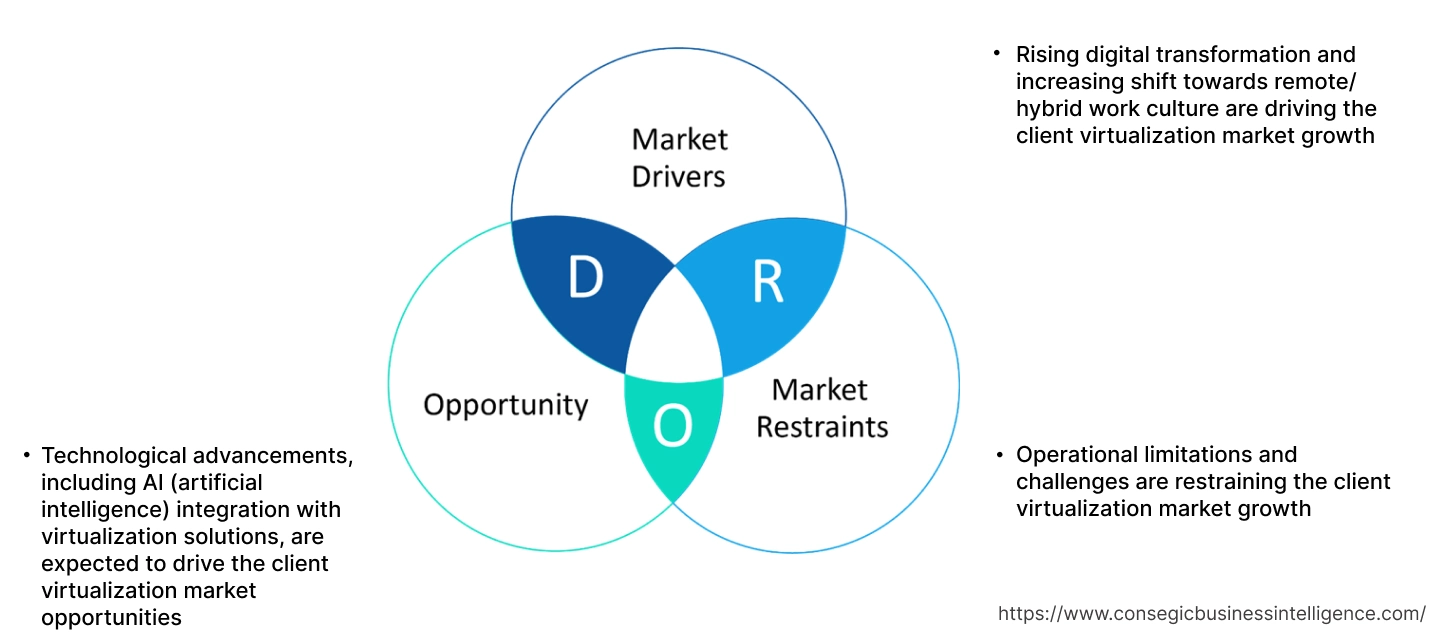
Rising digital transformation and increasing shift towards remote/hybrid work culture are driving the client virtualization market growth
The rising pace of digital transformation, along with the growing shift towards remote/hybrid work culture, are among the key factors driving the market. Client-side virtualization solutions, such as Virtual Desktop Infrastructure (VDI) and Desktop-as-a-Service (DaaS), help in facilitating secure, seamless access to corporate resources from any device or location, which plays an important role in remote/hybrid work environments. Moreover, it also helps organizations in maintaining business continuity, improving data security through centralized management, along with scaling their operations with greater agility.
In addition, client-side virtualization also helps companies attain significant cost savings by decreasing the requirement for high-performance physical hardware and large office spaces. The above benefits of operational efficiency for businesses and improved work-life balance for employees make client-side virtualization an essential tool in the current digital era.
- For instance, according to the World Economic Forum, European countries, including Denmark, Germany, Netherlands, Spain, Sweden, Portugal, and others, accounted for nearly 50% of the global remote work index in 2023.
Hence, the rising digital transformation and increasing shift towards remote/hybrid work culture are increasing the demand for virtualization solutions, in turn driving the client virtualization market size.
Key Restraints :
Operational limitations and challenges are restraining the client virtualization market growth
Operational limitations and challenges associated with client virtualization solutions are limiting the market growth. Moreover, the deployment of virtualization solutions is known to cause issues with performance and latency. Virtual desktop environments mostly rely heavily on stable, high-bandwidth network connections for streaming applications and data to endpoint devices. In cases with limited bandwidth or high latency, users mostly experience considerable delays, reduced application responsiveness, as well as degraded performance, which in turn directly impacts productivity and user satisfaction, particularly for resource-intensive applications.
Also, the complexity of managing large-scale virtual environments along with combining them with existing legacy systems, offers substantial operational challenges. Such operational hurdles, combined with the potential for a single point of failure in the hypervisor layer, can impact its adoption in some organizations. Hence, the aforementioned factors are hindering the client virtualization market expansion.
Future Opportunities :
Technological advancements, including AI (artificial intelligence) integration with virtualization solutions, are expected to drive the client virtualization market opportunities
Technological advancements, including AI integration, offer a transformative approach for managing complex virtual environments. AI-powered solutions are capable of proactively evaluating usage patterns for improving performance, predicting resource demands, and automatically scaling infrastructure up or down to ensure a consistent as well as responsive user experience while lowering operational costs.
Also, AI-driven automation can assist in simplifying management tasks, which in turn helps in reducing the need for extensive manual IT intervention while making virtualization more accessible as well as cost-effective for a wider range of businesses. As a result, rising technological advancements are providing lucrative aspects for market development.
- For instance, NVIDIA Corporation offers NVIDIA vGPU 19.0 along with NVIDIA RTX PRO Blackwell GPUs, which are capable of supporting upto 48 concurrent VMs on a single GPU. Moreover, this configuration can also assist in managing a broad range of workloads like AI virtualization, business operations, AI development, and others.
Consequently, the above factors are projected to boost the client virtualization market opportunities during the forecast period.
Client Virtualization Market Segmental Analysis :
By Type:
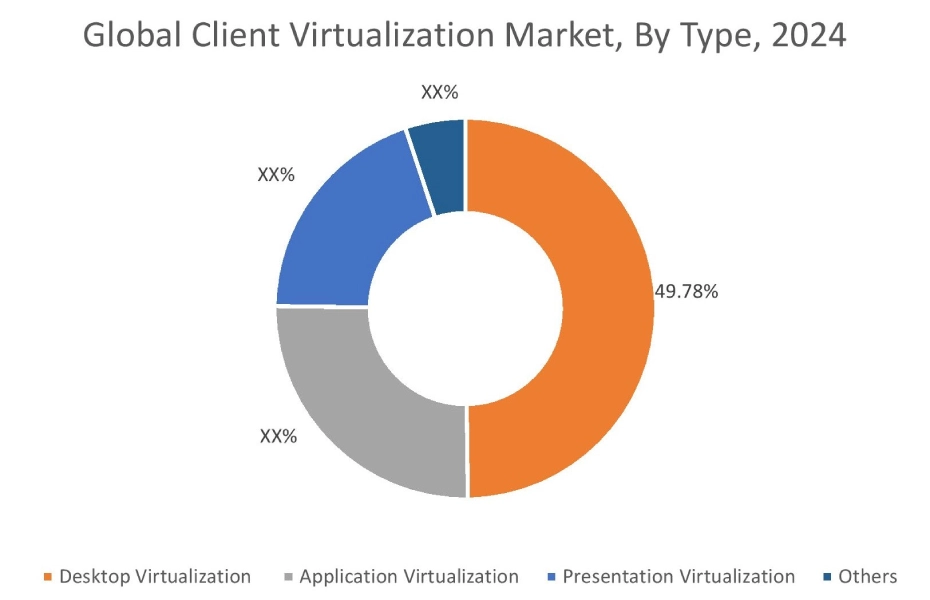
Based on type, the market is segmented into desktop virtualization, application virtualization, presentation virtualization, and others.
Trends in the type:
- Rising adoption of desktop virtualization solutions in business enterprises for facilitating secure remote work, centralizing IT management, and reducing hardware costs is driving the market.
- Increasing adoption of application virtualization solutions due its several benefits, including simplified deployment & management, reduced conflicts, legacy app support, enhanced security, and remote access, is boosting the market.
Desktop virtualization segment accounted for the largest revenue share of 49.78% in the client virtualization market share in 2024, and it is anticipated to register a significant CAGR during the forecast period.
- Desktop virtualization involves decoupling a user's desktop environment, applications, as well as data from their physical device and hosting it on a central server in a data center or the cloud.
- Moreover, desktop virtualization enables users to access their complete virtual desktop from any device and location, as long as they are connected to the network, which in turn helps in offering increased flexibility while simplifying IT management through centralized updates and maintenance.
- Moreover, desktop virtualization offers numerous benefits such as centralized data management, improved security, increased flexibility, remote access from any device, cost savings on hardware, simplified IT management, and others, which in turn make it ideal for remote work and BYOD (Bring Your Own Device) policies.
- According to the client virtualization market analysis, the above benefits of desktop virtualization are further increasing its adoption in business enterprises operating across several industries, in turn boosting the client virtualization market size.
By Deployment Mode:
Based on deployment mode, the market is segmented into on-premise, cloud, and hybrid.
Trends in the deployment mode:
- The adoption of on-premise deployment is primarily driven by factors including higher security and privacy, along with more control over server hardware.
- Factors including the ease of integration, rapid deployment, and increasing consumer preference for flexible, scalable, reliable, and cost-effective virtualization solutions are driving the cloud deployment segment.
On-premise segment accounted for a significant revenuein the overall client virtualization market share in 2024.
- On-premise client virtualization solution enables organizations to host and manage virtual desktops as well as applications within their own data centers or servers.
- Moreover, on-premise deployment enables enterprises to manage and have complete control over its integrations, and maintain tighter control over the system’s security aspects as compared to cloud-based deployment.
- Factors including higher security and privacy, lower network bandwidth costs, and more control over server hardware are vital aspects driving the on-premise deployment segment.
- Consequently, the above benefits of on-premise deployment are further driving its adoption for deployment of virtualization solutions, thereby propelling the client virtualization market trends.
The cloud segment is anticipated to register the fastest CAGR during the forecast period.
- Cloud-based client virtualization solutions are capable of delivering virtualized desktops and applications over the internet from a central cloud, allowing users to access them securely from any device.
- It essentially runs the complete work environment remotely on powerful cloud servers, which in turn improves flexibility, security, as well as management for businesses, particularly with BYOD policies.
- Moreover, cloud-based deployment provides a range of benefits such as minimal capital expense, rapid implementation, ease of utilization and integration, faster processing, and higher scalability, among others.
- Hence, the increasing advancements related to cloud-based virtualization solutions are projected to boost the market during the forecast period.
By Enterprise Type:
Based on enterprise type, the market is segmented into large enterprises and small and medium enterprises (SMEs).
Trends in the enterprise type:
- Increasing trend in deployment of client-side virtualization solutions in large enterprises for streamlining business operations, specifically in remote/hybrid work environments, is driving the market.
- Factors including growing investments in development of small & medium enterprises and rising deployment of virtualization solutions in SMEs for facilitating improved flexibility in remote work, cost savings, and resource optimization are among the key prospects driving the SMEs segment.
The large enterprises segment accounted for the largest revenue in the client virtualization market in 2024.
- Client-side virtualization helps in centralizing desktops/apps on servers, which enables large enterprises to streamline operations by easily managing IT, improving security, facilitating secure remote/hybrid work, lowering hardware/support costs, as well as scaling efficiently for complex requirements.
- Also, large, geographically dispersed enterprises mostly use client-side virtualization solutions for offering secure, consistent access to corporate desktops, applications, as well as data from any device and any location in the world.
- The use of client-side virtualization solutions in large enterprises helps in supporting business continuity during disruptions while also facilitating flexible work models without compromising security.
- Consequently, the above benefits of client-side virtualization solutions are further increasing its adoption in large enterprises, in turn driving the market growth.
The small and medium enterprises (SMEs) segment is anticipated to register the fastest CAGR during the forecast period.
- Small and medium enterprises are companies that typically maintain workforce, revenues, and assets below a certain threshold. Moreover, SMEs usually account for the majority of the businesses that are operating across the world.
- Moreover, client-side virtualization solutions enable a single physical machine to run multiple isolated virtual environments, such as desktops or applications, which are hosted and managed centrally on a server. This in turn, offers several benefits for small and medium enterprises, including substantial cost savings, enhanced data security, improved flexibility for remote work, as well as simplified IT management.
- For instance, the number of small businesses in the United States reached 31.7 million as of 2024, representing nearly 99.9% of total businesses in the U.S.
- According to the analysis, the increasing number of small & medium enterprises is expected to drive the adoption of client-side virtualization solutions, thereby boosting the market during the forecast period.
By End-User:
Based on the end user, the market is segmented into IT & telecommunication, BFSI, government & defense, healthcare, retail & e-commerce, manufacturing, education, and others.
Trends in the end user:
- There is an increasing trend in adoption of client-side virtualization solutions in IT & telecommunication sectorfor managing vast IT infrastructure, enhancing security, along with supporting complex IT environments and remote work.
- There is a rising trend towards the utilization of client-side virtualization solutions in healthcare industry, driven by the rise of telemedicine services and remote patient monitoring, along with the growing need for secure management of sensitive patient data (EHRs) and isolation of regulated workloads.
The IT & telecommunication segment accounted for the largest revenue share in the market in 2024.
- In IT & telecommunication sector, client-side virtualization helps in improving operational efficiency, enhancing security, and offering the flexibility required for modern remote/hybrid work models as well as network management.
- Moreover, client-side virtualization solutions also help IT administrators in managing, updating, as well as securing a broad number of virtual desktops or applications from a single, central location, which in turn significantly reduces manual effort and potential errors.
- For instance, according to the National Association of Software and Service Companies (NASSCOM), the IT industry in India was valued at approximately USD 245 billion in FY23, witnessing an increase of almost 8% as compared to USD 227 billion in FY22.
- Hence, the growing IT & telecom sector is driving the adoption of client-side virtualization solutions, in turn propelling the market growth.
The healthcare segment is anticipated to register the fastest CAGR during the forecast period.
- Client-side virtualization solutions are mostly used in healthcare sector for offering secure, flexible, as well as efficient access to clinical applications and patient data from numerous devices and locations.
- Also, virtualization solutions offer a flexible and scalable IT infrastructure which is required for telehealth platforms.
- It also helps in facilitating secure video consultations, remote patient monitoring, as well as real-time transmission of large data volumes, which in turn makes healthcare more accessible and convenient, particularly for patients in remote areas or those with chronic conditions.
- Moreover, factors including increasing digital transformation among healthcare organizations, combined with the rise of telemedicine services and remote patient monitoring, along with the growing need for secure management of sensitive patient data (EHRs) and isolation of regulated workloads, are among the key prospects driving the healthcare segment.
- Thus, according to the analysis, the aforementioned factors are projected to increase the utilization of client-side virtualization solutions in healthcare sector, in turn driving the market during the forecast period.
Regional Analysis:
The regions covered are North America, Europe, Asia Pacific, Middle East and Africa, and Latin America.
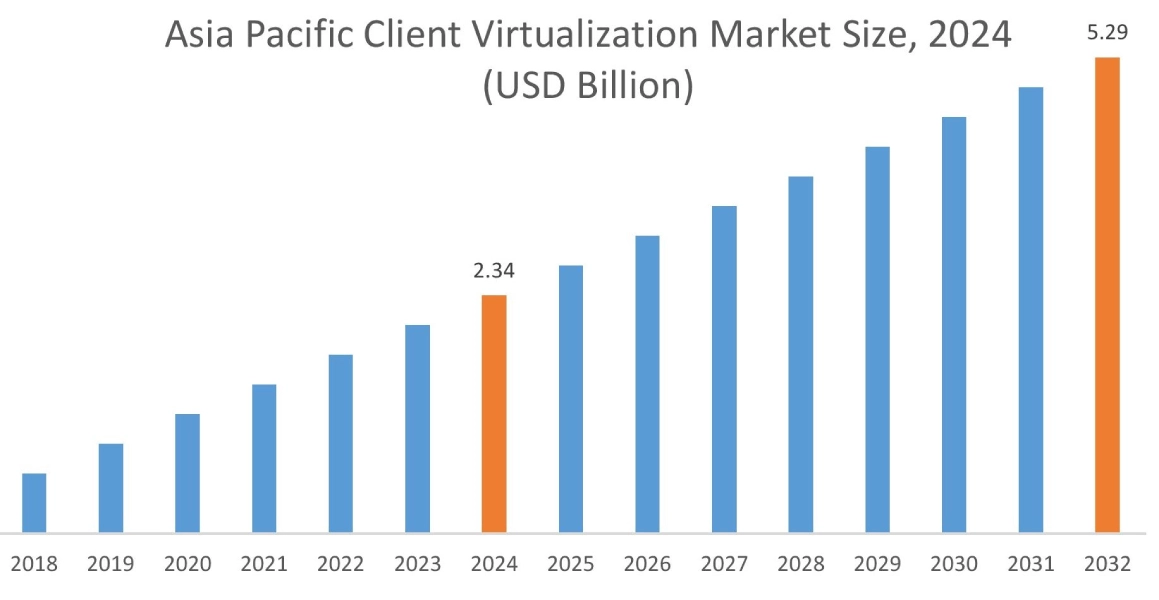
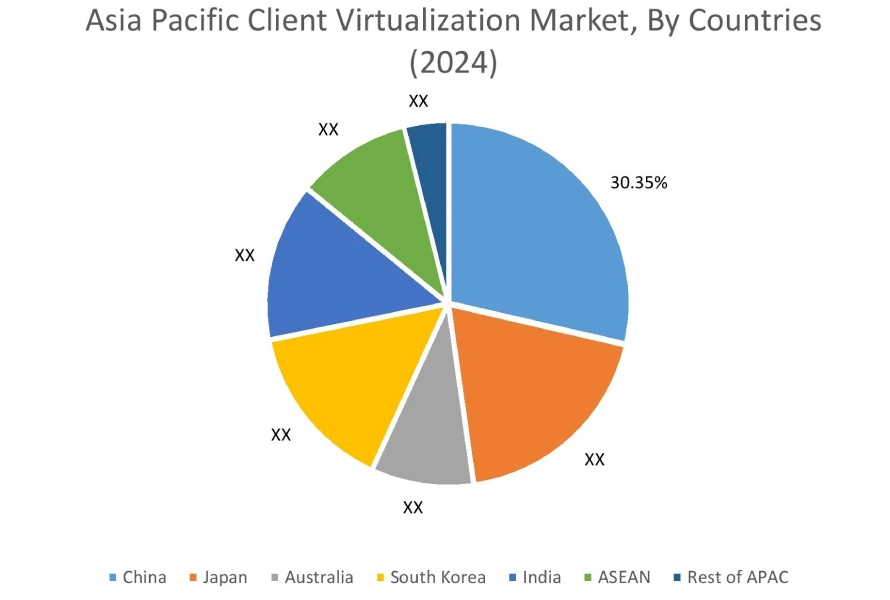
Asia Pacific region was valued at USD 2.34 Billion in 2024. Moreover, it is projected to grow by USD 2.54 Billion in 2025 and reach over USD 5.29 Billion by 2032. Out of this, China accounted for the maximum revenue share of 30.35%. As per the client virtualization market analysis, the adoption of client-side virtualization solutions in the Asia-Pacific region is primarily driven by the growing IT & telecommunication, retail, and government sectors, among others. Additionally, the rising digitalization of business enterprises and increasing demand for scalable virtualization solutions for facilitating remote/hybrid work models and streamlining an enterprise's workflows are further accelerating the client virtualization market expansion.
- For instance, according to the Indian Ministry of Electronics & IT, the digital economy in India emerged as a substantial contributor to its economic growth, accounting for nearly 11.74% of the country's total GDP (approx. USD 402 billion) in FY 2022-23. Hence, the rising digitalization of business enterprises is driving the market in the Asia-Pacific region.
North America is estimated to reach over USD 7.25 Billion by 2032 from a value of USD 3.36 Billion in 2024 and is projected to grow by USD 3.63 Billion in 2025. In North America, the growth of the client virtualization industry is driven by the prevalence of mature IT infrastructure along with growing investments in healthcare, BFSI, retail, and other sectors. Moreover, the increasing adoption of virtualization solutions in BFSI sector for supporting flexible work models and improving operational efficiency is further contributing to the client virtualization market demand in the region.
- For instance, in July 2022, Citi Bank launched its new Citi Commercial Bank in Canada, as part of the company’s global extension plan. Citi Commercial Bank offers a wide range of institutional solutions and products to meet the evolving needs of corporates. The aforementioned factors are expected to drive the client virtualization market trends in North America during the forecast period.
Meanwhile, according to the regional analysis, factors including growing healthcare, manufacturing, IT & telecom, and retail & e-commerce sectors, presence of robust digital transformation initiatives, along with increasing demand for scalable and cost-efficient virtualization solutions among business enterprises are driving the client virtualization market demand in Europe. Furthermore, according to the market analysis, the market demand in Latin America, Middle East, and African regions is expected to grow at a considerable rate due to factors such as rising development of IT firms, increasing investments in BFSI sector, growing need for reliable and scalable virtualization solutions among organizations, and others.
Top Key Players & Market Share Insights:
The global client virtualization market is highly competitive with major players providing solutions to the national and international markets. Key players are adopting several strategies in research and development (R&D), product innovation, and end-user launches to hold a strong position in the client virtualization market. Key players in the client virtualization industry include-
- VMware Inc. (Broadcom)(USA)
- Citrix Systems Inc. (Cloud Software Group Inc.)(USA)
- Oracle Corporation(USA)
- Microsoft Corporation (USA)
- IBM Corporation (USA)
- Amazon Web Services Inc. (USA)
- Nutanix Inc. (USA)
- Red Hat Inc. (USA)
- Parallels International (USA)
- Huawei Technologies Co., Ltd. (China)
Recent Industry Developments :
Product Launches:
- In November 2024, Citrix, a part of Cloud Software Group Inc., officially released the general availability of its Citrix DaaS offering, which is integrated with Amazon Web Services' (AWS) managed VDI service, Amazon WorkSpaces Core. This solution helps businesses in offering secure, high-performance, and cost-efficient virtual desktop and application delivery solutions to users. The service also ensures users can access tools, including Microsoft 365 Apps for enterprise, from any location or device.
Acquisitions & mergers:
- In November 2023, Broadcom acquired VMware Inc., a virtualization solution provider. With this acquisition, Broadcom aims to focus on creating and modernizing its private and hybrid cloud environments, as well as edge environments, for accelerating the deployment of applications, application networking, along with advanced security services, among others.
Client Virtualization Market Report Insights :
| Report Attributes | Report Details |
| Study Timeline | 2021-2034 |
| Market Size in 2034 | USD 23.66 Billion |
| CAGR (2026-2034) | 9.10% |
| Base Year | 2025 |
| By Type |
|
| By Deployment Mode |
|
| By Enterprise Type |
|
| By End-User |
|
| By Region |
|
| Key Players |
|
| North America | U.S. Canada Mexico |
| Europe | U.K. Germany France Spain Italy Russia Benelux Rest of Europe |
| APAC | China South Korea Japan India Australia ASEAN Rest of Asia-Pacific |
| Middle East and Africa | GCC Turkey South Africa Rest of MEA |
| LATAM | Brazil Argentina Chile Rest of LATAM |
| Report Coverage |
|
Key Questions Answered in the Report
How big is the client virtualization market? −
The client virtualization market was valued at USD 9.18 Billion in 2024 and is projected to grow to USD 19.88 Billion by 2032.
Which is the fastest-growing region in the client virtualization market? +
Asia-Pacific is the region experiencing the most rapid growth in the client virtualization market.
What specific segmentation details are covered in the client virtualization report? +
The client virtualization report includes specific segmentation details for type, deployment mode, enterprise type, end user, and region.
Who are the major players in the client virtualization market? +
The key participants in the client virtualization market are VMware Inc. (Broadcom) (USA), Citrix Systems Inc. (Cloud Software Group Inc.) (USA), Oracle Corporation (USA), Microsoft Corporation (USA), IBM Corporation (USA), Amazon Web Services Inc. (USA), Nutanix Inc. (USA), Red Hat Inc. (USA), Parallels International (USA), Huawei Technologies Co., Ltd. (China), and others.
Overview
Reputation & Certifications


Our Services
- Market Intelligence & Forecasting
- Custom Research Solutions
- Market Entry Strategy
- Competitive Intelligence
- Customer Insights
- Industry Innovation Analysis
- Investment Advisory