Jump to Content
Electric Underfloor Heating Market - Size, Share, Industry Trends, and Forecasts (2025-2032)
Electric Underfloor Heating Market Size:
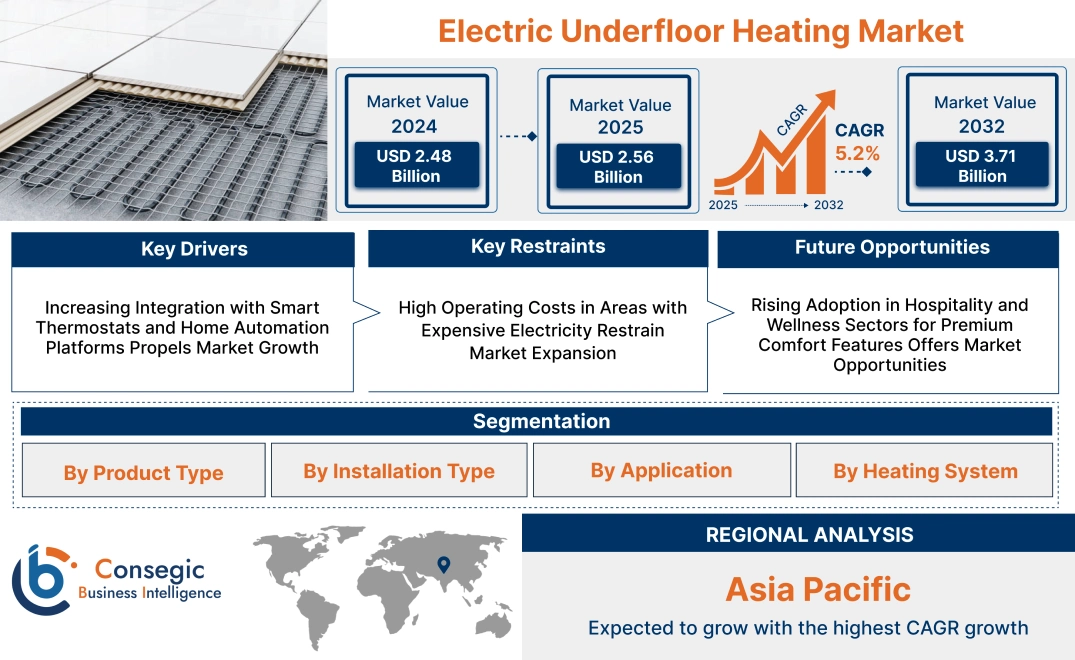
Electric Underfloor Heating Market size is estimated to reach over USD 3.71 Billion by 2032 from a value of USD 2.48 Billion in 2024 and is projected to grow by USD 2.56 Billion in 2025, growing at a CAGR of 5.2% from 2025 to 2032.
Electric Underfloor Heating Market Scope & Overview:
Electric underfloor heating is a radiant system utilizing electric resistance cables or mats laid underneath flooring surfaces to provide consistent warmth throughout indoor areas. Utilized in domestic, hospitality, and commercial applications, it is a discreet and energy-efficient alternative to conventional radiators or forced-air systems.
The system involves thermostatically controlled heating elements, programmable timers, and safety insulation covering to provide evenly controlled temperature adjustment and easy operating convenience. Supportive of almost any flooring substrate—tile, laminate, or engineered wood—without taking up wall or floor space, it gives interior design options without compromising these spaces.
Key benefits are silent running, less air circulation of allergens, and uniform distribution of heat from room to room. Electric underfloor heating aids zoned temperature control and adds comfort levels in bathrooms, kitchens, and lounges. Its application in both new builds and retrofit schemes ensures it is an effective means to deliver modern thermal comfort in energy-aware environments.
Electric Underfloor Heating Market Dynamics - (DRO) :
Key Drivers:
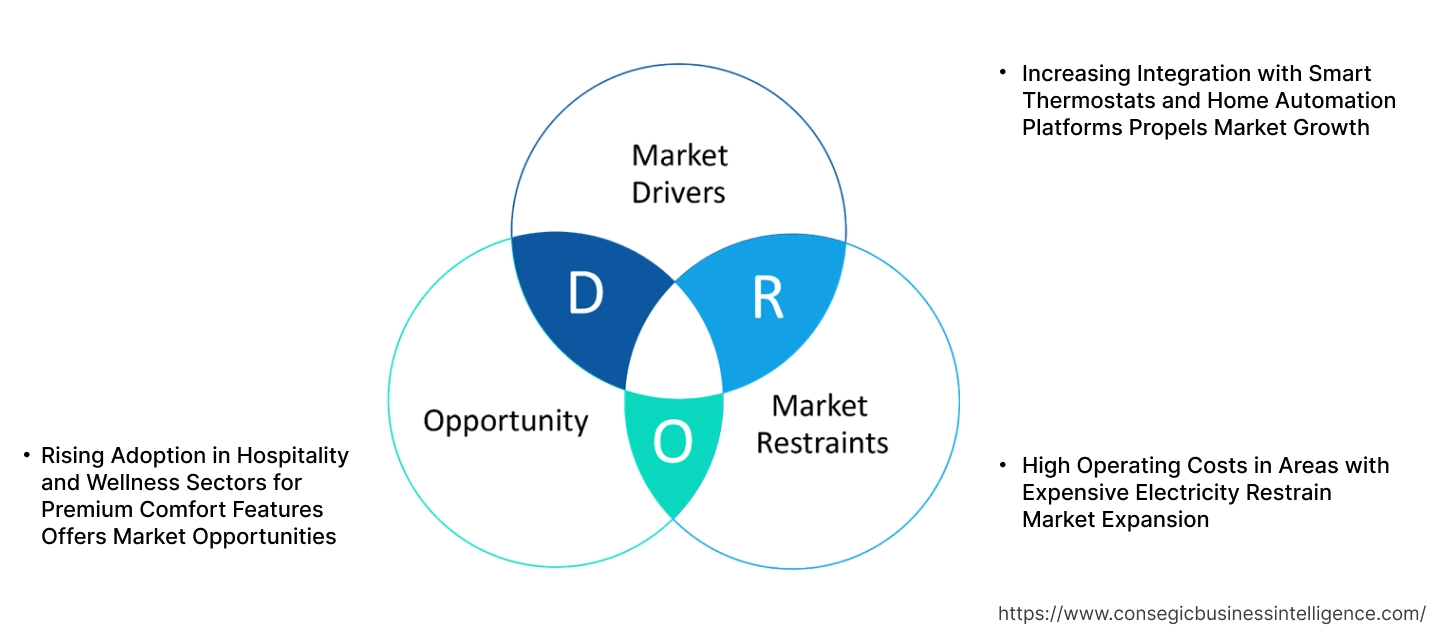
Increasing Integration with Smart Thermostats and Home Automation Platforms Propels Market Growth
The incorporation of electric underfloor heating systems with smart thermostats and home automation platforms is revolutionizing indoor comfort management for users. The systems enable zoned control of heating, adaptive scheduling, and monitoring of energy consumption using mobile apps and voice assistants. Occupancy sensors and real-time feedback of temperatures maximize energy efficiency without sacrificing thermal comfort. Builders and end users are increasingly seeking connected climate systems that provide greater visibility of operation and user control. This requirement is particularly strong in contemporary urban dwelling and high-end residential spaces where automation is seen as an addition to value. Suppliers with app-based user interfaces, Wi-Fi-controlled thermostats, and integration with smart home platforms are winning out in competitiveness.
- For instance, in March 2025, CBI-electric: low voltage launched the new Astute Range of IoT smart products, which enable the remote control of geysers, lights, underfloor heating, pool pumps, etc., through the CBI Home App. The product line includes the Astute Smart Controller (ASC), the Astute Smart Isolator (ASI) and the Astute Smart Plug (ASP), which aid in energy monitoring, scheduling and switch controlling.
With the smart home ecosystem expanding internationally, integration with heating equipment is becoming an accepted norm, facilitating the electric underfloor heating market expansion.
Key Restraints:
High Operating Costs in Areas with Expensive Electricity Restrain Market Expansion
Where electricity costs are high, the running cost of electric underfloor heating systems is a constraint. Ongoing energy input over prolonged periods of heating results in high monthly bills on the utility front, especially if used over large floor spaces. Compared to gas-fired or hydronic solutions, electric solutions might not deliver cost-effective long-term operation, particularly in less well-insulated buildings. This discourages mass adoption in markets where operational economy is more highly valued than simplicity of installation. Where there is demand for effective heating solutions, cost-conscious consumers tend to choose other systems that will deliver higher returns in the long term. The cost of electricity has a direct influence on consumption patterns and buying behavior, thus hampering electric underfloor heating market growth in some geographies.
Future Opportunities :
Rising Adoption in Hospitality and Wellness Sectors for Premium Comfort Features Offers Market Opportunities
Hotels, spas, and upscale resorts are progressively implementing electric underfloor heating solutions to deliver premium comfort in bedrooms, bathrooms, and wellness areas. These systems provide a quiet, consistent, and unobtrusive warmth experience that supports luxury hospitality requirements. Properties that seek to distinguish based on comfort are combining these systems with occupancy-based controls and building automation systems to optimize energy use. The need for bespoke, luxury thermal comfort is especially prevalent in boutique hotels, ski resorts, and premium wellness facilities. With the hospitality industry moving toward user-driven design and operational effectiveness, there is growing interest in radiant floor systems across refurbishment and new-build projects.
- For instance, in May 2021, Schlüter-Systems provided bathroom waterproofing and underfloor heating solutions at the Newt in Somerset hotel and spa in the United Kingdom, as part of extensive renovations. The Schlüter-DITRA-HEAT-DUO, an electric underfloor heating system, was used to provide a uniform and consistent heating experience throughout the benches and seats in the Barton Spa to ensure user comfort.
This move into non-residential use opens up high-margin installations, opening up long-term electric underfloor heating market opportunities backed by premium necessity and sector-specific growth.
Electric Underfloor Heating Market Segmental Analysis :
By Product Type:
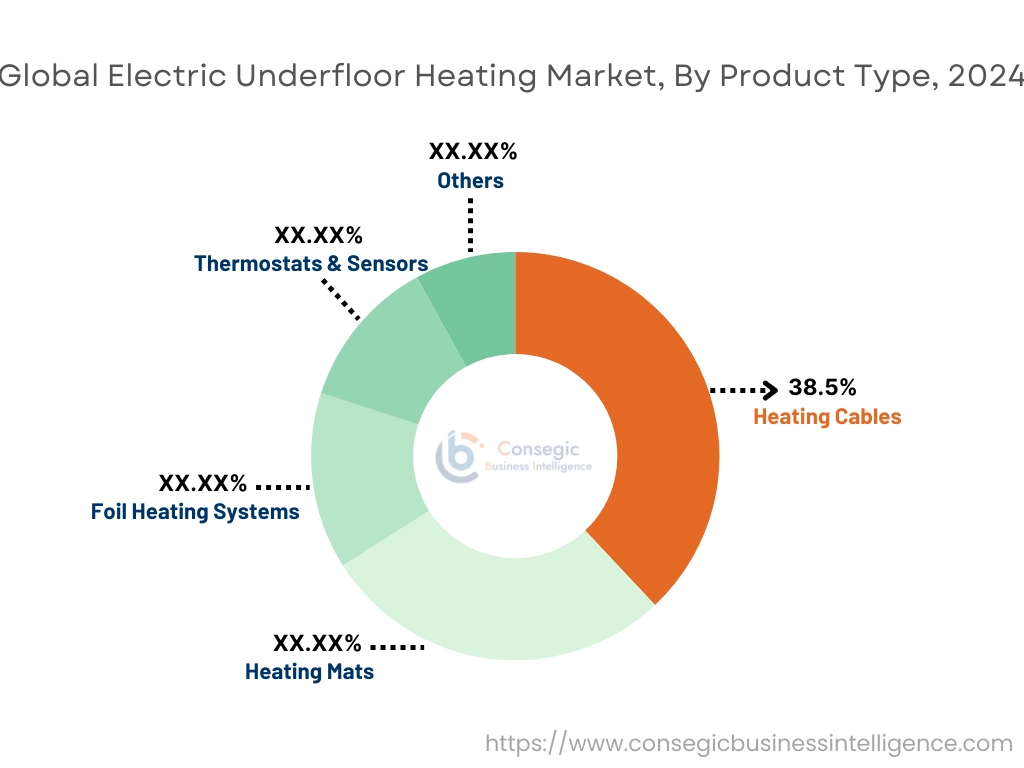
Based on product type, the market is segmented into heating cables, heating mats, foil heating systems, thermostats & sensors, and others.
The heating cables segment accounted for the largest electric underfloor heating market share of 38.5% in 2024.
- Heating cables are favored for their flexibility in installation, particularly in irregular or complex floor layouts across both residential and commercial buildings.
- These systems offer higher output wattage and can be embedded directly into floor screeds, ensuring efficient and even heat distribution.
- Long lifespan and minimal maintenance requirements make them a cost-effective solution in new construction projects.
- As per the electric underfloor heating market analysis, the durability and versatility of heating cables reinforce their dominance in the segment.
The thermostats & sensors segment is projected to register the fastest CAGR during the forecast period.
- Integration of smart thermostats and advanced sensors supports real-time temperature monitoring, improving energy efficiency and user comfort.
- Wireless and programmable systems are gaining traction in smart homes and commercial automation setups.
- Market participants are launching app-enabled and voice-controlled thermostat interfaces to attract tech-savvy consumers.
- According to electric underfloor heating market trends, increasing focus on sustainability and intelligent energy use supports rapid adoption of this subsegment.
By Installation Type:
Based on installation type, the electric underfloor heating market is segmented into new installation and retrofit installation.
The new installation segment accounted for the largest share in 2024.
- New construction projects provide ideal conditions for embedding underfloor heating systems during the initial flooring stage, ensuring better performance and minimal disruption.
- Government incentives and green building regulations across Europe and North America are driving the integration of electric heating in sustainable housing.
- Builders and developers increasingly include underfloor heating as a value-added amenity in high-end residential and commercial developments.
- According to electric underfloor heating market analysis, ongoing urbanization and smart infrastructure investments strengthen this segment's dominance.
The retrofit installation segment is anticipated to witness the fastest CAGR during the forecast period.
- Retrofits are gaining momentum as homeowners and businesses look to upgrade existing heating systems without major structural changes.
- Advancements in ultra-thin mats and foil-based systems make installations easier under existing floors, reducing labor and downtime.
- The segment benefits from rising requirements for personalized comfort and energy savings in aging building stocks across mature markets.
- For instance, in January 2025, Ambiente launched LoFloor 18, an incredibly thin underfloor heating (UFH) solution for projects with premium floor build-up. With an overall thickness of only 18mm, the product is ideal for retrofit installations.
- Thus, retrofits are crucial to the electric underfloor heating market growth, particularly in the residential sector.
By Application:
Based on application, the market is categorized into residential (single-family, multi-family), commercial (education, healthcare, retail, logistics & transportation, offices, hospitality, others), and industrial.
The residential segment accounted for the largest electric underfloor heating market share in 2024.
- Increasing consumer focus on energy-efficient, low-profile heating systems supports strong adoption in both new homes and renovations.
- In single-family homes, underfloor heating is commonly installed in bathrooms and kitchens, while multi-family units are adopting zonal control systems.
- Home automation trends and integration with smart thermostats enhance user convenience and energy optimization.
- As per electric underfloor heating market trends, growing awareness about indoor comfort and air quality continues to drive residential segment expansion.
The commercial segment is expected to register the fastest CAGR during the forecast period.
- Commercial establishments prioritize space-saving and uniform heating systems, making underfloor heating an attractive alternative to radiators or forced-air units.
- Healthcare and hospitality segments, in particular, require silent, low-allergen heating solutions that enhance occupant comfort and hygiene.
- Office and retail projects benefit from reduced HVAC costs and better aesthetic flexibility with concealed heating installations.
- The electric underfloor heating market demand in commercial spaces is also driven by rising energy regulations and building certification programs.
By Heating System:
Based on heating system, the electric underfloor heating market is divided into radiant electric systems and convection-based systems.
The radiant electric systems segment held the largest revenue share in 2024.
- Radiant systems transfer heat directly from the floor to occupants, offering superior thermal comfort and energy efficiency.
- These systems are compatible with various floor coverings including tiles, laminates, and engineered wood, enhancing design flexibility.
- Reduced air circulation minimizes dust and allergens, making radiant heating ideal for sensitive indoor environments.
- The consistent heating pattern and lower operating temperature support long-term cost efficiency and sustained electric underfloor heating market demand.
The convection-based systems segment is anticipated to grow at the fastest CAGR during the forecast period.
- Convection systems operate by warming the air above the heating element, creating a vertical heat gradient suited for specific industrial and large-area applications.
- These systems are particularly used in industrial zones, loading areas, and utility rooms requiring targeted spot heating.
- Their relatively faster response time and simpler controls appeal to users with basic heating needs and budget constraints.
- Thus, innovation in hybrid systems combining convection and radiant elements is bolstering the electric underfloor heating market expansion.
Regional Analysis:
The regions covered are North America, Europe, Asia Pacific, the Middle East and Africa, and Latin America.
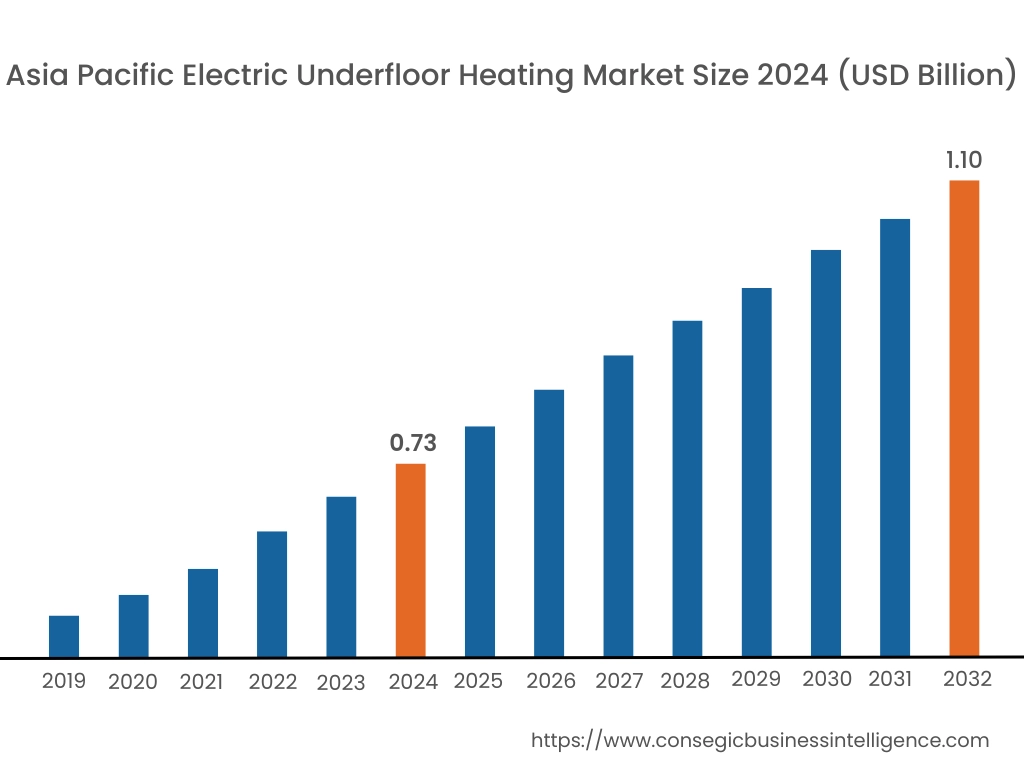
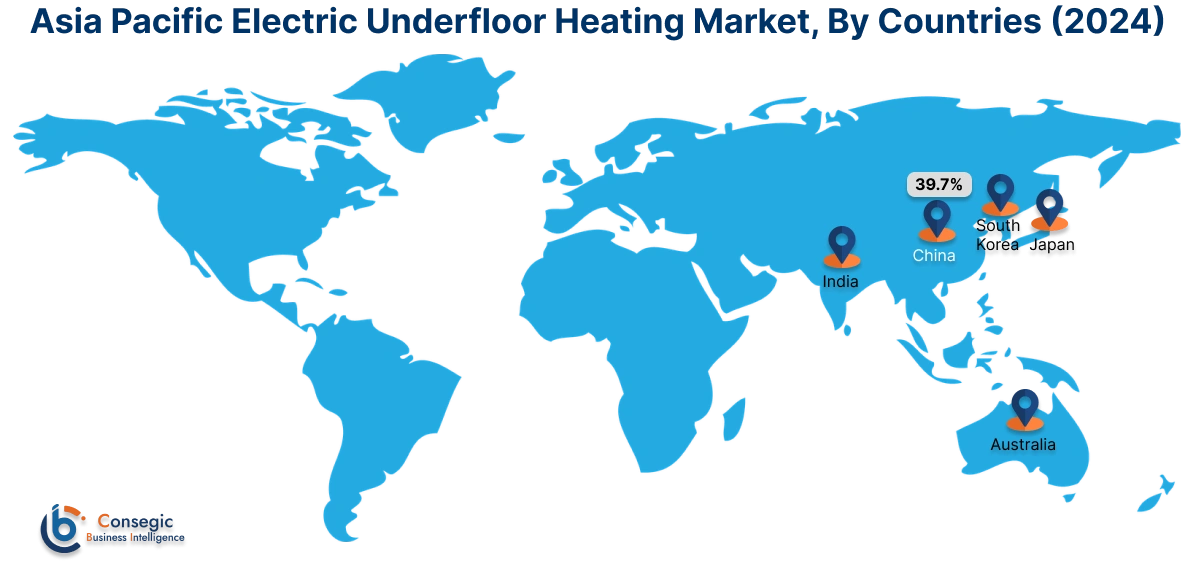
Asia Pacific region was valued at USD 0.73 Billion in 2024. Moreover, it is projected to grow by USD 0.75 Billion in 2025 and reach over USD 1.10 Billion by 2032. Out of this, China accounted for the maximum revenue share of 39.7%. The Asia-Pacific region is experiencing growth in the electric underfloor heating market, especially in Japan, South Korea, China, and parts of Australia. Market research indicates greater consciousness of energy efficiency, and growing demand for luxury residential products that improve winter season comfort. Hence, urban growth and the spread of high-rise buildings are also encouraging low-profile heating system installation without sacrificing ceiling space. China, specifically, is experiencing localized production and government initiatives to enhance indoor living standards in colder northern provinces, which is adding to more system integration in both public and private developments.
North America is estimated to reach over USD 1.01 Billion by 2032 from a value of USD 0.67 Billion in 2024 and is projected to grow by USD 0.69 Billion in 2025. North America reflects steadily increasing requirement, especially in the colder parts of the United States and Canada where residential and commercial buildings appreciate radiant heating solutions. Market research indicates that increasing interest in energy-efficient homes combined with the interior design trend toward minimalism is fueling installations in new builds as well as renovations. The combination of electric underfloor systems with intelligent thermostats and building automation is also adding appeal among upscale residential builders. Furthermore, the support of local incentives and green building certifications further increases adoption, particularly in green housing projects centered on thermal comfort and energy conservation.
Europe is the most advanced and regulation-led region in the electric underfloor heating industry, particularly in Germany, the UK, the Netherlands, and the Nordic countries. The synergy of strict energy efficiency requirements and extensive retrofitting of older infrastructure continues to support market development. Analysis suggests high usage in domestic bathrooms, kitchens, and whole-house applications in low-carbon housing estates. The drive to phase out gas boilers and cut dependence on fossil fuels is making electric heating increasingly significant in zero-carbon building plans. Product innovation aimed at swift heat-up systems and adaptability with renewable electricity is also influencing market demand.
Latin America is a developing market with occasional but growing interest in electric heating technologies in areas with seasonal cold weather, like southern Brazil, Argentina, and parts of Chile. Although conventional heating technology remains prevalent, market research indicates increasing demand in the hospitality and high-end real estate markets, where comfort and beauty are the top considerations. The electric underfloor heating market opportunity in this region lies in educating homeowners and contractors to value operational efficiency and long-term value, as well as building distribution channels to facilitate localized adoption.
The need for electric underfloor heating systems is niche but growing in particular applications in the Middle East and Africa. Premium residential projects, resorts, and healthcare facilities in countries such as the UAE, South Africa, and Turkey are leading the uptake in cooler regions or comfort-based applications like spas and wellness centers. Analysis indicates that ambient temperatures tend to decrease the demand for space heating but that interest in energy-efficient radiant systems for tile and stone flooring is on the rise. Further urbanization and increased incomes are anticipated to drive adoption in targeted verticals, especially where energy efficiency requirements are harmonized with overall infrastructure development.
Top Key Players and Market Share Insights:
The electric underfloor heating market is highly competitive with major players providing products and services to the national and international markets. Key players are adopting several strategies in research and development (R&D), product innovation, and end-user launches to hold a strong position in the global electric underfloor heating market. Key players in the electric underfloor heating industry include -
- nVent Electric plc (UK)
- Warmup plc (UK)
- Termo-Fol Sp. z o.o. (Poland)
- Giacomini S.p.A. (Italy)
- John Guest (Reliance Worldwide Corporation Ltd.) (UK)
- MAGNUM Heating Group B.V. (Netherlands)
- DEVI (Danfoss Group) (Denmark)
- ETHERMA (Austria)
- Warmset S.r.l. (Italy)
- Flexel International Ltd. (UK)
Recent Industry Developments :
Acquisitions:
- In October 2024, Purmo Group acquired Unitherm Heating Systems Ltd, a provider of holistic climate solutions. Situated in Helsinki, Purmo Group provides complete HVAC solutions to residential and non-residential buildings, including underfloor heating and cooling and heat pumps. This development enables the Group to expand in the United Kingdom and Ireland, where Unitherm maintains a stronghold.
Electric Underfloor Heating Market Report Insights :
| Report Attributes | Report Details |
| Study Timeline | 2019-2032 |
| Market Size in 2032 | USD 3.71 Billion |
| CAGR (2025-2032) | 5.2% |
| By Product Type |
|
| By Installation Type |
|
| By Application |
|
| By Heating System |
|
| By Region |
|
| Key Players |
|
| North America | U.S. Canada Mexico |
| Europe | U.K. Germany France Spain Italy Russia Benelux Rest of Europe |
| APAC | China South Korea Japan India Australia ASEAN Rest of Asia-Pacific |
| Middle East and Africa | GCC Turkey South Africa Rest of MEA |
| LATAM | Brazil Argentina Chile Rest of LATAM |
| Report Coverage |
|
Key Questions Answered in the Report
How big is the Electric Underfloor Heating Market? −
Electric Underfloor Heating Market size is estimated to reach over USD 3.71 Billion by 2032 from a value of USD 2.48 Billion in 2024 and is projected to grow by USD 2.56 Billion in 2025, growing at a CAGR of 5.2% from 2025 to 2032.
What specific segmentation details are covered in the Electric Underfloor Heating Market report? +
The Electric Underfloor Heating market report includes specific segmentation details for product type, installation type, application and heating system.
What are the applications in the Electric Underfloor Heating Market? +
The applications in the Electric Underfloor Heating Market are residential (single-family, multi-family), commercial (education, healthcare, retail, logistics & transportation, offices, hospitality, others), and industrial.
Who are the major players in the Electric Underfloor Heating Market? +
The key participants in the Electric Underfloor Heating market are nVent Electric plc (UK), Warmup plc (UK), MAGNUM Heating Group B.V. (Netherlands), DEVI (Danfoss Group) (Denmark), ETHERMA (Austria), Warmset S.r.l. (Italy), Flexel International Ltd. (UK), Termo-Fol Sp. z o.o. (Poland), Giacomini S.p.A. (Italy) and John Guest (Reliance Worldwide Corporation Ltd.) (UK).
Overview
Reputation & Certifications


Our Services
- Market Intelligence & Forecasting
- Custom Research Solutions
- Market Entry Strategy
- Competitive Intelligence
- Customer Insights
- Industry Innovation Analysis
- Investment Advisory