Jump to Content
Ethanol Market Size & Industry Share - Growth Trends & Forecasts (2026 - 2034)
Ethanol Market Size:
Ethanol Market size is estimated to reach over 187.79 (US$B) by 2034 from a value of 108.36 (US$B) in 2025 and is projected to grow by 115.19 (US$B) in 2026, growing at a CAGR of 6.3% from 2026 to 2034, according to a recent report from Consegic Business Intelligence.
Ethanol Market Scope & Overview:
The ethanol market encompasses the production, distribution, and consumption of ethyl alcohol, primarily used for biofuel blending in gasoline to reduce emissions, with significant secondary applications in beverages, industrial solvents, and pharmaceuticals. Features including cleaner burning, biodegradable, and reduced greenhouse gas emission drives the market. Further, key trends driving the demand for include supportive government mandates and policies that require biofuel blending, the global push for cleaner energy to reduce carbon emissions, and the rising need from industrial applications such as hand sanitizers, pharmaceuticals, and cosmetics.
How is AI Transforming the Ethanol Market?
AI is profoundly transforming the market by optimizing the entire production lifecycle, from feedstock to final fuel. Machine learning algorithms, particularly Artificial Neural Networks, are used to create predictive models that fine-tune critical fermentation parameters like temperature, pH, and enzyme concentration in real time, leading to significantly higher ethyl alcohol yields and consistent outcomes. Furthermore, AI minimizes operational costs and energy consumption, especially in the energy-intensive distillation stage, by continuously analyzing thousands of data points to improve efficiency and predict maintenance needs.

Ethanol Market Dynamics - (DRO) :
Key Drivers:
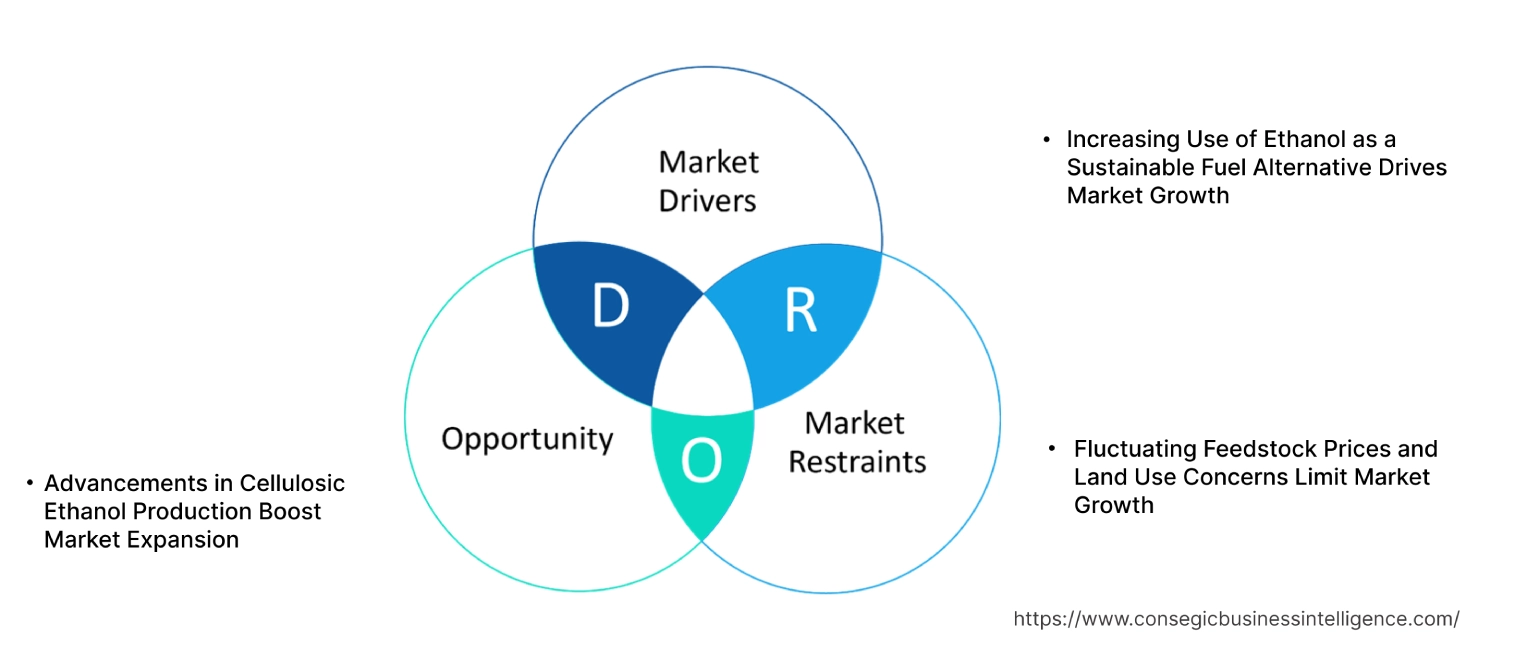
Government Policies and Mandates Drive the Ethanol Market Growth
Stringent government policies are the primary catalyst for ethanol market growth, as numerous countries, including the US, Brazil, and India, enforce mandatory blending programs like the Renewable Fuel Standard (RFS) or specific E20 targets. These mandates compel oil companies to mix a set percentage of ethyl alcohol into gasoline, creating a massive, assured demand base and directly driving the market. Furthermore, governments provide financial incentives such as subsidies, tax breaks, and favorable procurement pricing, which encourage capital investment in new and expanded distillery capacity, all with the core strategic goals of reducing dependence on imported fossil fuels and meeting national climate change commitments.
- For instance, the Indian government has moved up its timeline for achieving 20% ethyl alcohol blending in petrol (E20), advancing the target from 2030 to the Ethyl Alcohol Supply Year (ESY) 2025-26.
Thus, increasing blending mandates and tax incentives are contributing significantly to the ethanol market size.
Key Restraints :
Feedstock Supply Concerns and Price Fluctuations are Limiting the market.
The heavy reliance on food crops, such as corn and sugarcane, as primary ethyl alcohol feedstocks, is a major market constraint. Agricultural output is vulnerable to weather events like droughts or floods, leading to unpredictable crop yields and volatile commodity prices. This fluctuation in feedstock cost directly impacts ethyl alcohol production margins and limits investment stability. Furthermore, the persistent "food versus fuel" ethical debate raises socio-political concerns about diverting food sources for energy, especially during periods of global food price inflation, hindering the expansion of conventional ethyl alcohol production capacity. The long-term stability and profitability of the market, therefore, depend on diversifying into second-generation non-food feedstock.
Future Opportunities :
Advancements in Second-Generation (2G) Ethanol Drive Ethanol Market Opportunities
Increasing advancements in Second-Generation (2G) ethanol are revolutionizing the market by addressing the critical "food vs. fuel" debate. This advanced biofuel is produced from non-food cellulosic biomass such as agricultural residues, which include rice straw & corn stover, and forestry waste. This, in turn, ensures a more secure and diverse feedstock supply, mitigating price volatility. Further, 2G ethyl alcohol offers significantly lower Greenhouse Gas (GHG) emissions compared to traditional fossil fuels and even first-generation ethyl alcohol, positioning it as a key solution for decarbonizing the transport and aviation sectors. Furthermore, technological breakthroughs in enzyme efficiency and biorefinery integration are rapidly lowering production costs, making 2G ethyl alcohol an increasingly attractive and scalable commercial opportunity.
- For instance, in September 2025, India’s Directorate General of Foreign Trade (DGFT) implemented a new policy condition to regulate the export of Second-Generation (2G) ethyl alcohol.The primary goal is to manage 2G ethyl alcohol exports while simultaneously promoting the domestic utilization and growth of environmentally sustainable biofuels.
Thus, the development and commercial viability of Second-Generation (2G) cellulosic fuel drive the ethanol market opportunities.
Ethanol Market Segmental Analysis:
By Source :
Based on the source, the market is segmented into synthetic ethanol and bioethanol.
Trends in the Source:
- Increasing development in technologies like carbon capture and storage, making corn ethanol more competitive under stringent environmental regulations, driving the ethanol market trends.
- Biorefineries are moving beyond simple ethyl alcohol production to maximize co-product value, such as extracting high-protein animal feed from the leftover grain mash, which in turn drives ethanol market size.
Bioethanol accounted for the largest revenue share of 35.49% in the year 2024 and is anticipated to register the fastest CAGR during the forecast period.
- There is massive R&D and investment in second-generation cellulosic ethanol, derived from non-food agricultural waste and wood chips, driving the ethanol market share.
- There's a growing trend in major developing economies like India and China, where aggressive advancements are taking place regarding blending targets which in turn drives ethanol market demand.
- Furthermore, ethyl alcohol is increasingly being viewed as a key low-cost pathway for producing sustainable aviation fuel which in turn drives the ethanol market trends.
- Thus, as per ethanol market analysis, the shift to advanced feedstocks, sustainable aviation fuel growth, and a rise in blending mandates are driving the market.
By Purity:
Based on the purity, the market is bifurcated into denatured and undenatured.
Trends in the Purity:
- There is a growing push, particularly from ethyl alcohol producers, to deregulate or simplify denaturant requirements to reduce costs, eliminate the use of fossil-derived denaturants, and streamline the blending process, in turn driving the ethanol market demand.
- Producers face increasing pressure to meet stringent and complex international regulatory standards (USP, EP, FCC) for residual solvents and impurities which in turn drives the ethanol market.
Denatured accounted for the largest revenue share in the year 2024.
- The segment is experiencing sustained high demand in the industrial cleaning and sanitation sectors which is driving the ethanol industry.
- Furthermore, denatured continues to gain market share in the broader industrial solvent sector as a cost-effective, bio-based, and relatively safer alternative to many traditional petrochemical-based solvents which in turn drives the ethanol market share.
- Thus, as per ethanol market analysis, cost-effectiveness and a surge in industrial adoptions are driving the market.
Undenatured is anticipated to register the fastest CAGR during the forecast period.
- Growing need for high-purity undenatured ethyl alcohol in the pharmaceuticals and cosmetics sectors, especially for drug formulations, vaccines, and premium personal care products, drives the market.
- Further, the beverage segment is seeing strong growth and premiumization, particularly in emerging Asia, driving the need for top-tier extra neutral alcohol quality, which subsequently propels the ethanol market expansion.
- Therefore, based on analysis, rising adoption inthe pharmaceuticals and beverage sectors is anticipated to boost the growth of the market during the forecast period.
By Application:
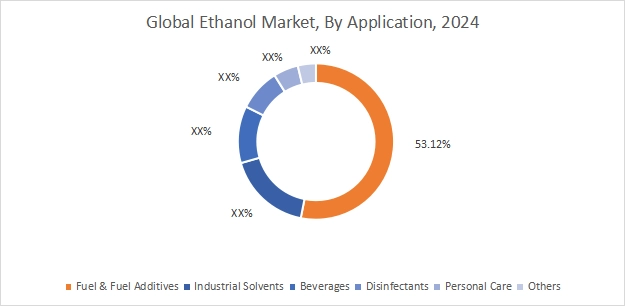
Based on the application, the market is segmented into fuel & fuel additives, industrial solvents, beverages, disinfectants, personal care, and others.
Trends in the Application:
- Brands are constantly launching new flavors and formulations, often utilizing ethyl alcohol as a crucial solvent for extracting and carrying complex natural and artificial flavorings into the final product, which in turn drives the ethanol market expansion.
- Hygiene awareness has become institutionalized in commercial, healthcare, and household settings, permanently increasing the sustained global demand for ethyl alcohol based hand sanitizers and surface disinfectants, which subsequently propels the ethanol market.
Fuel & fuel additives accounted for the largest revenue share of 53.12% in the year 2024 and is anticipated to register a significant CAGR during the forecast period.
- Government mandates in key markets like India are aggressively pushing for higher blending ratios, moving from E10 to E20 (20% ethyl alcohol), which requires substantial new production capacity and guarantees robust demand growth.
- Further, ethyl alcohol is being explored as a clean-burning marine bunker fuel, particularly for large two-stroke engines, offering a promising solution for the maritime industry's decarbonization goals.
- Furthermore, policy drivers are specifically targeting second-generation or cellulosic ethyl alcohol, ensuring its gradual but mandatory integration into the fuel mix to enhance sustainability credentials.
- For instance, in November 2023, during the third International Civil Aviation Organization (ICAO) Conference on Aviation and Alternative Fuels, which involved over 100 governments, industry, and civil society, established a collective goal for 2030. The goal is to make global aviation fuel 5% less carbon-intensive by transitioning to sustainable aviation fuel and other lower-carbon alternatives.
- Thus, based on analysis,integration of advanced bioethanol, marine fuel development, and others is driving the market.
Regional Analysis:
The regions covered are North America, Europe, Asia Pacific, Middle East and Africa, and Latin America.
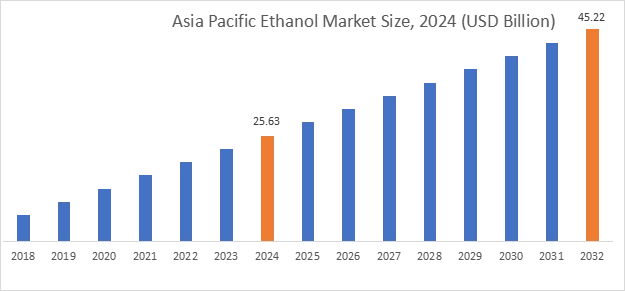
Asia Pacific region was valued at USD 25.63 Billion in 2024. Moreover, it is projected to grow by USD 27.19 Billion in 2025 and reach over USD 45.22 Billion by 2032. Out of this, China accounted for the maximum revenue share of 30.44%. The market growth is mainly driven by the rapid acceleration of government blending mandates in major countries like India and Indonesia, and significant investments in Sustainable Aviation Fuel.
- For instance,Civil Aviation Minister of India announced a commitment to blend Sustainable Aviation Fuel (SAF) with traditional jet fuel for international flights, setting clear targets: 1% by 2027, 2% by 2028, and an indicative goal of 5% by 2030.

North America is estimated to reach over USD 58.60 Billion by 2032 from a value of USD 33.71 Billion in 2024 and is projected to grow by USD 35.73 Billion in 2025. Based on analysis, the North American market is primarily driven by policy mandates, high financial incentives, and growing environmental awareness.
- For instance, in 2024, the U.S. Environmental Protection Agency (EPA) and the Department of Energy (DOE) released a Funding Opportunity Announcement (FOA) for up to USD 9.4 million, sourced from the Inflation Reduction Act (IRA), to accelerate the development of advanced biofuels.
The regional trends analysis depicts that stringent, binding targets set by the Renewable Energy Directive in Europe are driving the market. Additionally, the factors driving the market in the Middle East and African region are national energy diversification strategies and increasing pilot projects and policy frameworks. Further, strong regional agricultural capacity and focus on energy diversification are paving the way for the progress of market in Latin America region.
Top Key Players & Market Share Insights:
The global ethanol market is highly competitive with major players providing solutions to the national and international markets. Key players are adopting several strategies in research and development (R&D), product innovation, and end-user launches to hold a strong position in the ethanol industry. Key players in the global ethanol market include-
- POET, LLC (U.S.)
- Raízen (Brazil)
- Valero Energy Corporation (U.S.)
- Green Plains Inc. (U.S.)
- Cargill, Inc. (U.S.)
- Alto Ingredients, Inc. (U.S.)
- CropEnergies AG (Germany)
- ADM (U.S.)
- The Andersons, Inc. (U.S.)
- Flint Hill Resources LP (U.S.)
Recent Industry Developments:
Collaboration
In July 2024, CF Industries and POET LLC, the world's largest biofuel producer, collaborated on a pilot program. The goal is to use low-carbon ammonia fertilizer to reduce the carbon intensity of corn cultivation, which will, in turn, lower the overall carbon footprint of ethyl alcohol produced from that corn.
Ethanol Market Report Insights :
| Report Attributes | Report Details |
| Study Timeline | 2021-2034 |
| Market Size in 2034 | USD 187.79 Billion |
| CAGR (2026-2034) | 6.30% |
| Base Year | 2025 |
| By Source |
|
| By Purity |
|
| By Application |
|
| By Region |
|
| Key Players |
|
| North America | U.S. Canada Mexico |
| Europe | U.K. Germany France Spain Italy Russia Benelux Rest of Europe |
| APAC | China South Korea Japan India Australia ASEAN Rest of Asia-Pacific |
| Middle East and Africa | GCC Turkey South Africa Rest of MEA |
| LATAM | Brazil Argentina Chile Rest of LATAM |
| Report Coverage |
|
Key Questions Answered in the Report
How big is the ethanol market? −
The ethanol market is estimated to reach over USD 166.19 Billion by 2032 from a value of USD 95.93 Billion in 2024 and is projected to grow by USD 101.63 Billion in 2025, growing at a CAGR of 6.3% from 2025 to 2032.
What specific segmentation details are covered in the ethanol report? +
The ethanol report includes specific segmentation details for source, purity, application, and regions.
Which is the fastest segment anticipated to impact the market growth? +
In the ethanol market, undenatured segment is the fastest-growing segment during the forecast period.
Who are the major players in the ethanol market? +
The key participants in the ethanol market are POET, LLC (U.S.), Raízen (Brazil), Valero Energy Corporation (U.S.), Green Plains Inc. (U.S.), Cargill, Inc. (U.S.), Alto Ingredients, Inc. (U.S.), CropEnergies AG (Germany), ADM (U.S.), The Andersons, Inc. (U.S.), Flint Hill Resources LP (U.S.), and others.
What are the key trends in the ethanol market? +
The ethanol market is being shaped by several key trends including rising biofuel blending programs, the rapid development of higher-value applications in sustainable aviation fuel and pharmaceuticals, and increased investment in advanced, non-food cellulosic production technologies.
Overview
Reputation & Certifications


Our Services
- Market Intelligence & Forecasting
- Custom Research Solutions
- Market Entry Strategy
- Competitive Intelligence
- Customer Insights
- Industry Innovation Analysis
- Investment Advisory