Jump to Content
Linear Actuator Market - Size, Industry Share, Growth Trends and Forecasts (2026 - 2034)
Linear Actuator Market Size:
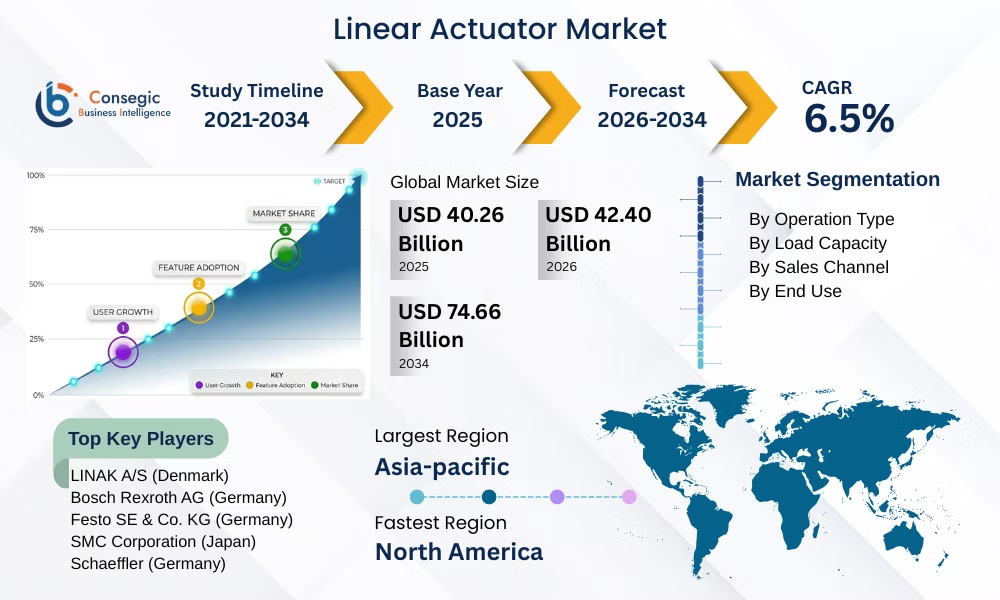
Linear Actuator Market size is estimated to reach over USD 74.66 Billion by 2034 from a value of USD 40.26 Billion in 2025 and is projected to grow by USD 42.40 Billion in 2026, growing at a CAGR of 6.5% from 2026 to 2034.
Linear Actuator Market Key Takeaways
Key Growth Drivers
- Rising adoption of industrial automation, robotics, and smart manufacturing is driving demand for high-precision linear actuators across industries.
- Growing integration of IoT-enabled manufacturing systems is increasing the need for actuators that support real-time monitoring and predictive maintenance.
- Expanding automated production lines in the automotive and electronics sectors are boosting the utilization of advanced motion control solutions.
Market Limitations & Challenges
- High initial investment costs for advanced linear actuator systems are limiting adoption, particularly among small and medium-sized enterprises.
- Integration of modern actuators requires additional expenses for controllers, software, engineering, and system calibration.
Strategic Opportunities
- Rising adoption of electric vehicles is creating significant opportunities for linear actuators in automotive applications.
- Increasing use of electromechanical actuators in braking systems, active suspension, and automated vehicle functions is supporting market growth.
Key Players
- Market Leader: Parker Hannifin Corporation held a significant share of the global Linear Actuator Market in 2025, driven by its extensive motion and control technologies portfolio, strong industrial automation presence, and continuous innovation in high-performance electromechanical and hydraulic actuator solutions across diverse end-use industries.
Linear Actuator Market Scope & Overview:
A linear actuator is a device that converts rotational energy, usually from electric, hydraulic, or pneumatic sources, into straight-line (push or pull) motion. These devices offer precise, repeatable, and automated position control without the need for complex mechanical linkages such as gears or belts. It offers several benefits, including high energy efficiency, low maintenance, compact dimensions, and the ability to safely hold loads in place even without power. Additionally, the market is driven by factors such as the rapid adoption of industrial automation, advancements in robotics, rising shift toward electric vehicles (EVs), and increasing need for precision engineering in the manufacturing sector.
Linear Actuator Market Dynamics - (DRO):
Market Drivers:
The rising adoption of industrial automation, robotics, and smart manufacturing is driving the market growth
The market is experiencing significant growth, mainly driven by the expansion of industrial automation, robotics, and smart manufacturing, among others. Since actuators convert energy into precise, continuous straight-line motion, they play an essential role in executing complex, repetitive tasks without human intervention. Within modern automated factories, actuators are used for operating the critical joints of robotic arms, power automated material-handling systems, and drive the sorting mechanisms in logistics centers.
Moreover, the rising adoption of smart manufacturing requires systems capable of extreme precision, real-time data feedback, and high repeatability. Modern electric actuators fulfill this need by integrating seamlessly with IoT platforms, which in turn facilitates predictive maintenance, remote condition monitoring, and energy efficiency. Additionally, the growing smart assembly and continuous production lines, particularly in the automotive and electronics industries, requires advanced motion control and precise operation, further propelling the market demand.
- For instance, in 2024, Xiaomi launched its completely automated smart factory in Beijing, China. The automated factory spans across 860,000 square feet, and it was developed to manufacture approximately 10 million smartphones each year without any human intervention.
Hence, the rising adoption of industrial automation in manufacturing facilities is driving the linear actuator market size.
Market Restraints:
High initial investment is restraining the linear actuator market growth
The high initial investment required for advanced motion control systems is among the primary factors restricting the market growth. Transitioning from legacy mechanical or traditional pneumatic setups to high-precision electro-mechanical or direct-drive linear systems involves substantial upfront capital expenditure.
Moreover, the initial financial investment comprises the cost of actuators along with the necessary auxiliary hardware, including compatible servo drives, programmable logic controllers (PLCs), and specialized cabling. Beyond hardware procurement, integrating these modern actuators into existing factory systems mostly requires intricate engineering design, system calibration, and complex software programming, further adding to deployment and labor costs. This in turn, may cause financial barriers, mostly for smaller businesses or businesses operating on tighter budgets. Thus, the above factors are hindering the linear actuator market expansion.
Future Opportunities:
Rising adoption of electric vehicles is expected to drive the linear actuator market opportunities
The rising adoption of electric vehicles is expected to offer lucrative aspects for market growth. As the automotive industry transitions to sustainable mobility, electromechanical actuators are replacing bulky, leak-prone hydraulic and pneumatic systems. These actuators offer high precision, energy efficiency, and compact packaging, which play an important role in optimizing EV driving range. Moreover, in modern EVs, electromechanical actuators are essential for facilitating advanced features such as active grille shutters for enhanced aerodynamics, automated charging port doors, and intelligent tailgate operations, among others. In addition, these actuators are commonly used in advanced braking mechanisms, active suspension systems, and steer-by-wire setups, delivering the high accuracy necessary for autonomous driving and safety features. In addition to mechanical operations, the actuators also drive in-cabin comfort systems, such as automated seating and power tailgate adjustments.
- For instance, according to the International Energy Agency (IEA), the global electric vehicle sales reached approximately 21 million units in 2025, witnessing an increase of 20% year-on-year.
Hence, as per the analysis, the rising adoption of electric vehicles is projected to increase the integration of electric actuators in modern EVs, thereby boosting the market opportunities during the forecast period.
Linear Actuator Market Segmental Analysis:
By Operation Type:
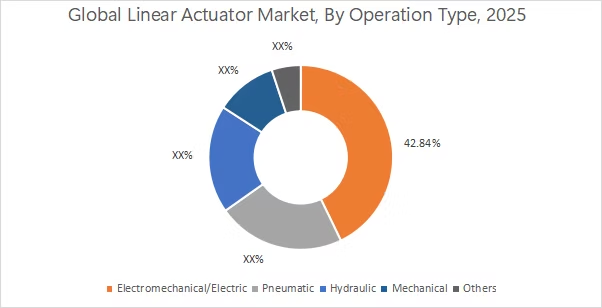
Based on the operation type, the market is segmented into electromechanical/electric, pneumatic, hydraulic, and mechanical.
Trends in the operation type:
- The market is witnessing a substantial shift from hydraulic and pneumatic actuators toward electromechanical actuators for attaining tighter positional repeatability, decreasing lifetime maintenance costs, and facilitating operational efficiency.
- The market is mainly driven by the growing demand for high-precision manufacturing, industrial automation, robotics, and the integration of smart, energy-efficient industrial control systems.
The electromechanical/electric segment accounted for the largest revenue share of 42.84% in the market in 2025, and it is anticipated to register the fastest CAGR during the forecast period.
- Electromechanical/electric actuators are devices which convert electrical energy into controlled mechanical motion. It uses an electric motor for generating torque, which is then converted into either linear (push/pull) movement by mechanical systems such as gears, screws, or toothed belts.
- Electromechanical/electric actuators offer multiple benefits including superior precision and repeatability, significant energy efficiency, minimal maintenance requirements, along with seamless integration with digital automation systems such as PLCs, and others.
- In addition, the market is primarily driven by the rising demand for high-precision manufacturing, industrial automation, robotics, and the growing integration of smart, energy-efficient industrial control systems.
- According to the analysis, the above factors are further propelling the market growth.
By Load Capacity:
Based on load capacity, the market is segmented into low load, medium load, and high load.
Trends in the load capacity:
- Factors including rising integration of industrial automation, growing miniaturization of electronic devices, and rising adoption of actuators across manufacturing, automotive, and healthcare sectors are propelling the market development.
- The market is also driven by factors including rising adoption of industrial automation, growing automotive/EV production, along with a strong shift toward highly precise, energy-efficient manufacturing and advanced robotics.
The medium load segment accounted for the largest revenue share in the market in 2025.
- Linear actuators with a medium load capacity are essential components in modern automation and ergonomics. It offers a range of benefits including cost-effectiveness, energy efficiency, compact footprints, and high positional accuracy.
- Moreover, actuators with medium load capacity are ideal for a broad range of applications, including lifting mechanisms for motorized hospital beds, automated robotic assembly arms, adjustable standing desks, solar panel trackers, and others.
- Also, factors including rising shift toward highly precise, energy-efficient manufacturing and advanced robotics, combined with rising adoption of actuators across manufacturing, packaging, and healthcare sectors, are key aspects driving the segment.
- According to the linear actuator market analysis, the aforementioned factors are further driving the market.
By Sales Channel:
Based on sales channel, the market is segmented into direct sales and distributor sales.
Trends in the sales channel:
- Factors including the availability of excellent support and warranty, higher product quality, and reliable shipping and return policies are key trends driving the direct sales channel segment.
- Factors such as higher accessibility to a variety of products, higher flexibility, and expanded reach are primary determinants for driving the distributor sales channel segment.
The direct sales channel segment accounted for a significant revenue in the linear actuator market share in 2025.
- In direct sales channel, actuators are sold directly to customers through numerous physical outlets, including company outlets, among others.
- Moreover, the direct sales channel also consists of an online mode, wherein the manufacturers sell actuators through its own company websites.
- Also, purchasing actuators from direct sales channel offers several benefits, including higher product quality, higher return on investments, faster response time, competitive pricing, and others, which are key aspects for increasing the purchase of actuators from direct sales channel.
- Therefore, the increasing availability of actuators in direct sales channels is driving the market.
The distributor sales segment is anticipated to register a substantial CAGR during the forecast period.
- The distributor sales channel involves an indirect distribution of actuators, wherein the actuator is purchased from several regional distributors operating in multiple regions worldwide.
- Moreover, distributor sales channels offer various benefits, including expanded market reach, lower capital expenditure, increased cost efficiency, and others. The above benefits of distributor sales channels are further increasing its utilization for sales of actuators.
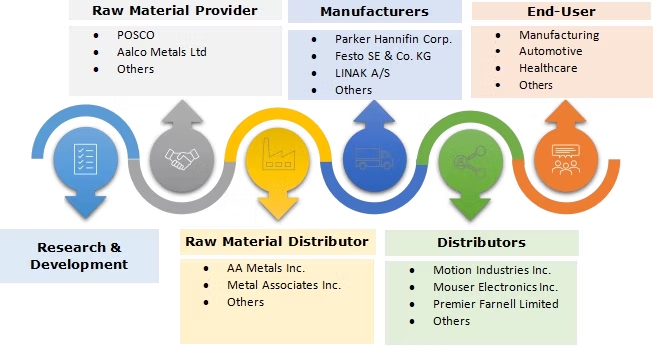
- For instance, Motion Industries Inc., Mouser Electronics Inc., Premier Farnell Limited, and others are few of the distributors of actuators.
- Hence, the increasing availability of actuators in distributor sales channels is anticipated to boost the market during the forecast period.
By End Use:
Based on end use, the market is segmented into manufacturing & industrial automation, automotive, healthcare & laboratory devices, aerospace & defense, renewable energy, packaging, construction & agriculture equipment, and others.
Trends in the end use:
- Factors including growing adoption of electric vehicles (EVs), advancements in autonomous driving technologies, and rising adoption of automation and robotics in vehicle manufacturing plants are key prospects driving the automotive segment.
- Industrial facilities have witnessed a substantial growth trend in utilization of actuators for optimizing industrial processes and facilitating precise, automated workflows, which is further driving the market.
The automotive segment accounted for a significant revenue share in the market in 2025.
- In the automotive industry, actuators are primarily used for driving automation and comfort, powering mechanisms like adjustable seating, automatic trunks/tailgates, sunroofs, active aerodynamic spoilers, as well as custom pedal adjustments.
- Moreover, electromechanical actuators are also used for controlling core EV operations, ranging from aerodynamic adjustment and cabin comfort to advanced battery cooling and active suspension, among others.
- Furthermore, factors including rising adoption of electric vehicles (EVs), advancements in autonomous driving technologies, and increasing adoption of automation and robotics in vehicle manufacturing plants are key prospects driving the segment.
- According to the analysis, the aforementioned factors are driving the linear actuator market trends.
The manufacturing & industrial automation is anticipated to register a substantial CAGR during the forecast period.
- In manufacturing and automation, actuators play an important role in facilitating precise, automated workflows. They are used for powering the linear axes of CNC machines and 3D printers, positioning cutting tools and extruders with improved accuracy, and other related applications.
- Moreover, actuators are mostly used in assembly lines for powering pick-and-place robots, which help in seamlessly transferring components among stations for decreasing cycle times, while minimizing human error and maximizing production throughput.
- Also, the segment is driven by the increasing adoption of industrial automation systems in manufacturing facilities for optimizing production processes and operations with minimal human intervention.
- Further, the increasing development of smart factories and technological advancements in manufacturing equipment has further propelled the market development.
- According to the analysis, the rising developments associated with smart factories and increasing adoption of automation in manufacturing facilities are expected to drive the market during the forecast period.
Linear Actuator Market Regional Analysis:
The regions covered are North America, Europe, Asia Pacific, Middle East and Africa, and Latin America.
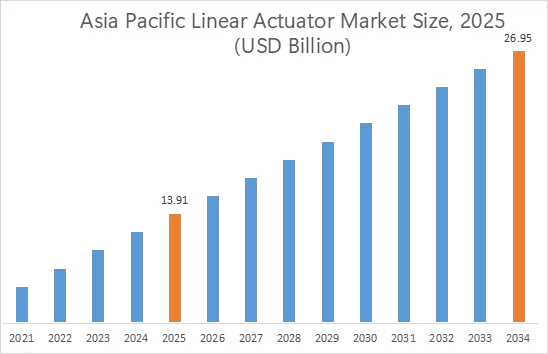
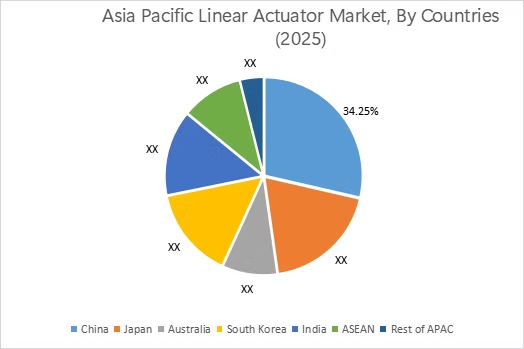
Asia Pacific region was valued at USD 13.91 Billion in 2025. Moreover, it is projected to grow by USD 14.72 Billion in 2026 and reach over USD 26.95 Billion by 2034. Out of this, China accounted for the maximum revenue share of 34.25%. As per the market analysis, the adoption of actuators in the Asia-Pacific region is primarily driven by rapid industrialization, favorable industrial automation policies, significant automotive production, and renewable energy shifts, among others. Additionally, increasing advancements associated with smart factory solutions are further accelerating the market expansion.
- For instance, according to the International Energy Agency (IEA), the total sales of battery electric vehicles (BEVs) in China reached 8.1 million units in 2025, witnessing an increase of 26.6% from 6.4 million units in 2024. The above factors are further driving the market in the Asia-Pacific region.
North America is estimated to reach over USD 22.28 Billion by 2034 from a value of USD 12.14 Billion in 2025 and is projected to grow by USD 12.77 Billion in 2026. In North America, the market is mostly driven by expanding industrial automation, significant proliferation of robotics, and a booming electric vehicle (EV) sector, which requires highly precise assembly lines. Furthermore, strict green manufacturing policies and rapid incorporation of smart factory solutions are further contributing to the linear actuator market demand.
- For instance, according to the International Federation of Robotics, industrial robot installations in the United States reached 38,000 units in 2025, representing an increase of 11% as compared to 2024. The above factors are expected to propel the market trends in North America during the forecast period.
Meanwhile, according to the regional analysis, factors including the widespread adoption of industrial automation, presence of advanced manufacturing hubs in automotive, medical device, and aerospace, and the integration of Industry 4.0 technologies, are driving the market demand in Europe. Furthermore, according to the market analysis, the market in Latin America, Middle East, and African regions is expected to grow at a considerable rate due to factors such as increasing investments in the development and modernization of industrial manufacturing facilities and rising adoption of industrial automation solutions within factories.
Top Key Players & Market Share Insights:
The global linear actuator market is highly competitive with major players providing solutions to the national and international markets. Key players are adopting several strategies in research and development (R&D), product innovation, and end-user launches to hold a strong position in the linear actuator market. Key players in the market include-
- Parker Hannifin Corporation(United States)
- Festo SE & Co. KG(Germany)
- LINAK A/S (Denmark)
- Bosch Rexroth AG (Germany)
- SMC Corporation (Japan)
- Thomson Industries Inc. (United States)
- Schaeffler (Germany)
- Rockwell Automation Inc. (United States)
- Tolomatic Inc. (United States)
- Jiecang Linear Motion Technology Co., Ltd. (China)
- TiMOTION Technology Co., Ltd. (Taiwan)
Linear Actuator Market Ecosystem:
Recent Industry Developments:
Product Launches:
- In April 2026, Schaeffler announced the launch of its EWELLIX electromechanical actuators in EMA-50 and EMA-60 variants. The new EWELLIX linear actuators are capable of covering several hydraulic and pneumatic applications, including mobile machinery such as construction vehicles, or in plastics or food industries.
- In May 2025, Rollon expanded its actuator product lineup by introducing the size 200 variant for its high-precision TH ball screw-driven linear actuators. The TH series actuators offer space-saving configuration and exceptional positioning precision, and can be used in industrial automation, robotics, and packaging sectors.
Linear Actuator Market Report Insights:
| Report Attributes | Report Details |
| Study Timeline | 2021-2034 |
| Market Size in 2034 | USD 74.66 Billion |
| CAGR (2026-2034) | 6.5% |
| By Operation Type |
|
| By Load Capacity |
|
| By Sales Channel |
|
| By End Use |
|
| By Region |
|
| Key Players |
|
| Report Coverage |
|
Key Questions Answered in the Report
How big is the linear actuator market? −
The linear actuator market was valued at USD 40.26 Billion in 2025 and is projected to grow to USD 74.66 Billion by 2034.
Which is the fastest-growing region in the market? +
Asia-Pacific is the region experiencing the most rapid growth in market.
What specific segmentation details are covered in the linear actuator report? +
The linear actuator report includes specific segmentation details for operation type, load capacity, sales channel, end use, and region.
Who are the major players in the market? +
The key participants in the market are Parker Hannifin Corporation (United States), Festo SE & Co. KG (Germany), LINAK A/S (Denmark), Bosch Rexroth AG (Germany), SMC Corporation (Japan), Thomson Industries Inc. (United States), Schaeffler (Germany), Rockwell Automation Inc. (United States), Tolomatic Inc. (United States), Jiecang Linear Motion Technology Co., Ltd. (China), TiMOTION Technology Co., Ltd. (Taiwan), and others.
Overview
Reputation & Certifications


Our Services
- Market Intelligence & Forecasting
- Custom Research Solutions
- Market Entry Strategy
- Competitive Intelligence
- Customer Insights
- Industry Innovation Analysis
- Investment Advisory