Jump to Content
Iot Microcontroller Market Size & Industry Share - Growth Trends & Forecasts (2026 - 2034)
IoT Microcontroller Market Size:
The IoT Microcontroller Market is expected to expand from 6,472.77 (US$M) in 2025 to 7,340.12 (US$M) in 2026, and is forecast to surpass 20,072.79 (US$M) by 2034, growing at a CAGR of 13.4% between 2026 and 2034, according to a recent report from Consegic Business Intelligence.
IoT Microcontroller Market Scope & Overview:
An IoT microcontroller is a small computer with a chip consisting of a processor, memory, and input/output parts. The microcontroller communicates with the environment using sensors and tools as well as the instructions are provided through programming languages such as C or C++. The IoT-based microcontroller has the ability to link with the internet using Wi-Fi or cellular and communicate with other devices. Moreover, the IoT microcontroller is used to control and monitor different systems and devices. The controller is majorly found in sensors, actuators, and other electronic parts to manage device works while processing and sending data. Further, the rising security concerns and increasing number of connected devices with the development of IoT are propelling the need for microcontrollers. The IoT MCU has the ability to operate at minimal power levels while maintaining optimal performance in various IoT devices is driving the market progress. Thus, the ability to link with the internet to communicate with other devices with improved security and enhanced performance of devices is boosting the global IoT microcontroller market.

IoT Microcontroller Market Dynamics - (DRO) :
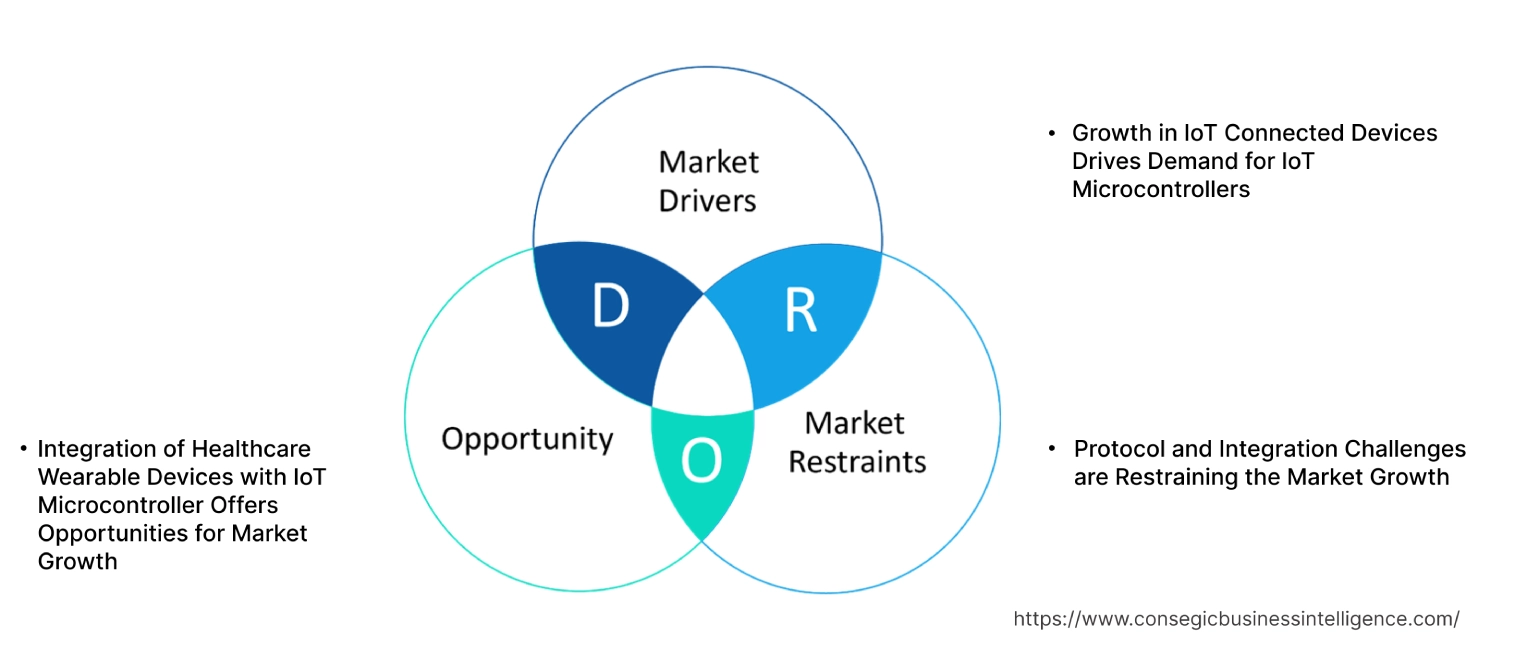
Key Drivers:
Growth in IoT Connected Devices Drives Demand for IoT Microcontrollers
IoT is primarily utilized in the consumer electronics sector for application in smart TVs, kitchen appliances, and others. The characteristics include improved connectivity, enhanced security, increased scalability, and adaptability among others are key prospects for increasing its utilization in the healthcare, automotive, consumer electronics, construction sectors, and others. Factors including rising demand for connecting IoT devices with cloud platforms to enhance security and improve the performance of microcontrollers are primary aspects fostering the IoT microcontroller market expansion.
- In September 2023, STMicroelectronics launched software named X-CUBE-AZURE-H5 which is engineered to simplify connection between IoT devices with STM32H5 microcontrollers into Microsoft Azure IoT Hub.
Therefore, as per the IoT microcontroller market analysis, rising need for connecting IoT devices and enhancing security as well as improving performance in turn proliferating the growth of the market.
Key Restraints :
Protocol and Integration Challenges are Restraining the Market Growth
IoT microcontroller is a crucial component in smart devices, such as sensors, wearables, and IoT gadgets. The microcontroller faces various challenges such as power consumption, programming, and debugging as well as integration issues due to various protocols. Additionally, IoT MCUs have minimal memory and processing power which cannot support the full range of programming tools. Furthermore, the IoT microcontrollers are susceptible to insecure communication protocols which increases the risk of cyber-attacks which leads to data loss. IoT embedded devices produce a huge amount of data, benefiting sectors but the increase in ransomware attacks is hampering the market growth.
Thus, the rising protocol and integration challenges are restraining the expansion of the IoT microcontroller market share.
Future Opportunities :
Integration of Healthcare Wearable Devices with IoT Microcontroller Offers Opportunities for Market Growth
The IoT plays a crucial role in tracking, documenting, storing, presenting, and communicating in healthcare, smart cities, engineering, and others. In the healthcare sector, microcontrollers are used in IoT-based monitoring system that tracks data and transmit data to cloud storage through a network for analysis. The devices present real-time data to both doctors and patients which is beneficial for allowing urgent medical decisions by doctors at the right time. Further, the growing robust medical infrastructure across the globe and increasing utilization of IoT in electronic devices is providing an opportunity for IoT microcontroller market growth.
- In April 2021, Renesas Electronics Corporation launched RX23W 32-bit RX MCU which features integrated Bluetooth low energy communication with wireless communication on IoT endpoint devices. The MCU improves the efficiency of various IoT devices including home appliances, healthcare, and sports and fitness equipment.
Hence, the rising adoption of IoT in devices and the ability to make precise decisions with real-time data and analysis is driving the IoT microcontroller market opportunity during the forecast period.
IoT Microcontroller Market Segmental Analysis :
By Type:
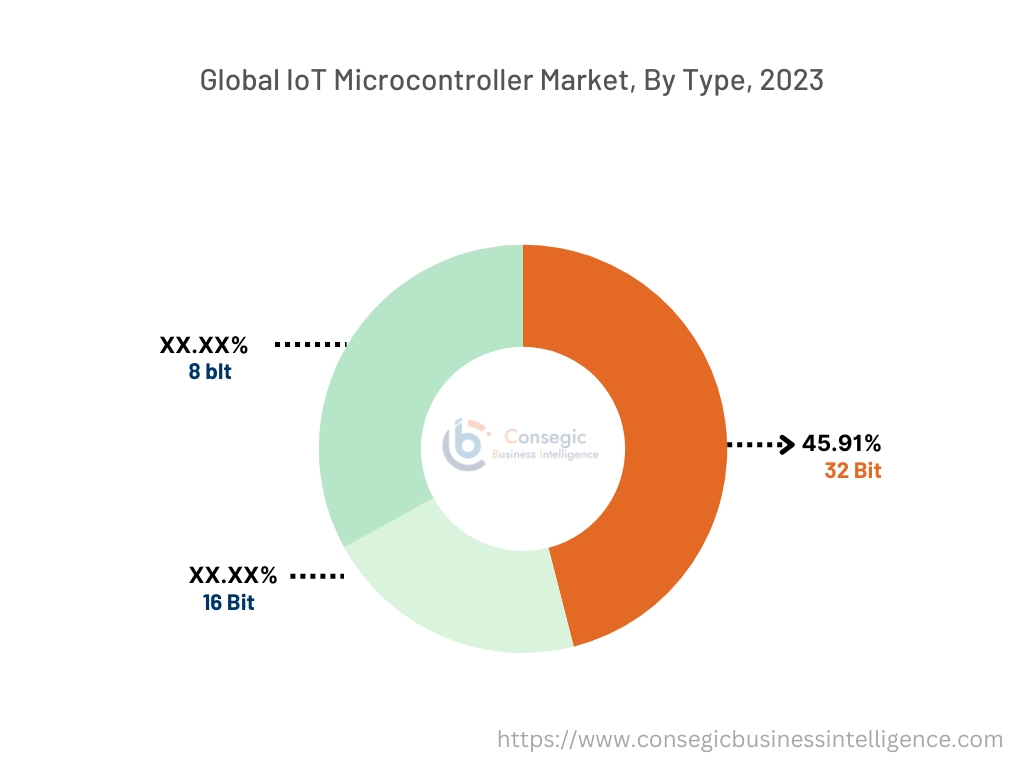
Based on the type, the market is segmented into 8 Bit, 16 Bit, and 32 Bit.
Trends in the type:
- The rising demand for improving performance in IoT-connected devices is driving the need for 32-bit microcontrollers.
- The deployment of IoT in consumer electronics, automotive, industrial, medical devices, and others is raising the need for 8-bit, 16-bit, and 32-bit microcontrollers.
The 32 Bit accounted for the largest revenue share of 45.91% in the year 2023.
- 32-bit microcontrollers have the ability to improve performance with enhanced features and are used in various embedded systems and applications for handling large amounts of data and performing high-speed processing.
- The application includes gaming systems, multimedia devices, high-end industrial automation, and advanced driver assistance systems (ADAS) among others.
- In November 2023, Renesas Electronics Corporation launched RX23E-B designed for high-end industrial sensor systems which features a 32-bit device for high-precision analog front end (AFE) and provides fast and accurate analog signal measurements.
- Thus, the ability to improve performance with enhanced features in various applications is driving the IoT microcontroller market trends.
The 8 Bit is anticipated to register the fastest CAGR during the forecast period.
- 8-bit microcontrollers have the ability to handle and process 8-bits of data due to the smaller width of the microcontroller which is suitable for simple and low processing power applications.
- 8-bit microcontrollers are majorly used in applications including smoke alarms, security, personal care, home appliances, and automobile electronic components.
- In November 2023, Silicon Labs expanded the microcontroller unit with the launch of the 8-bit microcontroller for catering to customers requiring optimal performance within budget.
- Therefore, the ability to handle low processing power applications such as smoke alarms, security, personal care, and others is anticipated to boost the IoT microcontroller market demand during the forecast period.
By Connectivity:
Based on the connectivity, the market is segmented into Wi-Fi, Bluetooth, ZigBee, cellular, and others.
Trends in connectivity:
- The ease of integration with Bluetooth, Wi-Fi, and ZigBee is increasing the use of wireless connectivity options to collect and analyze data from microcontrollers.
- The enhancement in connecting technology including 5G, blockchain, and edge computing is providing industry-specific solutions, sustainability, enhanced data analytics, and others.
Wi-Fi accounted for the largest revenue share in the year 2023 and is anticipated to register the fastest CAGR during the forecast period.
- The rising demand for Wi-Fi 6 is due to the following factors including power-saving protocols, range enhancements, and spectrum additions as well as supporting high-throughput options for smartphones, laptops, and IoT devices.
- They offer a range of benefits including the secured protocol, enabling flexibility, reducing collisions, and improving the quality of service on the network.
- They are utilized in consumer electronics and other industrial applications that require longer-range, low-power connectivity solutions.
- In April 2021, Espressif Systems launched ESP32-C6 with features including a 32-bit RISC-V microcontroller, Wi-Fi 6, Bluetooth 5 (LE) SoC, and others. The Wi-Fi 6 is optimized to support IoT devices.
- Thus, the power-saving protocol and range enhancement factor in the Wi-Fi segment are driving the IoT microcontroller market expansion.
By Application:
Based on application, the market is segmented into industrial automation, smart home devices, advanced driver assistant systems (ADAS), wearable devices, medical devices, and others.
Trends in the application:
- The advanced driver assistant system (ADAS) is increasingly adopting IoT-based microcontrollers for enhancing voice-activated entertainment systems and autonomous driving capabilities.
- The trend towards Industry 4.0 is advancing microcontrollers with artificial intelligence and machine learning for managing automated manufacturing systems.
The industrial automation accounted for the largest revenue share in the year 2023.
- The rising demand for increasing productivity and reduced costs associated with human activity is boosting the need for automation in industries. The major purpose of a microcontroller is to interconnect components through a bus and provide safety by offering better control over machinery in industries.
- Further, rapid robust industrialization and the growing integration of IoT for remote monitoring and control of various heavy equipment are propelling the development of the IoT microcontroller market in industrial automation applications.
- In November 2021, ASIX Electronics Corporation launched the AX58400 EtherCAT Slave Controller with a Dual-Core MCU embedded with an ARM Cortex-M family dual-core microcontroller. The device is suitable for various industrial automation applications, including motion control, digital input and output control, sensor data acquisition, and robotics among others.
- Thus, the industrialization and integration of IoT with equipment to increase productivity and reduce costs is driving the IoT microcontroller market in industrial automation applications.
The smart home devices are anticipated to register the fastest CAGR during the forecast period.
- The smart home devices are embedded with IoT-based microcontrollers for remote monitoring and management of appliances and systems, including kitchen appliances, smart TVs, and others.
- Further, the growth of home automation and smart meter systems, along with IoT MCUs providing the ability to seamlessly manage and automate various home devices, is boosting smart home device applications.
- In April 2024, NXP Semiconductors launched the MCX MCU portfolio designed with Arm Cortex-M33-powered multiprotocol MCUs for smart home devices such as locks, lighting management, smart plugs, window coverings, and sensors.
- Therefore, the evolution of building automation and the ability to seamlessly manage and automate various home devices is driving the IoT microcontroller market opportunity for smart home devices during the forecast period.
By End Use:
Based on end-use, the market is segmented into Consumer Electronics, Automotive, Healthcare, Industrial, Energy & Utility, and Others.
Trends in the End-use:
- The trend towards remote patient monitoring systems is fueling the need for IoT-based microcontrollers in the healthcare sector.
- The trend towards the adoption of IoT MCUs in commercial vehicles for real-time tracking and fare collection is spurring the IoT microcontroller market trends.
The industrial segment accounted for the largest revenue share in the year 2023.
- The rising automation in various industries is boosting the need for IoT-based microcontrollers for seamlessly automating and controlling various components in the industry remotely.
- The major use of the integration is to enhance productivity and safety as well as improve the predictive maintenance feature for increasing the life of machinery.
- In January 2023, Syntiant Corp. launched NDP115 Neural Decision Processor embedded with Arm Cortex M0 microcontroller for applications including industrial solutions for predictive maintenance and consumer electronics.
- Thus, as per the analysis, the rising need for improving productivity and enhancing safety with predictive maintenance facilities is driving the IoT microcontroller market growth in the industrial segment.
The consumer electronics is anticipated to register the fastest CAGR during the forecast period.
- The role of IoT MCU is to optimize energy efficiency and enhance the performance and efficiency of consumer electronics.
- The smart thermostats used in homes are embedded with microcontrollers for remotely adjusting the room temperature and environment, majorly used in home applications as well as office spaces among others.
- Wearable devices such as fitness trackers and smartwatches rely on IoT MCU for monitoring vitals and providing notifications. Additionally, MCU ensures prolonged battery life and efficient performance for wearable devices.
- In June 2024, Innatera launched a neuromorphic microcontroller engineered with an always-on sensing feature for consumer electronics and IoT devices.
- Therefore, the ability to enhance performance and efficiency is anticipated to boost the market during the forecast period.
Regional Analysis:
The regions covered are North America, Europe, Asia Pacific, the Middle East and Africa, and Latin America.
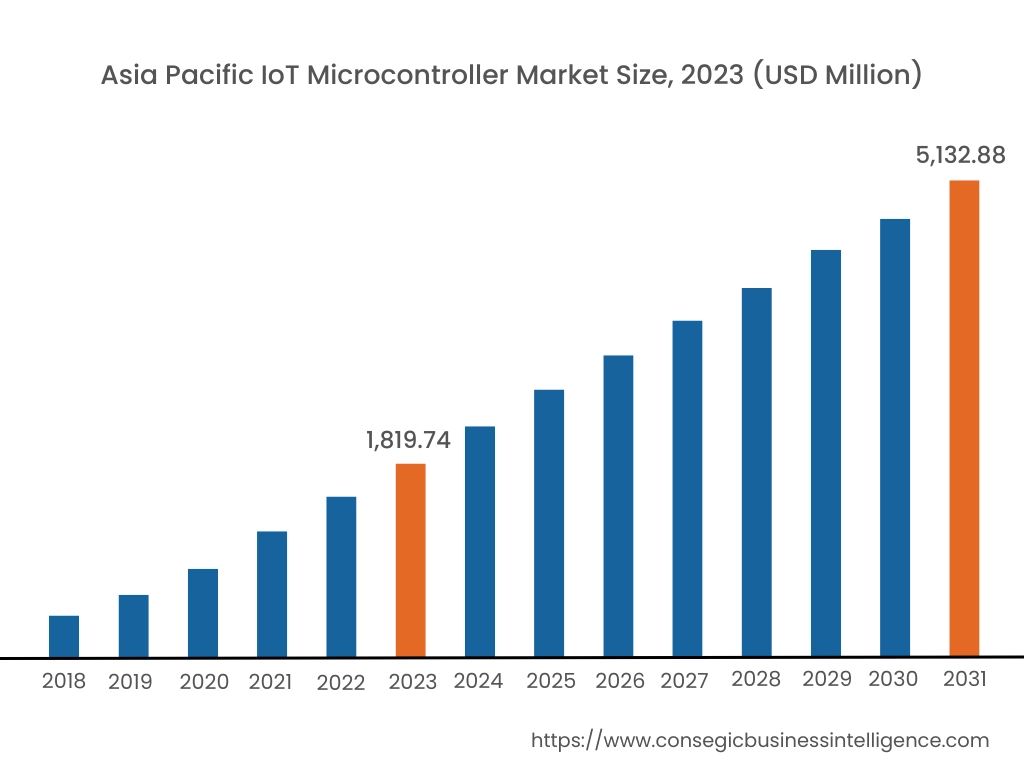
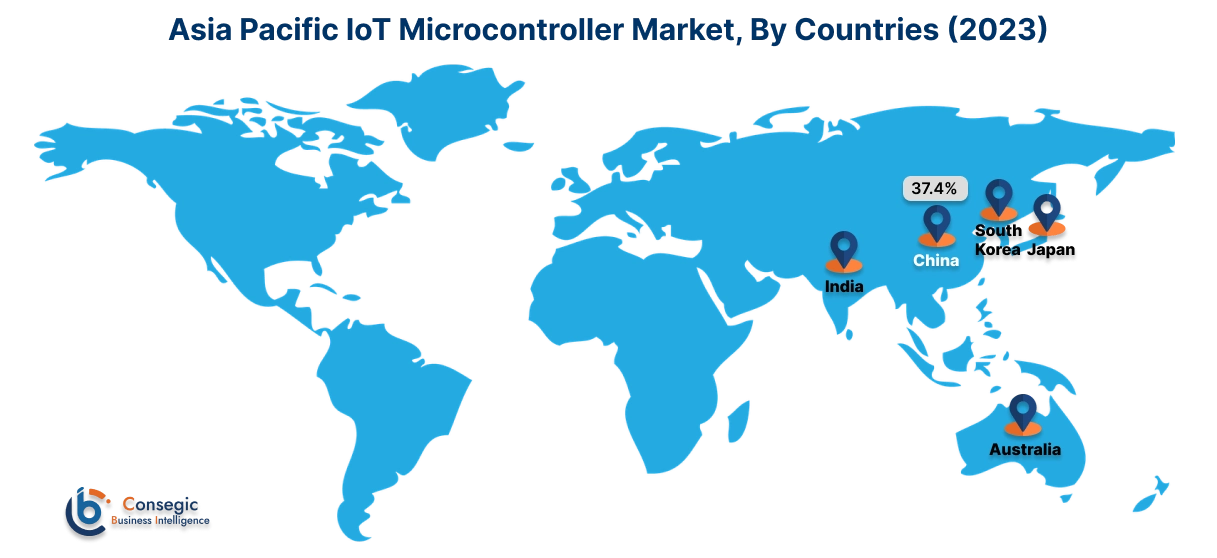
Asia Pacific region was valued at USD 1,819.74 Million in 2023. Moreover, it is projected to grow by USD 2,060.16 Million in 2024 and reach over USD 5,132.88 Million by 2031. Out of this, China accounted for the maximum revenue share of 37.4%. The Asia Pacific region's growing urbanization and industrialization offer lucrative market progress. Additionally, the progress of automation and smart factory initiatives is driving IoT microcontroller market demand.
- In April 2024, Renesas Electronics Corporation launched the RA0 microcontroller (MCU) Series embedded with an Arm Cortex-M23 processor. The microcontroller features 32-bit MCUs with a low power consumption facility.
Additionally, according to the analysis, Europe is anticipated to witness substantial evolution that is backed by the industrial 4. O revolution and the rise of automation catering to the surging need for microcontrollers across the region.
North America is estimated to reach over USD 3,881.66 Million by 2031 from a value of USD 1,401.39 Million in 2023 and is projected to grow by USD 1,584.08 Million in 2024. The market is mainly driven by the rising adoption of smart home devices, consumer electronics, and other industries.
- For instance, In December 2023, Microchip launched the AVR EB series of microcontrollers designed to reduce noise and increase efficiency, with near-zero latency in BLDC applications
Furthermore, factors including the emergence of edge computing and integration with artificial intelligence are projected to drive the IoT microcontroller industry in North America during the forecast period.
Further, as per the IoT microcontroller market analysis, the Middle East and African region is experiencing rapid innovation in energy management and smart grid technology which utilize microcontrollers as well as rising adoption in the automotive sector for advancement in connected vehicle technology is driving the IoT microcontroller market size in the region.
Furthermore, the Latin American region is expected to grow at a considerable rate owing to the rising adoption of healthcare wearable devices as well as renewable energy sources utilizing microcontrollers for real-time monitoring and controlling to improve efficiency is driving the IoT microcontroller market size in the region.
Top Key Players & Market Share Insights:
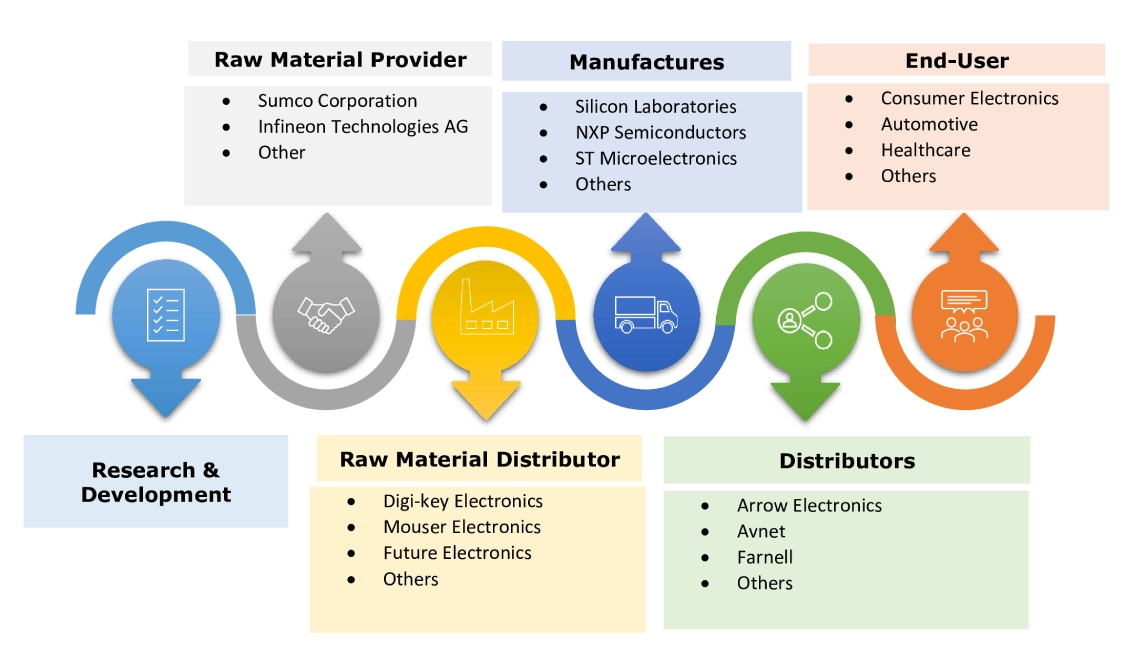
The IoT microcontroller market is highly competitive with major players providing microcontrollers to the national and international markets. Key players are adopting several strategies in research and development (R&D), product innovation, and end-user launches to hold a strong position in the IoT microcontroller market share. Key players in the IoT microcontroller industry include-
- Silicon Laboratories (U.S)
- NXP Semiconductors (Netherlands)
- Texas Instruments (U.S)
- Infineon Technologies AG (Germany)
- Renesas Electronics Corporation (Japan)
- ST Microelectronics (Switzerland)
- Advantech (Taiwan)
- Digi International (U.S)
- Microchip Technology (U.S)
- Broadcom (U.S)
Recent Industry Developments :
Product launches:
- In June 2024, Alif Semiconductor launched Ensemble E1C, a microcontroller series engineered with a low-power on-chip neural processing unit (NPU) providing advanced features combined with digital and analog capabilities.
- In March 2024, Renesas Electronics Corporation launched an RA2A2 microcontroller (MCU) for various IoT applications including smart energy management, building automation, medical devices, and others.
- In March 2023, STMicroelectronics launched STM32H5 MCUs to enhance security, energy efficiency, and affordability for smart connected devices. The MCU is designed to strengthen defenses against attacks on IoT assets.
Partnerships & Collaborations:
- In September 2024, Sony Semiconductor Solutions Corporation partnered with Raspberry Pi Ltd to launch an AI camera that featured integrated RP2040 for neural network firmware management, which is a microcontroller from Raspberry Pi.
- In March 2023, Data I/O Corporation partnered with Nuvoton Technology Corporation to enhance security in Nuvoton's M2354 Series, which is an IoT security microcontroller.
IoT Microcontroller Market Report Insights :
| Report Attributes | Report Details |
| Study Timeline | 2021-2034 |
| Market Size in 2034 | USD 20,072.79 Million |
| CAGR (2026-2034) | 13.40% |
| Base Year | 2025 |
| By Type |
|
| By Connectivity |
|
| By Application |
|
| By End-Use |
|
| By Region |
|
| Key Players |
|
| North America | U.S. Canada Mexico |
| Europe | U.K. Germany France Spain Italy Russia Benelux Rest of Europe |
| APAC | China South Korea Japan India Australia ASEAN Rest of Asia-Pacific |
| Middle East and Africa | GCC Turkey South Africa Rest of MEA |
| LATAM | Brazil Argentina Chile Rest of LATAM |
| Report Coverage |
|
Key Questions Answered in the Report
How big is the IoT microcontroller market? −
IoT Microcontroller Market size is estimated to reach over USD 13,764.76 Million by 2031 from a value of USD 5,028.30 Million in 2023 and is projected to grow by USD 5,678.23 Million in 2024, growing at a CAGR of 13.4% from 2023 to 2031.
What specific segmentation details are covered in the IoT microcontroller report? +
The IoT microcontroller report includes specific segmentation details for type, connectivity, application, end-user, and regions.
Which is the fastest segment anticipated to impact the market growth? +
In the IoT microcontroller market, the 32-bit segment is the fastest-growing segment during the forecast period due to a surge in demand for industrial automation, and the rise in demand in consumer electronics is driving the market.
Who are the major players in the IoT microcontroller market? +
The key participants in the IoT microcontroller market are Silicon Laboratories (U.S), NXP Semiconductors (Netherland), ST Microelectronics (Switzerland), Texas Instruments (U.S), Infineon Technologies AG (Germany), Renesas Electronics Corporation (Japan), Advantech (Taiwan), Digi International (U.S), Microchip Technology (U.S), Broadcom (U.S) and others.
What are the key trends in the IoT microcontroller Market? +
The IoT microcontroller market is being shaped by several key trends including the rise of Industry 4.0, industrial automation, and rising adoption across various sectors including automotive, healthcare, and consumer electronics are the key trends driving the market trend.
Overview
Reputation & Certifications


Our Services
- Market Intelligence & Forecasting
- Custom Research Solutions
- Market Entry Strategy
- Competitive Intelligence
- Customer Insights
- Industry Innovation Analysis
- Investment Advisory