Jump to Content
Nanowire Battery Market - Size, Share, Industry Trends, and Forecasts (2025 - 2032)
Nanowire Battery Market Size:
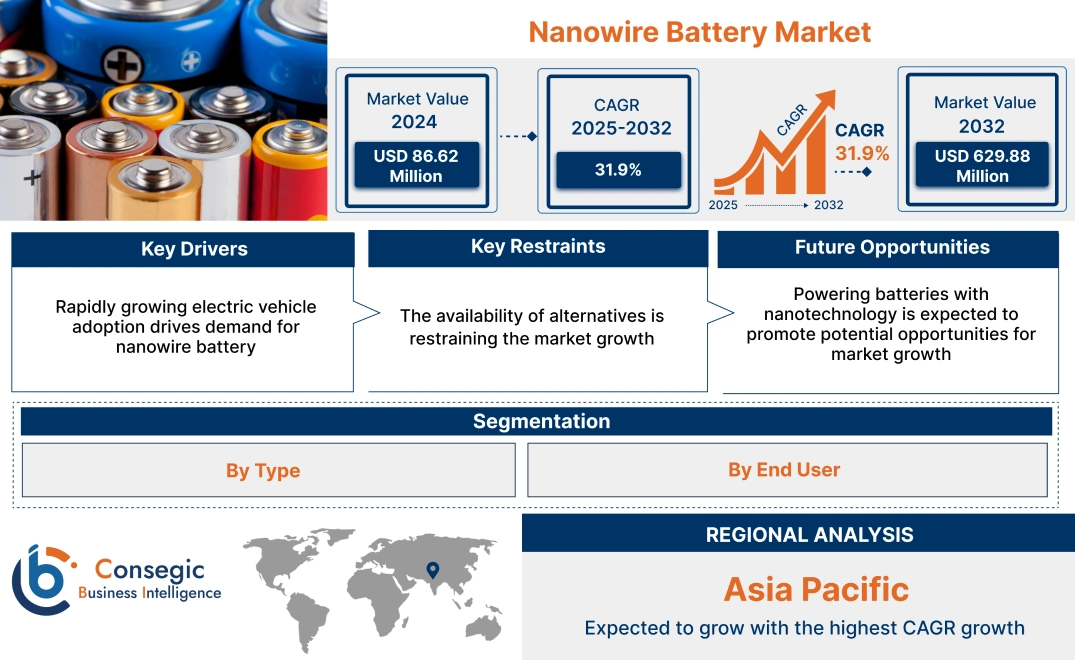
Nanowire Battery Market is estimated to reach over USD 629.88 Million by 2032 from a value of USD 86.62 Million in 2024 and is projected to grow by USD 109.49 Million in 2025, growing at a CAGR of 31.9% from 2025 to 2032.
Nanowire Battery Market Scope & Overview:
The nanowire battery is a rapidly evolving energy storage technology by leverages nanowires which enhances the battery performance. Additionally, the materials used in the manufacturing of nanowire-based batteries include silicon, transition metal oxides, gold, germanium, and others. The materials provide a higher surface area which enables faster charging capability without degrading the battery performance as compared to lithium-ion batteries. Moreover, the advantages of adopting nanowire-based batteries include volume expansion, improved accommodation, enhanced performance, improved battery life, and reliability among others, which is further driving the nanowire battery market growth. Additionally, the progress of electric vehicles is propelling the demand for advancing and enhancing battery life, which in turn is fueling the nanowire battery market demand.
Nanowire Battery Market Dynamics - (DRO) :
Key Drivers:
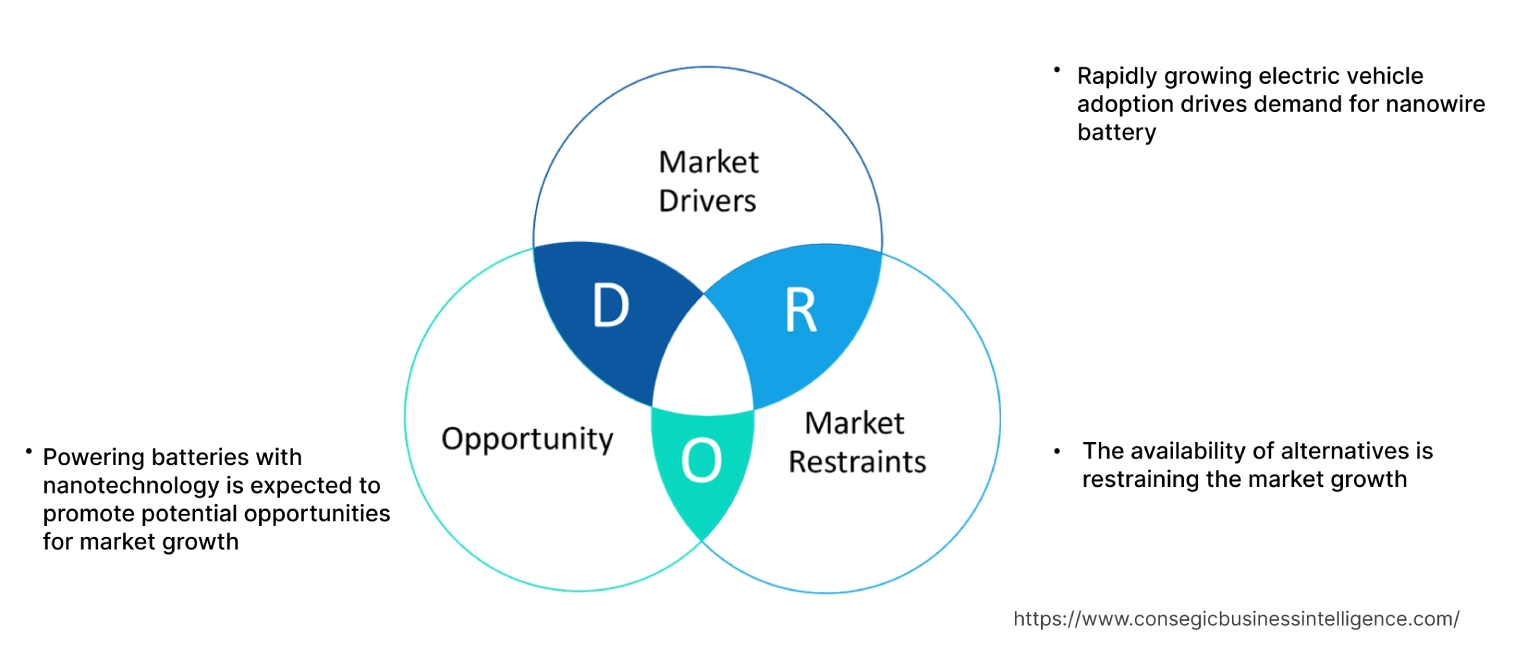
Rapidly growing electric vehicle adoption drives demand for nanowire battery
The stringent government rules and regulations for vehicle emissions are promoting the adoption of electric vehicles, which reduce emissions and support sustainability goals. Additionally, the increasing number of electric vehicles on roads is driving the need for enhanced battery performance, increased battery life, and reliability, which in turn is propelling the need for batteries that are durable, support fast charging, and others. Further, the demand for long-range EVs with short charging times is driving the nanowire battery market demand.
- For instance, according to IEA, electric vehicle sales reached 14 million globally in the year 2023. Additionally, the YoY growth is 35% for the sale of electric cars. The rising adoption of electric vehicles is driving the need for lesser discharge time, which in turn is paving the way for nanowire battery market growth.
Thus, the growing number of electric vehicles is propelling the progress of the nanowire battery market.
Key Restraints:
The availability of alternatives is restraining the market growth
The battery market is dominated by lithium-ion batteries, which pose a significant hindrance to the adoption of nanowire batteries. Additionally, the cost of manufacturing nanowire batteries is much higher than that of traditional lithium-ion batteries which in turn hinders the nanowire battery market expansion. Further, the availability of alternatives such as solid-state batteries, lithium-sulfur batteries, and others has improved the battery capacity and safety which eventually hinders the nanowire battery market expansion.
Therefore, the availability of alternatives such as lithium-ion batteries, solid-state batteries, and lithium-sulfur batteries among others is restraining the market growth.
Future Opportunities :
Powering batteries with nanotechnology is expected to promote potential opportunities for market growth
The integration of nanotechnology into batteries is providing a significant prospect for the nanowire battery market. Additionally, silicon nanowires are integrated into batteries to increase energy efficiency, enhance charge and discharge rates, improve durability, and others, which is paving the way for nanowire battery market opportunities in applications such as electric vehicles, wearable devices, and others. Further, ongoing research and development in the field of nanotechnology are expected to promote potential solutions for enhancing the lifespan and reducing the cost of manufacturing nanowire batteries. Furthermore, the rising demand for nanowire batteries in aviation and electric vehicles is driving market development.
- For instance, in December 2023, Amprius expanded the Silicon Nanowire Anode Megawatt Hour Manufacturing Line in Fremont, California. Additionally, the factory will manufacture industry-leading, high-energy batteries, for aviation and electric vehicle manufacturers.
Hence, the ongoing research and development as well as the integration of nanotechnology into batteries is anticipated to promote potential nanowire battery market opportunities during the forecast period.
Nanowire Battery Market Segmental Analysis :
By Type:
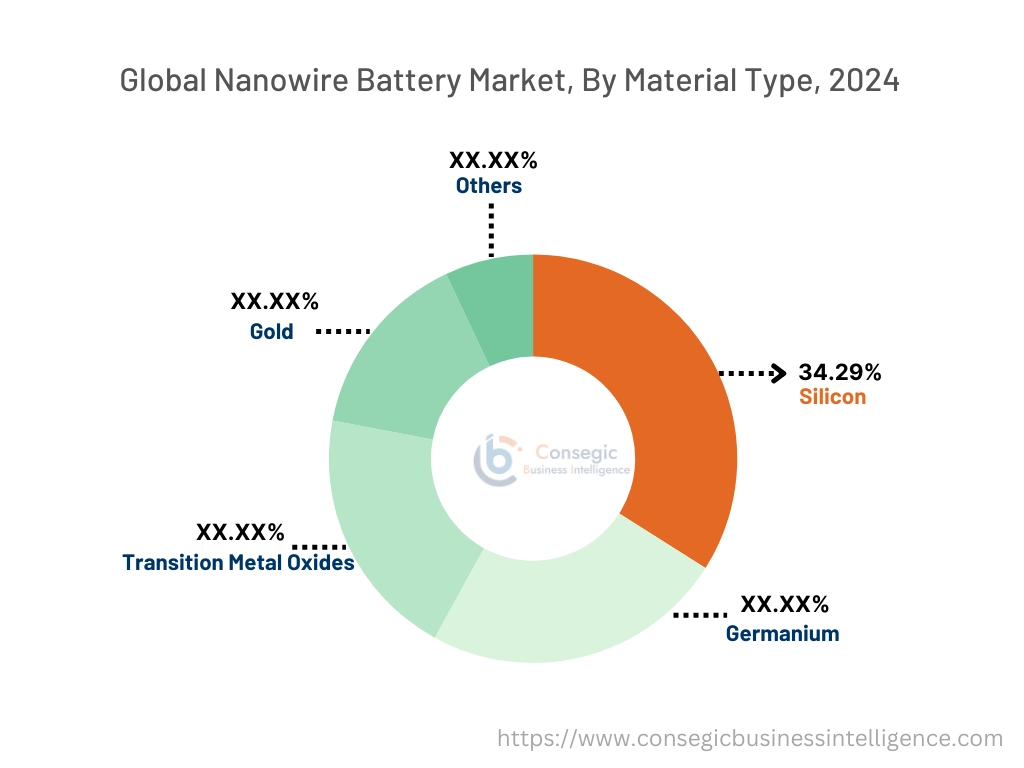
Based on the material type, the market is segmented into silicon, germanium, transition metal oxides, gold, and others.
Trends in the Material Type:
- Germanium is highly conductive which enables faster charge and discharge rate, in turn driving the nanowire battery market trend.
- The trend towards sustainability is propelling the need for transition metal oxide to be used in renewable energy storage due to reliable structural integrity and thermal stability.
Silicon accounted for the largest revenue share of 34.29% in the year 2024 and is anticipated to register the fastest CAGR during the forecast period.
- The advancement in silicon nanowire batteries has led to higher energy density, enhanced battery life, reduced discharge time, and others, in turn driving the silicon-based nanowire battery market.
- Moreover, the silicon-based battery is an alternative to the traditional lithium-ion battery which is majorly used in electric vehicles and wearable devices among others.
- Further, the growing automotive sector and consumer electronics sector are driving the demand for the nanowire battery industry.
- For instance, in May 2022, Amprius Technologies received a contract from USABC of USD 3 Million for manufacturing low-cost, fast-charge silicon nanowire battery technology development.
- Thus, according to the nanowire battery market analysis, advancement in silicon-based batteries as well as the growing automotive sector and consumer electronics sector are driving the nanowire battery market share.
By End User:
Based on the end-user, the market is segmented into consumer electronics, automotive, aerospace & defense, healthcare, and others.
Trends in the End User:
- The trend toward rising adoption of unmanned aerial vehicles is driving the need for lightweight high-performance batteries, which in turn fuels the market.
- The trend towards rising need for energy-efficient batteries in fitness trackers, portable medical devices, and others is driving the nanowire battery market trend.
The automotive sector accounted for the largest revenue share in the year 2024.
- The stringent rules and regulations associated with vehicle emissions are boosting government promotions and subsidies for EV manufacturing, which in turn propels the nanowire battery market size.
- Further, the global shift towards electric vehicles is driving the need for high-performance batteries, which in turn is fueling the nanowire battery market share.
- Furthermore, the ongoing research and development in the field of silicon anode technology increases energy density for a longer range and reduces cost.
- For instance, in September 2022, GM collaborated with OneD Battery Sciences for joint R&D of silicon anode technology by fusing silicon nanowires into EV-grade graphite for more efficient EV batteries.
- Thus, according to the nanowire battery market analysis, the global shift towards electric vehicles as well as ongoing research and development are driving the market in the automotive sector.
The consumer electronics sector is anticipated to register the fastest CAGR during the forecast period.
- The rapidly evolving consumer electronics sector is paving the way for emerging technologies such as silicon-based nanowire technology, which is being developed for compact and durable batteries.
- Further, the advancing IoT-enabled devices as well as the 5G network are consuming much energy from smartphones and ongoing research and development are propelling the need for high-performance batteries, in turn fueling the market.
- For instance, according to IBEF India, electronic manufacturing generated USD 400 Billion and surpassed USD 100 Billion in March 2024 with mobile phones contributing 43%. The increasing adoption of electronic devices such as smartphones is propelling the need for high-performance batteries.
- Therefore, as per the market analysis, the evolving consumer electronics sector as well as advancing IoT-enabled devices and 5G networks are anticipated to boost the growth of the nanowire battery market size during the forecast period.
Regional Analysis:
The regions covered are North America, Europe, Asia Pacific, the Middle East and Africa, and Latin America.
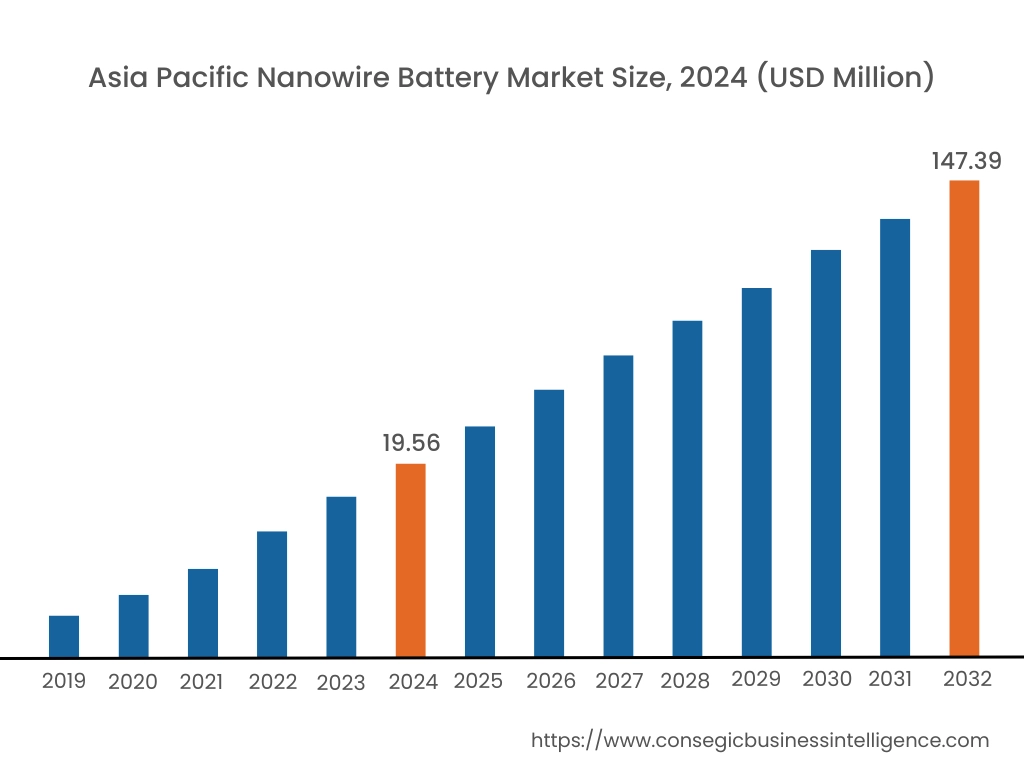
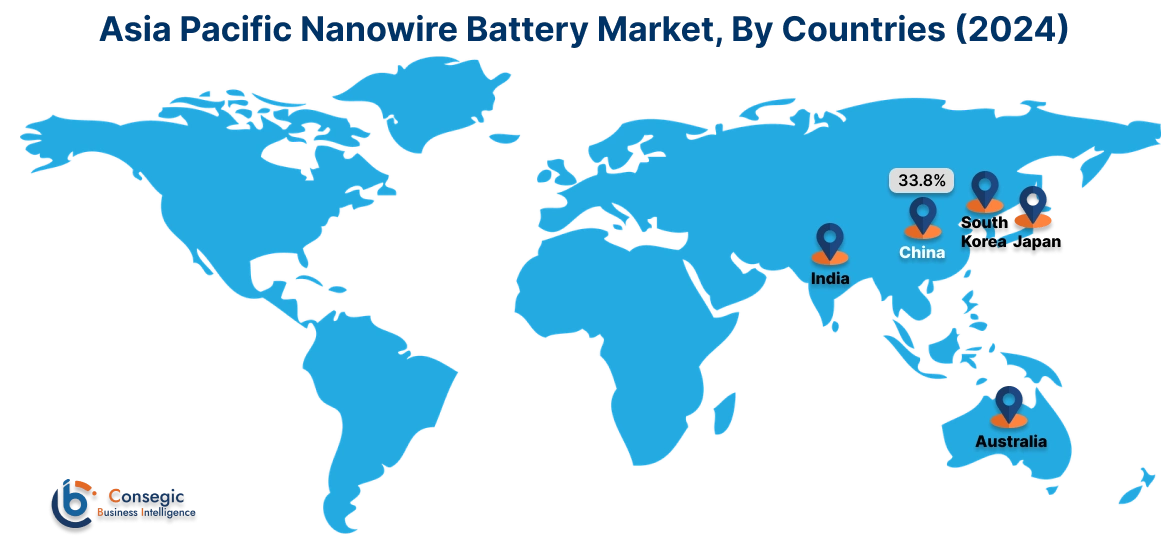
Asia Pacific region was valued at USD 19.56 Million in 2024. Moreover, it is projected to grow by USD 24.80 Million in 2025 and reach over USD 147.39 Million by 2032. Out of this, China accounted for the maximum revenue share of 33.8%. As per the analysis, the market for nanowire batteries is mainly driven by their deployment in automotive and other industries. Furthermore, factors including the growing EV market and government subsidies are projected to drive the market evolution in Asia Pacific during the forecast period.
- For instance, according to ESCAP, the Asia Pacific region is experiencing significant adoption of EVs with China accounting for a 95 percent share of global EV buses as well as 6.1 million EV sales in 2022. Hence, the rising adoption of electric vehicles is driving the need for high-performance batteries, which in turn fuels the market in the Asia Pacific region.
North America is estimated to reach over USD 241.87 Million by 2032 from a value of USD 32.91 Million in 2024 and is projected to grow by USD 41.64 Million in 2025. The North American region's analysis depicts that growing EV adoption offers lucrative growth prospects for the market. Additionally, the ongoing research and development in nanotechnology as well as the increasing need for portable electronics and wearable devices are driving the market.
- For instance, in November 2024, Amprius Technologies Inc. announced the shipment of SiMaxx A-Sample EV Cells to USABC. The cells feature superior energy and power performance, fast charging, and others.
The regional trends analysis depicts that the increasing focus on renewable energy generation projects in Europe is driving the market. Additionally, the primary factor driving the market in the Middle East and African region is the smart city initiative promoting the adoption of IoT-connected energy storage devices. Further, the rising EV market and urbanization are paving the way for the need for high-performance batteries and energy storage solutions, which in turn drives the market in the Latin America region.
Top Key Players and Market Share Insights:
The global nanowire battery market is highly competitive with major players providing nanowire batteries to the national and international markets. Key players are adopting several strategies in research and development (R&D), product innovation, and end-user launches to hold a strong position in the nanowire battery industry. Key players in the nanowire battery market include-
- Amprius Technologies (USA)
- OneD Battery Sciences (USA)
- Targray (Canada)
- Panasonic (Japan)
- Samsung SDI (South Korea)
- Enevate Corporation (USA)
- Enovix (USA)
- Nexeon (UK)
- ORLIB (Japan)
- XNRGI (USA)

Recent Industry Developments :
Manufacturing Contracts:
- In September 2024, Amprius Technologies, Inc. received a contract of USD 20 Million for the manufacturing of lithium-ion batteries with its silicon anode platform for light electric vehicle applications.
Partnerships & Collaborations:
- In October 2024, Amprius Technologies, Inc. partnered with a Fortune 500 company for the development of a small format custom high-energy SiMaxx pouch cell.
Nanowire Battery Market Report Insights :
| Report Attributes | Report Details |
| Study Timeline | 2019-2032 |
| Market Size in 2032 | USD 629.88 Million |
| CAGR (2025-2032) | 31.9% |
| By Material Type |
|
| By End User |
|
| By Region |
|
| Key Players |
|
| North America | U.S. Canada Mexico |
| Europe | U.K. Germany France Spain Italy Russia Benelux Rest of Europe |
| APAC | China South Korea Japan India Australia ASEAN Rest of Asia-Pacific |
| Middle East and Africa | GCC Turkey South Africa Rest of MEA |
| LATAM | Brazil Argentina Chile Rest of LATAM |
| Report Coverage |
|
Key Questions Answered in the Report
How big is the nanowire battery market? −
The Nanowire Battery Market is estimated to reach over USD 629.88 Million by 2032 from a value of USD 86.62 Million in 2024 and is projected to grow by USD 109.49 Million in 2025, growing at a CAGR of 31.9% from 2025 to 2032.
What specific segmentation details are covered in the nanowire battery report? +
The nanowire battery report includes specific segmentation details for material type, end-user, and regions.
Which is the fastest segment anticipated to impact the market growth? +
In the nanowire battery market, the consumer electronics sector is the fastest-growing segment during the forecast period due to advancing IoT-enabled devices as well as the 5G network consuming much energy from smartphones and ongoing research and development.
Who are the major players in the nanowire battery market? +
The key participants in the nanowire battery market are Amprius Technologies (USA), OneD Battery Sciences (USA), Enevate Corporation (USA), Enovix (USA), Nexeon (UK), ORLIB (Japan), XNRGI (USA), Targray (Canada), Samsung SDI (South Korea), Panasonic (Japan) and others.
What are the key trends in the nanowire battery market? +
The nanowire battery market is being shaped by several key trends including the trend towards the rising adoption of unmanned aerial vehicles and the rising need for energy-efficient batteries in fitness trackers, portable medical devices, and others.
Overview
Reputation & Certifications


Our Services
- Market Intelligence & Forecasting
- Custom Research Solutions
- Market Entry Strategy
- Competitive Intelligence
- Customer Insights
- Industry Innovation Analysis
- Investment Advisory