Jump to Content
Reusable Packaging Market Size & Industry Share - Growth Trends & Forecasts (2026 - 2034)
Reusable Packaging Market Size:
The Reusable Packaging Market is expected to expand from 129.58 (US$B) in 2025 to 136.45 (US$B) in 2026, and is forecast to surpass 206.25 (US$B) by 2034, growing at a CAGR of 5.3% between 2026 and 2034, according to a recent report from Consegic Business Intelligence.
Reusable Packaging Market Scope & Overview:
Reusable packaging is packaging designed for reuse in the same or similar application used in a supply chain. There are various products such as plastic containers, bottles, bags, and others. There are different kinds of raw materials used in the packaging such as plastic, wood, metal, fiber, and others. Reusable packaging has applications in various industries such as food and beverages, automotive, retail and e-commerce, and others. There are various benefits such as reducing waste, environment-friendly, cost-efficiency, and more. Recent developments such as the integration of radio-frequency identification (RFID) labels, QR codes, and more have improved the tracking and monitoring of reusable packaging products, further fueling the market.
How is AI Transforming the Reusable Packaging Market?
AI transforms the reusable packaging market by enhancing supply chain logistics through optimized routing and inventory management of reusable containers, improving packaging design for efficiency and sustainability, increasing material recovery and sorting in recycling processes, and others. Additionally, AI enables dynamic waste management for collection. Moreover, AI helps in fostering innovation which in turn helps minimize waste, lower carbon footprints, and promote the use of more sustainable materials, supporting environmental goals. Hence, these applications lead to reduced material waste, lower operational costs, improved resource utilization, and a more efficient, sustainable, and competitive industry.

Reusable Packaging MarketDynamics - (DRO) :

Key Drivers:
Government Initiatives for Sustainability and Waste Reduction are Driving Market Growth
The growing emphasis on sustainability and waste reduction has significantly influenced reusable packaging market trends across industries. Government initiatives like the U.S. Environmental Protection Agency’s National Recycling Strategy are further promoting this market. It aims to increase recycling rates and promote a circular economy for adopting reusable packaging solutions. These strategies align with global efforts to minimize environmental impact and foster innovation in sustainable practices.
- In 2021, the U.S. Environmental Protection Agency launched the National Recycling Strategy which advanced the national municipal solid waste (MSW) recycling system. The national municipal solid waste (MSW) recycling system in the U.S. is the process of separating, recovering, and reusing components of solid waste that have economic value. This National Recycling Strategy also identified strategic objectives and collaborated with stakeholders to create a stronger, more resilient, and cost-effective U.S. MSW recycling system.
Thus, the government is promoting sustainability and waste reduction, further enhancing the reusable packaging market growth.
Implementation of Stringent Regulations for Packaging Materials is Fueling the Market
Governments and regulatory bodies are increasingly imposing stringent regulations on packaging materials due to growing environmental concerns and consumer demand for sustainable products. For example, the European Commission implemented the Packaging and Packaging Waste Regulation (PPWR) in 2022 as part of the European Green Deal Circular Economy action plan. The PPWR aims to promote circularity in packaging and address the constantly growing level of waste in Europe's economy. It is creating reusable packaging market demand due to the growing preference for reusable plastic containers, bottles, bags, and others.
- In 2022, according to the European Commission, the Packaging and Packaging Waste Regulation (PPWR) is ensuring the use of reusable packaging solutions and providing clear labels to support correct recycling in Europe. Many measures aim to make packaging fully recyclable and reusable by 2030. This includes setting design criteria for packaging and creating mandatory deposit return systems for plastic bottles and aluminum cans.
Thus, government regulations such as Packaging and Packaging Waste Regulation (PPWR) are fueling the reusable packaging market expansion through sustainable practices and circular economy.
Key Restraints :
High Cost Associated with Reusable Packaging is Constraining the Market Growth
High cost is a significant constraint in the reusable packaging market, due to the initial investment required for adopting reusable packaging solutions. The cost of this type of packaging is higher as compared to single-use packaging due to advanced manufacturing technologies, higher transport, and maintenance.
- In 2023, according to the report of Zero Waste Europe, the cost of a single-use plastic packaging unit is USD 0.21 while the cost of a reusable plastic packaging unit is USD 2.64. The higher cost of reusable plastic packaging compared to reusable plastic packaging is due to the advanced manufacturing technologies and higher maintenance, posing restraints for the reusable packaging market.
Thus, high costs are restraining the market due to the requirement for advanced manufacturing technologies, higher transport, and maintenance.
Future Opportunities :
Growing Preference for Radio-Frequency Identification (RFID) Labels is Expected to Create Reusable Packaging Market Opportunities.
Integration of radio-frequency identification (RFID) labels is enabling real-time tracking and monitoring of packaging assets. RFID is a technology that uses radio waves to track a package's location throughout warehouses. This ensures proper management, maintenance, and return of packages, promoting innovation in the packaging industry.
- In 2024, Phenix Label introduced a reusable packaging solution featuring a tear-away radio-frequency identification (RFID) label. It is designed to improve the scanning reliability of liquid-filled bottles on retail shelves, improving the tracking of reusable packaging products.
Thus, technological advancements such as RFID are enhancing the market growth through real-time tracking and monitoring.
Reusable Packaging MarketSegmental Analysis :
By Raw Material:
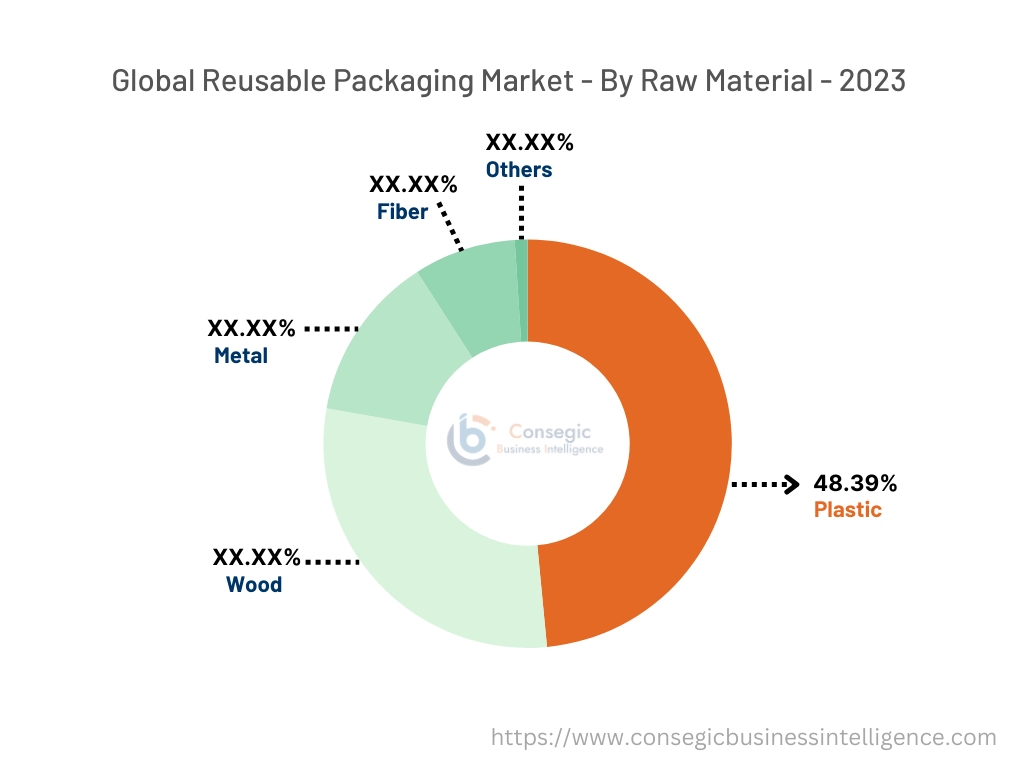
By raw material, the market is divided into plastic, wood, metal, fiber, and others.
Trends in Raw Material:
- As per market trends, plastic-based reusable packaging is being used in the shipment of fruits.
- Fiber-based reusable packaging is rapidly used for consumer health brands as per market trends.
Plastic accounted for the largest market share of 48.39% in the year 2023.
- Plastic is the leading material in the market due to its durability, lightweight nature, cost-effectiveness, and versatility. It is widely used in various industries such as logistics, retail, food and beverage, and healthcare.
- Plastic reusable packaging includes products like pallets, crates, containers, and intermediate bulk containers.
- Many leading producers and manufacturers of fruits are incorporating the use of reusable plastic products for the packaging and shipment of fruits.
- For instance, in 2024, Fresh Del Monte launches reusable plastic containers for banana shipments. The new banana packaging aligns with the organization's plans to redefine the process of packing, shipping, ripening, storing, and merchandising bananas, promoting the use of this packaging.
- Thus, plastic-based reusable packaging is seeing major development in various industries, fueling the reusable packaging market demand as per the analysis.
The fiber in the raw material segment is expected to grow at the fastest CAGR over the forecast period.
- Fiber-based materials are emerging as the fastest-growing segment in the market, driven by increasing consumer and regulatory demand for eco-friendly and biodegradable solutions.
- These materials include paperboard, corrugated cardboard, molded fiber, and others, typically reinforced for durability in reusable applications.
- Many pharmaceutical companies are introducing fiber-based packaging for their brands and products.
- For instance, in 2024, Bayer partnered with PAPACKS to develop biodegradable, fiber-based reusable packaging for consumer health brands like Aspirin, Bepanthen, and Claritin. It will replace products’ traditional plastic packaging for these brands. Also, it will utilize fibers and PAPACKS’ molded pulp technology, which makes use of materials derived from renewable sources and a plant-based coating, promoting the use of reusable packaging solutions.
- Thus, the use of fiber-based reusable packaging is growing rapidly, due to rising environmental concerns and a preference for biodegradable solutions.
By End-Use industry:
By end-use industry, the market is divided into food and beverages, automotive, retail and e-commerce, and others.
Trends in the end-use industry:
- The demand for reusable packaging is increasing in retail and e-commerce due to the demand for sustainable and efficient packaging solutions in online shopping as per market trends.
Food and beverages accounted for the largest market share in the year 2023.
- The food and beverages industry dominates the market due to its extensive use of reusable pallets, crates, and containers for food products
- This industry is heavily relying on reusable packaging to ensure product safety, maintain quality, and reduce waste across supply chains.
- Leading manufacturers in the food and beverages industry like McDonald's, Burger King, and others are incorporating the use of smart technologies like RFID, and QR codes in reusable packaging. RFID is a technology that uses radio waves to track a package's location throughout warehouses.
- For instance, in 2021, McDonald has collaborated with Checkpoint Systems in France to implement food-safe RFID technology into its new reusable containers. It will keep track of the packaging, optimize the restaurant’s reusable system, and reduce waste, further improving packaging solutions.
- Thus, the food and beverages sector is experiencing growth in reusable packaging solutions, driven by smart technologies like RFID and QR codes as per the analysis.
Retail and e-commerce in the end-use industry are expected to grow at the fastest CAGR over the forecast period.
- The retail and e-commerce industry is the fastest-growing segment. It is particularly driven by increasing demand for sustainable and efficient packaging solutions in online shopping and brick-and-mortar retail operations.
- The surge in online shopping has led to increased demand for reusable packaging solutions, especially for subscription-based and grocery deliveries.
- Major e-commerce players like IKEA and Amazon are adopting reusable solutions for packaging, for their e-commerce business.
- For instance, in 2024, RE-ZIP launched reusable packaging in five European countries together with Amazon. They launched specially designed cardboard boxes that can be easily folded, returned, and reused, promoting the use of reusable packaging solutions in E-commerce.
- In conclusion, retail and e-commerce are rapidly adapting reusable packaging solutions owing to growing environmental concerns and the need for eco-friendly products in the latest trends.
Regional Analysis:
The regional segment includes North America, Europe, Asia Pacific, the Middle East and Africa, and Latin America.
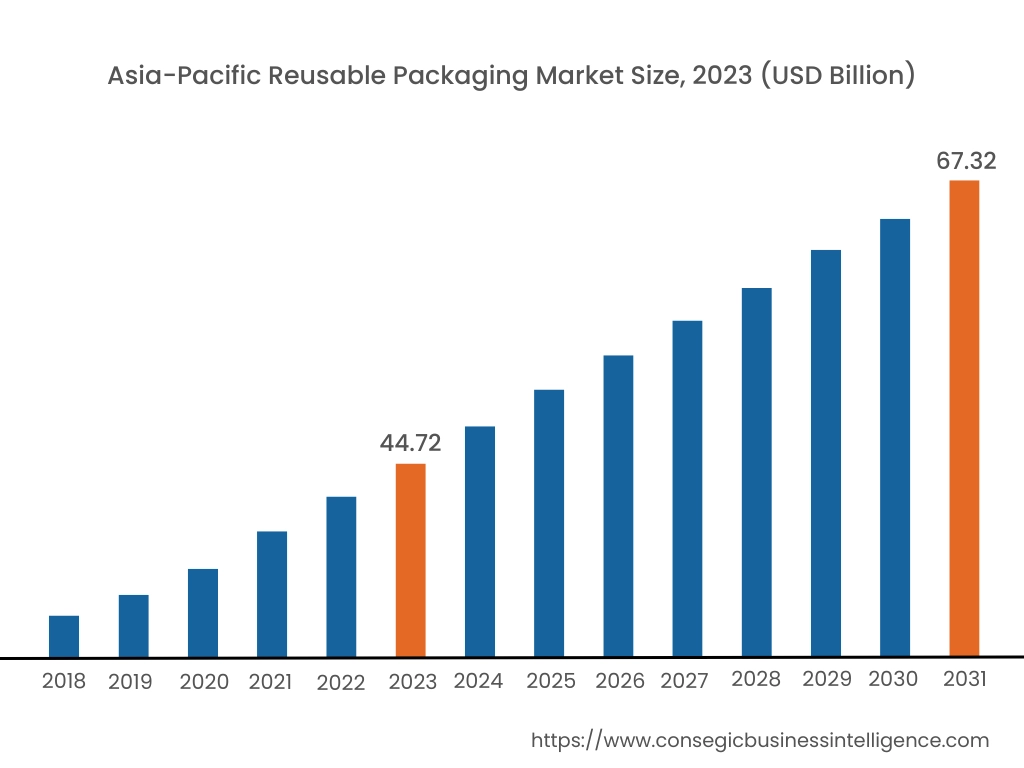
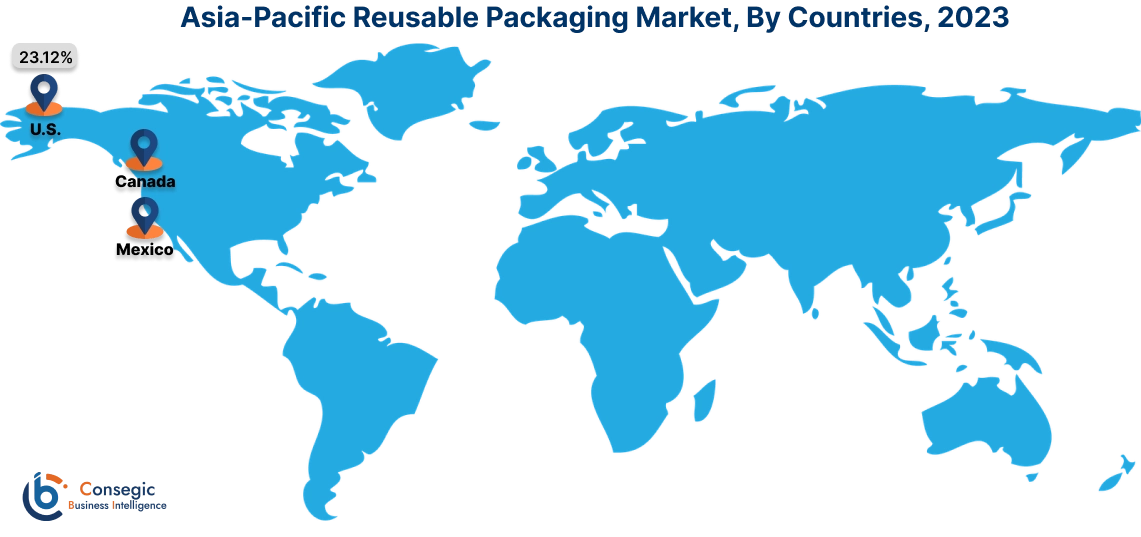
In 2023, Asia-Pacific accounted for the highest market share at 38.02% and was valued at USD 44.72 Billion and is expected to reach USD 67.32 Billion in 2031. In Asia-Pacific, China accounted for the highest market share of 23.12% during the base year of 2023. The Asia-Pacific reusable packaging market share is driven by government initiatives that are promoting sustainable practices. Countries like China, India, and Japan are major contributors to this market, by promoting sustainable practices and a circular economy. Further in China, Starbucks China launched reusable cup-sharing programs in selected locations, further fueling the market. Additionally, several Asian countries like India, Thailand, Indonesia, and Vietnam are implementing the Plastic Pact further promoting reusable packaging solutions. This Pact aims to promote collaborative action to enable innovative solutions to change the way plastics are designed, produced, used, and disposed of.
- In 2021, India is the first Asian country to launch a Plastics Pact. Targets include making 100% of plastic packaging reusable or recyclable and effectively recycling 50% of plastic packaging by 2030. It encourages the sustainable use of plastic.
Thus, Asia-Pacific is dominating in market, supported by government initiatives and technological advancements as per reusable packaging market analysis.
North America is expected to witness the fastest CAGR over the forecast period of 5.7% during 2024-2031. The reusable packaging market share in North America is experiencing significant growth, driven by increasing awareness of sustainability, stringent environmental regulations, and advancements in packaging technologies. The region’s well-established supply chain infrastructure and technological innovation are further fueling this market. In the North American region, companies like Cabinet Health are offering reusable packaging and a refill system for the healthcare market.
- In 2023, Cabinet Health launched national pharmacies to expand access to refillable and compostable medicine. They launched 700 retail national pharmacies across the country to address the surging demand for quality medicines and sustainably packaged products like plant-based plastics, paper bottles, and more. This has significantly accelerated the market, by offering reusable packaging and a refill system for the healthcare businesses.
Thus, North America is expected to emerge rapidly in the market, through technological advancements and sustainable solutions.
According to market analysis, the European market for reusable packaging is growing significantly. It is primarily driven by stringent environmental regulations and a strong emphasis on sustainability. The European Union’s commitment to a circular economy, supported by initiatives like the EU-single-use plastic Directive, has encouraged industries to adopt reusable packaging solutions. Key sectors such as food and beverage, and automotive are leading this shift, supported by consumer preferences for eco-friendly and sustainable packaging. Additionally, European startups like Hipli and Re-zip are partnering with e-commerce giant Amazon to provide reusable packaging in the E-commerce business. Countries like Germany, France, and the Netherlands are pioneers in this market leveraging advanced recycling infrastructure and innovation in reusable packaging. Also, the European government is promoting sustainable practices through Registration, Evaluation, Authorization, and Restriction of Chemicals regulation, further fueling the market.
The market in the Middle East and Africa region is experiencing steady growth, driven by growing industrialization, government initiatives to reduce waste, and rising awareness about sustainability. Industries like food and beverage, logistics, and retail are embracing reusable packaging in the Middle East and Africa region. Gulf Council Countries are adopting green initiatives as part of their long-term environmental goals, further accelerating the market. The region is focusing on using biodegradable bags to stylish reusable packaging, promoting eco-friendly and sustainability practices. However, underdeveloped recycling infrastructure, high initial costs, and limited awareness in some parts of the region hinder the widespread adoption of packaging solutions in the region as per the analysis.
Latin America's reusable packaging market growth is gaining traction, driven by an increasing focus on sustainability and the adoption of eco-friendly practices by industries. Key sectors such as food and beverage, automotive, and retail are majorly contributing to this market with the use of reusable packaging solutions. Countries like Brazil, Mexico, and Argentina are leading this market due to rising consumer awareness and government regulations aimed at reducing waste. Regional economies are promoting circular economy practices and the participation of global companies is accelerating reusable packaging market expansion in this region. Additionally, advancements in logistics and packaging technologies, such as the Internet of Things (IoT)-enabled tracking for efficient reuse are improving the adoption rate of packaging solutions in this region.
Top Key Players & Market Share Insights:
The reusable packaging market is highly competitive with major players providing products and services to the national and international markets. Key players are adopting several strategies in research and development (R&D), product innovation, and end-user launches to hold a strong position in the global market. Key players in the reusable packaging industry include -
- Buckhorn Inc (United States)
- Brambles (Australia)
- RPP Containers (United States)
- GWP Group (England)
- Nefab Group (Sweden)
- ORBIS Corporation (United States)
- DS Smith (United Kingdom)
- IFCO Systems (Germany)
- Plasmix (India)
- Tri-Wall (Japan)
Recent Industry Developments :
Launches:
- In 2024, KYSU launched recyclable, reusable packaging made from recycled materials for the entire product line. This airtight, recyclable, and reusable paper packaging is used for the entire range of over 80 different products in environmentally friendly containers, creating reusable packaging market opportunities.
- In 2024, Burger King launched a reusable cup pilot in restaurants across Finland. These cups are made from Sulapac Solid, a 100% bio-based, recyclable, and industrially compostable material designed specifically for reusable tableware without requiring hazardous chemicals in its production. This will result in market expansion through the use of bio-based, recyclable products.
Partnerships and Collaborations:
- In 2024, Movopack and Brave Kid collaborated on reusable packaging for children’s fashion. The partnership is aimed at integrating reusable packaging into Brave Kid’s operations. The packaging, customized with the tagline “Be a BRAVE KID too! Send back the packaging”, is designed to promote reusable packaging in the fashion industry.
Reusable Packaging Market Report Insights :
| Report Attributes | Report Details |
| Study Timeline | 2021-2034 |
| Market Size in 2034 | USD 206.25 Billion |
| CAGR (2026-2034) | 5.30% |
| Base Year | 2025 |
| By Raw Material |
|
| By End-Use industry |
|
| By Region |
|
| Key Players |
|
| North America | U.S. Canada Mexico |
| Europe | U.K. Germany France Spain Italy Russia Benelux Rest of Europe |
| APAC | China South Korea Japan India Australia ASEAN Rest of Asia-Pacific |
| Middle East and Africa | GCC Turkey South Africa Rest of MEA |
| LATAM | Brazil Argentina Chile Rest of LATAM |
| Report Coverage |
|
Key Questions Answered in the Report
How big is the Reusable packaging Market? −
The global reusable packaging market size is estimated to reach over USD 176.65 Billion by 2031 from a value of USD 117.61 Billion in 2023, growing at a CAGR of 5.3% from 2024 to 2031.
What specific segmentation details are covered in the Reusable packaging Market report? +
The Reusable Packaging Market report includes specific segmentation details for raw material and end-use industry.
Which is the fastest-growing region in the Reusable packaging Market? +
North America is the fastest-growing region in the Reusable packaging Market.
Who are the major players in the Reusable Packaging Market? +
The key participants in the Reusable packaging market are Buckhorn Inc. (United States), Brambles (Australia), ORBIS Corporation (United States), DS Smith (United Kingdom), IFCO Systems (Germany), Plasmix (India), Tri-Wall (Japan), RPP Containers (United States), GWP Group (England, Nefab Group (Sweden).
Overview
Reputation & Certifications


Our Services
- Market Intelligence & Forecasting
- Custom Research Solutions
- Market Entry Strategy
- Competitive Intelligence
- Customer Insights
- Industry Innovation Analysis
- Investment Advisory