Jump to Content
Smart Crop Mobility Market - Size, Share, Industry Trends, and Forecasts (2025-2032)
Smart Crop Mobility Market Size:
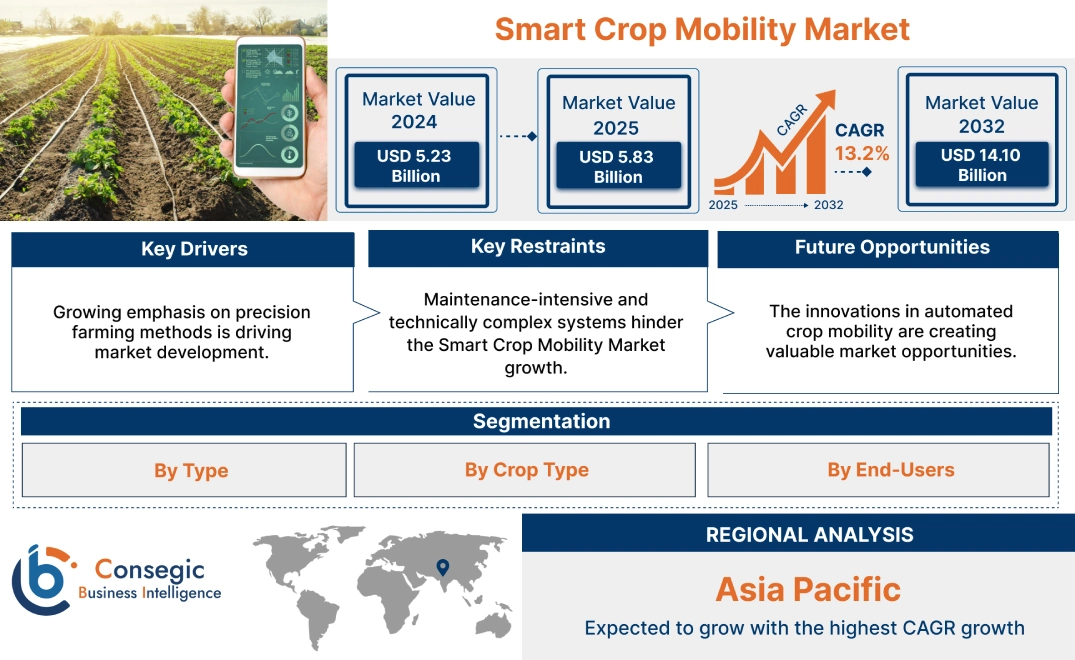
Smart Crop Mobility Market size is estimated to reach over USD 14.10 Billion by 2032 from a value of USD 5.23 Billion in 2024 and is projected to grow by USD 5.83 Billion in 2025, growing at a CAGR of 13.2% from 2025 to 2032.
Smart Crop Mobility Market Scope & Overview:
Smart Crop Mobility refers to the integration of autonomous or semi-autonomous machines, sensor-based navigation, and data-driven coordination to move and manage crops efficiently within cultivated fields. These systems help with tasks such as carrying harvested produce, delivering inputs like fertilizers, or assisting in other movements across the field using location data and sensors.
The technology includes mobile platforms that can adapt to different terrain types, embedded sensor arrays, route optimization software, and attachments for specific farm activities. In some cases, several machines work together in a coordinated manner to cover larger areas. Their design assist to move through narrow spaces and minimizing physical contact without damaging crops.
These systems help reduce manual work while improving crops and materials mobility in narrow, yield-dense farm environments. These systems are usually employed for horticulture growers, precision farming operators, and protected agriculture facilities where mobility of inputs and outputs must be managed in narrow, yield-dense environments.
Smart Crop Mobility Market Dynamics - (DRO) :
Key Drivers:
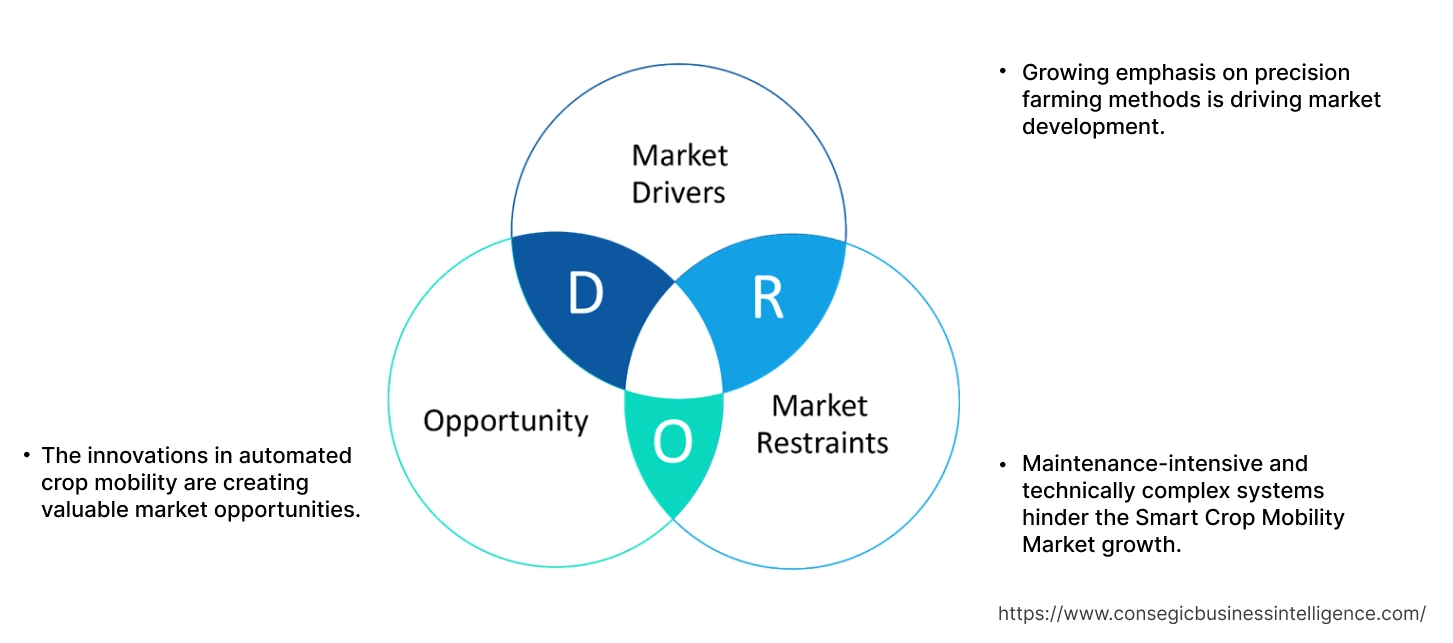
Growing emphasis on precision farming methods is driving market development.
Precision farming is revolutionizing farming techniques for farmers. These systems utilize advanced technologies like GPS, IoT sensors, and automated machinery to monitor and manage key agricultural variables such as soil moisture, crop health, temperature, and nutrient levels. This data-driven approach allows farmers to optimize resource use, such as water, fertilizers, and pesticides, ensuring that they are applied precisely where needed. Additionally, by automating time-consuming tasks like irrigation, fertilization, and harvesting, these technologies help reduce labor costs, improve crop yield, and minimize environmental impact.
- For instance, in January 2025, Naïo Technologies unveiled their Naïo Companion app at the SIVAL exhibition. This app offers first-in-class solutions in monitoring robots for agriculture routine management and enhanced precision farming while saving time in working both remotely and in real-time.
Furthermore, the increasing adoption of these systems by farmers to improve productivity, increase profitability, and address environmental challenges, is significantly driving the smart crop mobility market demand.
Key Restraints:
Maintenance-intensive and technically complex systems hinder the Smart Crop Mobility Market growth.
The smart crop mobility systems that are equipped with advanced technologies like including robotics, artificial intelligence (AI), machine learning, and IoT integration to monitor and manage various agriculture variables, are often intricate and may be difficult for average farmers to comprehend. Operating and maintaining these advanced systems demands a high degree of technical expertise, which is often scarce in many agricultural areas. In regions with limited access to training and skilled technicians, farmers may find it challenging to fully utilize these technologies, resulting in underuse or equipment failure. Additionally, the availability of extra parts for maintenance of these systems is scarce, making it difficult, expensive and time consuming for the consumers. Therefore, investing in complex technologies becomes a major hurdle for farmers to integrate these systems, impeding the overall global smart crop mobility market.
Future Opportunities :
The innovations in automated crop mobility are creating valuable market opportunities.
The rise of integration of AI and machine learning algorithms into tractors, harvesters and drones making them self-automated represents a transformative opportunity for the market. Autonomous field machinery can navigate fields, monitor crop growth, and detect pest infestations without any human intervention. This automation reduces labor costs, improves operational efficiency, and increases productivity, particularly in regions facing labor shortages or where high labor costs make manual farming less viable. Additionally, automation helps in precise farming, where water and minerals are only added when required leading to minimized wastage and reduced environmental impact.
- For instance, in November 2023, Naïo Technologies launched the ‘Augmented Autonomy’ that allows robots to work fully autonomously, while following all the regulatory and safety standards. These robot ensure soil protection and optimize crop yield with the help of AI tools.
Furthermore, these technologies will save labor and improve efficiency, thereby improving cop quality and yield, significantly fueling the global smart crop mobility market opportunities.
Smart Crop Mobility Market Segmental Analysis :
By Type:
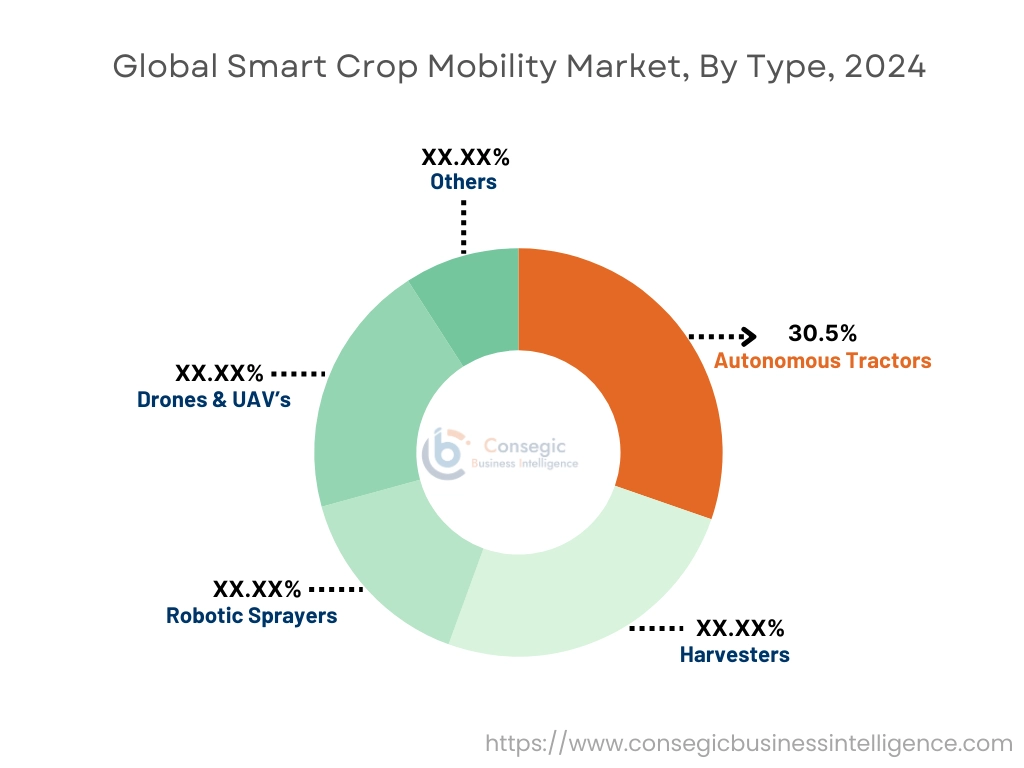
Based on Type, the market is categorized into autonomous tractors, harvesters, robotic sprayers, drones & UAVs, and others.
The autonomous tractors segment holds the largest revenue of the overall Smart Crop Mobility Market share of 30.5% in the year 2024.
- Autonomous tractors are central to smart crop mobility because they integrate powerful engines with GPS navigation, automated steering, and precise control for tasks like tillage, seeding, and plowing.
- Leading OEMs are integrating AI-based obstacle detection, adaptive path planning, and VRT compatibility into autonomous tractors to support diverse terrain and cropping systems.
- Additionally, these machines are widely deployed in large commercial farms where operational efficiency, labor reduction, and time-sensitive field preparation are key priorities.
- For instance, in February 2024, Agtonomy, announced the launch of the paid pilot program that when integrated with tractors, will autonomously drive them for common agriculture tasks like tilling, mowing, weeding, and more.
- According to the smart crop mobility market analysis, the advancements in autonomous tractors and rising demand for large scale farming drive their increased requirement, significantly fueling the smart crop mobility market expansion.
The drones & UAVs segment is expected to grow at the fastest CAGR during the forecast period.
- Drones and UAVs are transforming crop mobility through aerial imaging, field scouting, precision spraying, and input optimization—offering real-time, bird’s-eye visibility of crop health and field variability.
- Cloud-connected drones are now part of integrated agronomic platforms, where AI-driven analytics convert imagery into actionable insights on irrigation, nutrient stress, and pest incidence.
- Additionally, lightweight, GPS-guided drones equipped with multispectral cameras and thermal sensors are becoming essential tools for smallholder and large-scale farms alike.
- For instance, in September 2023, AgEagle Aerial Systems Inc.announced the integration of its latest sensor innovations the RedEdge-P dual in DeltaQuad’s new DeltaQuad EVO. This drone systems are ideal in plant classification for agriculture and for environmental research.
- As per the market analysis, due to the access to real-time aerial monitoring and integration of advanced crop analytics, the global smart crop mobility market is expanding.
By Crop Type:
Based on Crop Type, the market is categorized into Field Crops, Horticultural Crops, Plantation Crops, and others.
The Field Crops segment holds the largest revenue of the overall Smart Crop Mobility Market share in the year 2024.
- Field crops, including cereals, grains, pulses, and oilseeds represent the largest segment due to their sheer cultivation volume, mechanization compatibility, and widespread global acreage.
- Crops such as wheat, maize, soybeans, and rice benefit significantly from smart tractors, autonomous planters, robotic sprayers, and field-monitoring UAVs, especially in high-acreage geographies.
- Additionally, technologies like GPS-guided machinery, autonomous weeding bots, and fleet management systems are widely deployed in field crop systems due to repetitive and large-scale operational needs.
- According to the smart crop mobility market analysis, high demand for field crops boosts the worldwide dependency on automated systems making it the largest segment, significantly fueling the market growth.
The Horticulture Crops segment is expected to grow at the fastest CAGR during the forecast period.
- Horticultural crops, including fruits and vegetables are the fastest-growing segment due to their high value per hectare, labor intensity, and need for precision across different growth stages.
- These crops require constant monitoring, careful harvesting, and targeted input application, all of which are increasingly being handled by mobile robots, precision drones, and narrow autonomous platforms.
- Additionally, smart sprayers, pruning robots, and crop maturity analytics (based on vision systems and AI models) are rapidly being deployed in high-input crops such as tomatoes, berries, and leafy greens.
- As per the market trends, the rising need for precision agriculture and the demand for AI-based systems have substantially driven the global smart crop mobility market opportunities.
By End-Users:
Based on End-Users, the market is categorized into Large Commercial Farms, Small & Medium-Sized Farms, Agricultural Cooperatives, and Research & Academic Institutions.
The Large Commercial Farms segment holds the largest revenue share of the overall Smart Crop Mobility Market in the year 2024.
- Large-scale agribusinesses are the primary adopters of smart crop mobility technologies due to their financial capability, need for automation, and scalability of operations.
- Investment in technologies like autonomous tractors, fleet management systems, and real-time yield tracking is highest among large commercial operations.
- Additionally, investment in technologies like autonomous tractors, fleet management systems, and real-time yield tracking is highest among large commercial operations.
- For instance, in March 2025, Bluewhite announced the launch of GEN 4 autonomous solution that is powered by NVIDIA AGXOrin. This next-gen AI-driven autonomy has set exceptional standards for large-scale farming applications.
- According to the market analysis, the high capacity of investment and advancements in precision tools have significantly boosted the smart crop mobility market trends.
The Small & Medium-Sized Farms is expected to grow at the fastest CAGR during the forecast period.
- Small and mid-scale farms are now rapidly adopting smart crop mobility through compact, modular, and cost-effective solutions.
- These farms benefit most from labor-saving automation in high-labor tasks like weeding, spraying, and harvesting of horticultural and row crops.
- Additionally, OEMs are introducing miniaturized and retrofittable robotic tools, including lightweight autonomous sprayers and drones with mobile-based interfaces tailored for decentralized usage.
- Thus, the market analysis shows that the more cost efficient options and integration in labor intensive tasks, significantly drives the smart crop mobility market trends.
Regional Analysis:
The regions covered are North America, Europe, Asia Pacific, Middle East and Africa, and Latin America.
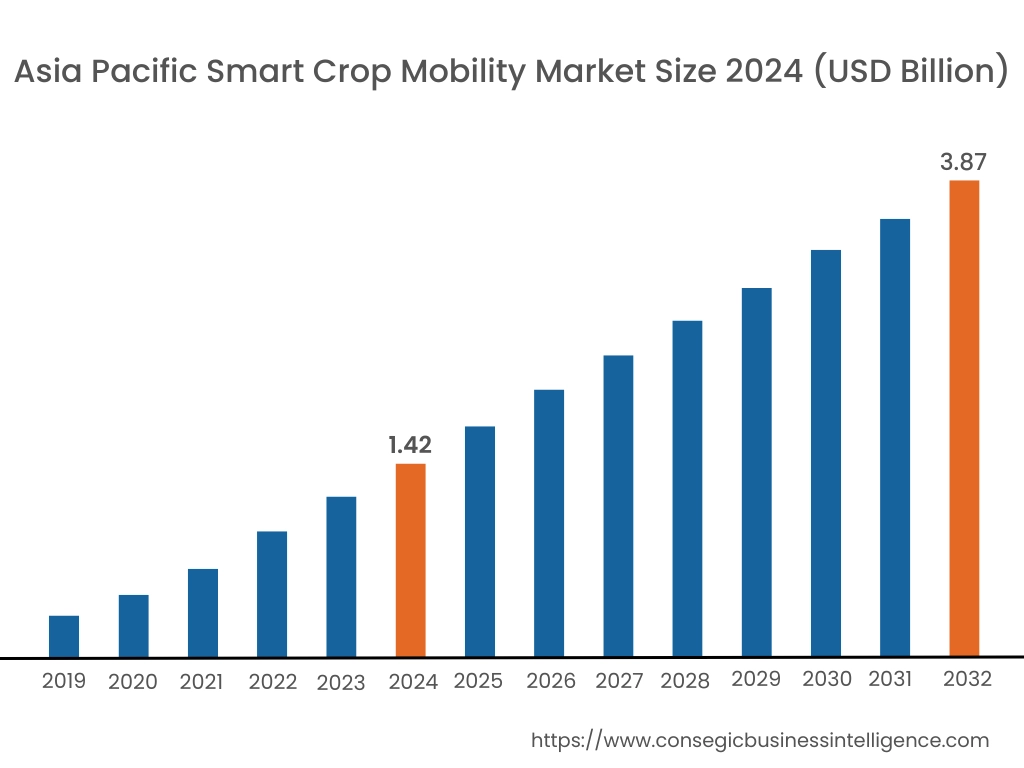
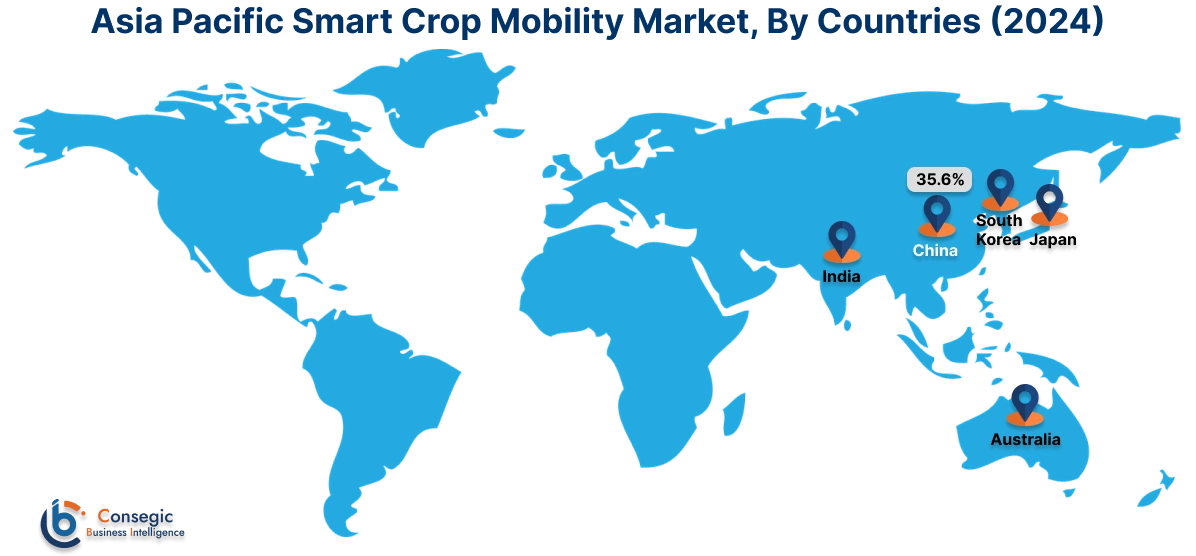
Asia Pacific region was valued at USD 1.42 Billion in 2024. Moreover, it is projected to grow by USD 1.58 Billion in 2025 and reach over USD 3.87 Billion by 2032. Out of this, China accounted for the maximum revenue share of 35.6%.
In the Asia-Pacific region, rapid modernization of agriculture and development of automated, IoT-enabled mobility solutions fuels the market trends. Additionally, one emerging trend focuses on locally adapted systems that offer flexible control over irrigation and nutrient management during crop transportation. Furthermore, the proactive government initiatives and localized research efforts in enhancing crop mobility are driving the growth of these advancements, significantly driving the smart crop mobility market growth.
North America is estimated to reach over USD 4.70 Billion by 2032 from a value of USD 1.74 Billion in 2024 and is projected to grow by USD 1.94 Billion in 2025.
In North America, the market is influenced by the rising trend in seamless crop tracking and efficient transportation of the harvest. Additionally, integrating sensor-based systems into mobile platforms, which allow farmers to monitor crop conditions in real time fuels the market development.
- For instance, in June 2024, Bluewhite announced a multi-phased collaboration with New Holland, a brand of CNH, manufacturing fully autonomous tractors integrated with Bluewhite’s autonomous solutions in North America for orchards, vineyards and other specialty crop operations.
As per the regional analysis, the supportive regulatory policies and increasing collaboration and partnerships play a pivotal role, significantly driven the smart crop mobility industry in this region.
Europe holds a significant market share due to the strong focus on sustainability and precision farming objectives. Additionally, integration of smart digital sensors embedded in mobility equipment to facilitate accurate management of crop movement fuels the market demand. Analysis of the market showed that initiatives aimed at modernizing farming practices and stringent regulations led by the government to initiate automation in agriculture, significantly boosting the smart crop mobility market in this region.
The smart crop mobility market in the Middle East and Africa is primarily driven by the challenges related to water scarcity and variable environmental conditions. The shifting trend towards the adoption of robust and lightweight mobility platforms designed to operate in harsh climatic environments and the policies and strategic regional initiatives are driving the adoption of these innovative systems, further boosting the industry growth.
In Latin America agriculture is transforming with the introduction of smart crop mobility solutions that enhance productivity and streamline crop logistics. One notable trend is the development of user-friendly platforms designed to simplify complex processes during crop handling and transportation. Additionally, the market analysis shows that initiatives aimed at modernizing farming practices and integration of real-time data collection systems is significantly driving the market expansion.
Top Key Players and Market Share Insights:
The smart crop mobility market is highly competitive with major players providing products and services to the national and international markets. Key players are adopting several strategies in research and development (R&D), product innovation, and end-user launches to hold a strong position in the global smart crop mobility market. Key players in the smart crop mobility industry include -
- AGCO Corporation (United States)
- AgEagle Aerial Systems (United States)
- CNH Industrial (United Kingdom)
- Ag Leader Technology (United States)
- Deere & Company (United States)
- Blue River Technology (United States)
- Naïo Technologies (France)
- AgXeed B. V. (The Netherlands)
- Bluewhite (Israel)
- Agtonomy (United States)
Recent Industry Developments :
Mergers and Acquisitions:
- For instance, in April 2025, Taylor Farms announced the acquisition of FarmWise to reinforce advancements in agriculture and sustainable farming, along with delivering high-quality foods to its consumers. The acquisition will strengthen the innovative momentum behind the Vulcan technology.
Smart Crop Mobility Market Report Insights:
| Report Attributes | Report Details |
| Study Timeline | 2019-2032 |
| Market Size in 2032 | USD 14.10 Billion |
| CAGR (2025-2032) | 13.2% |
| By Type |
|
| By Crop Type |
|
| By End-Users |
|
| By Region |
|
| Key Players |
|
| North America | U.S. Canada Mexico |
| Europe | U.K. Germany France Spain Italy Russia Benelux Rest of Europe |
| APAC | China South Korea Japan India Australia ASEAN Rest of Asia-Pacific |
| Middle East and Africa | GCC Turkey South Africa Rest of MEA |
| LATAM | Brazil Argentina Chile Rest of LATAM |
| Report Coverage |
|
Key Questions Answered in the Report
How big is the Smart Crop Mobility Market? −
Smart Crop Mobility Market size is estimated to reach over USD 14.10 Billion by 2032 from a value of USD 5.23 Billion in 2024 and is projected to grow by USD 5.83 Billion in 2025, growing at a CAGR of 13.2% from 2025 to 2032.
What specific segments are covered in the Smart Crop Mobility Market? +
The Smart Crop Mobility Market specific segments for Type, Crop Type, End-Users, and Region.
Which is the fastest-growing region in the Smart Crop Mobility Market? +
Asia pacific is the fastest growing region in the Smart Crop Mobility Market.
What are the major players in the Smart Crop Mobility Market? +
The key players in the Smart Crop Mobility Market are AGCO Corporation (United States), AgEagle Aerial Systems (United States), CNH Industrial (United Kingdom), Ag Leader Technology (United States), Blue River Technology (United States), Naïo Technologies (France), AgXeed B. V. (The Netherlands), Bluewhite (Israel), Agtonomy (United States), Deere & Company (United States), and others.
Overview
Reputation & Certifications


Our Services
- Market Intelligence & Forecasting
- Custom Research Solutions
- Market Entry Strategy
- Competitive Intelligence
- Customer Insights
- Industry Innovation Analysis
- Investment Advisory