Jump to Content
3D Imaging Market - Size, Share, Industry Trends, and Forecasts (2025-2032)
3D Imaging Market Size:
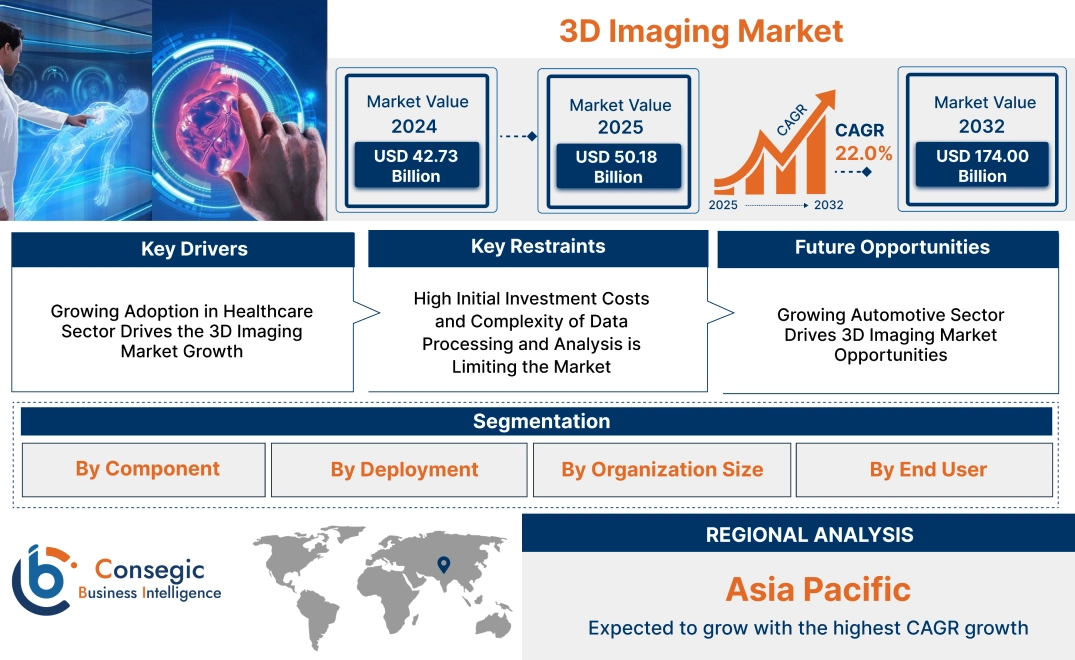
3D Imaging Market Size is estimated to reach over USD 174.00 Billion by 2032 from a value of USD 42.73 Billion in 2024 and is projected to grow by USD 50.18 Billion in 2025, growing at a CAGR of 22.0% from 2025 to 2032.
3D Imaging Market Scope & Overview:
3D imaging is the process of capturing, processing, and displaying visual representations of objects or environments in three dimensions, providing depth and spatial information. The benefits including enhanced visualization, improved accuracy, and increased efficiency are driving the 3D imaging market. Further, imaging technology is used for a wide range of applications in automotive, manufacturing, healthcare, construction, media and entertainment, and other sectors. Furthermore key trends driving the market include increasing integration of AI and machine learning for advanced image analysis, growing adoption of cloud-based imaging solutions, and continuous advancements in sensor technology for better resolution and accuracy.
3D Imaging Market Dynamics - (DRO):
Key Drivers:
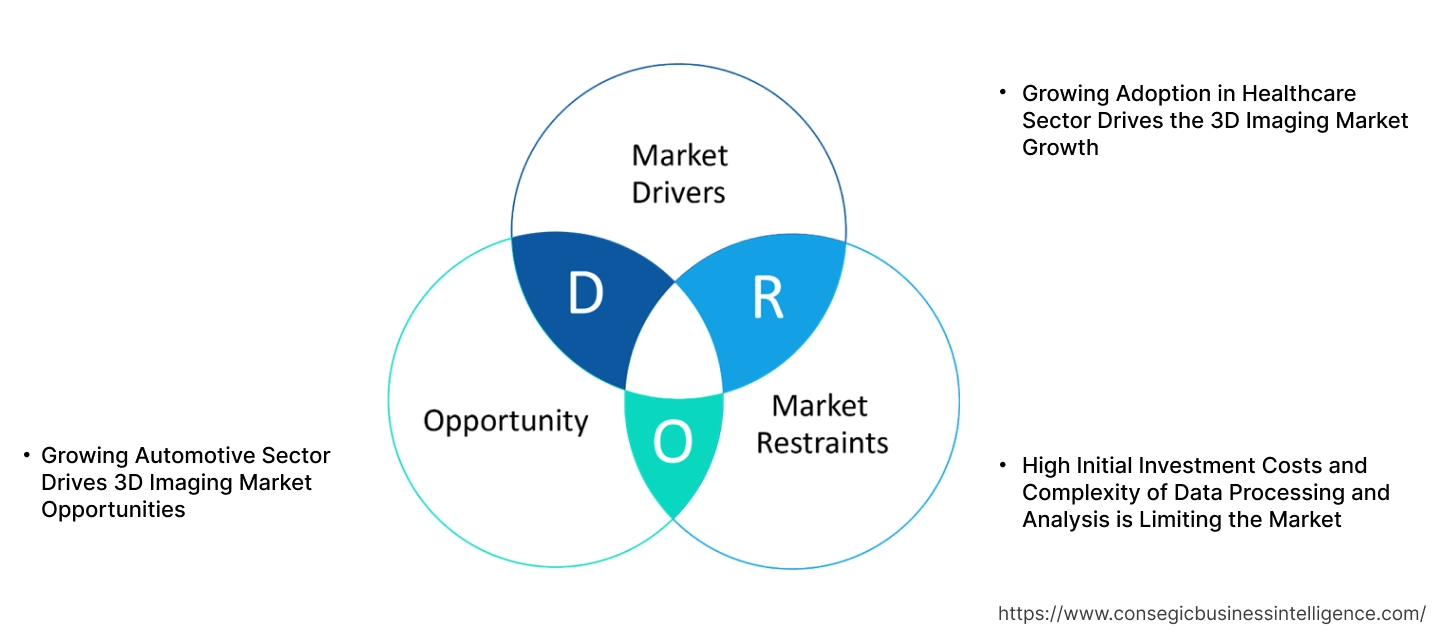
Growing Adoption in Healthcare Sector Drives the 3D Imaging Market Growth
The increasing adoption of imaging technology within the healthcare sector is an important driver for the overall market's expansion. The surge is fueled by technology’s ability to provide detailed anatomical visualizations which significantly enhances diagnostic accuracy and treatment planning. Further, imaging techniques, such as CT scans and MRI, allow for precise surgical planning, reducing invasiveness and improving patient outcomes. Furthermore, creation of customized prosthetics and implants, is another key application of the technology. Moreover, as healthcare providers seek to improve patient care and optimize procedures, the demand for advanced imaging solutions continues to rise.
- For instance, in September 2022, Olympus Corporation launched the VISERA ELITE III which is a surgical visualization platform designed to streamline endoscopic procedures. The system combines 3D, infrared, and 4K imaging capabilities, along with fluorescence-guided surgery.
Thus, growing adoption of technology in healthcare sector for a wide range of applications drives the 3D imaging market growth
Key Restraints:
High Initial Investment Costs and Complexity of Data Processing and Analysis is Limiting the Market
The 3D imaging market faces limitations due to high initial investment costs and the complexity of data processing and analysis. The substantial expenses associated with acquiring advanced 3D scanning equipment and sophisticated software create a significant barrier, particularly for small and medium-sized enterprises. Furthermore, the sheer volume of data generated by imaging requires powerful computing infrastructure and specialized software for effective processing. This complexity extends to the need for skilled personnel capable of interpreting and utilizing the data, adding to operational costs. Further, the intricate nature of 3D data manipulation, including reconstruction and visualization, necessitates advanced algorithms and techniques, further complicating implementation. Thus, aforementioned factors collectively hinder market adoption and restrict the market growth.
Future Opportunities:
Growing Automotive Sector Drives 3D Imaging Market Opportunities
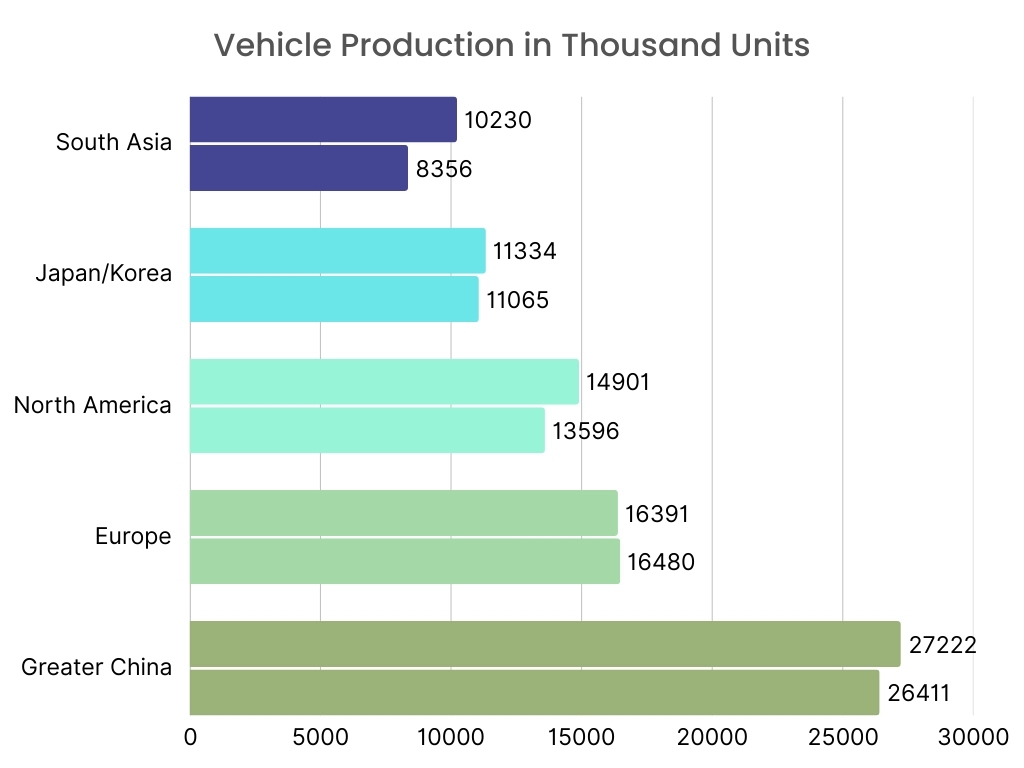
The rising automotive sector is presenting substantial opportunities for the 3D imaging market. The need for autonomous driving necessitates precise environmental mapping and object detection, making 3D LiDAR and other imaging technologies essential. Further, shift towards electric vehicles (EVs) demands meticulous design and quality control, where 3D imaging excels in component analysis and vehicle body scanning. Advanced driver-assistance systems (ADAS) also rely on accurate 3D data for features like collision avoidance and lane departure warning. Furthermore, the automotive sector’s focus on innovation and efficiency is driving a significant demand for sophisticated imaging solutions.
- For instance, as per the European Automobile Manufacturers' Association (ACEA), the production of vehicle worldwide reached 85.4 million units in the year 2022, with a rise of 5.7% from 2021.
Thus, the growing automotive sector with increasing technological advancements drives the 3D imaging market opportunities.
3D Imaging Market Segmental Analysis :
By Component:
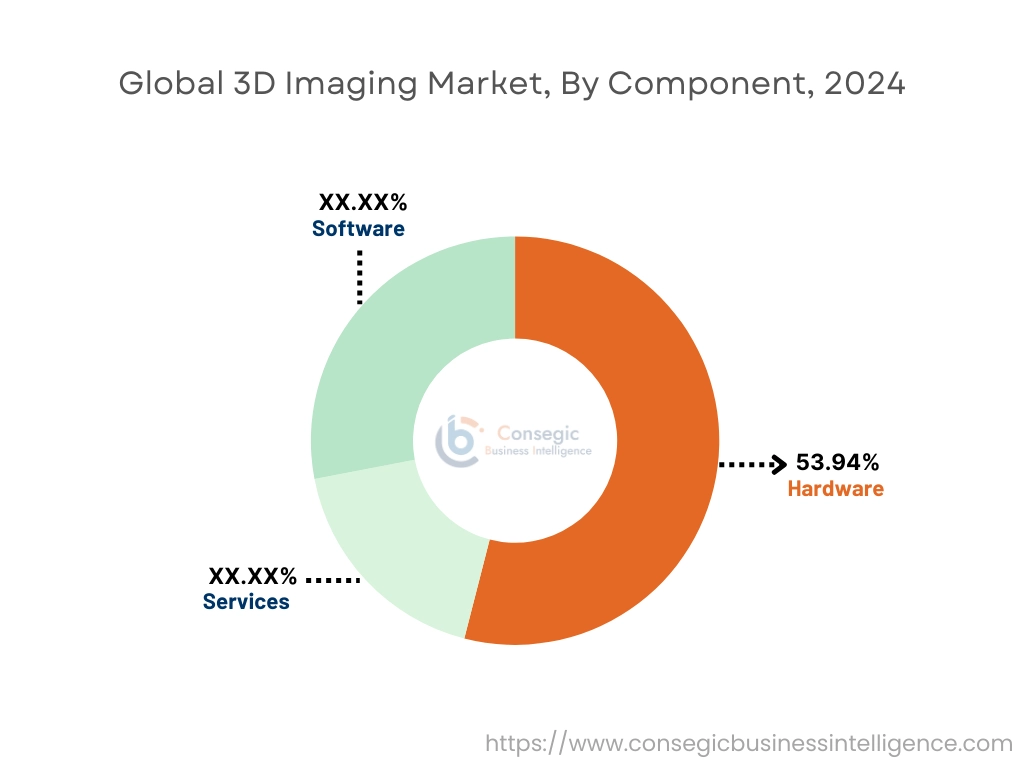
Based on the component, the market is segmented into software, hardware, and services.
Trends in the Component:
- Increasing demand for professional 3D scanning and digitization services, is driving the 3D imaging market trends.
- Increasing popularity of 3D printing services for rapid prototyping is expected to drive 3D imaging market size.
Hardware accounted for the largest revenue share of 53.94% in the year 2024.
- There's a strong trend towards higher-resolution and more accurate 3D sensors, including LiDAR, time-of-flight (ToF), and structured light sensors which in turn is driving the 3D imaging market share.
- Further, imaging hardware is becoming smaller and more portable, enabling its integration into a wider range of devices, such as smartphones, tablets, and handheld scanners, driving the 3D imaging market trends.
- Furthermore, increasingly incorporation of AI processors and edge computing capabilities in imaging hardware
- Thus, as per 3D imaging market analysis, advancements in sensor technology, miniaturization and integration with AI and edge computing are driving the market.
Software is anticipated to register the fastest CAGR during the forecast period.
- AI and machine learning algorithms are being used to enhance 3D image reconstruction and visualization which in turn drives the 3D imaging market share.
- Further, software enables real-time 3D rendering and simulation, which is crucial for applications in virtual reality (VR), augmented reality (AR), and gaming which in turn drives the market.
- For instance, Planmeca Oy offers Planmeca Romexis which is a versatile dental software platform designed to maximize clinic potential and improve patient care.
- Therefore, aforementioned factors are anticipated to boost the market during the forecast period.
By Deployment:
Based on the Deployment, the market is segmented into on-premise and cloud.
Trends in the Deployment:
- Cloud platforms provide access to powerful AI and machine learning tools, which can be used to enhance 3D image analysis, processing, and visualization which in turn drives the 3D imaging market demand.
On-premise accounted for the largest revenue share of 40.96% in the year 2024.
- On-premise systems offer greater control over data and infrastructure, minimizing the risk of unauthorized access which in turn drives the 3D imaging market size.
- Further, on-premise solutions are often preferred for applications demanding high-performance computing, such as complex 3D rendering and simulations driving the imaging industry.
- Thus, as per 3D imaging market analysis, enhanced security and control and high-performance computing are driving the market.
Cloud is anticipated to register the fastest CAGR during the forecast period.
- Cloud-based imaging solutions offer exceptional scalability, allowing businesses to adjust their resources as needed.
- Further, cloud deployments enable remote access to imaging data and tools, facilitating collaboration among geographically dispersed teams which subsequently propels the imaging market.
- Furthermore, cloud-based solutions can reduce upfront infrastructure costs which in turn drives the market growth.
- Therefore, scalability, accessibility, and cost-effectiveness is anticipated to boost the growth of the market during the forecast period.
By Organization Size:
Based on the organization size, the market is segmented into large enterprises and small and medium-sized enterprises.
Trends in the organization size:
- SME's are increasingly utilizing imaging technology to create compelling marketing and sales materials, such as 3D product visualizations, virtual tours, and augmented reality experiences which in turn drive the 3D imaging market expansion.
Large enterprises accounted for the largest revenue share in the year 2024 and is anticipated to register the fastest CAGR during the forecast period.
- Large enterprises are increasingly integrating imaging data and workflows into their existing ERP, PLM, and MES.
- Further, large corporations are investing in advanced imaging applications, such as digital twin, predictive maintenance, and complex simulations.
- Furthermore, enterprises are implementing robust security measures and compliance protocols to protect their imaging data which in turn drives market.
- Thus, aforementioned factors are driving the market during the forecast period.
By End User:
Based on the end user, the market is segmented into automotive and transportation, manufacturing, healthcare and life sciences, architecture and construction, media and entertainment, security & surveillance, and others.
Trends in the End User:
- 3D imaging is integral to 3D printing, enabling precise design, prototyping, and production of complex parts in manufacturing industry which in turn drives the 3D imaging market demand.
- Imaging technology is integrated with BIM to create accurate and detailed digital representations of buildings and infrastructure.
Healthcare and life sciences accounted for the largest revenue share in the year 2024.
- Growing adoption of imaging technology as it provides detailed anatomical models for pre-operative planning and intraoperative guidance.
- Further, advanced imaging techniques like CT, MRI, and ultrasound are used for accurate diagnosis and treatment planning which in turn drives the 3D imaging industry.
- Furthermore, 3D scanning and printing are used to create customized prosthetics and implants tailored to individual patients
- For instance, Fujifilm offers Synapse 3D platform which provides over 50 advanced visualization applications and is developed in collaboration with medical specialists, to enhance image analysis through server-side technology with cloud and on-premise hosting, supporting interpretation, reporting, treatment planning, and enterprise-wide clinical collaboration.
- Thus, surgical planning, medical imaging, prosthetics & implants are driving the market.
Automotive and Transportation is anticipated to register the fastest CAGR during the forecast period.
- Imaging technology is utilized in automotive sector for activities including vehicle design, prototyping, quality control and other.
- Further, the requirement of high-precision measurements to withstand quality standards is propelling the 3D imaging market expansion.
- Furthermore, 3D LiDAR and other imaging technologies are crucial for autonomous driving systems, enabling accurate environmental perception and navigation.
- Therefore, increasing adoption in vehicle development and rise of autonomous vehicle is anticipated to boost the growth of the market during the forecast period.
Regional Analysis:
The regions covered are North America, Europe, Asia Pacific, Middle East and Africa, and Latin America.
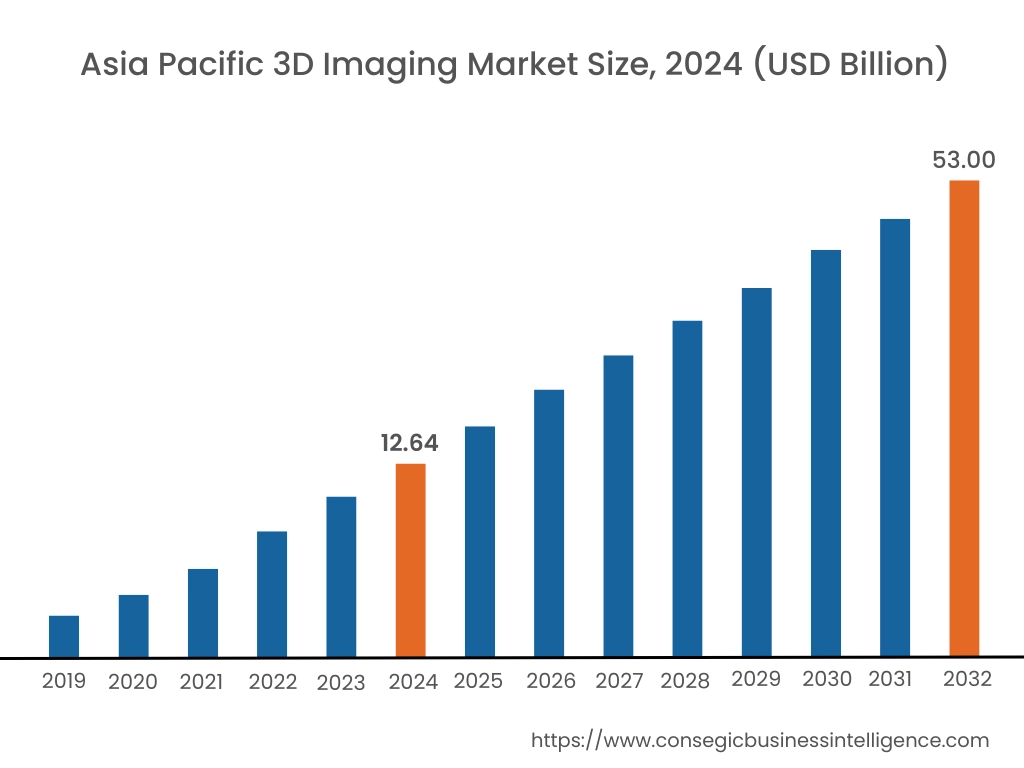
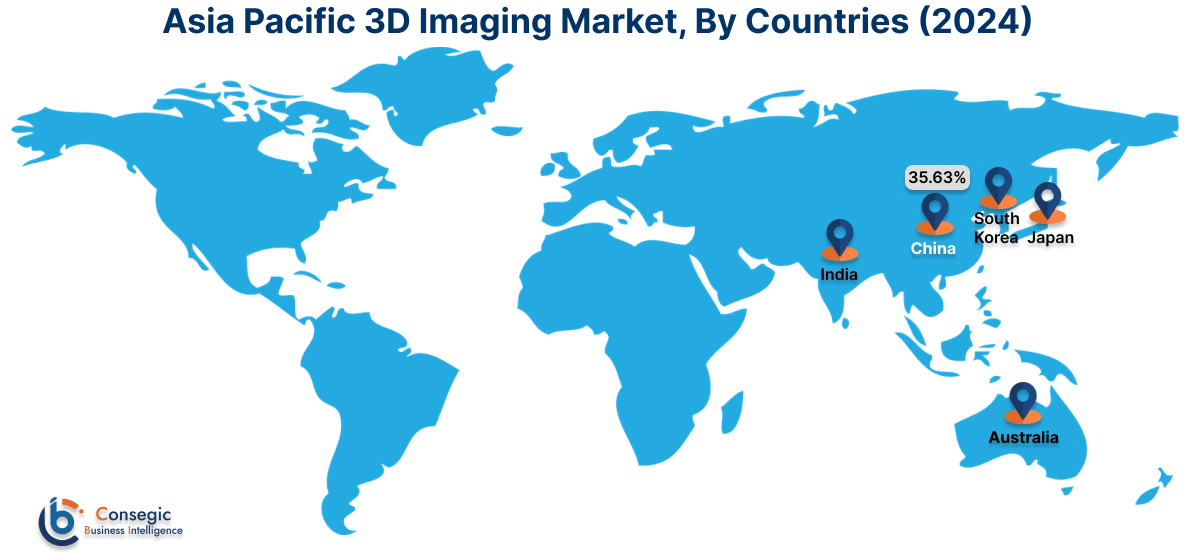
Asia Pacific region was valued at USD 12.64 Billion in 2024. Moreover, it is projected to grow by USD 14.88 Billion in 2025 and reach over USD 53.00 Billion by 2032. Out of this, China accounted for the maximum revenue share of 35.63%. The market growth for 3D imaging is mainly driven by rapid development in the region's automotive and manufacturing sectors, which are increasingly adopting 3D imaging technologies for advanced applications. Additionally, the rising investment in healthcare infrastructure is driving the market.
- For instance, according to Global EV Outlook 2024 by IEA, the sale of electric cars in China grew to 8.2 million units in 2023 from 5.9 million units in 2022. The increased sales of electric vehicles are resulting in a growing need for imaging solutions.
North America is estimated to reach over USD 61.09 Billion by 2032 from a value of USD 15.07 Billion in 2024 and is projected to grow by USD 17.69 Billion in 2025. The North American market is primarily driven by advanced healthcare sector, where 3D imaging is increasingly utilized for diagnostics and surgical planning, and by the strong presence of leading technology companies driving innovation in areas like automotive and aerospace.
- In April 2023, KUBTEC Medical Imaging introduced the MOZART iQ 3D Margin Management System at the American Society of Breast Surgeons meeting. The system utilizes 3D intraoperative tomosynthesis X-ray and amorphous selenium direct capture imaging for enhanced surgical margin visualization.
The regional trend depicts that robust industrial manufacturing and healthcare sectors in Europe are driving the market. Additionally, the factors driving the market in the Middle East and African region are increasing investments in infrastructure development, particularly in the construction sectors. Further, increasing investments in infrastructure and manufacturing modernization is paving the way for the progress of market trends in Latin America region.
Top Key Players & Market Share Insights:
The global 3D imaging market is highly competitive with major players providing solutions to the national and international markets. Key players are adopting several strategies in research and development (R&D), product innovation, and end-user launches to hold a strong position in the 3D imaging industry. Key players in the global 3D imaging market include-
- Olympus America (US)
- TOMTEC Imaging Systems GmbH (Germany)
- GE HealthCare (US)
- FARO (US)
- Alphatec Holdings, Inc. (US)
- KUBTEC (US)
- Siemens Healthineers AG (Germany)
- Planmeca Oy (Finland)
- Koninklijke Philips N.V. (Netherlands)
- Intrasense (France)
Recent Industry Developments :
Product Launches:
- In December 2024, GE HealthCare launched Sonic DL for 3D which is an AI-powered MRI technology that significantly accelerates 3D volumetric scans. The technology has applications in brain, spine, orthopedic, and body exams.
Partnerships and Collaborations:
- In March 2025, Olympus Corp. in partnership with Ziosoft, launched first AI-powered clinical decision tool (Ziosoft Revoras platform) with an aim to improve pre-operative planning for liver, lung, and kidney procedures. This system transforms 2D images into 3D models using AI, aiding surgeons in visualizing anatomy and planning minimally invasive surgeries.
3D Imaging Market Report Insights:
| Report Attributes | Report Details |
| Study Timeline | 2019-2032 |
| Market Size in 2032 | USD 174.00 Billion |
| CAGR (2025-2032) | 22.0% |
| By Component |
|
| By Deployment |
|
| By Organization Size |
|
| By End User |
|
| By Region |
|
| Key Players |
|
| North America | U.S. Canada Mexico |
| Europe | U.K. Germany France Spain Italy Russia Benelux Rest of Europe |
| APAC | China South Korea Japan India Australia ASEAN Rest of Asia-Pacific |
| Middle East and Africa | GCC Turkey South Africa Rest of MEA |
| LATAM | Brazil Argentina Chile Rest of LATAM |
| Report Coverage |
|
Key Questions Answered in the Report
How big is the 3D imaging market? −
The 3D imaging market is estimated to reach over USD 174.00 Billion by 2032 from a value of USD 42.73 Billion in 2024 and is projected to grow by USD 50.18 Billion in 2025, growing at a CAGR of 22.0% from 2025 to 2032.
What specific segmentation details are covered in the 3D imaging report? +
The 3D imaging report includes specific segmentation details for component, deployment, organization size, end user, and regions.
Which is the fastest segment anticipated to impact the market growth? +
In the 3D imaging market, cloud deployment is the fastest-growing segment during the forecast period.
Who are the major players in the 3D imaging market? +
The key participants in the 3D imaging market are Olympus America (US), TOMTEC Imaging Systems GmbH (Germany), KUBTEC (US), Siemens Healthineers AG (Germany), Planmeca Oy (Finland), Koninklijke Philips N.V. (Netherlands), Intrasense (France), GE HealthCare (US), FARO (US), Alphatec Holdings, Inc. (US), and others.
What are the key trends in the 3D imaging market? +
The 3D imaging market is shaped by several key trends including advancements in AI and machine learning, which are enhancing image reconstruction and analysis. Additionally, the increasing adoption of 3D imaging across diverse medical specialties, from surgical planning to diagnostic imaging, is expanding its market reach.
Overview
Reputation & Certifications


Our Services
- Market Intelligence & Forecasting
- Custom Research Solutions
- Market Entry Strategy
- Competitive Intelligence
- Customer Insights
- Industry Innovation Analysis
- Investment Advisory