Jump to Content
Aerial Refueling Systems Market Size & Industry Share - Growth Trends & Forecasts (2026 - 2034)
The Aerial Refueling Systems Market is expected to expand from 842.86 (US$M) in 2025 to 902.7 (US$M) in 2026, and is forecast to surpass 1,562.65 (US$M) by 2034, growing at a CAGR of 7.1% between 2026 and 2034, according to a recent report from Consegic Business Intelligence.
Aerial Refueling Systems Market Scope & Overview:
An aerial refueling system is a specialized suite of equipment designed to transfer aviation fuel from a tanker aircraft to a receiver aircraft while both are in flight to extend operational range and endurance. The key benefits offered by the system include extending aircraft range and endurance, increasing mission lethality, and enhancing operational flexibility. Further, key trends driving the demand for aerial refueling systems include increasing adoption of Multi-Role Tanker Transport (MRTT) platforms that balance fuel transfer with cargo capabilities, shift toward autonomous and AI-driven refueling systems to support unmanned aerial vehicles (UAVs), and the escalating geopolitical tensions forcing nations to invest in long-range strategic power projection and fleet modernization.
How is AI Transforming the Aerial Refueling Systems Market?
AI is revolutionizing the aerial refueling market by shifting the industry toward autonomous, high-precision operations that reduce human error and pilot workload. Advanced AI algorithms now power Automatic Air-to-Air Refueling (A3R) systems, which use high-definition computer vision to identify a receiver aircraft's shape and receptacle, flying the boom into position with centimeter-level accuracy even in low visibility. Beyond manned tankers, AI is the foundational technology for unmanned platforms, enabling fully autonomous docking and fuel transfer. Furthermore, AI-driven predictive analytics optimize fleet readiness by forecasting component failures before they occur in critical mission environments.

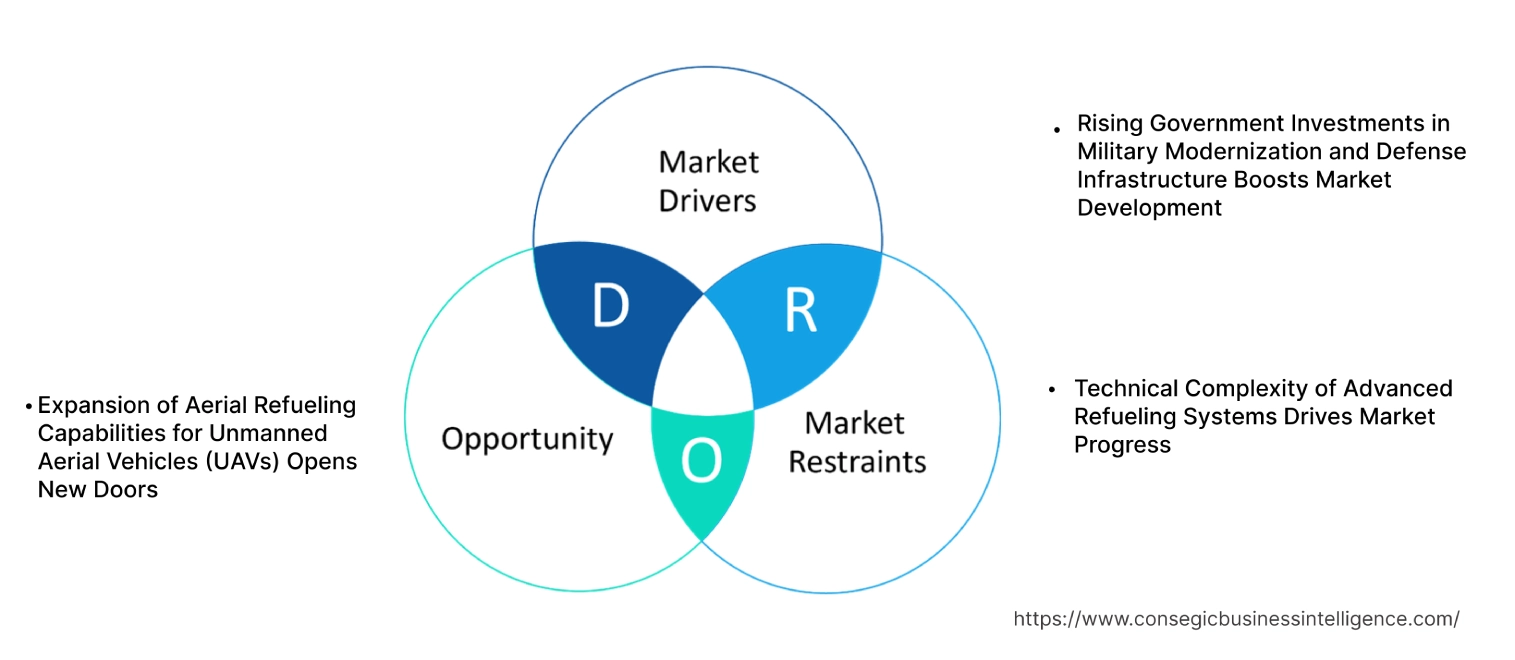
Aerial Refueling Systems Market Dynamics - (DRO) :
Key Drivers:
Rise of Unmanned Aerial Vehicles Drives the Aerial Refueling Systems Market Growth
The rise of Unmanned Aerial Vehicles (UAVs) is a primary catalyst for the aerial refueling market, as modern defense strategies prioritize persistent intelligence, surveillance, and reconnaissance (ISR) missions that require drones to remain airborne for days. This shift has transitioned aerial refueling from a manned-only support role to a high-tech ecosystem centered on autonomous fuel transfer. Consequently, the market is experiencing a surge in demand for AI-driven sensors and "smart" probe-and-drogue systems capable of sub-centimeter docking precision without human intervention.
- For instance, in November 2023, Airbusdemonstrated a major leap in autonomous refueling by using an A310 MRTT to coordinate five drones, including two digital twins, via AI-driven navigation and cooperative control systems.
Thus, uninterrupted flight duration and the adoption of self-governing refueling links contribute significantly to the aerial refueling systems market size.
Key Restraints :
High Acquisition Costs and Technical Complexities are Limiting the Market
High acquisition costs and technical complexities act as significant barriers to the aerial refueling market, as modern tankers cost over USD 200 million per unit, straining national defense budgets. Beyond the initial purchase, the intricate engineering required for fly-by-wire booms and high-definition remote vision systems introduces immense developmental risk and certification hurdles. These complexities often lead to multi-year program delays and expensive retrofits, as seen with early sensor issues in next-generation platforms. Consequently, many nations opt for lower-cost "probe-and-drogue" conversions or fleet life-extension programs, limiting the immediate adoption of the most advanced, high-revenue refueling technologies.
Future Opportunities :
Increasing Focus on Autonomous Air-to-Air Refueling Drives Aerial Refueling Systems Market Opportunities
The increasing focus on Autonomous Air-to-Air Refueling (A3R) is opening significant market opportunities by enabling tankers to operate with greater precision and safety in high-stakes environments. AI-driven systems, such as the Airbus A330 MRTT’s certified A3R, utilize advanced computer vision and sensors to automate the physical connection between aircraft, minimizing human error and reducing the workload for boom operators. This shift is particularly vital for the rising fleet of unmanned aerial vehicles (UAVs), which require autonomous docking to maintain long-endurance missions.
- For instance, in April 2025, Boeingsecured a contract through the Air Force Research Laboratory to advance next-generation autonomous aerial refueling systems, aiming to set a new standard for modern warfare. By integrating evolutionary technology into existing tanker fleets, Boeing focuses on providing real-world, fieldable capabilities that ensure the U.S. military maintains a decisive advantage against emerging global threats.
Thus, integration of artificial intelligence and machine learning into refueling architecture drives the aerial refueling systems market opportunities.
Aerial Refueling Systems Market Segmental Analysis :
By System Type:
Based on the system type, the market is segmented into flying boom, probe and drogue, and autonomous refueling.
Trends in the System Type:
- Integration of fully automated boom systems that use sensors and AI to handle the connection, significantly reduces boom operator workload, thereby driving the aerial refueling systems market trends.
- Implementation of secure, hardened data links to synchronize tankers and receiver flight path data, drives the aerial refueling systems market size.
Probe and Drogue accounted for the significant revenue share in the year 2024.
- There is a growing trend of underwing pods, which allow a single tanker to refuel two or three tactical aircraft simultaneously, driving the aerial refueling systems market share.
- Further, the development of smart drogues with active control surfaces drives the aerial refueling systems market expansion.
- Furthermore, growing adoption of "buddy refueling" where carrier-based fighters carry external pods to refuel their wingmen, is driving the aerial refueling systems market trends.
- Thus, as per the aerial refueling systems market analysis,multi-point refueling, active drogue stabilization, and buddy-pod expansion are driving the market.
Autonomous Refueling is anticipated to register the fastest CAGR during the forecast period.
- Autonomous refueling is becoming a standard requirement for the Collaborative Combat Aircraft (CCA) programs in the US and Europe, which in turn drives the aerial refueling systems market share.
- Further, there is a growing focus on shifting from tankers refueling manned jets to drones refueling other drones, which in turn drives the aerial refueling systems market demand.
- Global defense bodies are working to standardize the Universal Aerial Refueling Receptacle Slipway Installation (UARRSI) for drones to ensure cross-platform compatibility between different nations.
- Therefore, based on analysis, the aforementioned trends are anticipated to boost the market growth during the forecast period.
By Component:
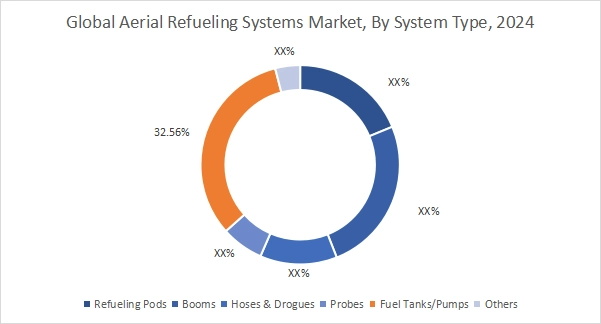
Based on the component, the market is segmented into refueling pods, booms, hoses & drogues, probes, fuel tanks/pumps, and others.
Trends in the Component:
- Growing demand for pods that can convert standard fighter jets or UAVs into tactical tankers, providing flexibility without needing a dedicated heavy tanker, is driving the aerial refueling systems market demand.
- A shift toward high-definition 3D camera arrays and panoramic sensors that allow boom operators to work from the cockpit using augmented reality, which in turn drives the aerial refueling systems market growth.
Fuel Tanks and Pumps accounted for the largest revenue share of 32.56% in the year 2024 and is anticipated to register the significant CAGR during the forecast period.
- Shift from metal to carbon-fiber reinforced tanks, which significantly reduces the tanker's empty weight and increases the total "fuel offload" capacity.
- Further, the transition from mechanical to electronically controlled pumps that offer variable flow rates, saving energy and reducing heat buildup in the fuel, drives the aerial refueling systems industry.
- Furthermore, integration of fire-suppressant inerting systems and sustainable aviation fuel compatibility drives the market.
- Thus, as per aerial refueling systems market analysis, lighter composite fuel tanks, high-efficiency electric pumps, and others are driving the market growth.
By Distribution Channel:
Based on the distribution channel, the market is segmented into OEM and aftermarket.
Trends in the Distribution Channel:
- There is a high demand for retrofitting older boom systems with 3D/HD cameras and infrared sensors to allow for safer refueling during night operations or poor weather, which in turn drives the aerial refueling systems market expansion.
- Operators are installing IoT sensors on legacy hardware to predict when a refueling pump or hose reel might fail, shifting from reactive to predictive repairs, which subsequently propels the market.
OEM accounted for the largest revenue share in the year 2024 and is anticipated to register a significant CAGR during the forecast period.
- Leading OEMs are now integrating Automatic Air-to-Air Refueling as a standard factory feature rather than an optional add-on, particularly for high-end tankers.
- Further, OEMs are now pre-installing sensors and fiber-optic data buses specifically designed to support future AI and autonomous refueling software updates.
- Furthermore, OEMs are replacing heavy metallic fuel lines and internal structures with high-strength, lightweight carbon-fiber composites.
- Thus, based on analysis, standardization of smart hardware and lightweight composite material integration are driving the market growth.
Regional Analysis:
The regions covered are North America, Europe, Asia Pacific, Middle East and Africa, and Latin America.
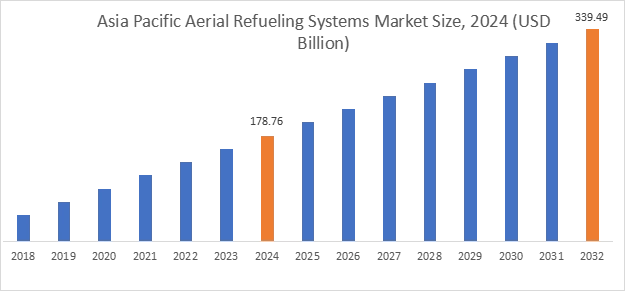
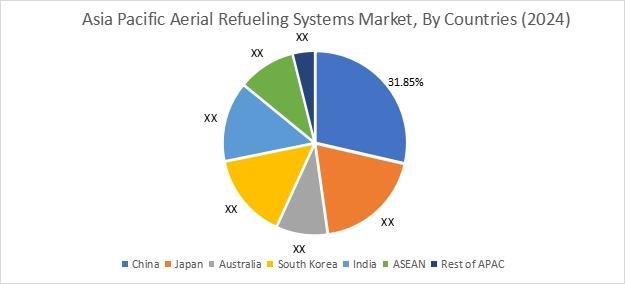
Asia Pacific region was valued at USD 178.76 Million in 2024. Moreover, it is projected to grow by USD 191.40 Million in 2025 and reach over USD 339.49 Million by 2032. Out of this, China accounted for the maximum revenue share of 31.85%. The market growth for aerial refueling systems is mainly driven by rapid military modernization and rising defense budgets in major economies like China and India. Additionally, escalating regional geopolitical tensions and the vast maritime geography of the Indo-Pacific necessitate extended aircraft endurance and long-range operational reach for both manned and unmanned platforms.
- Safraninaugurated its largest global maintenance, repair, and overhaul (MRO) center in Hyderabad for LEAP engines (used in civil aviation) and broke ground on the first international MRO shop for the M88 engines that power the Rafale fighter jet. This is expected to drive demand for aerial refueling system market.
North America is estimated to reach over USD 541.12 Million by 2032 from a value of USD 290.45 Million in 2024 and is projected to grow by USD 310.49 Million in 2025. The North American market is primarily driven by large-scale recapitalization of the U.S. Air Force’s aging tanker fleet, region’s leadership in unmanned aerial vehicle (UAV) innovation, and high defense expenditures for long-range strategic operations.
- For instance, the S. Governmentallotted USD 883.7 billion budget for national defence for FY 2024, among which USD 841.4 billion was allocated for the United States Department of Defence.
The regional trends analysis depicts accelerated modernization of regional air forces, and a heightened focus on strategic autonomy in Europe is driving the market. Additionally, the factors driving the market in the Middle East and African region are massive defense modernization programs and significant procurement of next-generation tankers. Further, based on analysis indigenous aerospace development and the need for cost-effective, multi-role platforms are paving the way for the growth of market in Latin America region.
Top Key Players & Market Share Insights:
The global aerial refueling systems market is highly competitive, with major players providing solutions to the national and international markets. Key players are adopting several strategies in research and development (R&D), product innovation, and end-user launches to hold a strong position in the aerial refueling systems industry. Key players in the global aerial refueling systems market include-
- Eaton Corporation(Ireland)
- Safran SA(France)
- Airbus (Netherlands)
- Boeing (US)
- Lockheed Martin (US)
- Israel Aerospace Industries (Israel)
- Northrop Grumman (US)
- Parker Hannifin (US)
- Federal Industries Inc. (US)
- Collins Aerospace (US)

Recent Industry Developments:
Product Development
- In November 2024, Eatonsecured a USD 3.5 million contract from the U.S. Air Force Research Laboratory (AFRL) to develop a "platform-agnostic" refueling kit. This innovative system features a podded refueling boom designed to be mounted on various aircraft, effectively turning traditional transport planes or next-generation platforms into tankers.
Partnership
- Airbus,in partnership with Singapore’s Defence Science and Technology Agency (DSTA) and the Republic of Singapore Air Force (RSAF), has officially secured full certification for Automatic Air-to-Air Refueling (A3R) on the A330 MRTT. The certification was issued by the Spanish National Institute for Aerospace Technology (INTA) following a rigorous flight-test program.
Aerial Refueling Systems Market Report Insights :
| Report Attributes | Report Details |
| Study Timeline | 2021-2034 |
| Market Size in 2034 | USD 1,562.65 Million |
| CAGR (2026-2034) | 7.10% |
| Base Year | 2025 |
| By System Type |
|
| By Component |
|
| By Distribution Channel |
|
| By Region |
|
| Key Players |
|
| North America | U.S. Canada Mexico |
| Europe | U.K. Germany France Spain Italy Russia Benelux Rest of Europe |
| APAC | China South Korea Japan India Australia ASEAN Rest of Asia-Pacific |
| Middle East and Africa | GCC Turkey South Africa Rest of MEA |
| LATAM | Brazil Argentina Chile Rest of LATAM |
| Report Coverage |
|
Key Questions Answered in the Report
How big is the aerial refueling systems market? −
The aerial refueling systems market is estimated to reach over USD 1,362.33 Million by 2032 from a value of USD 735.45 Million in 2024 and is projected to grow by USD 785.80 Million in 2025, growing at a CAGR of 7.1% from 2025 to 2032.
What specific segmentation details are covered in the aerial refueling systems report? +
The aerial refueling systems report includes specific segmentation details for system type, component, distribution channel, and regions.
Which is the fastest segment anticipated to impact the market growth? +
In the aerial refueling systems market, autonomous refueling is the fastest-growing segment during the forecast period.
Who are the major players in the aerial refueling systems market? +
The key participants in the aerial refueling systems market are Eaton Corporation (Ireland), Safran SA (France), Airbus (Netherlands), Boeing (US), Lockheed Martin (US), Israel Aerospace Industries (Israel), Northrop Grumman (US), Parker Hannifin (US), Federal Industries Inc. (US), Collins Aerospace (US), and others.
What are the key trends in the aerial refueling systems market? +
The aerial refueling systems market is being shaped by several key trends including rapid shift toward autonomous and AI-driven refueling to support unmanned aerial vehicles (UAVs), the increasing adoption of multi-role tanker transport platforms, and the development of stealthy or high-survivability systems designed for contested airspace.
Overview
Reputation & Certifications


Our Services
- Market Intelligence & Forecasting
- Custom Research Solutions
- Market Entry Strategy
- Competitive Intelligence
- Customer Insights
- Industry Innovation Analysis
- Investment Advisory