How is AI Impacting the Dicing Die Attach Film Market?
Artificial Intelligence is significantly impacting the dicing die attach film market by enhancing manufacturing precision, process optimization, and product reliability. In semiconductor production, AI-driven monitoring systems analyze temperature, pressure, and adhesive behavior in real time, ensuring consistent film performance and bonding quality. Machine learning models predict defects and optimize cutting parameters, reducing material waste and improving yield. AI also accelerates R&D by simulating adhesive compositions and testing conditions, enabling the creation of films with superior thermal stability and adhesion strength. Additionally, AI supports supply chain forecasting and inventory management to align with semiconductor industry demands. Overall, AI integration is driving higher efficiency, precision, and innovation in the global dicing die attach film market.
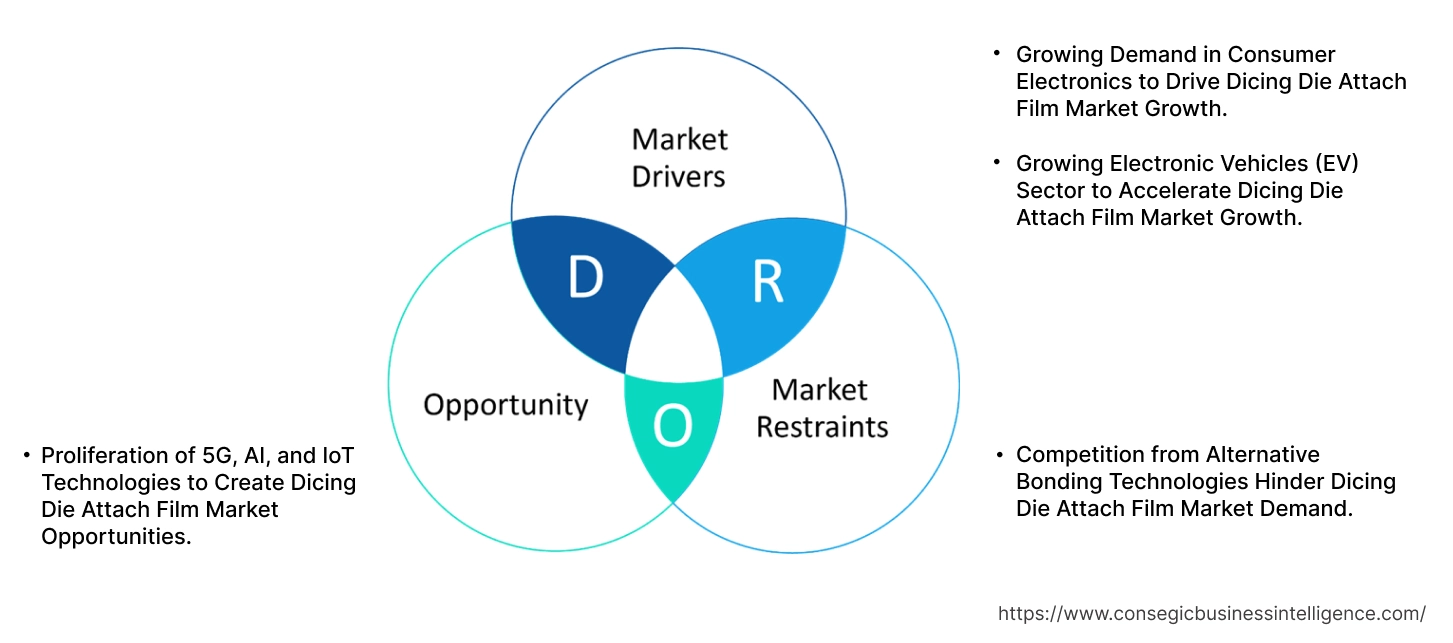
Dicing Die Attach Film Market Dynamics - (DRO) :
Key Drivers:
Growing Demand in Consumer Electronics to Drive Dicing Die Attach Film Market Growth.
As global consumers increasingly adopt advanced electronic devices such as smartphones, laptops, wearables among others, the production of the underlying semiconductor chips experiences a corresponding surge. DDAF plays a critical role in the manufacturing of these chips, enabling the high-density packaging and miniaturization required for sleek, powerful, and multi-functional gadgets. Its ability to create ultra-thin and reliable bond lines facilitates advanced packaging techniques which are essential for integrating more functionality into smaller form factors. Therefore, the continuous innovation and high-volume production within the consumer electronics sector results in sustained and significant adoption of these films.
- For instance, the according to China Briefing, total mobile production volume in China amounted to 1.67 billion units, representing a 7.8% increase from 2023.
Thus, the market for these films in consumer electronics is witnessing significant growth.
Growing Electronic Vehicles (EV) Sector to Accelerate Dicing Die Attach Film Market Growth.
EVs rely heavily on a vast array of sophisticated electronic components such as power modules, battery management systems, and advanced sensors among others. All of these EV components require high-performance semiconductor chips. DDAF is critical for packaging these components due to its ability to create reliable, robust, and thermally conductive bonds in a compact form factor. As the global production and adoption of electric vehicles continue to surge, driven by environmental concerns, government incentives, and technological advancements, the adoption of these films increase for the underlying semiconductor content.
- For instance, as per analysis published by IEA, Global electric car production reached 17.3 million units in 2024, a 25% increase from 2023, primarily driven by China's output of 12.4 million electric cars.
Thus, significant rise in EV production is impacting positively on the dicing die attach film market demand.
Key Restraints :
Competition from Alternative Bonding Technologies Hinder Dicing Die Attach Film Market Demand.
The market faces a significant constraint due to the widespread presence and established utilization of alternative bonding technologies. The market experiences stiff competition from a range of other die attach methods capable of fulfilling similar bonding and electrical connection functions in semiconductor packaging. Non-conductive paste (NCP) and non-conductive adhesive (NCA) offer alternative solutions for die attachment and are preferred in certain specialized packaging formulations. Other prominent substitutes include traditional liquid epoxy adhesives, solder pastes, and even direct bonding technologies for specific high-performance applications. This abundance of readily available, often competitively priced, and increasingly advanced substitutes creates a competitive landscape for DDAF. It continuously encourages semiconductor manufacturers and packaging houses to evaluate and adopt alternatives, thereby limiting the dicing die attach film market expansion.
Future Opportunities :
Proliferation of 5G, AI, and IoT Technologies to Create Dicing Die Attach Film Market Opportunities.
The pervasive proliferation of 5G, Artificial Intelligence (AI), and Internet of Things (IoT) technologies collectively create requirements for increasingly sophisticated, high-performance, and miniaturized semiconductor devices. 5G connectivity requires faster, more efficient chips for network infrastructure and end-user devices. AI and machine learning applications necessitate powerful processors capable of handling massive data computations in compact forms. Similarly, the widespread deployment of IoT devices, ranging from smart sensors to connected appliances, mandates highly integrated and reliable semiconductor packages. Dicing die attach film, with its ability to facilitate ultra-thin bond lines, superior thermal management, among others, is positioned to meet these stringent requirements, thus creating significant new avenues for market growth.
- For instance, according to analysis provided by the European Court of Auditors, fifth generation wireless technology is expected to facilitate an unprecedented expansion of the Internet of Things with number of connected devices projected to increase to approximately 50 billion by 2030 worldwide.
Henceforth, the proliferation of aforementioned technologies is creating lucrative dicing die attach film market opportunities over the forecast period.
Dicing Die Attach Film Market Segmental Analysis :
By Type:
Based on type, the market is categorized conductive die attach film, non-conductive die attach film, and others.
Trends in the Type:
- NC-DAF is crucial for achieving ultra-thin bond lines and electrical isolation in advanced multi-die stacking architectures for memory and logic chips.
- C-DAF is seeing rising adoption for efficient thermal management in high-power devices including those found in electric vehicles and 5G infrastructure.
The non-conductive die attach film segment accounted for the largest dicing die attach film market share in 2024.
- Non-conductive die attach film (NC-DAF) is formulated without electrically conductive fillers.
- This type of die attach film is distinguished by strong adhesion, high dielectric strength, good mechanical stability, and low outgassing properties. It helps prevent short circuits and signal interference between components.
- These films are widely used for applications where electrical isolation of the die from the substrate is required. It's particularly crucial in high-density packaging where multiple chips are closely integrated.
- For instance, in 2022, Henkel announced the commercial availability of a new high-performance non-conductive die attach film, named Loctite Ablestik ATB 125GR. specifically developed to meet the requirements of modern semiconductor packaging.
- Hence, owing to the well-established use, the non-conductive die attach film segment is dominating the overall market revenue.
The others segment is expected to grow at the fastest GAGR over the forecast period.
- The others segment includes innovations such as Film-over-Wire (FOW) and Film-over-Die (FOD). These films are crucial for complex 3D IC stacking and multi-chip modules by facilitating embedded wire bonds or enabling ultra-precise, thin bonding layers.
- Additionally, it features Low-K DDAF and Temporary DDAF, designed with very low dielectric constants for high-frequency applications to minimize signal loss and temporary wafer bonding during specific processing respectively.
- This category represents the forefront of this die attach film technology, driven by continuous R&D to address the escalating need for highly complex, high-performance, and specialized semiconductor packages.
- Consequently, as per the analysis, the other segment is expected to witness fastest growth rate in the dicing die attach film market trends.
By Application:
Based on application, the market is categorized into memory chips, logic integrated circuits, power devices, LED packages, image sensors, and others.
Trends in the Application:
- Emphasis on thermal management for high-performance chips is a key market trend.
- Focus on ultra-thin bond line due to miniaturization in memory modules necessitates die attach film that enables extremely thin and uniform adhesive layers for higher density.
The memory chips segment accounted for the largest market share in 2024.
- Memory chip segment includes the bonding of various types of memory chips, such as Dynamic Random-Access Memory, NAND Flash, and other non-volatile memory components.
- This represents a very significant application for adhesive film due to the high-volume production of these devices in mobile devices, data centers, and solid-state drives among others creating the need for memory solutions.
- Moreover, the growing focus on the development of high bandwidth memory chips presenting requirements such as ultra-thin, void-free, and precise bonding of stacked dies fuels segment revenue.
- For instance, in 2024, SK Hynix commenced mass production of its latest high-bandwidth memory chip, which is the first 321-High NAND, making it the largest among currently available HBM chips.
- Hence, as per analysis, memory chips segment is dominating the market.
The power devices segment is expected to grow at the fastest CACR over the forecast period.
- Power devices application involves dicing die attach film for bonding power semiconductors, such as power transistors, diodes, rectifiers among others which are designed to handle high currents and voltages.
- Power devices are critical components in electric vehicles, renewable energy systems, industrial power supplies, and consumer electronics chargers among others.
- Due to the significant heat generated by these devices, conductive DAF with excellent thermal conductivity is predominantly used.
- The expanding EV sector and the increasing focus on energy efficiency are the factors fueling the power devices segment revenue in the overall dicing die attach film market trends.
By End Use:
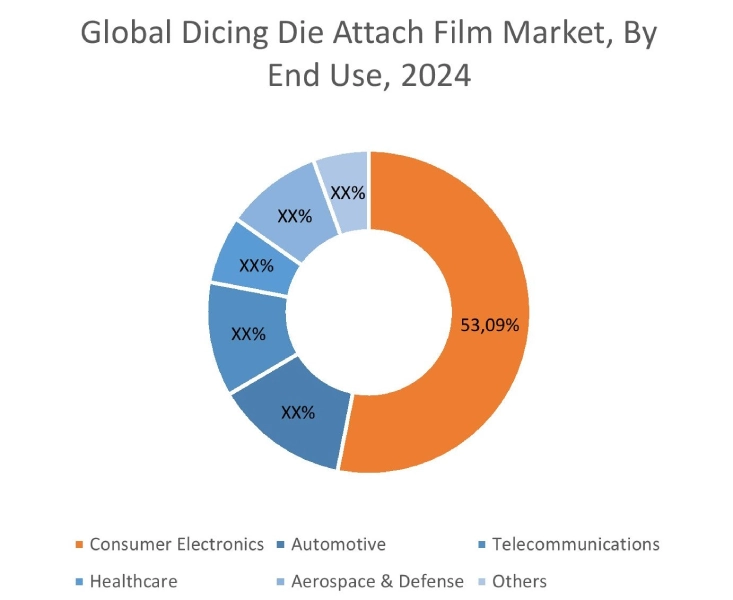
Based on the end use, the market is categorized into consumer electronics, automotive, telecommunications, healthcare, aerospace & defense, and others.
Trends in the End Use:
- Continued Miniaturization and Integration in electronics is a key trend positively impacting the adoption of die attach films in 3D stacking.
- Growing data traffic and cloud services demanding more powerful and efficient server processors and memory is a key trend.
The consumer electronics segment accounted for the dicing die attach film market share of 53.09% in 2024.
- Consumer electronics segment encompasses a vast array of devices used by consumers, including smartphones, laptops, tablets, smart wearables among others.
- The high volume of consumer electronic products manufactured worldwide along with the growing emphasis on miniaturization, higher performance, and increased functionality in these devices is primarily driving the segment revenue.
- In these products, dicing die attach film is used to package essential semiconductor components. The adoption of new technologies ensures sustained adoption of these films.
- For instance, according to IBEF, India's mobile phone manufacturing sector has experienced significant growth, with production value expanding from USD 3.00 billion in FY15 to USD 49.27 billion in FY24.
- Thus, as per the dicing die attach film market analysis, the consumer electronics segment holds dominating contribution in the market.
The healthcare segment is expected to grow at the fastest CAGR over the forecast period.
- Healthcare segment encompasses the semiconductors bonded with die attach film used in various medical devices such as diagnostic equipment, medical wearables, imaging systems, and portable medical electronics.
- The growing necessity for advanced medical diagnostics along with remote patient monitoring is fueling this segment.
- Dicing die attach film contributes to the compact size, reliability, and precision required for medical electronics, which often operate under stringent performance and safety standards.
- Overall, aforementioned factors are expected to fuel healthcare segment turnover in the forecast period.
Regional Analysis:
The regional segment includes North America, Europe, Asia Pacific, the Middle East and Africa, and Latin America.
Download Sample
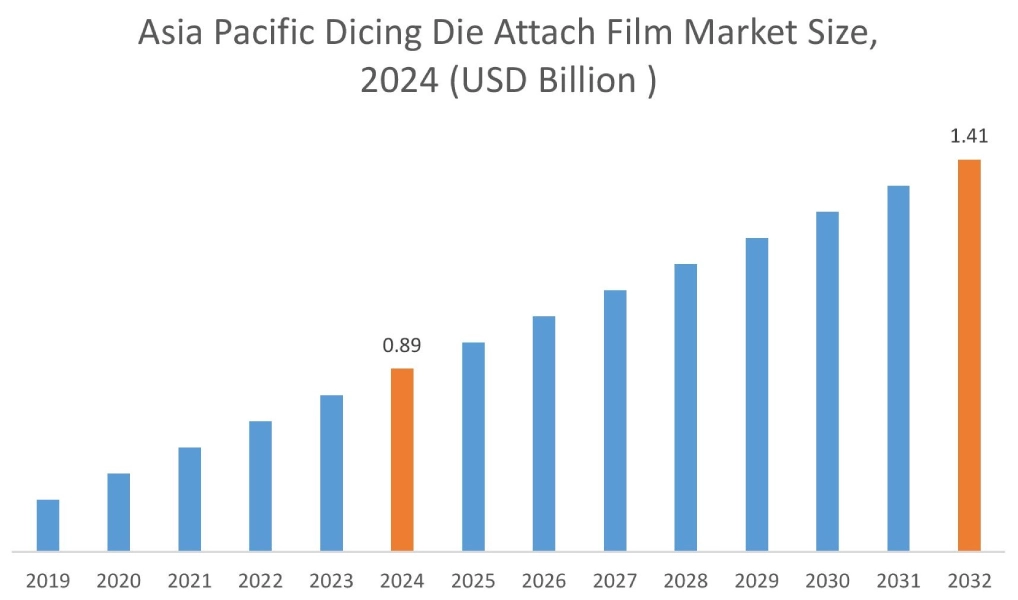
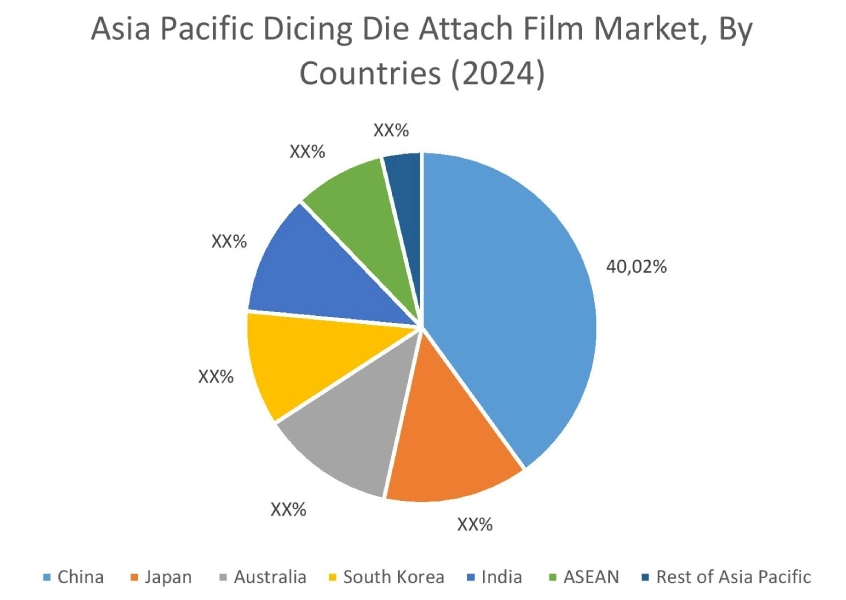
In 2024, Asia Pacific accounted for the highest market share at 41.50% and was valued at USD 0.89 Billion and is expected to reach USD 1.41 Billion in 2032. In Asia Pacific, China accounted for a market share of 40.02% during the base year of 2024. The dominance of Asia Pacific in the global dicing die attach film market is attributed to the presence of major semiconductor manufacturing hubs in countries like China, Taiwan, South Korea, Japan, and Southeast Asian nations. The region's vast production of consumer electronics, coupled with increasing investments in advanced packaging technologies and the rise of automotive electronics, fuels the adoption of these films. Additionally, the initiatives to support the domestic semiconductor sector also play a crucial role.
- For instance, in February 2024, Tata Electronics Private Limited (TEPL) received approval for its proposal to establish a Semiconductor Fab facility in India, representing a substantial investment of USD 10,730 Million. This facility is developed through a technology partnership with PSMC, a well-established semiconductor company based in Taiwan.
Thus, as per analysis, these factors collectively position Asia-Pacific as a key region for the market.
Download Sample
In Europe, the dicing die attach film industry is experiencing the fastest growth with a CAGR of 9.7% over the forecast period owing to the increasing proliferation of 5G, AI, and IoT technologies across the region. As industries and consumers in Europe increasingly adopt these advanced technologies, there's a corresponding surge in need for high-performance semiconductor components. This die attach film is crucial for manufacturing these components, enabling efficient, ultra-thin bonding in complex packaging architectures required for 5G infrastructure, AI processing units in various applications, and a vast array of IoT devices. This technological shift, coupled with Europe's focus on industrial automation and smart solutions, drives the need for reliable and high-quality materials. Hence, as per analysis, these factors collectively present a positive impact on the European market.
The North American market benefits from accelerating automotive electronics and Electric Vehicle sectors. The region is advanced in automotive technology, with increasing investments in advanced driver-assistance systems, infotainment and the EV sector. As these vehicles become more technologically sophisticated, they demand a growing number of high-performance, compact, and reliable semiconductor components within EVs and other automotive electronic systems. This escalating requirement from a rapidly evolving automotive landscape is therefore a major driver for the North America dicing die attach film market analysis.
The dicing die attach film market expansion in Latin America is defined by the miniaturization of electronic devices within the region. As consumer demand for compact and feature-rich electronics, such as smartphones, wearables, and IoT devices, rises across Latin American countries, it creates the imperative for advanced semiconductor packaging solutions. The increasing consumption of such devices and the growing trend towards local electronics assembly are fueling the demand for die attach film to meet the evolving needs for highly integrated and compact electronic components.
The market in the Middle East and Africa is characterized by the region’s growing focus on semiconductor production. While traditionally not a major hub for advanced semiconductor fabrication, countries within the MEA are making strategic investments to diversify their economies away from oil and gas. These efforts include significant government incentives and public-private partnerships aimed at establishing the domestic semiconductor sector. As these regional semiconductor initiatives mature and expand, the MEA's dicing die attach film industry is expected to witness substantial opportunities.
Top Key Players & Market Share Insights:
The Global Dicing Die Attach Film Market is highly competitive with major players providing products to the national and international markets. Key players are adopting several strategies in research and development (R&D) and product innovation to hold a strong position in the global Dicing Die Attach Film market. Key players in the Dicing Die Attach Film industry include
- LG Chem (South Korea)
- AI Technology, Inc (U.S.)
- LINTEC Advanced Technologies (Germany)
- Henkel Adhesives (Germany)
- Resonac Holdings Corporation (Japan)
- Nitto Denko Corporation (Japan)
- Furukawa Electric Co., Ltd. (Japan)


